1 LONDON TO EXETER: Sauce
I believe mustard to be one of the most amazing condiments.
– Justin Timberlake, 2009
It’s grey, and chilly for late spring when I stumble crossly out of bed the next morning after a luxurious almost three hours of anxious, broken sleep I can’t even blame on the dog, who trotted off with Kaj last night without so much as a backward glance. Apparently they had a date with RuPaul’s Drag Race.
Pulling on my Lycra workwear, I haul my startlingly weighty bags up to street level, where I half hope they’ll be stolen as I’m bringing up the bike. As they’re not, I then face the problem of how to get them onto the new pannier rack, something I now realise I could have investigated in advance had I not been in denial that this was actually happening.
Eventually I work it out, at which point there’s nothing for it but to leave, though, worried I’m going to overbalance after so long riding without luggage, I scuttle across the main road on foot first. Not the most noble start to the expedition but I’m nervous enough without being run over by the 17 bus.
I’m still a bit wobbly when I get to the Australian café in Paddington Basin where I’m meeting my first travelling companion, the aforementioned Caroline (who’s coming with me as far as South Wales) and two well-wishers, my school friend Lucinda, and my ‘book club’ friend Claire.*
I’ve chosen Bondi Green for my first breakfast of the trip not only for its proximity to the railway station, but because of the glorious absurdity of its menu – I sense† I’m unlikely to find anywhere else offering gluten-free celeriac ‘toast’ for the next seven weeks. As a fair dinkum Aussie, Claire has kindly offered to act as translator and cultural consultant, in which capacity she’s quick to assure me they do have ‘actual toast, made out of bread’ in the Antipodes as well.
Apparently so, I say, regarding my smashed avocado on cold-fermented activated charcoal sourdough (I swear I’m not making this up) with house labne, Aleppo chilli and a poached egg. Though I try not to eat it often for the reasons mentioned below, when the avocados are as soft and yellow as butter, and just as generously salted, avocado toast can be a beautiful thing. That said, I suspect a large part of the dish’s appeal is how great tragically underripe examples look in photos, all fresh and green and crunchy, perhaps accessorised with a sprinkle of red chilli for a few extra likes … not to mention the shameful craze for carving the noble fruit of the Aztecs into hard, watery roses for the benefit of social media.
Of course, every trend has a curve, and you know something’s on its way out when even Wetherspoons ditches it from the menu. I’d like to think it’s because of sustainability concerns around this water-thirsty crop or because they’ve heard many of those who grow avocados can no longer afford to eat them … but I suspect they were just too much faff to prepare.
Lucinda, horrified by my blackened bread, asks Claire if toast is always served this burnt Down Under – but washed down with a tepid flat white (you guessed it, ‘it’s meant to be like that’) and a green juice to offset any future bacon roll consumption, it’s not bad, the richness of the eggs balanced by the zingy lime and chilli-spiked avocado underneath. The mound of salad on the side, however, should probably be illegal.
Tea Break:
OR SHOULD THAT BE CHAI?
Of course, we’ve never all eaten the same thing for breakfast – no doubt those pesky Romans put a few backs up when they insisted on starting the day with garlicky cheese and honey. Britain has always been a population in flux, each wave of arrivals enriching our cuisine with their own traditions, and my narrative would be much the poorer without them.
Some of them have become so ingrained we claim them as our own – the cold smoked salmon brought by Jewish emigrés from Eastern Europe in the late nineteenth century – or bear little resemblance to the original dish that inspired them, like Anglo-Indian kedgeree (of which more in Chapter 8), while others are still thrillingly novel, like Tunisian shakshuka, a beneficiary of ‘the Ottolenghi effect’.
Should you have a yen to widen your breakfast horizons, here’s something to try from each of the top ten countries of origin for overseas-born Britons according to 2020 figures:
- India: appam – fluffy rice and coconut pancakes popular in the southern state of Kerala – with mutton curry or vegetable stew.
- Poland: naleśniki – thin pancakes with fresh cheese and sugar or fruit compote.
- Pakistan: halwa puri – flaky fried flatbreads with sweet, nutty semolina porridge, often served with chana masala and spicy potatoes too.
- Ireland: a full Irish, with black and white pudding, and potato farls.
- Romania: mămăligă cu lapte – thick cornmeal porridge (polenta) served in a bowl of hot milk. (An old-fashioned breakfast now, I’m told.)
- Germany: Bavarian Weisswurst sausages with sweet mustard.
- Nigeria: akara – spicy black-eyed pea fritters served with bread, corn custard or millet porridge.
- South Africa: mieliepap – maize porridge served with tea or coffee.
- Italy: biscotti with milky coffee.
- Bangladesh: sobji porota – mixed spiced vegetables with a flaky flatbread.
I won’t be sorry to leave problematic avocados and activated bread behind me, though – in fact, I’m eager to get going before I can change my mind. We pose for Official Pictures outside, and then Caroline and I head for the train that will take us to Wiltshire, and the first stop on my tour: the Tracklements condiment factory.
First we have to find the right platform, hoisting the laden bikes up one flight of steps and down another, me skidding precariously in my stupid, gripless shoes,* unused to the weight behind me. ‘How have you got so much luggage, mate?’ Caroline asks as, giving up on finding the allocated cycle spaces once on board, we prop them in a corridor.
I look at her unusually svelte packing and fight the urge to chuck my jolly yellow panniers out of the window – this is more than I took to France, and that included a passport. New bags, I say by way of explanation. The first rule of bike touring, we decide, is that stuff always expands to fit the space available.
My mood is improved by the appearance of a cheerfully whistling train conductor with a broad Bristol accent who, after explaining that the missing bike spaces are thanks to Great Western sending five carriages instead of the expected ten, pauses to tell us about his own cycling adventures, including a trip around Ireland with a friend with a £50 bike: ‘Rosslare to Killarney, and we didn’t pass a pub, put it that way. That were fun.’ Excitingly, unlike in France I’m able to engage in witty repartee at a level slightly above that of your average three-year-old. It strikes me that, given my modest fluency in English, there might be benefits to staying closer to home – though sadly the cost of train travel is not likely to be one of them.
We disembark in Chippenham, a busy commuter hub about halfway between Swindon and Bristol and 20km south of the Tracklements HQ. The first 10 minutes of riding are, as ever in my experience, a despondent slog – not only is traffic faster and less predictable out here, but merely turning the pedals feels like hard work. Trying to take comfort from my triathlete friend Rob’s airy assurance that training is overrated and I’ll get fit en route, I nevertheless can’t help a rush of profound regret. How am I going to survive almost two months of this? I wonder glumly, struggling to keep up with Caroline. Why did I ever think cycling was enjoyable?
And then we turn off the main road, and it all makes sense again. The sun’s out, the scenery is glorious, frothy with hawthorn blossom, every leaf soft and new, and the villages boast names like Tiddleywink and Knockdown and Lower Stanton St Quintin. Chancing our luck on a closed road, fate smiles upon us and the municipal hedge cutters are happy to wave us through. In the kind of swift change of mood that seems to happen more often on expeditions than in real life, I honestly can’t think of anywhere I’d rather be this Tuesday morning. I even start singing, before remembering Caroline is Musical, and my voice probably causes her active pain.
It’s then that Google springs another surprise upon us by taking us down the excitingly named Fosse Way, the Roman road that once linked Isca Dumnoniorum (Exeter) to Lindum Colonia (Lincoln) but is now, perhaps unsurprisingly, in rather bad nick. Despite the buckled cat’s eyes poking out of the mud as a bonus skid hazard (a recycled piece of motorway, I later discover), this ancient route has decayed into little more than a track, and eventually I have to get off and push, cursing my narrow tyres and heavy panniers. By the time we see the gate blocking the other end, I’m covered in mud and chin-deep in high dudgeon again – until I suddenly smell it.
ONIONS! I shout triumphantly. Startled out of her reverie, Caroline looks momentarily terrified. Can’t you smell them? I ask, now worried she might have Covid. Clearly she’s thinking the same thing, because she shouts, ‘YEESSSSSSS, MATE!’ Birds scatter in terror as we turn into a light industrial estate, following our noses to the Tracklements* factory, somewhat incongruously sited amid the Nissan huts of a Second World War prisoner-of-war camp.
* * *
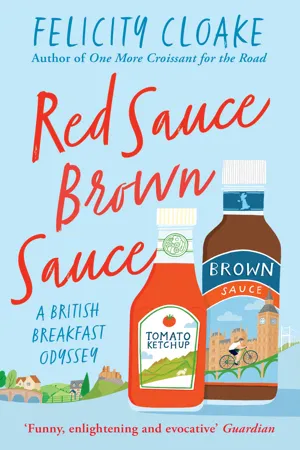
It feels fitting that a sauce factory should be my first stop, given it’s the thing that ties the disparate elements of a fry-up together, and here, owner Guy Tullberg confirms, as we obediently pause to have our temperatures taken, they make them all: ketchup, brown sauce and mustard. In fact, they specialise in mustard, producing eight varieties plus a mustard ketchup.
Before you throw down this book in disgust, accusing me of pro-mustard bias, I assure you that I would have visited Heinz Ketchup and HP Sauce too, but they’re both made abroad these days. The fact that conversation on our visit revolves almost solely around my own preferred breakfast condiment is purely coincidental, but if you’re miffed, please accept my apologies in the form of a brief skip through more populist options.
Tea Break:
RED, BROWN … OR YELLOW
Strictly speaking, both red sauce and brown sauce are ketchups, the generic name for what the Oxford Companion to Food describes as ‘a range of salty, spicy, rather liquid condiments’: western but with their roots in the east. The word probably comes from the Amoy Chinese word kêtsiap (fermented fish sauce), and arrives in English via the Malay kecap (kecap manis, keen cooks will know, is a thick, sweet soy sauce), though the recipe itself has changed more than its name.
Oyster, mussel and many other flavours of ketchup have come and gone, squashed in the path of Big Tomato. Though early tomato ketchups struggled with spoilage, Heinz solved the problem by dramatically upping the vinegar content, changing the flavour so significantly that people began to lose their taste for the homemade variety.
Launched in the States in 1876, it reached the UK a decade later, and was produced here from the 1920s – with a brief break during the war, when consumers had to be content with salad cream instead – until 1999, when production went abroad. Heinz isn’t the only brand of tomato ketchup of course, but it does hold by far the largest market share.
I suspect brown sauce bears more resemblance to early homemade ketchups, being also tomato based, but so heavily seasoned with dates, molasses, tamarind, vinegar and spices that you wouldn’t know it. The most famous brand, HP, or Houses of Parliament sauce, is said to have been originally developed in Leicestershire to go with the famous local pork pie; it acquired its current name when a subsequent owner discovered his ‘banquet sauce’ was gracing tables at the Palace of Westminster. These days, HP is also made by Heinz-Kraft, in the Netherlands. Again, other, arguably more delicious, brands are available.
English mustard, whose history is elaborated below, is, of course, the king of breakfast condiments, being possessed of a clean, sharp heat – vinegar-spiked Dijons or crunchy wholegrain* are, in my opinion, both too acidic to be enjoyable first thing.
Suitably kitted out in hairnets and shoe covers (if you take...