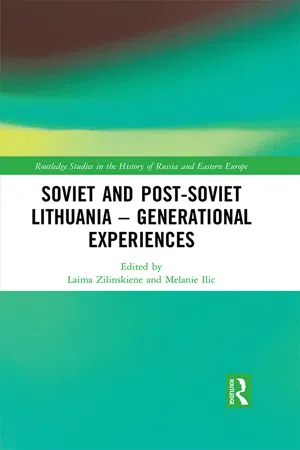
This book explores the impact on different generations of Lithuanians of the fifty-year Soviet modernisation project which was implemented in Lithuania from 1940 to 1991. It reveals the specific characteristics of 'the last Soviet generation', born in the 1970s, and sets this generation apart from those who were born earlier and later. It analyses changes in attitudes, choices and relationships in a variety of social spheres and contexts and the adaptation skills which were required during the late Soviet and post-Soviet transformation processes. Overall, it presents a great deal of detail on the social experiences of different generations in late Soviet and post-Soviet society.
eBook - ePub
Soviet and Post-Soviet Lithuania – Generational Experiences
- 264 pages
- English
- ePUB (mobile friendly)
- Available on iOS & Android
eBook - ePub
Soviet and Post-Soviet Lithuania – Generational Experiences
About this book
Information
1 Introduction: Social time and generations
DOI: 10.4324/9781003023050-1
This collection of essays focuses on people born between 1970 and 1980 in order to identify this age cohort as a specific generation and to define this generation in the historical context of Soviet Lithuania. The studies included here provide not only an overview of the life course trajectories of a specific age cohort that reached adulthood in Lithuania immediately before the final collapse of the Soviet regime in 1991, but also that generation’s unique demographic characteristics, the adaptability potential of its members and some of the particular shifts in their cultural and attitudinal outlook. These shifts include both critical re-evaluations of the Soviet past and necessary reconstructions of possible future life scenarios.
The identification of historical generations as a structure of social identity emerged as part of the modernisation process. The importance of generations in modern societies has grown partly in response to the increasing uncertainties linked to other collective identities (classical, national, religious) and as an outcome of rapid social change (Corsten, 1999; Eisenstadt, 1988; Misztal, 2003; Edmunds and Turner, 2005). Although the definitions of various ‘global generations’ (X, Y, Z, etc.) have recently dominated the discourse, a number of studies have also shown that generational formation and the chronological boundaries between generations differ in specific historical contexts. The theoretical discussions about the concept of ‘generations’ include the empirical evaluation of the influence of relevant macrosocial processes, such as modernisation and the change of political social systems, on the formation of generations. The study of generational formation is particularly important in examples of periods of change between two different modes of modernity. In the case study underpinning the chapters in this book, the transition from the Soviet regime to a Westernised system of governance forms the basis of the study. Periods of social turbulence and upheaval, according to White (2013: 5), provide a specific focus for public debates on the idea of generations. For example, the events of 1968 particularly as they took place in Eastern Europe gave rise to discussions of ‘the sixties generation’, and likewise the events of 1989 gave rise to talk of a ‘post-communist generation’.
The transformations that took place in Eastern Europe during the 1990s gave further impetus to the study of generations, resulting in those people born between 1960 and 1980 being identified as belonging to generations with unique demographic characteristics and adaptation strategies. In a series of geographically specific case studies, this collection of essays focuses particularly on those born in Lithuania in the 1970s with the aim of identifying this age cohort as a ‘generation’. The chapters explore the objective criteria that distinguish this generation, and how this age cohort perceives and names itself as a generation. The chapters delineate the boundaries of this generation and stake a claim for this age cohort to be named ‘the last Soviet generation’.
Such a question was prompted by an earlier sociological study (Žilinskienė, 2014) about ‘the first Soviet generation’ (born between 1945 and 1960) in Lithuania. The genealogical significance of this age cohort allowed researchers to build a picture of the adaptation strategies of the first Soviet generation in relation to their family experiences and the influence of Soviet ideology. The essential uniqueness of members of the first Soviet generation, when compared to their parents and grandparents, is their primary socialisation in the period of the early Soviet period. The collective wartime experiences of the earlier ‘transitional’ generation of the age cohort born during the Soviet and Nazi occupations of Lithuania (1940–1941–1944) are not directly recalled by the first Soviet generation born after 1945. The first generation of the Soviet era, in the terms of Miller (2000), is the ‘later’ generation because their adaptation as ‘participants’ in primary or secondary socialisation took different forms from those born earlier. Members of the first Soviet generation had to externalise their existence in the new Soviet social world alongside simultaneously internalising this world as objective reality (Berger and Luckmann, 1999: 163). For the parents and grandparents of this generation, however, this ‘objective’ reality was not the only reality they experienced during their life course.
Another important aspect that distinguishes the first Soviet generation from older generations is the format of the education system they experienced. Members of the first Soviet generation studied in an education system that from 1945 was centrally operated from Moscow. Some educational employees of the pre-Soviet system were ‘re-educated’ after the end of the Second World War. The first Soviet generation experienced an education system that had been reoriented ‘from West to East’. Another strong ‘player’ in the education system that contributed to the formation of the first Soviet generation was almost universally mandatory participation in Soviet ideologically oriented organisations for children and young adults.
As Berger and Luckmann point out (1999: 169), however, people live with the parents assigned to them by fate. In Soviet Lithuania, living with their parents presented children with a family reality that included long-established family membership practices, intergenerational memory formation and parental attitudes that did not necessarily align with Soviet ideology. When the Soviet ideological system began to enter children’s lives, another ‘world’ emerged alongside their parents’ ‘world’, and it brought with it its own practices, attitudes and values. When two ‘worlds’ collide in such a way, they may complement each other, ignore each other or conflict with each other. In Riesman’s (Riesman, Glazer and Denney, 1989) terms, ‘internal’ family directives are confronted with ‘external’ ideological directives and this, accordingly, results in different understandings of the given situation. In such a scenario, the question of trust plays a role in different strategies deployed in adapting to the new reality.
A certain degree of analogy can be traced between the first Soviet generation and those born in the 1970s because the early socialisation of the last Soviet generation also took place during a period of system change. In this case, however, the transition that now took place was from the Soviet regime to a Western model. This later transformation away from the Soviet system also required the input of older generations. Therefore, an intriguing aspect of this analysis is the identification of models of adaptation to the radical structural transformation in the post-Soviet period with which different generations were faced. Did different components of the transformation process determine different generational experiences of change and how were these experiences reflected in different generations? The contributors to this collection test and extend ideas relating to changing life scenarios and practices with a focus on age and intergenerational issues in the late Soviet and post-Soviet context.
Those born in the 1970s in Estonia have already been the specific focus of study. Raili Nugin’s study (2010) identifies this generation as one that overcame the challenges of transition. She identifies it as a strategic generation that had and still has better opportunities for self-realisation than other generations. Nugin also points to a problem in identifying the 1970s generation: on the one hand, it understands and defines itself as a distinctive (peculiar) generation, but, on the other hand, it contains signs of a split, of being between two systems.
In a 2018 study, Ene Kõresaar identifies the Baltic States not only as geographical region but also a mnemonic entity. According to Kõresaar, the mental maps of the various peoples living in this region are shaped by the memories of Soviet socialism. Each of the Baltic States, however, also has its own unique experiences relating to the transformation period. The demographic peculiarity of Lithuania in comparison with other Baltic countries is its homogeneity in that the majority of the population are of local origin: 85.9% Lithuanian in 2020.1 Other nationalities living in Lithuania reside not only in the capital, Vilnius, but also in other regions of the country. In Latvia’s capital, Riga, in contrast, 40% of the population are ethnic Russians, and Russian speakers constitute over half of the urban population.
Politics is another crucial factor. In 1989, the Lithuanian Communist Party (LCP) split from the Communist Party of the Soviet Union (CPSU) and in 1990 changed its name to the Lithuanian Democratic Labour Party. After the 1992 Seimas (parliamentary) and 1993 Presidential elections, the governments formed by the Lithuanian Democratic Labour Party took charge of economic policy. The ‘old guard of policy makers’, with their experience of active participation in Soviet economic policy making, also oversaw the implementation of these new policy directives. The Lithuanian Democratic Labour Party governed the newly independent state for almost 18 years. In Lithuania, the de-Sovietisation process proved to be much more difficult than it was in Estonia. Although the Law on De-Sovietisation had been discussed in Lithuania after the restoration of independence in 1990, it was never fully adopted. Estonia, on the other hand, witnessed a transformation of its political parties and the new political elite of independent Estonia were not former communists. It was thus easier in Estonia to implement reforms. Meanwhile, in Lithuania, members of the former Soviet nomenclature successfully adapted to the new post-Soviet conditions, and easily turned their political capital into economic benefit (Antanaitis, 2008). Unlike in Latvia, members of the Lithuanian nomenclature, having lost their assured route to economic prosperity, now found ways to turn their established positions in state power into sources of personal enrichment.
Economically, Latvia lagged behind Lithuania and Estonia, and was one of the worst-hit countries of the 2009 global economic downturn. According to Sommers (Sommers and Woolfsoon, 2014), the most successful years for the Baltic States have been from 2014 to the present. By the time Lithuania, Latvia and Estonia had regained their independence in 1990, neoliberal economic ideas had already taken root in the West. These neoliberal ideas were not critically accepted by the leaders of the Baltic States, and this had an impact on the development of these countries.
Time, as a social construct, gives a sense of linear progress from the past to the present and from the present to the future. However, time as a condition of social existence can be divided into different stages which differ in the forms of human experience. Koselleck (1985) perceives time as a panoramic horizontal line on which different historical time is only ever temporary. Each time segment as a temporality faces the problem of synchronising past and present experiences. According to Kosellek (1985), every present is an imaginary future in the past. European society in the twentieth century and at the beginning of the twenty-first century was characterised by a multitude of events, especially in the case of Eastern Europe: war, post-war recovery, repression, Sovietisation and the fundamental transformations of systems that resulted from the collapse of the Soviet regime. All of these events required a high degree of individual and personal adaptability. In this respect, time does not function in the same way for everyone. Adaptability is dependent, on the one hand, on individual participation in the events of any one specific time period and, on the other hand, on the age at which the individual experiences the various processes of socialisation at any given time. Time can be characterised through both social and personal prisms. The social prism of time encompasses various stages of social development, while the personal prism of time demonstrates at which stages of personal development personal life experiences are formed. Time is a collection of lives, identities and feelings. Time can be described as a living memory, an attempt to preserve identities and behaviours.
Sztompka (2004) has described the collapse of the Soviet empire (European communism) as a moment of traumatic change, and one which came quickly and unexpectedly. The changes that took place in the political, economic and cultural spheres also brought about fundamental changes to everyday life. This radical change of system inevitably had a major impact on individual life trajectories. These important events in twentieth-century history changed the European political map. The year 1989 brought about significant changes in Central and Eastern Europe, after which everything on the map of the former Soviet empire changed. The general atmosphere of change created interrelated processes, and other previously unimaginable geopolitical processes took place throughout Central and Eastern Europe.
As Svedas (2019) has pointed out, however, even such events as the fall of the Berlin Wall in 1989 cannot yet be considered to be complete because we still talk about borders in our thinking and borders between people. The fall of the Berlin Wall is still relevant today because the changes subsequent to it inevitably affected people’s lives, values, behaviours, relationships, outlooks and attitudes. After 1989, individuals had to adapt to different rules and life scenarios because their new life experiences were now in conflict with their past expectations. Thus, the changes that have taken place since the decentralisation and de-institutionalisation of the former Soviet space have required new processes of adaptation. As Winch (1989) argues, habits are formed not only through receiving instructions, but by living with people who normally behave in a certain way. In forming new habits, generational positionality is significant both in social space and in the family.
In a particular time segment (social time), some interpret that specific time period through the prism of their own life exper...
Table of contents
- Cover
- Half Title
- Series Page
- Title Page
- Copyright Page
- Dedication
- Table of Contents
- List of illustrations
- List of contributors
- Acknowledgements
- Lithuania: Timeline
- 1. Introduction: Social time and generations
- 2. Soviet dystopia: Public spaces and modern materialities in late Soviet Lithuania 1
- 3. Understandings of crime and deviance in Soviet and post-Soviet Lithuania 1
- 4. The last generation of engineers in Soviet Lithuania 1
- 5. Life course as an identity component of the last Soviet generation in Lithuania 1
- 6. Identifying the 1970s generation 1
- 7. Particularities of the behavioural models of the last Soviet generation 1
- 8. Lithuania’s cultural elite, born from 1970 to 1980: Group, class and generational identities
- 9. The role of religious experience in the formation of life choices, social attitudes and behaviour models of different generations in Lithuania
- 10. Communicative family memory across generations
- 11. Lithuania’s gender revolution: Reversed and stalled 1
- Bibliography
- Index
Trusted by 375,005 students
Access to over 1.5 million titles for a fair monthly price.
Study more efficiently using our study tools.
Frequently asked questions
Yes, you can cancel anytime from the Subscription tab in your account settings on the Perlego website. Your subscription will stay active until the end of your current billing period. Learn how to cancel your subscription
No, books cannot be downloaded as external files, such as PDFs, for use outside of Perlego. However, you can download books within the Perlego app for offline reading on mobile or tablet. Learn how to download books offline
Perlego offers two plans: Essential and Complete
- Essential is ideal for learners and professionals who enjoy exploring a wide range of subjects. Access the Essential Library with 800,000+ trusted titles and best-sellers across business, personal growth, and the humanities. Includes unlimited reading time and Standard Read Aloud voice.
- Complete: Perfect for advanced learners and researchers needing full, unrestricted access. Unlock 1.5M+ books across hundreds of subjects, including academic and specialized titles. The Complete Plan also includes advanced features like Premium Read Aloud and Research Assistant.
We are an online textbook subscription service, where you can get access to an entire online library for less than the price of a single book per month. With over 1.5 million books across 990+ topics, we’ve got you covered! Learn about our mission
Look out for the read-aloud symbol on your next book to see if you can listen to it. The read-aloud tool reads text aloud for you, highlighting the text as it is being read. You can pause it, speed it up and slow it down. Learn more about Read Aloud
Yes! You can use the Perlego app on both iOS and Android devices to read anytime, anywhere — even offline. Perfect for commutes or when you’re on the go.
Please note we cannot support devices running on iOS 13 and Android 7 or earlier. Learn more about using the app
Please note we cannot support devices running on iOS 13 and Android 7 or earlier. Learn more about using the app
Yes, you can access Soviet and Post-Soviet Lithuania – Generational Experiences by Laima Zilinskiene, Melanie Ilic, Laima Zilinskiene,Melanie Ilic in PDF and/or ePUB format, as well as other popular books in Social Sciences & Ethnic Studies. We have over 1.5 million books available in our catalogue for you to explore.