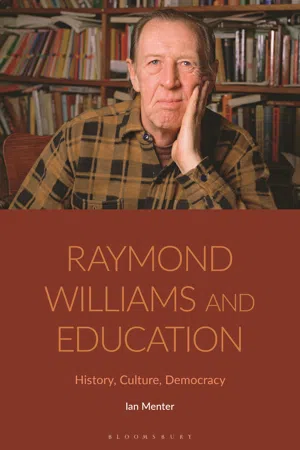
Raymond Williams' major contributions to intellectual progress are usually categorised within cultural theory, media studies or neo-Marxist studies. Serious analysis of his contributions to education as a field of practice as well as a field of study have been relatively neglected. This is the first book to redress that omission, focusing on how his writing and thought have helped us to understand education in Britain and also provide analytical tools that have helped to shape educational studies in the USA and internationally.
Ian Menter draws on Williams' several novels, including Border Country, as well as on his seminal contributions to cultural theory, including Culture and Society, The Long Revolution, Keywords and Marxism and Literature. Menter also examines how Williams' life shaped his understanding of education including his early involvement in adult education and his deeply ambivalent relationship with the academy. Public education is positioned as a key arena of social struggle where decisions shaping the nature of our futures and crucial to creating a democratic and just society. The book includes a foreword by Michael Apple who is John Boscom Professor Emeritus of Curriculum and Instruction at the University of Wisconsin–Madison, USA, which makes reference to the importance of Williams' work in relation to education in the USA.
- 224 pages
- English
- ePUB (mobile friendly)
- Available on iOS & Android
eBook - ePub
About this book
Information
1
Biography and Education – Raymond Williams’s Educational Experiences
I wish, first, that we should recognize that education is ordinary: that it is, before everything else, the process of giving to the ordinary members of society its full common meanings, and the skills that will enable them to amend these meanings, in the light of their personal and common experience.
(Williams, Culture and Society 1958/1989:14)
Introduction
When I try to answer the question of what Raymond Williams was … my answer is that he was a thinker. When you talked with him, his thinking was almost palpable: a deceptively slow delivery allowed a tremendously impressive body of mental capital to go into action.
(Barnett, 1988, cited by Eldridge and Eldridge, 1994:2)
So said one of his close collaborators, Anthony Barnett, soon after Williams’s death in 1988. However, Raymond Williams described himself first and foremost as a writer. The act of committing words to paper was a self-defining process. In spite of his lasting worldwide reputation for his writings on politics, on literature, drama, television and film, his own commitment throughout his life to writing fiction was never in any doubt. Reading the extensive interviews which were published as Politics and Letters, it is clear how important to him this creative process was:
It is certainly true that I have given relatively more time, in comparison with what became visible and valued, to fiction, than to any other forms of writing. In the late forties, I regarded the novels as the work which I most wanted to do. Now I feel differently about them. All along there have been certain things pressing on me, which I simply could find no alternative way of writing; today, however, fiction is something I’m prepared to work on a long time without feeling any urgency to finish quickly.
(Williams, 1979/2015:271)
During his lifetime five of his novels were published and then, following his death, a final two-volume fictional account of the area of his childhood was completed by his widow, Joy Williams, and published as People of the Black Mountains (Williams, 1989d, 1990). Dai Smith, Welsh historian and biographer of Williams, trawled through many of his unpublished or obscure writings, including numerous short stories and several unpublished novels, clearly demonstrating how important this process was to Williams’s life and work (Smith, 2008). Williams started writing fiction while still at school and always regarded this – the short story or novel – as the most immediate and powerful way of making sense of human experience and social life. It is paradoxical that he is much better remembered and more highly regarded for his non-fiction than for these novels.
This chapter seeks to explore how Williams understood the connections between biography and identity and in particular how his own educational experiences – in the broadest sense – shaped the person he became. That qualifier ‘in the broadest sense’ is necessary because Williams understood all personal experience as educational. The environment in which, and through which, we live our lives shapes us as we become who we are. Biography and identity are fundamentally intertwined. It was a profound belief in this idea which would eventually lead to Williams’s emphasis on ‘structures of feeling’ and his adoption of cultural materialism as his analytic method, as we shall see in later chapters. Throughout this writing the influence of place and time – geography and history – on human experience underlies his narrative as well as his analysis. Titles such as Border Country and The Country and the City demonstrate the former. The Long Revolution and Towards 2000 demonstrate the latter. Here though, in this chapter, the aim is to examine how Williams’s own life experiences, including experiences within formal and informal educational settings, shaped his thinking and his actions, shaped his identity. I draw on both strands of his writing, fiction and non-fiction, as well as on analyses carried out by others, to provide this account.
1.1 Childhood and School in Border Country Wales
I come from Pandy, which is a predominantly farming village with a characteristic Welsh rural structure: the farms are small family units. My father began work when he was a boy as a farm labourer. But through this valley had come the railway, and at fifteen he got a job as a boy porter on the railway, in which he remained until he went into the army during the First World War. When he came back he became an assistant signalman and then a signalman. So I grew up within a very particular situation – a distinctly rural social pattern of small farms, interlocked with another kind of social structure to which the railway workers belonged. They were unionized wage-workers, with a perception of a much wider social system beyond the village to which they were linked.
(Williams, 1979/2015:21)
These are Raymond Williams’s opening words in response to the first question he was asked in the interviews with the editors of New Left Review, published as Politics and Letters.
The village of Pandy where Williams spent his childhood lies on the River Honddu, which flows from the Black Mountains down to the valleys of South Wales. The railway line follows much the same north–south trajectory as the river and facilitated the transport of coal and steel from the industrial heartland of South Wales, northwards, beyond the Black Mountains, to the manufacturing centres of the English Midlands. The young Raymond understood the significance of both these natural and human features. His own father, Harry Williams, was employed as a signalman at the signal box in Pandy. In spite of this rural childhood, the young Williams soon became aware of the wider social structures in the world around him. His father was a committed trade unionist and took part in the General Strike of 1926. Raymond became acutely aware of the importance of a strong class consciousness, or what he described as the distinctive self-confidence, of the working people around him.
We were in no doubt at all about the character of the employers, but the ruling class still did not seem very formidable. The result was to build up a sense, which was very characteristic of the Labour movement at the time, that the working class was the competent class that did the work and so could run society. That was said so much after the General Strike. It was disabling ultimately. But as an adolescent I remember looking at these men even with a certain resentment – they seemed so absolutely confident. I have never seen such self-confident people since.
(Williams, 1979/2015:34–5)
This upbringing, both the society and the physical landscape are portrayed powerfully in his first major work of fiction, published in 1960, Border Country.
The narrow road wound through the valley. The railway, leaving the cutting at the station, ran out north on an embankment, roughly parallel with the road but a quarter of a mile distant. Between road and railway, in its curving course, ran the Honddu, the black water. On the east of the road ran the grassed embankment of the old tramroad, with a few overgrown stone quarries near its line.
(Williams, 1960/1988:33)
This, his most famous novel, evocatively portrays his childhood and surroundings and the title, Border Country, also reminds us of another key aspect in Williams’s identity. Borders can be both political and social. Welshness was a vital part of his identity, not least when he moved to England. He was always deeply bound to this part of Wales and, later in their lives together, Raymond and his wife Joy enjoyed a second home in the Black Mountains. His intimate love of this landscape comes over most strongly in his final novel The People of the Black Mountains, a novel with a deeply temporal dimension, covering the full pre-history, as well as the history, of the area, based on what is actually known as well as imagined in the lives and experiences of those who lived there. But another border which so engrossed Williams in his life was the social border, most frequently conveyed by the term ‘class’. Such were his own concerns about the injustices of a society divided by class, with the great disparities of wealth and power existing within western capitalist societies, that challenging these inequalities became a key aspect of his life’s work. In many ways he himself did cross these social borders, but his commitments to Wales and to working-class lives were recurrent themes in all that he lived and wrote.
Raymond’s parents believed passionately that education and learning can provide routes to fulfilment. As their only child, Raymond became very much the focus of their hopes for the future; they encouraged him to take his learning seriously, and he certainly did. He spent his early years in formal education at the elementary school in nearby Llanfihangel Crucorney, where he stood out scholastically. In 1932, with the support of the headteacher, Tom Davies, he, along with six other pupils from Pandy, won a scholarship to the King Henry VIII Grammar School in Abergavenny, the market town six miles down the valley from Pandy. Here again his academic prowess was evident. This was a selective school and in other communities, perhaps in northern England or in Scotland, attending such a school might have alienated him from his peers and their families, but he recalled that this was not the case. Indeed, there was a strong sense of pride in Pandy at his early achievements as well as his later success.
Apart from Williams’s parents, others were deeply influential on his experiences of schooling. In Pandy, the Church of Wales vicar, the Reverend J. A. Hughes, was encouraging and tutored the young Raymond in Latin. This support was provided in spite of the fact that there was relatively little commitment to participating in religious worship in the Williams household, especially among the males of the family. At the grammar school, Williams’s imagination was captured by his teacher of English and history, Mr A. L. Ralphs, who identified Raymond as a potential university scholarship boy. Ralphs was a philologist and it may be this that first aroused Williams’s interest in the close analysis of particular words. In relation to the wider school curriculum, however, when Williams subsequently reflected on it, he was deeply sceptical about its focus. He came to see it as being fundamentally an imperialist English curriculum designed to foster the subordination of Wales and Welshness and the conformity and obeisance of the working class. It was, he said, ‘intellectually deracinating’. In more of his own words:
What I did not perceive at the time but I now understand is that the grammar schools were implanted in the towns of Wales for the purpose of Anglicization. They imposed a completely English orientation, which cut one off thoroughly from Welshness. You can imagine how this combined with my hostility to the norms of the Welsh nonconformist community. The result was a rejection of my Welshness which I did not work through until well into my thirties, when I began to read the history and understand it.
(Williams, 1979/2015:25)
While at school in Abergavenny, Mr Ralphs, who was a committed internationalist, arranged for Raymond to attend a League of Nations event in Geneva, thus facilitating his first trip abroad. Already by this time he was taking on public speaking roles. He was also writing and taking part in dramatic productions.
In his last years at the grammar school, Williams was taking three subjects for his Higher Certificate (what would now be ‘A Levels’): English, Latin and French. It was the headteacher of the grammar school, Mr Newcombe, who wrote to Trinity College Cambridge, proposing that they offer his outstanding pupil a place. Newcombe had consulted Harry Williams, Raymond’s father, about this, but not apparently Raymond himself. Raymond was to be financially supported at Cambridge through scholarships both locally and from the university. Subsequently he wondered whether he might have been better suited to attend one of the universities in Wales.
Why didn’t the headmaster send me to a university in Wales? That would have been an orientation that would have suited my life much better. It is no use going back over it, but it would have. But that is what he was there for, to find boys like me and send them to Cambridge. I don’t say this in an spirit of hostility to him; he thought he was doing the best thing for me.
(Williams, 1979/2015:37)
1.2 ‘Crossing the Border’ to Cambridge University
In late 1939, Williams travelled across England to arrive at one of the most prestigious centres of learning in the world. He was not alone in the crossing of this border from a small, largely rural settlement in Wales to the elite and intellectually competitive environment. Others from working-class backgrounds had also crossed this border at about the same time, but such scholarship boys – and at this time it was very much a male trajectory – were very few. The University of Cambridge was a highly selective institution with the great majority of students arriving from private ‘independent’ schools, carrying a huge amount of what we might now call social and cultural capital with them.
The experience of arriving at Cambridge was not an easy one (see Williams, 1977, ‘My Cambridge’, reprinted in Williams, 1989). Williams arrived, already politically aware and committed and soon joined the Cambridge University Socialist Club (CUSS), which was very much dominated by members of the Communist Party. In Politics and Letters, he describes the Club as very much his ‘home from home’ (Williams, 1979/2015:40) and it contrasted greatly with the ethos of his college and the wider university. Even within the club, the members were nearly all from much wealthier backgrounds than him, but they did at least share his cultural and political interests.
I think I am right to say that I met only one other person from a working-class family at Cambridge, and he was a mature student in his thirties, but had himself been a manual worker as an adult …..The overwhelming majority of people I encountered at the Socialist Club were in terms of education and family very much the ordinary Cambridge mix.
(Williams, 1979/2015:40)
This was a strange time to be at the University of Cambridge. The Second World War commenced in the same year that he arrived there, and this had an increasing impact on ‘normal life’ at the university. On a personal level for Raymond Williams, one effect that was to have an enormous influence on his life stemmed from the temporary migration of students from the London School of Economics (LSE) to Cambridge, in order to avoid the blitz that was devastating the capital. Among these LSE students was Joyce Dalling, known as Joy, who was to become Williams’s wife in 1942 and who was a major collaborator in much of his work thereafter. In due course they would have three children: Merryn, Ederyn and Madawc.
Williams had gone to Cambridge to study English: a relatively new subject for this highly conservative establishment. An English Faculty was created there only in 1925, and the subject was still in its early days of development. But ‘Cambridge English’ was already becoming a very particular and widely recognized approach to the study of language and more particularly literature. Under the initial leadership of I. A. Richards, who created an approach which came to be known as ‘practical criticism’ (the title of one of his books – Richards, 1929), this mantle was later taken on by F. R. Leavis (always known by his initials, rather than his forename) often in collaboration with his wife, Q. D. (Queenie) Leavis. But the undergraduate Williams had very little direct contact with the Leavises at this time.
Practical criticism was an approach to the study of literature which involved close analysis of the ways writing was structured and the ways in which words were used. It focused on – and helped to establish – what would become known as the English canon, including, among others, the novels of Charles Dickens, Jane Austen and the Bronte sisters, the poetry of William Wordsworth and Samuel Taylor Coleridge and the drama of William Shakespeare. Williams was an avid reader of drama and fiction and was well versed in the great poetical works, as can be seen especially in The Country and the City (Williams, 1973).
Williams was tutored at Cambridge firstly by Lionel Elvin (later the Director of the London Institute of Education and the author of an early classic in education studies, Education and Contemporary Society – Elvin, 1968) and then by E. M. W. Tillyard, described by Inglis in his biography of Williams, as ‘a grandee’ of the English Faculty (Inglis, 1995:82). Elvin appears to have been culturally much more in tune with Williams’s dispositions, whereas Tillyard was a deeply conservative scholar.
As well as providing academic stimulation, Cambridge also provided considerable political and aesthetic stimulation. Through his membership of the CUSS, Williams soon came to know many other students with leftward leanings and became a member of the Communist Party. This was a time of great political debate at Cambridge – and to some extent around the wider country. The rise of German fascism and Soviet communism, and of course, the outbreak of war, had created a febrile international atmosphere and the fertile young minds at Cambridge were feverishly working out their individual and collective positions. Among those with whom Raymond came into contact in these early days were the historians E. P. Thompson and Eric Hobsbawm. On the cultural front, as well as already being a prolific writer for, and editor of, student newspapers, Williams became a frequent viewer not only of film, but also of ballet and theatre. In film, his collaboration with Michael Orrom, with whom he co-wrote one of his early publications (Williams and Orrom, 1954), began during his undergraduate days.
Dai Smith, in his biography of Williams, suggests that here at Cambridge, he was living three parallel lives:
The three he led over those two years to the summer of 1941 were that of an intermittently conscientious but academically blocked student, that of a full time...
Table of contents
- Cover
- Halftitle Page
- Title Page
- Dedication Page
- Contents
- Preface
- Foreword
- Introduction: To the Life and Work
- 1 Biography and Education – Raymond Williams’s Educational Experiences
- 2 Education in Fiction and Fiction in Education – Raymond Williams’s Novels and His Analyses of English Literature
- 3 The History of Schooling in England – Education in The Long Revolution
- 4 The Significance of Adult Education
- 5 Culture, the Academy and the Role of the Public Intellectual
- 6 Cultural Studies and the Educational Role of the Arts and Media
- 7 The Theoretical Legacy – Structures of Feeling; Cultural Materialism; Base and Superstructure
- 8 Conclusion – Language and Culture; Tradition and Revolution
- Notes
- References
- Index
- Imprint
Trusted by 375,005 students
Access to over 1.5 million titles for a fair monthly price.
Study more efficiently using our study tools.
Frequently asked questions
Yes, you can cancel anytime from the Subscription tab in your account settings on the Perlego website. Your subscription will stay active until the end of your current billing period. Learn how to cancel your subscription
No, books cannot be downloaded as external files, such as PDFs, for use outside of Perlego. However, you can download books within the Perlego app for offline reading on mobile or tablet. Learn how to download books offline
Perlego offers two plans: Essential and Complete
- Essential is ideal for learners and professionals who enjoy exploring a wide range of subjects. Access the Essential Library with 800,000+ trusted titles and best-sellers across business, personal growth, and the humanities. Includes unlimited reading time and Standard Read Aloud voice.
- Complete: Perfect for advanced learners and researchers needing full, unrestricted access. Unlock 1.5M+ books across hundreds of subjects, including academic and specialized titles. The Complete Plan also includes advanced features like Premium Read Aloud and Research Assistant.
We are an online textbook subscription service, where you can get access to an entire online library for less than the price of a single book per month. With over 1.5 million books across 990+ topics, we’ve got you covered! Learn about our mission
Look out for the read-aloud symbol on your next book to see if you can listen to it. The read-aloud tool reads text aloud for you, highlighting the text as it is being read. You can pause it, speed it up and slow it down. Learn more about Read Aloud
Yes! You can use the Perlego app on both iOS and Android devices to read anytime, anywhere — even offline. Perfect for commutes or when you’re on the go.
Please note we cannot support devices running on iOS 13 and Android 7 or earlier. Learn more about using the app
Please note we cannot support devices running on iOS 13 and Android 7 or earlier. Learn more about using the app
Yes, you can access Raymond Williams and Education by Ian Menter in PDF and/or ePUB format, as well as other popular books in Education & Education Theory & Practice. We have over 1.5 million books available in our catalogue for you to explore.