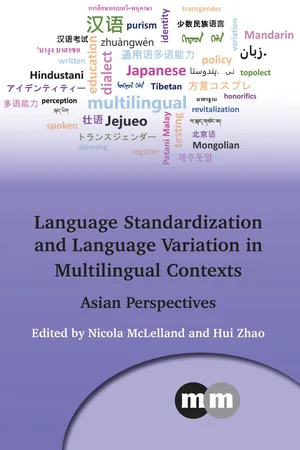
This important contribution to the sociolinguistics of Asian languages breaks new ground in the study of language standards and standardization in two key ways: in its focus on Asia, with particular attention paid to China and its neighbours, and in the attention paid to multilingual contexts. The chapters address various kinds of (sometimes hidden) multilingualism and examine the interactions between multilingualism and language standardization, offering a corrective to earlier work on standardization, which has tended to assume a monolingual nation state and monolingual individuals. Taken together, the chapters in this book thus add to our understanding of the ways in which multilingualism is implicated in language standardization, as well as the impact of language standards on multilingualism.
The introduction, Chapter 6 and Chapter 8 are free to download as open access publications under a CC BY NC licence. You can access them here:
Introduction: https://zenodo.org/record/5749388#.YaiwuNDP3cs
Chapter 6: https://zenodo.org/record/5749522#.Yaiw-9DP3cs
Chapter 8: https://zenodo.org/record/5749586#.Yai0RNDP3cs
eBook - ePub
Language Standardization and Language Variation in Multilingual Contexts
Asian Perspectives
- English
- ePUB (mobile friendly)
- Available on iOS & Android
eBook - ePub
Language Standardization and Language Variation in Multilingual Contexts
Asian Perspectives
About this book
Information
Part 1
Histories of Standardization in Multilingual Contexts
1Language Codification: Coloniality, Society and History
S. Imtiaz Hasnain
Introduction
‘The number of indigenous languages in the German colonies is immense. They are not known in their entirety yet, although missionaries, civil servants and scholars diligently contribute to their investigation’.1 This observation not only allows us to understand the relation of language and colonialism but also informs us how, despite the involvement of missionaries and several other professional groups in the exploration of the languages in the dominion or colony (what Stolz & Warnke, 2015, referred to as Schutzgebiete ‘protectorates’), the ‘knowledge about the linguistic diversity of Germany’s colonial empire’ (Stolz & Warnke, 2015: 4) still remained incomplete. Similarly, the new European masters of South Asia failed to comprehend the linguistic and cultural diversity of their newly colonized South Asian subjects. South Asian multilingual society bewildered their imagination.2 The complexities of language represented ‘a land of Babel brought to perpetual chaos by the sheer perversity of its natives’ (Washbrook, 1991: 187). It required a taming of the wilderness, which was effectively realized through the drive towards classification. Since the indigenous conceptual framework surrounding language was far removed from that of the 19th-century Europeans, colonization of language occupied the centre stage.
This chapter traces the role of language – especially language codification and classification – in the process of the colonization of India. In the first section, ‘Coloniality and Language’, I briefly show the interconnections between language and the process of colonialism. Language was used as a tool of empire-building by the colonizers, who perpetuated hierarchies and classifications using linguistic schematization. The second section, ‘British Colonial engagement, Scientific Philology and the Classification of Indian languages’, provides a historical perspective on the British colonial presence in India, highlighting the conditions under which the colonial engagement with Indian languages began and their insistence on the use of philology, providing the method for establishing the doctrine of monotheism and homogenizing the natives’3 sociocultural and linguistic diversity in line with a particular ideology of what a language should be like. Plurality and multiplicity, whether of language or of cultural traditions, seemed chaotic and irrational to the colonizers. Thus, they not only lacked Asian sensibility to language, but at times were also insensitive to the nuances of India’s diversity. The final section looks into the linguistic conundrum and the lack of sensitivity of the colonials in their understanding of the newly colonized society and situates language standardization in history. The Conclusion section focuses on the problematics and consequences of the classification and translation of indigenous knowledge systems into English, in ways that removed the finer distinctions and subtle nuances of the native tongue altogether. A larger aim of this exercise was, I argue, to appropriate the multiplicit...
Table of contents
- Cover-Page
- Half-Title
- Series
- Title
- Copyright
- Contents
- Contributors
- Note on the Use of Original Scripts in this Volume
- Introduction: Language Standardization and Language Variation in Multilingual Contexts – Asian Perspectives
- Part 1: Histories of Standardization in Multilingual Contexts
- Part 2: Standardization and Variation in Multilingual China: Implications for Education, Testing, Policy and Practice
- Part 3: Standardization and Minoritized Languages in Multilingual Contexts
- Part 4: Negotiating Standards and Variation: Case Studies From Japanese
- Index
Trusted by 375,005 students
Access to over 1.5 million titles for a fair monthly price.
Study more efficiently using our study tools.
Frequently asked questions
Yes, you can cancel anytime from the Subscription tab in your account settings on the Perlego website. Your subscription will stay active until the end of your current billing period. Learn how to cancel your subscription
No, books cannot be downloaded as external files, such as PDFs, for use outside of Perlego. However, you can download books within the Perlego app for offline reading on mobile or tablet. Learn how to download books offline
Perlego offers two plans: Essential and Complete
- Essential is ideal for learners and professionals who enjoy exploring a wide range of subjects. Access the Essential Library with 800,000+ trusted titles and best-sellers across business, personal growth, and the humanities. Includes unlimited reading time and Standard Read Aloud voice.
- Complete: Perfect for advanced learners and researchers needing full, unrestricted access. Unlock 1.5M+ books across hundreds of subjects, including academic and specialized titles. The Complete Plan also includes advanced features like Premium Read Aloud and Research Assistant.
We are an online textbook subscription service, where you can get access to an entire online library for less than the price of a single book per month. With over 1.5 million books across 990+ topics, we’ve got you covered! Learn about our mission
Look out for the read-aloud symbol on your next book to see if you can listen to it. The read-aloud tool reads text aloud for you, highlighting the text as it is being read. You can pause it, speed it up and slow it down. Learn more about Read Aloud
Yes! You can use the Perlego app on both iOS and Android devices to read anytime, anywhere — even offline. Perfect for commutes or when you’re on the go.
Please note we cannot support devices running on iOS 13 and Android 7 or earlier. Learn more about using the app
Please note we cannot support devices running on iOS 13 and Android 7 or earlier. Learn more about using the app
Yes, you can access Language Standardization and Language Variation in Multilingual Contexts by Nicola McLelland, Hui Zhao, Nicola McLelland,Hui Zhao,Dr. Nicola McLelland in PDF and/or ePUB format, as well as other popular books in Languages & Linguistics & Linguistics. We have over 1.5 million books available in our catalogue for you to explore.