
eBook - ePub
Systemic Racism 101
A Visual History of the Impact of Racism in America
- 224 pages
- English
- ePUB (mobile friendly)
- Available on iOS & Android
eBook - ePub
About this book
Discover how—and why—Black, Indigenous, and people of color in America experience societal, economic, and infrastructural inequality throughout history covering everything from Columbus’s arrival in 1492 to the War on Drugs to the Black Lives Matter movement.
From reparations to the prison industrial complex and redlining, there are a lot of high-level concepts to systemic racism that are hard to digest. At a time where everyone is inundated with information on structural racism, it can be hard to know where to start or how to visualize the disenfranchisement of BIPOC Americans.
In Systemic Racism 101, you will find infographic spreads alongside explanatory text to help you visualize and truly understand societal, economic, and structural racism—along with what we can do to change it. Starting from the discovery of America in 1492, through the Civil Rights movement, all the way to the criminal justice reform today, this book has everything you need to know about the continued fight for equality.
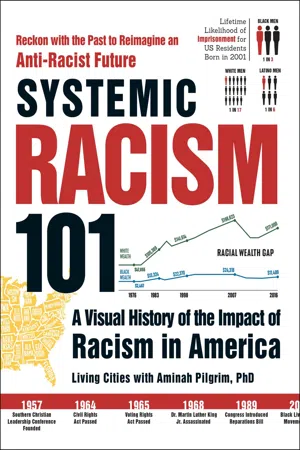
From reparations to the prison industrial complex and redlining, there are a lot of high-level concepts to systemic racism that are hard to digest. At a time where everyone is inundated with information on structural racism, it can be hard to know where to start or how to visualize the disenfranchisement of BIPOC Americans.
In Systemic Racism 101, you will find infographic spreads alongside explanatory text to help you visualize and truly understand societal, economic, and structural racism—along with what we can do to change it. Starting from the discovery of America in 1492, through the Civil Rights movement, all the way to the criminal justice reform today, this book has everything you need to know about the continued fight for equality.
Frequently asked questions
Yes, you can cancel anytime from the Subscription tab in your account settings on the Perlego website. Your subscription will stay active until the end of your current billing period. Learn how to cancel your subscription.
At the moment all of our mobile-responsive ePub books are available to download via the app. Most of our PDFs are also available to download and we're working on making the final remaining ones downloadable now. Learn more here.
Perlego offers two plans: Essential and Complete
- Essential is ideal for learners and professionals who enjoy exploring a wide range of subjects. Access the Essential Library with 800,000+ trusted titles and best-sellers across business, personal growth, and the humanities. Includes unlimited reading time and Standard Read Aloud voice.
- Complete: Perfect for advanced learners and researchers needing full, unrestricted access. Unlock 1.4M+ books across hundreds of subjects, including academic and specialized titles. The Complete Plan also includes advanced features like Premium Read Aloud and Research Assistant.
We are an online textbook subscription service, where you can get access to an entire online library for less than the price of a single book per month. With over 1 million books across 1000+ topics, weâve got you covered! Learn more here.
Look out for the read-aloud symbol on your next book to see if you can listen to it. The read-aloud tool reads text aloud for you, highlighting the text as it is being read. You can pause it, speed it up and slow it down. Learn more here.
Yes! You can use the Perlego app on both iOS or Android devices to read anytime, anywhere â even offline. Perfect for commutes or when youâre on the go.
Please note we cannot support devices running on iOS 13 and Android 7 or earlier. Learn more about using the app.
Yes, you can access Systemic Racism 101 by Living Cities,Aminah Pilgrim in PDF and/or ePUB format, as well as other popular books in History & African American History. We have over one million books available in our catalogue for you to explore.
Information
CHAPTER ONE 1492 TO THE CIVIL WAR
- 1400s: African civilizations thrive; age of European exploration
- 1492: Arrival of Columbus in the Americas begins settler colonialism; ongoing violence against Indigenous populations; early encounters give way to racial ideology
- 1500s: Religious doctrines and laws shape attitudes and practices between âracesâ; the word race first appears in the English language
- 1600s: Free people of African descent in the colonies, predating Jamestown
- 1619: First twenty enslaved people forcibly brought to Jamestown, Virginia
- 1662: Virginia enacts a law that makes enslavement a life sentence tied to Black womenâs bodies by making slavery hereditary
- 1675â1676: Baconâs Rebellion, a cross-class and mixed-race rebellion
- 1775â1783: American Revolution and United States Declaration of Independence from the British (1776)
- 1791â1804: Haitian Revolution
- 1780s: âQueenâ sugar (sugar cultivated by the enslaved) is the global âwhite goldâ
- 1794: Eli Whitney patents the cotton gin, making cotton âkingâ of cash crops
- 1800â1865: Height of the Underground Railroad; Harriet Tubman is one of its most well-known conductors
- 1807: British government abolishes the transatlantic slave trade throughout its territories; US slavery continues to grow
- 1831: Hanging of Nat Turner, leader of one of the most powerful US slave revolts
- 1850s: Resistance to slavery and calls for abolition intensify
- 1852: Harriet Beecher Stowe publishes Uncle Tomâs Cabin
- 1859: Harpers Ferry raid; midcentury tensions over slavery between Northern and Southern states
- 1861â1865: American Civil War
EUROPEANS EXPLOIT WESTERN AFRICA
In 1444, Portuguese explorersâfunded by Prince Henry the Navigatorâwere the first Europeans to arrive at the sub-Saharan coast of Guinea, West Africa. Ten Moors (a Christian European term to refer to people of mixed Arab ancestry) were sold to the Portuguese by African captives, who used the sale to negotiate their own release. The Moors were forcibly taken to the seaside city of Lagos, Portugal. The men, women, and children were marched through the streets of the city, to the shock and awe of onlookers. The captivesâ collective shame and trauma were intensified by being made so public. Worsening the pain, they were then separated from each other.
This expedition marked the beginnings of a brutal system and opened the floodgates for the trade in humans. The Portuguese used island colonies such as Cabo Verde and SĂŁo TomĂŠ and PrĂncipe to further exploit the West African coast, as did the Spanish, who had established a colony in the Canary Islands.
WHAT AFRICA WAS LIKE IN THE 1400S AND 1500S
Africa is the birthplace of humanity and home to the earliest ancestor of all humans. Ancient civilizations in Egypt and Nubia were vast and had influence upon ancient Rome and Greece. In the fifteenth century, the western region of Africa (the origin of most African Americans) was organized into small village states and kingdoms/queendoms. It was home to diverse ethnic groups, each with its own language, customs, and cultures. These groups did have similarities though:
- ⢠Family was the central building block of these collectivist societies.
- ⢠Land ownership and governance were passed through kinship lines (both patrilineal and matrilineal).
- ⢠Slavery existed there before European contact. The slavery that existed among them was a result of war and was no life sentence; it was a source of wealth building for the slaveholding clans as enslaved people often worked to earn release from punishments. Female âslavesâ may have been used as concubines. In most cases, this kind of slavery did not involve hard physical labor.
Prior to the transatlantic slave trade, many African tribes were wealthyânot only in possession but in culture and communityâand had no language for being âpoor.â Nor did they conceive of their identities in the same ways that European encounters would eventually lead them to adopt.
THE ORIGINS OF COLONIZERSâ PERCEIVED SUPERIORITY
The colonizersâ religious and cultural beliefs had given them a picture of what was moral, what was right, and a sense of divine order. Historian Jennifer Morganâs work on the European explorersâ travel diaries revealed that they first met femalesâboth in the Americas (with the Indigenous people) and in Africa. These colonizers were also sanctioned by the Catholic Church, which had gained a political foothold in all of Europe at this time. As church subjects, the colonizers held preconceived ideas of blood purity and were distinguishing between people and religions. They used biblical references and familiar images and legends from their home countries to develop ideas upon which to judge the darker strangers.
Morgan details the conflicting notions that came to inform the burgeoning construct of race that grew from these religious, moral, and gendered ideas. In essence, the colonizersâ descriptions of beastliness yet beauty, inordinate strength, and exaggerated and unhuman features, make clear how they marked the African people as an inferior âotherâ and thus defined themselves as superior.
The colonizersâ opinions and beliefs were translated into social constructs and a powerful racial ideology that would ultimately serve as the universal language of global exchange. Indeed, the ideology and âlanguageâ of race coded the power relations between slave traders and their captives, undergirded the laws that institutionalized enslavement throughout the world from the fifteenth through the nineteenth centuries, and have legitimized related practices up until today.
It is reasonable to assume, then, that dehumanization and racial and gendered violence were inherent outcomes of the emergence of racist ideas. These ideas established European-derived cultures and their norms as superior and dominant, and all others as inferior, immoral, uncivilized, and deficient. The racist ideas were powerful justifications for the exploits of the European explorers and traders, legitimizing their violence while convincing much of the world that enslaving and exploiting served the greater good. The system came to be so powerful and pervasive that over timeâparticularly with the silencing of the histories of other culturesâit went unquestioned and was assumed to be ânormalâ by vast populations. This was the environment during which Columbus crossed the Atlantic for the notorious exploits of 1492.
THE FALLACY OF THE âNEWâ WORLD
The Americas were not untouched, virgin green lands when European colonizers arrived. It is a lie to speak of Europeans âdiscoveringâ the area, since the Indigenous people were already there. Scholars of Indigenous history teach us that the First Nations had robust traditions, systems of governance, cultivated farmlands, and sophisticated roadways and waterways. In essence, they had already established an infrastructure that allowed European colonizers to take over the land and settle t...
Table of contents
- Cover
- Title Page
- Foreword
- Introduction
- Chapter One: 1492 to the Civil War
- Chapter Two: Reconstruction and Jim Crow
- Chapter Three: The Civil Rights Movement
- Chapter Four: 1970sâ2008
- Chapter Five: 2008âPresent
- Resources and Further Reading
- Data Sources for Infographics
- Image Sources for Infographics
- About the Author Team
- Index
- Copyright