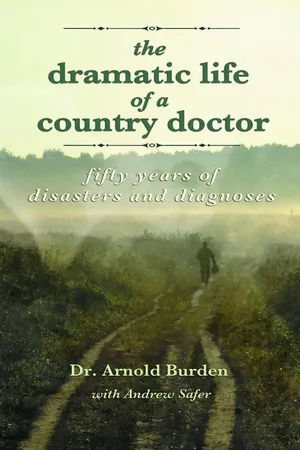
The Dramatic Life of a Country Doctor
eBook - ePub

The Dramatic Life of a Country Doctor

Fifty Years of Disasters and Diagnoses

  1. 192 pages
  2. English
  3. ePUB (mobile friendly)
  4. Available on iOS & Android
eBook - ePub

The Dramatic Life of a Country Doctor

Fifty Years of Disasters and Diagnoses

About this book

A Canadian physician reflects on a lifetime of helping others, including during World War II and two deadly mining disasters.

Dr. Arnold Burden's career began unintentionally when he performed his first surgery in the woods following a hunting accident at age fourteen. As a twenty-year-old hospital clerk, he handed battle casualties after D-Day in France and Germany. His early years as a doctor began in rural Prince Edward Island, where he served in the combined role of doctor and coroner. Back home in Springhill, Nova Scotia, Dr. Burden was the first medic to enter the mines after the deadly No. 4 mine explosion in 1956 and the No. 2 mine bump, the most severe bump ever recorded in North America, in 1958. In both cases he risked his life alongside the underground rescue teams to bring the gassed and trapped miners to the surface.

In this new edition Dr. Burden gives his account of an active life and of a man dedicated to his patients; a man full of common-sense and interesting stories, who writes candidly of his dealing with patients, unusual cases, and brave efforts made under difficult conditions. As the author states: "The real satisfaction in life has come from helping people."

Trusted by 375,005 students

Access to over 1.5 million titles for a fair monthly price.

Study more efficiently using our study tools.

Information

Publisher
Nimbus
Year
2014
Print ISBN
9781551098722
eBook ISBN
9781551098852

1. The Bay Ice Story

Late February, 1954
St. Peter’s Bay, Prince Edward Island
 
I am stirring the milk into my morning tea as I stand before the big bay window in the living room. Frost has crept into the corners of the smallish panes. The sun is brilliant. Yesterday’s blizzard is a fleeting thought. The screeching forlorn cry of an occasional gull violates the quiet. Not a sprig of greenery is in sight; everything is white, except for the reckless slate grey rocks that push through the snow at the water’s edge. They seem to stab at the sky in triumph.
High winds have randomly denuded the icy surface of the bay. Blue-green patches stand out against the mounds, drifts, and pockets of snow. The sunlight picks up rainbows in the ice crystals as they blow across the frozen desert.
“This is good news for my paperwork,” pops into my mind.
Maternities, coroner’s inquests, and a slew of children’s ailments have kept me going until eleven o’clock at night for the past week. “I hope there aren’t any emergencies, because I won’t be able to get to them.” As the last sip of tea sloshes across my tongue, I head for the office just beyond the living room.
A sheet of paper stands at alert in my typewriter. I am hammering out a supply order to Anglo Canadian Drug Company: blood pressure pills, cough syrups, and stomach medicines. Striking the “n” key, I’m dumbfounded by the sound I least expected: the doorbell.
“How in the hell could anyone get through the drifts on these roads?” I mutter, crossing the hallway. “Must be a neighbour….”
A husky man is standing out front. His face is barely visible beneath a hooded wool coat and the thick grey scarf he’s stretched tightly across his face. He yanks on it to speak and I recognize Ian McNeil from across the bay.
“You can say no if you wish, and I wouldn’t blame you,” he begins haltingly. “But my wife is bleeding badly….” His eyes search mine and hope overcomes timidity. The fact that I’m the only doctor for twenty miles has something to do with it. Finally, he blurts out: “Could you come?”
“How did you possibly get here?” I ask, measuring each word.
“We crossed the ice in a car.”
“Well, if you’re crazy enough to do that, I’m crazy enough to go back with you.” I grab my medical case and load it up with intravenous fluids, IV tubing, syringes, needles, plasma expanders1, and pitocin.2 I climb into my down-filled flight suit, pull down the ear-lugs on my Russian hat, lace up my heavy fur-lined boots, and slide on my fleece-lined gloves. In the kitchen I tell my wife, “Helen, there’s a woman hemorrhaging in Greenwich and I’m going there…across the ice.” I step outside.
Snow blinded and wind-whipped, I follow Ian across the buried lawn. The wedge-shaped bay draws to a point at St. Peter’s River, about a half mile from the house. Straight across the bay it’s just one mile, but it’s six miles to Greenwich. As we tromp through the drifts, I’m thinking of the Midgell and Morell rivers. The flowing water melts the ice where they empty into the bay, and then the surface freezes over, making the ice only inches thick. But we won’t be able to recognize these deathtraps because of the drifts.
I stop dead on the other side of the railroad tracks. There, at the bay’s edge, is a black sedan with its front doors wide open. A heavy sisal rope crosses the windshield and disappears in double knots on the two window frames. “This is not a routine car ride,” I remark dryly. Farther out on the ice is a dark blue pickup truck. A twenty-foot aluminum extension ladder is tied to the hood.
“What’s that for?” I cry. My host clears his throat. He’s probably wondering if I’m turning chicken.
“Can’t be too sure about the ice,” he says softly.
With a sinking feeling in my stomach I climb onto the passenger seat. I’m thinking that the woman may lose her life if she continues to hemorrhage, and my jaws tighten. Suddenly I recall a French play I read in college: No Exit. The title takes on a new meaning.
“We didn’t have any problem on the way over,” says Ian, a little too enthusiastically. “But we might as well leave the doors open on the way back. You never know.”
Our take-off imprints a semi-circle into the ice’s edge, and we begin to make our way cautiously across the bay, the pickup trailing us by a good hundred yards. “No good having him too close if we go through” is my not-so-comforting thought as I look back at our potential saviour. Even with the frigid wind raging inside the car, the sound of the ice crackling under the tires is all I notice.
I know Ian is following the same safe path he took on the way over, but my heart’s not convinced—it’s in my mouth. We do, in fact, miss the weak spots.
Ian pulls up to the shoreline and parks. Shore grasses poke out of snowdrifts on either side of the trail winding up to Ian’s farmhouse. His wife, as it turns out, is having a miscarriage and losing lots of blood. I give her medication and put ice packs on her abdomen. This slows down the bleeding and gets her out of danger. Now she’s at the mercy of the snowplows; she’ll go to hospital as soon as they open the roads.
I charge five dollars for the house call and a dollar for medication. Ian and I fortify ourselves with mugs of hot tea and homemade strawberry jam on white bread, and then we step outside. From a distance the car, with its roped-open doors, looks like a waiting bird of prey. We inch our way onto the bay highway. The faithful pickup bird-dogs us from a distance. This time, entrusting my life to the mercy of frozen water doesn’t seem quite so absurd…seven on a scale of one to ten.
Back at the house, we shake hands. Ian doesn’t say much; his eyes do. Inside, I tell Helen what happened, peel off my outer clothes, and sit back down at the typewriter. After counting my blessings, I take out the half-finished supply order and insert a fresh piece of paper to write the bay ice story.
 
NOTES
1. Plasma expander: A fluid that fills up the veins with substitute plasma to prevent the patient from going into shock.
2. Pitocin: A drug that causes the uterus to contract.
2. The Dirty Thirties

I grew up during the Depression in Springhill, Nova Scotia. The lifeblood of our town had slowed to a trickle, with the coal mines working only a third of the time. We called it the “Dirty Thirties”—times were tough.
We were poor but we didn’t know it, since we were all in the same boat—except when Buddo Walsh, a doctor’s son, came to visit his grandparents across the road from me. Little did I know that I myself would become a doctor, after coming home from the war.
By the time I was born in 1922, Springhill had already attracted close to six thousand settlers, compared to less than five thousand today. About two thousand men worked in the five mines: numbers 1, 2, 4, 6, and 7. My grandfather, George W. Burden, had come from Stellarton around the turn of the century, and later became manager of two of the mines.
Each coal mine is like a town, bustling with dozens of occupations. There are carpenters, labourers, stonedusters who throw fine stone dust on the face of the coal to prevent it from catching fire, water pumpers who keep the mine from flooding, trip drivers who run the coal trolleys up and down the mine slopes, trappers who open and slam doors for ventilation and also to let the trol1eys in and out, and—final1y—the miners, who swing their picks at the coal face.
Mother died when I was four. No one ever told me what it was from, but I’ve always figured it was complications of childbirth. My sister, Audrey, is one and a half years younger than me. I have a few scattered memories of Mother, mostly from when she was sick. But one that really sticks in my mind was the time I never even saw her. I stood out in the street in front of Grandma’s home, watching her funeral procession.
Dad was a machinist and a lathe operator. He machined parts for locomotives, and for anything that broke down in the mines. Since broken parts had to be fixed before the next shift, he had more work than the average Springhiller. In those days before the war, that meant three days a week instead of one or two.
As kids, we were noisy most of the time, except at 6:00 PM—time for the mine whistle to blow. That was the only time Audrey and I sat still: if we didn’t hear a “WHOO” that meant there would be work the next day.
The men earned two to three dol1ars a day. With two days of work a week, twenty-four dollars a month had to support a family. There were no mortgages since everyone built their own homes, and most families weren’t privileged to have upkeep on automobiles. This was way before the days of Employment Insurance and Old Age Security. But we had something that was unique in Canada at that time: a pre-paid medical plan, called a “check-off” at the mines. Twenty-five cents came out of Dad’s pay each week to cover the medical needs of our entire family, including doctor’s visits, surgery, maternity care, and medications.
Back then we could get by with very little money, unlike today. Nowadays, our refrigerators’ compressors show up on our monthly electric bills as a matter of course; we don’t even think of the cost. Refrigerators and freezers didn’t even exist in Springhill in the Dirty Thirties. Instead, we used “dummy waiters” in the summertime for lowering the milk, butter, and cheese into the basement where the mud walls would keep the perishables cool.
Everybody hunted, fished, and tended their own gardens. When you shot a deer or moose, you had to give most of it away since you couldn’t keep meat without a freezer. The women baked, canned, and made preserves, and the kids went berry picking in late June and July on the outskirts of town. Despite hard time...

Table of contents

  1. Cover
  2. Title page
  3. Dedication
  4. Copyright
  5. Contents
  6. Preface
  7. 1. The Bay Ice Story
  8. 2. The Dirty Thirties
  9. 3. A Close Call at Sea
  10. 4. Heavy Casualties
  11. 5. Sandbostel Concentration Camp
  12. 6. Veteran, Student, Miner, and Doctor
  13. 7. Reviving a Dead Man and the Interminable Maternity
  14. 8. Surgery on a Horsehair Sofa, a Mysterious Suicide, and Murder by Mistake
  15. 9. The Mine Explosion: Rescuing the Trapped Men
  16. 10. The Fire that Gobbled Up Main Street
  17. 11. The Bump: Burial or Nightmare
  18. 12. More Rescues and the Ed Sullivan Show
  19. 13. Wringing Urine from Diapers and Other Rewards
  20. About the Author

Frequently asked questions

Yes, you can cancel anytime from the Subscription tab in your account settings on the Perlego website. Your subscription will stay active until the end of your current billing period. Learn how to cancel your subscription
No, books cannot be downloaded as external files, such as PDFs, for use outside of Perlego. However, you can download books within the Perlego app for offline reading on mobile or tablet. Learn how to download books offline
Perlego offers two plans: Essential and Complete
  • Essential is ideal for learners and professionals who enjoy exploring a wide range of subjects. Access the Essential Library with 800,000+ trusted titles and best-sellers across business, personal growth, and the humanities. Includes unlimited reading time and Standard Read Aloud voice.
  • Complete: Perfect for advanced learners and researchers needing full, unrestricted access. Unlock 1.5M+ books across hundreds of subjects, including academic and specialized titles. The Complete Plan also includes advanced features like Premium Read Aloud and Research Assistant.
Both plans are available with monthly, semester, or annual billing cycles.
We are an online textbook subscription service, where you can get access to an entire online library for less than the price of a single book per month. With over 1.5 million books across 990+ topics, we’ve got you covered! Learn about our mission
Look out for the read-aloud symbol on your next book to see if you can listen to it. The read-aloud tool reads text aloud for you, highlighting the text as it is being read. You can pause it, speed it up and slow it down. Learn more about Read Aloud
Yes! You can use the Perlego app on both iOS and Android devices to read anytime, anywhere — even offline. Perfect for commutes or when you’re on the go.
Please note we cannot support devices running on iOS 13 and Android 7 or earlier. Learn more about using the app
Yes, you can access The Dramatic Life of a Country Doctor by Arnold Burden,Andrew Safer in PDF and/or ePUB format, as well as other popular books in Medicine & Medicine Biographies. We have over 1.5 million books available in our catalogue for you to explore.