Closer to Antarctica than to Buenos Aires, the port town of Ushuaia, Argentina is home to a national park as well as a museum that is housed in the world’s southernmost prison. Ushuaia’s radial panopticon operated as an experimental hybrid penal colony and penitentiary from 1902 to 1947, designed to revolutionize modern prisons globally. A Carceral Ecology offers the first comprehensive study of this notorious prison and its afterlife, documenting how the Patagonian frontier and timber economy became central to ideas about labor, rehabilitation, and resource management. Mining the records of penologists, naturalists, and inmates, Ryan C. Edwards shows how discipline was tied to forest management, but also how inmates gained situated geographical knowledge and reframed debates on the regeneration of the land and the self. Bringing a new imperative to global prison studies, Edwards asks us to rethink the role of the environment in carceral practices as well as the impact of incarceration on the natural world.
eBook - ePub
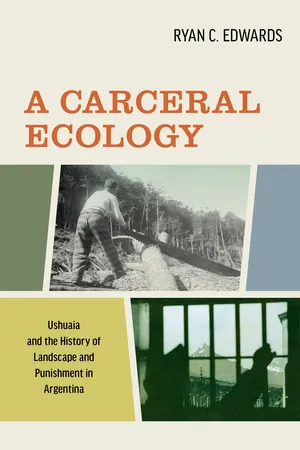
A Carceral Ecology
Ushuaia and the History of Landscape and Punishment in Argentina
- 272 pages
- English
- ePUB (mobile friendly)
- Available on iOS & Android
eBook - ePub
About this book
Information
ONE
Constructing an Open-Door Penitentiary
In the outskirts of the territorial capital [Ushuaia, Tierra del Fuego] lies the Recidivists Prison. . . . It is the first prison that I have seen in my life that does not have external walls. Here, everyone comes and goes as they please.
—EDUARDO A. HOLMBERG, 1906
THE FOUNDING STONE
On September 15, 1903, the small town of Ushuaia, Argentina, celebrated an anniversary. That same day one year prior, the founding stone (la piedra fundamental) was laid for the Ushuaia Prison.1 Townspeople dressed in formal wear and military regalia gathered as a band played patriotic anthems. The Argentine flag waved overhead as a pulley-lever system lowered a precious block of earth atop subpolar dirt. Officials buried a wooden urn forged in zinc beneath the stone, inside of which they placed a glass bottle filled with various commemorative documents from that year. Among the memorabilia was a signed sheet of paper from all present to record for future generations those involved in the momentous occasion—each would take home a silver medallion as a token of appreciation. Signatories lauded Prison Director Catello Muratgia on his success, and noted with pride that they were participants in the colonization and settlement of Argentina’s southernmost frontier, the island territory of Tierra del Fuego.2
An inmate crew had begun work a year prior in July 1902 leveling the foundation and excavating a basalt quarry on the shores of the Beagle Channel where the prison would be erected. Director Muratgia listed the earthen materials beneath their feet as black pyroxene and feldspar, but he noted that an exceptional snowfall during the austral winter had made operations difficult, adding ice to the list of strata to be broken in order to extract the needed raw materials. Inmates excavated roughly seven thousand cubic meters of stone and felled thirty-five hundred trees that year. They also began work on a dock to aid in the loading and unloading of supplies brought by naval steamships, which provided the only connection to northern resources and communication. By 1906, the prison consisted of a one-thousand-square-meter building containing seventy-six individual cells, four work rooms, and a central rotunda. The grounds occupied thirty hectares and were serviced by forty-eight staff members and a budget of $150,000 pesos.3 Over the following decades, the prison would grow to include five cellblocks (pavilions), 380 cells, a kitchen and bakery, infirmary, library, multiple workshops, gardens, a foundry, and a sawmill. In addition to the prison grounds, inmate labor would build the infrastructure of the world’s southernmost city, including its roads, church, and hospital.
This was the start of the “open-door” penitentiary, an experimental institution on the forested Beagle Channel that connected urban populations and governments to penal colonization and ecological change in southernmost Patagonia. The founding stone was celebrated as a marker both of settlement and progress for Ushuaia, as the prison would play an integral role in the local economy and southern sovereignty, as well as in Argentine carceral and forest sciences. Moreover, the Ushuaia prison operation consciously combined the institutions of a rural/peripheral penal colony and an urban/metropolitan penitentiary in turn-of-the-century Argentina. Such an approach deviated from the teleological penology of the era that stressed a distancing from the premodern practices of convict transport to peripheral spaces in favor of urban scientific sites of incarceration. It was a peculiar project that married cosmopolitan sciences with a frontier ethos, forging a carceral ecology that stretched well beyond the stone structure of the prison. Rather than a fringe experiment, many authorities believed that the operation would move Latin America out of the shadow of European and US carceral practices, and into an era of Argentine penology.
Muratgia, who would serve as director from 1900 to 1909, stressed the elements of outdoor labor and physical transformation measured through urban sciences. Criminal tendencies, he argued, stemmed from physical-psychic-pathological (fisio-psico-patológica) phenomena.4 Some of which were genetic, others were social, while the rest were external, including climatic and environmental forces. The “open-door” prison would, in theory, solve the global problems of nineteenth-century incarceration by perfecting the modern penitentiary through a symbiosis between the human body, architectural order, and environment. There was a great deal of uncertainty around the project, however, from its first proposal in congress in the 1860s, to debates about its location in Ushuaia versus Lapataia in 1900, and finally with its abrupt closure in 1947. Tracing these transformations, from a penal colony charged with colonization to a scientific environmental-rehabilitation experiment to an aging penitentiary beyond federal oversight, reveals not only the life of the Ushuaia prison, but the entangled ecological transformation and geo-national imaginary of southernmost Argentine Patagonia.
PENAL COLONIZATION
The Ushuaia prison played an integral part in state formation and the consolidation of national territories during the late nineteenth and early twentieth centuries.5 La Cárcel de Reincidentes de Ushuaia, as it was officially known, was the nation’s second national penitentiary and was built to house recidivists (repeat offenders). The initial construction plans were completed in 1920 and renovations and expansion would continue up through 1946, the year before its closure. Despite this compressed official timeline, the southern prison was a slow and uncertain project that dated back to a proposal in the 1860s. During this protracted lifespan, its operations vacillated between that of a penal colony and that of a modern penitentiary under different directors. What is clear, however, is that the penal colony was first envisioned within a much broader and more traditional collection of peripheral outposts. In particular, it was a defense measure against neighboring Chile (and Britain) in the contested Tierra del Fuego archipelago, and was therefore founded as a colonization project that would secure Argentine territory.
Presidios in Latin America date back to the colonial period and continued through the nineteenth century.6 These facilities began as military outposts, but changed over time to include civilian carceral functions. From northern Mexico to the farthest stretches of the Southern Cone, conscripts and convicts were placed side by side to claim national territory in the nascent frontiers of independent Latin America.7 These fortified spaces used coerced labor to build infrastructure, such as roads and telegraph lines, and to clear land for ranches and agricultural projects. The late colonial to early independence period marked a continuity in the use of these outposts to legitimate national territorial claims, though the term presidio would increasingly be associated with prison spaces, as opposed to strictly military forts.8
By the mid-nineteenth century the simultaneous undertaking to pacify frontier zones and modernize prison facilities yielded two divergent though often parallel operations in Argentina. Penal reform began with broader social reforms under the national constitution of 1853.9 There were two distinct carceral institutions at this time: the cárcel, or jail, was generally an urban or local edifice used as a holding space for individuals who awaited trial or served short stints for local infractions; the presidio, or prison, as noted, was an institution often connected to a military outpost located in communities throughout the country where individuals served their sentences, most often through labor and service obligations.10 There was little cohesion or consistency between these various facilities and each jurisdiction operated more or less independently.
Nicasio Oroño, a politician from Rosario, first proposed the creation of a penal colony in Patagonia during a congressional address in 1868. He proposed the penal colony as a pragmatic plan for colonization in Latin America’s contested southernmost frontier.11 Oroño’s proposal was dually progressive in that he wanted to abolish the death penalty, and in exchange, sentence individuals for ten years to a domestic location in the far south where they would work and be instilled with Argentine morals. Given the desire to capture these still contested territories, the proposal implied something akin to internal exile. This initial plan was not adopted, though other prominent figures pushed for similar projects in subsequent years.12 Such plans, however, were overshadowed by reforms in the capital.
Neighboring nations had begun the process of penal modernization, with Rio de Janeiro becoming the first city in Latin America to erect a modern penitentiary in 1834, followed by Santiago, Chile, in 1844 and Lima, Peru, in 1854. In 1877 the National Penitentiary in Buenos Aires was inaugurated, adding Argentina to a growing list of Latin American nations with a modern cellular penitentiary in its capital.13 The city of Buenos Aires was federalized in 1880, and a coinciding urban penal reform included work by the Sisters of the Good Shepard, which began operating female correctional facilities, and the Sierra Chica agricultural colony established outside of the capital in Buenos Aires Province.14 There was similarly an increase in mental health facilities, which often blurred the line between madness and criminality.15 That same year, 1880, President Julio Roca created the office of Prison Corrections and the Capital Penitentiary. The agency’s director, Dr. Eduardo Wilde, sought to expand and normalize the national prison system, which again included “deporting” non-violent criminals to regions in need of settlement where they would be under minimal supervision and have the right to buy property and colonize these territories upon their release.16
Prison reform in Patagonia was additionally linked to geopolitical operations following a contentious border treaty with Chile in 1881.17 Given the scant presence of the Argentine government in the region, the proposed location needed to be economically sustainable through local resources, and accessible to naval vessels for transport and rationing needs. The Argentine Austral Expedition set course on September 1, 1882, equipped with scientific instruments to survey zoological and botanical properties, and to capture the region’s geographic and ethnographic characteristics.18 The voyage was commissioned by the Argentine Geographic Institute and its president, Estanislao Zeballos, who felt the pressure of international scientific competition in the region.19 Moreover, Anglican missions already speckled the island of Tierra del Fuego, including one in Ushuaia Bay founded in 1869.20 Surveyors recommended this southern end of the island—first translated from indigenous dialect as Usciuuaia—as a site for the penal colony because of its timber supply and protected ports, though perhaps most importantly, its geopolitical position vis-à-vis Chile and British settlers.
In 1883 President Roca and Director Wilde approved a $500,000 peso investment to launch the project, outlined by an eight-point plan that made clear that colonization was the institution’s primary mission.21 Serious offenders would be held in the prison while minor offenders would live outside its walls and aid in construction and the populating of the island. Argentine statesmen referenced the British sites of Botany Bay and New South Wales in Australia as examples to follow, and they hoped for a similar transformation of Tierra del Fuego, which was named an official Argentine territory the subsequent year in 1884.22 Legal challenges questioned whether convict transport could be used for colonization, stalling Law 3335’s ratification, which officially sanctioned the project, until 1895. Once the law was passed, administrators wasted no time and sent the first cohort of inmates to Ushuaia. These were volunteers who were promised reduced sentences for their efforts, as well as land following their release to stay and settle on the island. On January 5 the first convict volunteers, fourteen in total, traveled to Ushuaia from Buenos Aires aboard the naval vessel 1 de Mayo, and less than two weeks later eighteen more traveled south, including nine female convicts.
Operations commenced with two separate facilities in 1897 under inaugural prison director Pedro Della Valle and Tierra del Fuego’s governor, Lieutenant Colonel Pedro T. Godoy. The first site was a military prison constructed in Lapataia, located a few kilometers west of Ushuaia near the newly adjudicated Chilean border, to house the relocated offenders from the abandoned project in nearby Staten Island. The second site was the recidivist prison in Ushuaia. From the outset there were concerns regarding connections to the world beyond the Beagle Channel. Since the colony relied on government resources, this raised bigger jurisdictional issues, with regard to both funding and hierarchy. Director Della Valle spoke regularly with the local police chief, Ramón L. Cortés and representatives in Buenos Aires, which seemed to undermine the authority of Governor Godoy, who was already limited by the territorial status of Tierra del Fuego. Writing to the Ministry of the Interior, Godoy argued that “a penal colony is a complete organism” requiring careful integration with local government oversight, especi...
Table of contents
- Subvention
- Title Page
- Copyright
- Dedication
- Contents
- List of Illustrations
- Acknowledgments
- Introduction: Rethinking Prisons and Patagonia
- 1 • Constructing an Open-Door Penitentiary
- 2 • Forestry in Fireland
- 3 • “I Too Am Ushuaia”
- 4 • The Martyr in Argentine Siberia
- 5 • The Lettered Archipelago
- 6 • Developing an Argentine Prisonscape
- Epilogue: Curating the End of the World
- Notes
- Bibliography
- Index
Trusted by 375,005 students
Access to over 1.5 million titles for a fair monthly price.
Study more efficiently using our study tools.
Frequently asked questions
Yes, you can cancel anytime from the Subscription tab in your account settings on the Perlego website. Your subscription will stay active until the end of your current billing period. Learn how to cancel your subscription
No, books cannot be downloaded as external files, such as PDFs, for use outside of Perlego. However, you can download books within the Perlego app for offline reading on mobile or tablet. Learn how to download books offline
Perlego offers two plans: Essential and Complete
- Essential is ideal for learners and professionals who enjoy exploring a wide range of subjects. Access the Essential Library with 800,000+ trusted titles and best-sellers across business, personal growth, and the humanities. Includes unlimited reading time and Standard Read Aloud voice.
- Complete: Perfect for advanced learners and researchers needing full, unrestricted access. Unlock 1.5M+ books across hundreds of subjects, including academic and specialized titles. The Complete Plan also includes advanced features like Premium Read Aloud and Research Assistant.
We are an online textbook subscription service, where you can get access to an entire online library for less than the price of a single book per month. With over 1.5 million books across 990+ topics, we’ve got you covered! Learn about our mission
Look out for the read-aloud symbol on your next book to see if you can listen to it. The read-aloud tool reads text aloud for you, highlighting the text as it is being read. You can pause it, speed it up and slow it down. Learn more about Read Aloud
Yes! You can use the Perlego app on both iOS and Android devices to read anytime, anywhere — even offline. Perfect for commutes or when you’re on the go.
Please note we cannot support devices running on iOS 13 and Android 7 or earlier. Learn more about using the app
Please note we cannot support devices running on iOS 13 and Android 7 or earlier. Learn more about using the app
Yes, you can access A Carceral Ecology by Ryan C. Edwards in PDF and/or ePUB format, as well as other popular books in Historia & Historia de Latinoamérica y el Caribe. We have over 1.5 million books available in our catalogue for you to explore.