Honourable Mention for Best Book in Jewish Studies from the British and Irish Association for Jewish Studies.
This engaging and accessible textbook provides an introduction to the study of ancient Jewish and Christian women in their Hellenistic and Roman contexts.
This is the first textbook dedicated to introducing women's religious roles in Judaism and Christianity in a way that is accessible to undergraduates from all disciplines. The textbook provides brief, contextualising overviews that then allow for deeper explorations of specific topics in women's religion, including leadership, domestic ritual, women as readers and writers of scripture, and as innovators in their traditions. Using select examples from ancient sources, the textbook provides teachers and students with the raw tools to begin their own exploration of ancient religion. An introductory chapter provides an outline of common hermeneutics or "lenses" through which scholars approach the texts and artefacts of Judaism and Christianity in antiquity. The textbook also features a glossary of key terms, a list of further readings and discussion questions for each topic, and activities for classroom use. In short, the book is designed to be a complete, classroom-ready toolbox for teachers who may have never taught this subject as well as for those already familiar with it.
Jewish and Christian Women in the Ancient Mediterranean is intended for use in undergraduate classrooms, its target audience undergraduate students and their instructors, although Masters students may also find the book useful. In addition, the book is accessible and lively enough that religious communities' study groups and interested laypersons could employ the book for their own education.
Conclusion: what role do our assumptions play in our reading?
Discussion questions
Glossary terms
Further reading
What sort of book is this?
You might think from the title of this book that it is all about the past—specifically about a certain window of time that classicists might refer to as Hellenistic and Roman, or the “Greco-Roman” period. This era is so named because of two major ancient empires: the Greek (Hellenistic) Empire, and the Roman Empire. In terms of dates, that covers from about 300 BCE to about 300 CE. However, as we hope you will soon discover, every book about the past is also always a book about the present!
You also might also have noticed from the title that this book is about a certain place—the Mediterranean. That region includes all the countries around the Mediterranean Sea, so the northern coast of Africa, the Levantine coast, and the southern coast of Europe. But perhaps as you are reading you will begin to suspect that no matter which place a book is about, it is always also about the places from which the author is writing. You might even start to see that your own place and time (your position and culture as the reader) wind their way into each book you read as well.
This is because researching what happened in the past involves thousands—possibly even millions—of decisions and assumptions made by the researcher in the present. Archaeologists, anthropologists, geologists, sociologists, and philologists who investigate the past stitch together artefacts, writings, and other clues to tell us “what happened.” But think about it: is it really possible to tell the story of what happened in a given time and place? Only very selectively. You might pick up a book called The Romantic Period, and think “oh, this will have pretty much everything significant that happened from the late 1700s to the mid-1800s.” But it would be impossible to learn everything from a given time period or a given place; in fact, when you think about it, almost everything from the past is lost. Billions of conversations, relationships, jokes, interactions, births, deaths, weather patterns, recipes, clothing, plants, insects, and songs are all irretrievable to us now. For this reason, everyone who researches the past must narrow in on just a few aspects of what we can learn from the kinds of things that remain. Traditionally, the way students have been taught about the past has focused on three things:
political rulers, their biggest feats, and any propaganda they left (such as architecture, temples, coins, or commissioned writings and inscriptions)
wars, especially the winners, and the changes they made to political borders
economic trade.
Sometimes, scholars make such decisions without admitting how much they are leaving out. For instance, they might cover the economic and military “winners,” and we as readers and students assume that’s just what’s important to remember. But are those criteria necessarily the best ones? Are the questions that our textbooks don’t answer necessarily just “not important”? Who decides which parts of the past are important? The academic study of the past has often avoided, for example, questions such as: what economically disadvantaged people did for enjoyment, how parents interacted with their children, how everyday people prayed, washed their clothes, or cut their hair, how people dealt with menstruation, or how they grieved a dead loved one.
In the twentieth century, as part of the movement now referred to as postmodernism, academics have begun to self-critically acknowledge that our investigations are not neutral and objective as once was thought. Instead, each investigator makes major choices about where to focus … and what to ignore. In an attempt to correct such patterns, some scholars are now starting to produce research “from below” or “people’s histories.” A “people’s history” attempts to uncover the stories of non-elite people: the stories of those who lost wars rather than won them, the story of those who couldn’t afford fancy tombs or scribes to record their deeds, the story of those not valued by typical historians.
Even though it is much more difficult to find evidence for people who were not considered important by their societies, and who could not afford to leave behind writings or lasting artworks, we now understand that it is important to try anyway.
This is in some ways a book like that. We home in on two areas that have often been ignored or misunderstood by past historians. One is the study of women, since the predominant narratives have been those of elite, powerful men. The other is the study of religion, since researchers often fail to understand how pervasive religion was in antiquity, and how it encompassed things we now consider separate from religion, such as the household, philosophy, ethics, politics, economics, and culture.
As specialists in ancient religion and gender, we decided to create a textbook that will give you some of the special tools necessary to do the rigorous detective work of trying to uncover the lost stories of women—both real women’s experiences and society’s expectations of what women “should” be like. This book does this by focusing, not on Greco-Roman wars and political leaders (which rarely helps to highlight women and often tells a history of men alone), but instead on ancient religion, since that is an area full of women leaders, practitioners, goddesses, financial patrons, prophets, dedicated virgins, priests, oracles, literary figures, gendered norms, and artistic images depicting ideals of gender.
An added bonus to studying women is that it also helps us to study men as men. All humans have gender, but men’s stories are often just called “history” or “literature”, and they happen in the history or the literature departments, whereas women’s stories get strongly tied to their gender, and are often relegated to a separate “gender studies” department. In reality, men’s history and men’s literature are gendered too. People’s ideas of masculinity and manliness affect men just as much as their ideas of femininity and womanhood affect women. Ancient norms, constructions of masculinity, and the “proper” roles for men are just as central to understanding the past as are notions of femininity and women’s gendered roles.
This book will give you some of the skills and the knowledge needed to piece together how ancient Mediterranean people were using and participating in their society’s ideas of gender. It will provide a window into what some of their real-life gendered and religious experiences were like. We hope you’ll soon see that studying gender and religion actually tells us more about other aspects of life, not just the “gendered” or “religious” ones.
What is gender studies?
Before we go one step further, let’s make sure we have some shared working definitions of what gender is (and what it isn’t!).
When we speak of gender, we aren’t talking about a physiological binary (a strict choice of either A or B) that is easily determined at birth simply by looking at genitalia. Instead, gender refers to a spectrum of characteristics, behaviours, experiences, stereotypes, and assumptions. That long spectrum may be constructed with “feminine” on one end and “masculine” on the other, but the vast majority of human beings are somewhere nearer the middle, or even fall at different places on the spectrum depending on the characteristic in question. Even though biology itself is a construct, and not “natural,” only a very small number of the characteristics that are deemed “masculine” or “feminine” are biological (for example, vaginas, menstruation, and breasts are usually associated with women, and penises and chest hair are usually associated with men). The vast majority of characteristics deemed masculine or feminine are learned from society and not determined at birth. The question of whether a hair style, a clothing article or colour, a personality trait (curiosity, bravery, shyness), a school subject, or a career is “for boys” or “for girls” is something that is entirely socially constructed (that is, something learned).
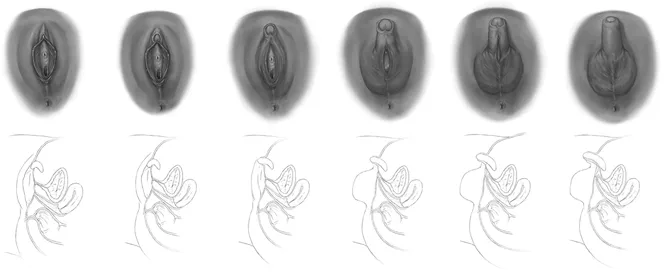
The fact that most ideas that cluster around “feminine” or “masculine” are not set in stone can be demonstrated by the simple observation that these ideas change over time or differ from one country or culture to another. While physical strength gets associated with masculinity across many cultures and time periods, the association between men and powerful emotions only holds true in certain places and times; at other times men are associated with a stoic detachment and self-control over emotions. While child-rearing is associated with femininity across many cultures and time periods, the association between women and deep wisdom only holds true in certain cultures and times. While many cultures and times have associated beauty with women, others have much more strongly associated beauty with men. Where tights or leggings currently fall near the “feminine” end of the spectrum, just a couple of hundred years ago they fell exclusively on the “masculine” end. While 50 years ago, it was almost exclusively women who removed their armpit hair, writings from ancient Rome frequently mock men who failed to pluck their armpits (see Seneca’s Epistle 114.14 for instance.) Even genitals, which are often thought to be a strict binary, fall along a spectrum.
Figure1.1 The Prader Scale for determining assigned sex at birth for intersex conditions.
Source: Photo used with permission. Artist Hillary Wilson.
Box 1.1 Non-binary people in antiquity
One prominent example of people who don’t fit neatly into a binary idea of gender are the priests of the goddess Cybele, or Magna Mater, called the galli (sing. gallus). The galli were born with male genitals and as part of the process of becoming a priest of this goddess, performed a ritual of self-castration. In their lives and as these special religious professionals, the galli wore traditionally female clothing (the stola—a long robe worn by married women) and wore makeup, as Roman women (but not men) did. Chris Mowat argues that the galli inhabited a non-binary space within Roman gender norms, one that was written into the cult of Magna Mater or Cybele. They write that the surgical reassignment of sex in a ritual context placed the galli outside the Roman framework of gender. Our literary evidence about galli comes from elite male authors who often disparage or mock the galli; a complicating factor is the perceived foreignness of the cult of Cybele, who was invited to Rome from Anatolia. Though those sources give detail about the galli’s behaviour and dress, it’s hard to pick out hyperbole and derision from factual accuracy. Mowat uses the analogy of “drag” (“assumed female attire on an assumed male body”) to discuss how the galli use clothing and attire performatively and ritually to position themselves as neither men, nor women; with their bodies and with their performance of gender, Mowat argues, the galli occupy non-binary identities.
Figure1.2 Funerary relief of an archigallus. The priest is depicted wearing a stola and is surrounded by objects associated with the cult of Cybele.
Source: Capitoline Museum. Photo by Sissel Undheim. Used with photographer’s permission.
Recognising the range of options for categorising gender in different cultures is important because ancient cultures had a very different way of doing so compared to the way Western society commonly does. Although many societies, ancient and modern (but certainly not all), only allow for two normative gender categories (male and female), the reality is that there are many combinations of hormones, sex chromosomes, internal and even external genitalia (as seen in Figure 1.1). The spectrum of physical options on Figure 1.1 above can help us to think about how the Roman world understood gender, which was as a spectrum of “men” and everyone else. But a man was very narrowly defined: enslaved men did not count as men on this sliding scale, for example, nor did foreign (non-Roman) men. Simply because they saw gender as a spectrum did not mean that the ancients were “progressive” and gender-egalitarian! On the contrary, to fall anywhere towards the “womanly” end of the spectrum was seen as a negative. Perhaps more accurately, there was really only one gender in antiquity, the male or vir (Latin for “man”) and then various degrees of failure to measure up to it. This concept is sometimes referred to as the one-gender model. The one-gender model in antiquity was first observed in the discipline of Classics, but is now used in the study of gender in ancient Judaism and Christianity as well, by scholars such as Colleen Conway.
That one ideal gender was male. The vir (man) was both virtuous and powerful. The word “virtue” comes from that same Latin word for man, and indeed true manliness meant possessing both virtue and control (virtus and imperium, in Latin). But very few men achieved vir status. Rather than being born, vir were made, by brave and noble behaviour, honour, strength, and power. Being a vir was also a status that could be lost through dishonourable behaviour or misfortune. Power (over others and a...
Table of contents
Cover
Half Title
Title Page
Copyright Page
Dedication
Table of Contents
List of illustrations
Acknowledgements
Introduction for instructors
1 Introduction
2 Religious systems of antiquity
3 Bodies of literature
4 Accessing ancient sources
5 Ancient Judaism
6 Early Jesus movement
7 Religion in daily life: from birth to death
8 Women as consumers, characters, and creators of literature
9 (Wo)manly ways of dying
10 The second century and beyond
Glossory
Bibliography
Index of ancient sources
Index of subjects
Trusted by 375,005 students
Access to over 1.5 million titles for a fair monthly price.
Study more efficiently using our study tools.
Frequently asked questions
Yes, you can cancel anytime from the Subscription tab in your account settings on the Perlego website. Your subscription will stay active until the end of your current billing period. Learn how to cancel your subscription
No, books cannot be downloaded as external files, such as PDFs, for use outside of Perlego. However, you can download books within the Perlego app for offline reading on mobile or tablet. Learn how to download books offline
Perlego offers two plans: Essential and Complete
Essential is ideal for learners and professionals who enjoy exploring a wide range of subjects. Access the Essential Library with 800,000+ trusted titles and best-sellers across business, personal growth, and the humanities. Includes unlimited reading time and Standard Read Aloud voice.
Complete: Perfect for advanced learners and researchers needing full, unrestricted access. Unlock 1.5M+ books across hundreds of subjects, including academic and specialized titles. The Complete Plan also includes advanced features like Premium Read Aloud and Research Assistant.
Both plans are available with monthly, semester, or annual billing cycles.
We are an online textbook subscription service, where you can get access to an entire online library for less than the price of a single book per month. With over 1.5 million books across 990+ topics, we’ve got you covered! Learn about our mission
Look out for the read-aloud symbol on your next book to see if you can listen to it. The read-aloud tool reads text aloud for you, highlighting the text as it is being read. You can pause it, speed it up and slow it down. Learn more about Read Aloud
Yes! You can use the Perlego app on both iOS and Android devices to read anytime, anywhere — even offline. Perfect for commutes or when you’re on the go. Please note we cannot support devices running on iOS 13 and Android 7 or earlier. Learn more about using the app
Yes, you can access Jewish and Christian Women in the Ancient Mediterranean by Sara Parks,Shayna Sheinfeld,Meredith J. C. Warren in PDF and/or ePUB format, as well as other popular books in Theology & Religion & Ancient History. We have over 1.5 million books available in our catalogue for you to explore.