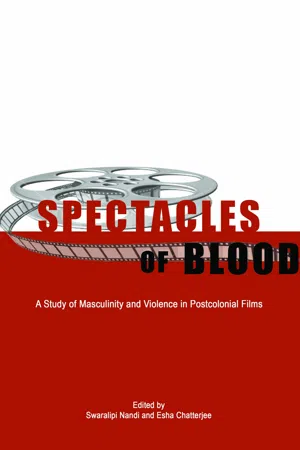
This book addresses the current issues of violence, masculinity and power in the postcolonial context and their representation in films.The essays contribute critical insights into the analyses of films based on societal violence in postcolonial cultures: be it in the context of colonial oppression, terrorism, genocide, communal riots, criminal underworld or mob violence etc.The volume seeks to investigate some of those variegated facets of postcolonial 'violences' as they are played out in historically and culturally diverse public spaces of different postcolonial societies through the paradigm of cinematic representation. Although the book seeks to explore the phases of differences among postcolonial cultures, the essays hinge around common questions? How does the experience and representation of violence change with the specificity of the postcolonial context? How do postcolonial cinemas negotiate ideas of conflict through the scenes of violence? How does violence as a cinematic trope shape postcolonial identities, especially of masculinities?The authors set out to discuss these through the spectacle of violence in postcolonial films, consequently invoking issues of both representational and affective aspects of violence as a performative act in the postcolonial public space.
eBook - ePub
Spectacles of Blood
A Study of Masculinity and Violence in Postcolonial Films
- English
- ePUB (mobile friendly)
- Available on iOS & Android
eBook - ePub
Spectacles of Blood
A Study of Masculinity and Violence in Postcolonial Films
About this book
Trusted by 375,005 students
Access to over 1.5 million titles for a fair monthly price.
Study more efficiently using our study tools.
Information
Subtopic
Media StudiesIndex
Social Sciences
1
Insurgent Cameras and Postcolonial Squibs
Preface
Insurgent Cameras and Postcolonial Squibs
[O]ur efforts were to realize a decolonizing film, a film of disruption as compared to the traditional values of American and European cinema…. A cinema which is very violent not only because it deals with the themes of reactionary violence and revolutionary violence, but because it is also designed for its expression. A cinema which could provide for our liberation on expressive grounds as a film fundamentally of research on the basis of language and expression. It is an intense cinema like an instrument of battle, of concrete struggle. Cinema like a gun, a guerrilla film, a film of and for the masses. (Volpi et al., 2010)
Instead of policing the definition of violence, this review deems the instability as crucial for understanding how the reality of violence includes its virtuality and its potential to make and unmake social worlds. (Das, 2008, p. 283)
Instead of policing the definition of violence, this review deems the instability as crucial for understanding how the reality of violence includes its virtuality and its potential to make and unmake social worlds. (Das, 2008, p. 283)
Violence is one of the common traits associated with the racial other in colonial discourses. As an ontological marker of difference between coloniser and colonised, the violence perpetuated by colonialism and its attendant modernity were mapped onto the bodies and cultures of the other. From narratives of sexual violence to those of ethnic violence, colonial discourses and disciplines such as anthropology conceived of the colonised subject as inherently violent. Third cinema and postcolonial cinemas resignify the meaning, goal and directionality of violence. Implicitly and explicitly challenging colonial tropes of naturalised violence, these cinemas locate violence at the nexus of national and global systems of exploitation and oppression, rather than in some naturalised notion of culture. In doing so, they counter colonial epistemologies offering oppositional and critical perspectives.
To counter colonial discourses, filmmakers and theorists have argued vehemently that not only do representations matter, but that the language and visualities of film must also be transformed. In line with decolonising political movements, film theories in the 1960s and 1970s propounded cinema as revolution, even as the instrument of violence. In their (masculinist) manifesto, Fernando Solanas and Octavio Getino (1976) articulate third cinema as a process of, rather than a product of, the revolution. As a critical component of liberation, their call for cinema is a demand for political uprising and revolution as they place third cinema in line with global struggles in places such as Argentina, Vietnam and Cuba. The manifesto explicitly affirms that revolution is achieved through violence and may be inconceivable outside its domain; in this case it is ideological violence. As Solanas and Getino enfold cinema within this chain of signification and action, they specifically locate decolonising cinema in opposition to Hollywood and European cinemas. In contrast to the opiate-like counterparts, third cinema’s ‘cinema like a gun’ suggests that holding a camera is tantamount to holding a gun, the means of liberation from neo colonialism and its cultural forms. With its images and metaphors of guerilla warfare, the emergence and birth of third cinema in the manifesto advocates upheaval and violence in the name of transformation and revolution; third cinema is constructed literally as a ‘detonator’ of a neo-colonial and bourgeois society. As such, it also demands that we consider violence a productive and generative act.
While a decolonising third cinema is configured as the oppositional agent and mode of revolution, postcolonial cinemas reframe these struggles. Cinemas of opposition have sought accountability for injustice by identifying negligence, exploitation and violence. At times, they have provided narratives of grief, mourning and suffering that emphasise continued survival and life in the face of trauma. Postcolonial cinemas may propagate insurgency or violent struggle, but, more frequently, they focus on the trauma of colonialism and the subsequent failures of the anti-colonial nation-state. Violence within cinema responds to and correlates with the violence of postcolonial life. In this case, the violence in cinema is enacted as a medium for witnessing the suffering and failings of neocolonial and anti-colonial systems from a postcolonial critique. In examining, analysing and critiquing capitalist, colonial and state ideologies and systems of oppression, postcolonial cinemas often narrate the trauma of colonialism and empire, atrocities of war, the violence by capitalism, or the foundational violence of nationhood. In doing so, historical and contemporary tales of harm, pain and suffering are rendered accessible for the present. Violence is demonstrated to be ordinary rather than exceptional. In this manner, they eschew a retreat from violence by locating its viewing in everyday media practices.
In the controversial essay ‘Walking with Comrades’, Arundhati Roy poignantly describes her journeys with armed Maoists in the Indian forests of Dandakaranya. Empathetic to the cause of the Maoists struggles in the face of extreme state violence and repression, Roy takes a strong and clear position about the violence in the everyday life of the insurgents. While detailing the daily life and larger political context of the struggles, she also refers at several places in the essay to the community’s social practices detailing the small and large clandestine assemblies of the Maoists. Though Roy emphasises the vibrant songs and vigorous dances at several of these gatherings, she also remarks on the crowd clustered around a screen watching the film Mother India:
… people are crowded like moths around a point of light. It’s Comrade Sukhdev’s tiny computer, powered by a solar panel, and they’re watching Mother India, the barrels of their rifles silhouetted against the sky. Kamla doesn’t seem interested. I ask her if she likes watching movies. ‘Nahin didi. Sirf ambush video (No didi. Only ambush videos).’ Later, I ask Comrade Sukhdev about these ambush videos. Without batting an eyelid, he plays one for me. It starts with shots of Dandakaranya, rivers, waterfalls, the close-up of a bare branch of a tree, a brainfever bird calling. Then suddenly a comrade is wiring up an IED, concealing it with dry leaves. A cavalcade of motorcycles is blown up. There are mutilated bodies and burning bikes. The weapons are being snatched. Three policemen, looking shell-shocked, have been tied up. (Roy, 2010)
Mother India and the ambush videos are presented as both complementary and oppositional in constituting the media of the insurgency. The postcolonial trauma presented in Mother India is clearly claimed on behalf of these insurgents who have been declared enemies of the state. At the same time, the presence of the ambush videos documents the ‘local’ landscape and its disruption by state violence thereby fomenting the revolutionary uprising and violence. Moreover, there is something noteworthy here as well. While violence is overwhelmingly associated with men and masculinity, the excerpt illustrates how this might be a troubling equation. The film Mother India is seen as an exemplar allegory of woman as nation. That Kamla prefers watch ing the videos of insurgent violence over the allegory indicates that the media assemblages are complex in their gendering, political positioning and media formations. Hence, a closer look at the gendering of screen and violence becomes necessary within postcolonial cinemas.
The violence in postcolonial cinema may be suffered or enacted by a variety of figures. Therefore, discussions of violence have to consider how screens abound with the sometimes brutal and volatile struggles of gangsters, police officers, corporate CEOs, avenging women, insurgents and the urban poor. Notably, most, though not all, of the figures are male. Masculinity is deeply entwined with violence on the screen and the blood flows freely. As both perpetrators and targets of violence, men’s bloody bodies frequently signify the cruelty of and the damage wrought by civil and state violence. Blood becomes a new symbol of sociopolitical visibility, the evidence of necropolitics and the site of visceral dis/identification. The formulations of third cinema and postcolonial cinemas that render violence as productive or ordinary challenge the dominant gendering of violence. We need to look beyond binaries that place women as creators and sustainers of life and men as its violent destroyers. This volume focuses on how masculinity and males are and have become so inextricably intertwined with the concept of violence. In explicitly looking at masculinity, the volume dismantles the quick and easy equation to interrogate the specific dynamics, significations and representations that constitute bloody screens.
Finally, it is important to note that third cinema and postcolonial cinemas deploy various technical apparatus to garner these effects. Detonations and bleeding are frequently achieved via special effects such as explosions triggered by detonating miniature explosive devices or squibs. Within media production, squibs are used not only for explosions, but also to simulate bullet impact, bodily injury and blood sprays. Moreover, squibs used to depict bodily injury have also frequently and ingloriously been referred to as latex ‘condoms’ filled with fake blood. Historically, the advent of blood squibs made possible a heightened and dramatic display of graphic trauma and violence to the body within cinema. Scholars specifically name them as technologies that enable the visualisation of ultraviolent realism within Hollywood since the late 1960s with films such as Bonnie and Clyde (Prince, 2000, p.9). The squib spread rapidly and did not remain a Hollywood technology and, like the cinematic apparatus itself, quickly transformed in its travels. Since then, squibs have become ubiquitous in producing the bullet-riddled decolonising or postcolonial body located within violence; its deployment enhanced the visceral and graphic visualisation of the righteous male body vulnerable to colonial, state and capitalist violence, bleeding profusely in the name of the nation, justice, or liberation. The postcolonial screen provides a constant reminder of the inadequate achievements of modernity, the nation-state and capitalism. The blood and violence on the postcolonial screen is less a call for the rise of a revolution than a marker of the current failures. In this manner, postcolonial cinema itself bleeds. While the viscerally bleeding bodies are often the point of identification, it might be helpful to think about not just the production of the bleeding body, but also its aesthetics, its affect, its materiality. It is possible to approach postcolonial films as contested representations, revolutionary acts, or through their materiality and haptic visuality (Marks, 2000).
The implications for the gory foundational violence of third cinema and postcolonial cinemas are taken up by the contributors to this volume. Working with the premise that blood-letting, bodily injury and trauma are defining rather than exceptional characteristics of postcolonial cinema, the authors attend to the gendered thematics and technologies of violence within cinema. To accomplish this, the collection is divided into three components: ‘The Violent Nation’, ‘The Masculine in Violence’ and ‘The Aesthetics of Violence’. The collection poses a formidable assessment of the dynamic interplay between violence and masculinity on the postcolonial screen.
REFERENCES
Das, Veena. 2008. ‘Violence, Gender, and Subjectivity’, Annual Review of Anthropology, vol. 37, October.
Marks, Laura. 2000. The Skin of the Film: Intercultural Cinema, Embodiment, and the Senses. Durham, North Carolina: Duke University Press.
Prince, Stephen. 2000. Screening Violence. New Brunswick, New Jersey: Rutgers University Press.
Roy, Arundhati. 2010. ‘Walking with the Comrades’, Outlook, 29 March, http://www.outlookindia.com/article.aspx?264738-8, accessed 15 June 2010.
Solanas, Fernando and Octavio Getino. 1976. ‘Towards a Third Cinema’, in Bill Nichols, ed., Movies and Methods: An Anthology. Berkeley: University of California Press, pp. 44–64.
Volpi, Gianni, Piero Arlorio, Geoffredo Fofi and Gianfranco Torri. ‘Cinema as a Gun: An Interview with Fernando Solanas’, in Resurrecting a Revolutionary Cinema: The Hour of the Furnaces. http://redchannels.org/writings/RC001/pdf/Furnaces_RC001.pdf, accessed 28 June 2010.
2
Violence, Cinema and the Postcolonial Masculine
Introduction
Violence, Cinema and the Postcolonial Masculine
This volume brings together original discussions on the multiple manifestations of violence, represented in films, in varied postcolonial cultures. Violence has been an integral part of the (post)colonial experience—whether in the processes of colonisation and anti-colonial movements, in the formation of the independent nation-states or the diasporas and in the conflicts of modern postcolonial societies. Yet, like any other postcolonial concept, post colonial violence too is nuanced with differences and ambiguities. This volume investigates some of those variegated facets of postcolonial ‘violences’ as they are played out in historically and culturally diverse public spaces of different postcolonial societies through the paradigm of cinematic representation. As much as we seek to explore the phases of differences, the essays hinge around common questions. How does the experience and representation of violence change with the specificity of the postcolonial context? How do postcolonial cinemas negotiate ideas of conflict through violent scenes? How does violence as a cinematic trope shape postcolonial identities, especially that of masculinities? The volume sets out to discuss these through the spectacle of violence in postcolonial films, consequently invoking issues of both representational and spectatorial aspects of violence as a performative act in the postcolonial public space.
It needs to be mentioned, however, that the volume seeks to discursively engage with the violence that is essentially ‘public’. Being aware that the term ‘public’ violence is a fuzzy one, we borrow Judy Torrance’s comprehensive theorisation of ‘public violence’ (1986, p. 15)—explained as (a) an act carried out as part of a group identity, (b) motivated by a desire to change or maintain social arrangements and (c) affecting a larger mass outside the immediate participants—to describe the focus of the volume. The essays in this volume explore the multiple manifestations of violence arising out of the complex dynamics of conflicts and negotiations that the postcolonial subject encounters in his public interaction with other members of society. Domestic and private violence, though extremely crucial in understanding the postcolonial experience, is outside the purview of this collection which seeks to explore those feats of violence that are carried out as a public act, either collectively or individually, but nevertheless pertaining to the individual’s negotiation with his identity as a public being.
The concept of public violence is surprisingly under-theorised in terms of a comprehensive paradigm of understanding such violence in the context of the notion of power. The sociological knowledge about power is mostly associated with the notion of compliance. Sociologist Steven Lukes (1974) defines power as necessarily having three dimensions. He states that the ‘one-dimensional view of power involves a focus on behaviour in the making of decisions on issues over which there is an observable conflict of (subjective) interests, seen as express policy preferences, revealed by political participation’ (p. 15). On the contrary, the second dimension of power involves the use of coercion or direct force in decision making to bring about a desired result. The third dimension of power involves shaping ideologies, norms and so on with the help of coercion. Thus, in Lukes’ conceptualisation, power is something that maintains the status quo and equilibrium in society. Public violence, in this context, necessarily arises when power structures fail in their modes of coercion to bring about compliance and gives rise to a state of anomie. Anomie, as Durkheim (1897) theorises it, implies the breakdown of norms and regulations and that further implies a chaos and breakdown of social equilibrium. As the power incumbents and the power subjects clash over their hierarchies on a macrocosmic scale, violence gets enacted in the public space. Consequently, violence can stem from collective notions of deprivation, from individual issues of isolation from group identity or even from the rise of individualism or what Durkheim calls ‘egoism’. Whatever may be the cause, violence in the public sphere has traditionally been understood as disruptive and chaotic, destroying all order and balance in society.
The concept of violence in the colonial and postcolonial public space is, however, a lot more complex than a simple connotation of disorder. With colonialism itself being the worst form of violence, the concept of violence assumes different meanings from being oppressive to curative and subversive. One of the fundamental manifestations of public violence in the postcolonial context is embodied in the power dialectics between the coloniser and the colonised. For Fanon (1965, p. 2), colonialism itself is violence in its natural state—’continued at the point of the bayonet and under cannon fire’—and hence can be countered only through an armed struggle by the colonised. It is only through violence that the colonised can claim back his lost identity so it is inevitable that the process of ‘decolonization reeks of red-hot cannonballs and bloody knives’ (ibid., p. 3). Asserting that the coloniser and the colonised are locked in a ‘circle of hate’ (ibid., p. 47), Fanon envisions a postcolonial situation of unrelenting antagonism and a regime of fierce counter-violence: ‘Violence among the colonized will spread in proportion to the violence exerted by the colonial regime’ (p. 46). Propelled by the dialectics of binary conflict, this violence is located in the dichotomies of the mutually exclusive identities of the coloniser and the colonised. Brian Cogan’s essay in this volume investigates violence as a conflict between these two antagonistic groups in the film Bloody Sunday, set in postcolonial Ireland. Analysing how the film portrays a historical moment in Ireland caught between the co...
Table of contents
- Cover
- Title Page
- Copyright
- Table of Contents
- Acknowledgements
- 1. Preface: Insurgent Cameras and Postcolonial Squibs
- 2. Introduction: Violence, Cinema and the Postcolonial Masculine
- 3. ‘We’re Just Having a Peaceful Rally’: Bloody Sunday and the Modern Irish Postcolonial Film
- 4. Visualising National Reconciliation after the Algerian Civil War: Violence, Gender and ‘Virtual Justice’ in Film
- 5. Assessing the Moral Landscape: Postcolonial Violence in Australian Films
- 6. Blood Masculinities: Men’s Violences in Ghanaian Videofilms
- 7. Becoming a Gwo Nèg in 1970s Haiti: Dany Laferrière’s Coming-of-Age Film Le Goût des Jeunes Filles (On the Verge of Fever)
- 8. Blood on the Screen in Tran Anh Hung’s Cyclo (1995), and the Cinematic Poetics of Masculinity, Violence and Urban Decay
- 9. Digging the Underworld Narrative: Revisiting Masculinity in Indian Films
- 10. Lexicons of Postcolonialism in Gangsters (BBC, 1975-78)
- 11. Slumdog Millionaire’s Aesthetic Controversy: Stylistic Violence against Masculinity
- 12. Blood in the Spotlight: Revealing Religious Fanaticism in Mani Ratnam’s Bombay
- About the Editor and Contributors
Frequently asked questions
Yes, you can cancel anytime from the Subscription tab in your account settings on the Perlego website. Your subscription will stay active until the end of your current billing period. Learn how to cancel your subscription
No, books cannot be downloaded as external files, such as PDFs, for use outside of Perlego. However, you can download books within the Perlego app for offline reading on mobile or tablet. Learn how to download books offline
Perlego offers two plans: Essential and Complete
- Essential is ideal for learners and professionals who enjoy exploring a wide range of subjects. Access the Essential Library with 800,000+ trusted titles and best-sellers across business, personal growth, and the humanities. Includes unlimited reading time and Standard Read Aloud voice.
- Complete: Perfect for advanced learners and researchers needing full, unrestricted access. Unlock 1.5M+ books across hundreds of subjects, including academic and specialized titles. The Complete Plan also includes advanced features like Premium Read Aloud and Research Assistant.
We are an online textbook subscription service, where you can get access to an entire online library for less than the price of a single book per month. With over 1.5 million books across 990+ topics, we’ve got you covered! Learn about our mission
Look out for the read-aloud symbol on your next book to see if you can listen to it. The read-aloud tool reads text aloud for you, highlighting the text as it is being read. You can pause it, speed it up and slow it down. Learn more about Read Aloud
Yes! You can use the Perlego app on both iOS and Android devices to read anytime, anywhere — even offline. Perfect for commutes or when you’re on the go.
Please note we cannot support devices running on iOS 13 and Android 7 or earlier. Learn more about using the app
Please note we cannot support devices running on iOS 13 and Android 7 or earlier. Learn more about using the app
Yes, you can access Spectacles of Blood by Swaralipi Nandi,Esha Chatterjee, Swaralipi Nandi, Esha Chatterjee in PDF and/or ePUB format, as well as other popular books in Social Sciences & Media Studies. We have over 1.5 million books available in our catalogue for you to explore.