The disciples once asked Jesus, "Teach us to pray." Like us, they had questions about why and how God calls us to pray. In Prayer 101, Dr. Warren Wiersbe addresses our deepest questions about prayer and gives us practical tools for incorporating prayer into our lives. He explores God's will, how our relationships with God and others affect our prayers, and what it means to pray for our enemies. Throughout this deeply spiritual book, Dr. Wiersbe points us away from legalism and toward joy as we practice the daily rhythm of conversation with God.
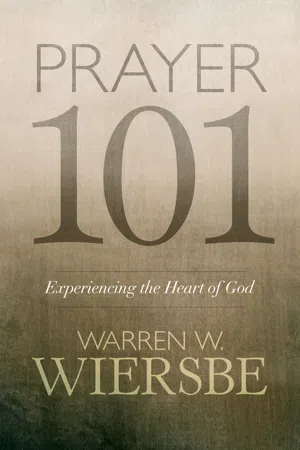
- 176 pages
- English
- ePUB (mobile friendly)
- Available on iOS & Android
eBook - ePub
Prayer 101
About this book
Information
Topic
Theology & ReligionSubtopic
Religion1
Defining a Mystery

“We all know what light is,” Samuel Johnson told his friend James Boswell, “but it is not easy to tell what it is.” He might have said the same thing about prayer, although he did mention that “to reason philosophically on the nature of prayer was very unprofitable.” Ponder that statement.
What, after all, is prayer? Can we define it? Do we really have to define it? And if God is an all-powerful God, why doesn’t He just do what needs to be done? Does He really need our help, through prayer, to accomplish these things? And if He’s an all-knowing God, why do we need to pray at all? Even Jesus taught that the Father knows what we need before we ask Him (Matt. 6:8), so why ask? If He’s a loving God and knows what we need, must He wait for us to pray before He can act on our behalf? Is God our servant?
The more you think about prayer and try to explain it, the more baffling it becomes. It reminds me of the fable of the centipede and the beetle. The beetle asked the centipede, “How do you know which legs to move next?” The centipede replied, “To tell the truth, I’ve never thought much about it.” And the more the centipede pondered the question, the more confused it became, until finally it was so bewildered that it became paralyzed.
To make things even more challenging—and I have a good reason for asking this, so please be patient—how does God, who dwells in eternity, relate to the prayers of His people, which are offered in the midst of time? Did He decree the prayers’ answers even before the creation of the world? How do we define time and eternity? “What, then, is time?” Augustine asked. “I know well enough what it is, provided nobody asks me; but if I am asked what it is and try to explain it, I am baffled.” 1 Both the lowly centipede and the great bishop warn us that, in some matters, analysis can lead to paralysis.
The esteemed devotional writer Oswald Chambers pondered these questions and wrote, “We are all agnostic about God, about the Spirit of God, and prayer. It is nonsense to call prayer reasonable; it is the most super-reasonable thing there is.” 2 Note his careful choice of words: prayer is not unreasonable but super-reasonable, that is, above the greatest thoughts we might think. Like faith, hope, love, joy, and a host of other precious spiritual and emotional experiences, prayer can’t be put into a beaker and carried into the laboratory to be tested—but that doesn’t make it any less real. To quote Chambers again, “Prayer is not logical, it is a mysterious moral working of the Holy Spirit.” 3
So from the unbeliever’s point of view, the question is, “Why pray?” But from the believer’s point of view, the question is, “Why not pray?” We’re the children of God, and as such, we need to speak to our Father as well as listen to what He says. In fact, the Christian life begins with the Holy Spirit speaking in our hearts and giving us the assurance of salvation by saying, “Abba, Father” (Gal. 4:6), and we echo those words in our own witness (Rom. 8:15). When the ascended Lord wanted to assure Ananias of Damascus that it was safe for him to go minister to Saul, He said to Ananias, “He is praying” (Acts 9:11). That was all the evidence Ananias needed.
Most of us don’t understand the functioning of our own minds and bodies, and yet we’re able to live somewhat normal lives in a difficult world. I can’t explain the workings of my car and yet I can drive it, and even though the operating mechanisms of my computer completely baffle me, I can turn the computer on and off and use it to write letters and books. I hear you saying, “But wait a minute. The better you understand both your car and your computer, the better you’ll relate to them and use them.” Agreed. And the better I know the Lord and His Word, the better I’ll be able to pray and see God answer. But I don’t have to wait until I have a PhD in prayer to be able to come to the throne of grace. Even a baby Christian can cry, “Abba—Papa—Father!”
Someone asked Mrs. Albert Einstein, “Do you understand Dr. Einstein’s mathematical equations?” She replied, “No, but I understand Dr. Einstein.” Do I understand the eternal equations involved in praying to my Father? No, but I am getting to understand the Father better, and this helps me to pray.
Many of the Pharisees Jesus met knew their theology, but they didn’t know God. The scribes counted the letters of the words written on their sacred Old Testament scrolls, but they overlooked learning about the God who wrote those words through His servants. Thirty years after his conversion, Paul prayed, “I want to know Christ” (Phil. 3:10)—and Paul had already been to heaven and back! Paul knew that knowing God better is the open secret of a successful Christian life, including a successful life of prayer. Certainly, there’s an important place for systematic theology in the Christian’s curriculum, but only if it leads to a better knowledge of the Lord Himself.
Why, then, do we pray? Because prayer is God’s ordained method for glorifying Himself by meeting our needs so that we can do His will and His work. “You do not have because you do not ask God” (James 4:2). The same God who ordains the end also ordains the means to the end, and prayer is an important part of that means. When God wants to accomplish something, He raises up a man or a woman, or perhaps a group of believers, to pray about that very matter, and through their prayers He accomplishes His work.
It was God’s plan that David become king of Israel and that from David’s family the Redeemer would be born, so He raised up Hannah to pray for a son, and that son, Samuel, anointed David to be king.
God had a timetable for His people and ordained that they would be delivered from captivity after seventy years. When Daniel understood this promise, he immediately began to pray that the Lord would fulfill it, and God did (Dan. 9).
It was God’s will that the promised forerunner (Isa. 40:1–5; Mal. 4:5–6) introduce the Redeemer to the nation of Israel. So He moved Elizabeth and Zechariah to pray for a son, and John the Baptist was born (Luke 1). Before Jesus was born, godly people like Anna and Simeon were praying for the promised Messiah to come (Luke 2:21–38), and God answered their prayers.
“Whether we like it or not,” said Charles Spurgeon, “asking is the rule of the Kingdom.” Asking humbles us, and it glorifies God.
It hasn’t been granted to us to understand fully the mysterious relationship between the eternal counsels of God, the promises of God, and the cries of His people, nor is it necessary that we understand. God is “over all and through all and in all” (Eph. 4:6), and His providence, power, and presence guarantee that His purposes will be accomplished. But in His grace, He has given us the privilege of prayer so that we might share in His great work of saving sinners and building His church. “We have not the remotest conception of what is done by our prayers,” wrote Oswald Chambers, “nor have we the right to try and examine and understand it; all we know is that Jesus Christ laid all stress on prayer.” 4 Godly Robert Murray McCheyne wrote, “If the veil of the world’s machinery were lifted off, how much we would find is done in answer to the prayers of God’s children.” 5
If you need a definition of prayer, here’s one to consider:
Prayer is the means God has ordained to glorify Himself by sharing His love with His children, meeting their needs, and accomplishing His purposes through their lives and the lives of others.
This suggested definition covers some of the various aspects of prayer:
worship—glorifying God
communion—loving God
petition—asking God for what we need
intercession—asking God for what others need
A balanced Christian life begins with a balanced prayer life.
Prayer is serious business, and it must be founded on the character and the promises of God. Unfortunately, we sometimes pick up unbiblical and ungodly ideas that influence our prayers and hinder the Lord from answering us. Unwittingly, we imitate the way others pray, and these ideas stick in our minds and take over. A. W. Tozer used to remind us, “The essence of idolatry is the entertainment of thoughts about God that are unworthy of Him.” 6 No professing Christian would deliberately bow before a pagan idol, but many of God’s children ignorantly ask God to give and to do that which is completely contrary to His character and His written Word.
In the first section of this book, we will think together about some of these popular “routine religious statements” that are often used when God’s children pray, and we will find out why they are dangerous. Before we can plant the seeds of prayer and cultivate healthy plants that bear fruit, we have to pull up a few of the weeds.
2
“He Done Prayed My Hot Dog Cold!”
Here is a generic version of a story that was told to me by a man who was at the event (the details have been deleted to protect this author and the people who were involved):
At the annual conference of an evangelical mission board, while the women were at a fancy tea, the men and children gathered to enjoy an old-fashioned outdoor wiener roast. As we all know, at informal picnic gatherings, protocol demands that somebody ask the blessing before the guests visit the tables and fill thei...
Table of contents
- Preface
- Semester I: Essential Prayer 101.
- 1. Defining a Mystery
- 2. “He Done Prayed My Hot Dog Cold!”
- 3. “I Have an Unspeakable Request”
- 4. “Lord, May This Accident Not Have Happened!”
- 5. “Let’s Have a Word of Prayer”
- 6. “Thank You, Father, for Dying for Us on the Cross”
- 7. “We’ll Just Have to Pray for Good Luck”
- 8. “Whisper a Prayer for Me”
- 9. “Don’t Wrestle in Prayer—Just Believe”
- 10. “Pray for My Enemies? Surely You’re Joking!”
- 11. “Let’s Fold Our Hands, Bow Our Heads, Close Our Eyes, and Pray”
- Semester II: Advancing in the School of Prayer
- 12. “Teach Us to Pray,” Entry Level
- 13. Promoted to Praying in God’s Will
- 14. Graduating to God’s Motives
- 15. Postgraduate Work of the Holy Spirit
- Semester III: The Internship of Unanswered Prayer
- 16. Your Relationship with God Defines Your Prayers
- 17. Your Relationships with Others Define Your Prayers
- 18. Religious Schizophrenia
- 19. Pernicious Presumption
- Examination Time
- 20. Taking Inventory of Your Prayer Life
- Graduating to the Joyful Discipline of Prayer
- 21. Approaching the Throne of Grace
- Discussion Questions
- Notes
- Selected Bibliography
- Bible Credits
Trusted by 375,005 students
Access to over 1.5 million titles for a fair monthly price.
Study more efficiently using our study tools.
Frequently asked questions
Yes, you can cancel anytime from the Subscription tab in your account settings on the Perlego website. Your subscription will stay active until the end of your current billing period. Learn how to cancel your subscription
No, books cannot be downloaded as external files, such as PDFs, for use outside of Perlego. However, you can download books within the Perlego app for offline reading on mobile or tablet. Learn how to download books offline
Perlego offers two plans: Essential and Complete
- Essential is ideal for learners and professionals who enjoy exploring a wide range of subjects. Access the Essential Library with 800,000+ trusted titles and best-sellers across business, personal growth, and the humanities. Includes unlimited reading time and Standard Read Aloud voice.
- Complete: Perfect for advanced learners and researchers needing full, unrestricted access. Unlock 1.5M+ books across hundreds of subjects, including academic and specialized titles. The Complete Plan also includes advanced features like Premium Read Aloud and Research Assistant.
We are an online textbook subscription service, where you can get access to an entire online library for less than the price of a single book per month. With over 1.5 million books across 990+ topics, we’ve got you covered! Learn about our mission
Look out for the read-aloud symbol on your next book to see if you can listen to it. The read-aloud tool reads text aloud for you, highlighting the text as it is being read. You can pause it, speed it up and slow it down. Learn more about Read Aloud
Yes! You can use the Perlego app on both iOS and Android devices to read anytime, anywhere — even offline. Perfect for commutes or when you’re on the go.
Please note we cannot support devices running on iOS 13 and Android 7 or earlier. Learn more about using the app
Please note we cannot support devices running on iOS 13 and Android 7 or earlier. Learn more about using the app
Yes, you can access Prayer 101 by Warren W. Wiersbe in PDF and/or ePUB format, as well as other popular books in Theology & Religion & Religion. We have over 1.5 million books available in our catalogue for you to explore.