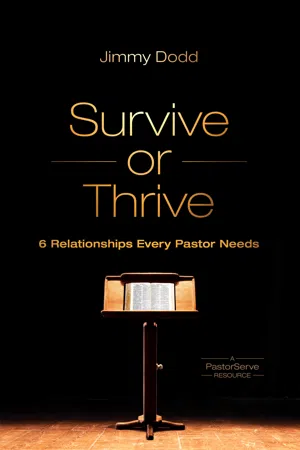
Every month 1, 500 pastors burn out and leave the church. Learn how to beat the odds. The majority of pastors are not truly known—by anyone. They subconsciously isolate themselves from both staff and congregation so their insecurities, doubts, and failures aren't exposed. Yet confiding in the wrong person can be a dead end at best and disastrous at worst. Former pastor Jimmy Dodd reveals how those in pastoral ministry can receive ongoing support, accountability, and restoration from relationships with a boss, counselor, trainer, mentor, coach, and good friend. Discover how you can move from surviving to thriving with the six relationships every pastor needs.
- 224 pages
- English
- ePUB (mobile friendly)
- Available on iOS & Android
eBook - ePub
About this book
Information
Topic
Theology & ReligionSubtopic
Christian ChurchSection 1
Survive
The Heart of the Problem—How Did We Arrive Here?
I couldn’t make this conversation up if I tried.
Recently, I was attending an event at the invitation of a PastorServe board member. As I stood in a noisy, crowded room, I strained to engage in conversations above the deafening roar of the crowd. It was one of those times when each sentence requires you to lean in toward the ear of the listener and speak at a level just below a shout. I met one gentleman who introduced himself as a vice president of a local bank. Then, in a piercing voice, he asked me about my occupation. I loudly responded that I was privileged to serve on the PastorServe team. I went on to explain how PastorServe works around the country serving pastors. He nodded enthusiastically as I went on to describe our work in greater detail. And then, the following exact conversation took place.
“That’s amazing work. You must feel deeply satisfied helping so many farmers. So what is your favorite crop?”
After a lengthy period of silence, I replied, “I’m sorry, did you just ask me about my favorite crop?”
“Yes, you said that you work with farmers to help them produce the very best yield from their crop.”
Another long pause; then I said, “I work with PastorServe, a ministry serving pastors and churches across the country.” Then the miscommunication struck me. “We serve pastors—not pastures.”
“Oh,” he said, now laughing. “I thought you said ‘Pasture Serve.’ I thought you traveled across the country helping farmers with their pastures.”
Communication. Even in a quiet room, it’s a challenge. Too often, miscommunication feels like the standard. Misunderstandings, assumptions, body language, tone of voice, defensiveness, and assigning motives all make it challenging to effectively connect and convey ideas. It’s no surprise that communication issues remain at the center of the majority of church conflicts.
Chapter 1
What Drives Us Back Stage?
I admit it; I love sports. While my wife remains unconvinced that this is a God-given gift, I can engage in a respectable conversation about most any sport. Recently, my attention was drawn to an amazing young athlete who quarterbacks a highly ranked college football team. A remarkable physical specimen, on the football field he is a natural, a superstar. National sportswriters describe him as a once-in-a-generation player, and he consistently executes above and beyond expectations on the field of play.
However, few were surprised when it was revealed that this star football player was in trouble—again. While the fan base appreciated his leading the university to consecutive conference titles, they most reluctantly acknowledged that his superior athletic ability had a dark side, commonly known as extreme immaturity bordering on sheer idiocy. Time and time again his outrageous off-field decisions resulted in a call to the local authorities followed by a meeting with the athletic director, a negative headline in the local sports page, a brief suspension, and embarrassment for every alumni and fan of the university. And yet, when memory of the wrongdoing (or in some cases, crime) faded, he was enthusiastically welcomed back, because we like to say we are all about second chances—and because the team couldn’t win without him.
Why is it that when the talent and skill level are off the charts, we are more tolerant of glaring immaturity, even scandalous behavior? What causes us to turn a blind eye to deep character issues when the benefits of talent bring so many positives? Yes, I know he confessed to spousal abuse, but we just won the Super Bowl!
Going a bit deeper, why do we apply words such as amazing, incredible, and remarkable to people when we know absolutely nothing about their personal lives? “Our quarterback is an amazing person.” “That singer is incredible.” “That actress is the absolute best.” “I am in love with that author.” “She is the most remarkable designer.” I get it. It feels only natural to praise those whom we admire on the front stage of public performance despite the fact that we know nothing about their back stage private personas. I’m not judging people who use such words. I have used similar expressions on countless occasions. My favorite professional football team, the Green Bay Packers, has been led by a number of quarterbacks I have described as incredible, amazing, and at times, faultless. I was fortunate to be present when my favorite college team, the Kansas Jayhawks basketball team, won their fifth national championship. That night in San Antonio, I struggled to find adequate superlatives to describe every member of the championship team, including the players, coaches, team managers, ball boys, and bus driver. In moments like these, we magnify natural gifts and abilities while minimizing character flaws.
When we apply adoring, descriptive, character-based words to people we essentially know nothing about, we are naively feeding a monster. We are adding fabric to the curtain separating the front stage from the back stage. We are driving a wedge even deeper between the public and the private. We are affirming that what takes place in the private sector (off the field) has no impact on the public sector (on the field). We are applauding the front stage performance while we turn a blind eye to embarrassing back stage behavior. And, well fed, this monster can lead to behavior for which there is little to no explanation.
Similar Problems in the Church
We have a mounting epidemic in the church. We have far too many amazing, wonderful, incredible pastors.
I recently attended a leadership conference with a number of fellow pastors. Following a particularly powerful message from a well-known speaker, a friend leaned over to me and said (actually he gushed), “Wow! What a message! I love that guy! He is incredible! I can’t believe how someone that young can be that mature! That was life changing!” Words typically used to describe elite athletes and Hollywood celebrities were now being enthusiastically applied to this well-known Christian speaker.
It’s harmless, common, everyday language, right? In the case of the conference speaker, clearly my friend was deeply touched by a particular message. Thank the Lord! And yet, it’s this common, everyday, seemingly innocent language of adulation (bordering on idolatrous worship) that pushes leaders down a dangerous road of secrets, deception, fraud, and lies. What I want to say to people (and sometimes I do) is that while I can appreciate their admiration of the speaker, they have selected the wrong words to describe the person delivering the message. What my friend at the conference meant is that the message delivered by the speaker was insightful, powerful, even life transformational. He was thankful to the Lord for gifting a speaker with the incredible ability to so clearly deliver a message. I considered asking, “Have you ever met the speaker? Do you know anything about his marriage, his parenting, his temperament, his walk with the Lord, or his personal habits? Do you know how he treats his staff? Do you know how he handles money? Is his life characterized by humility? Is he a man of prayer?” Far too often we link giftedness, talent, and skill with maturity and character. And it is this mistake that contributes to multitudes of pastors shrinking into a life of hiding, deception, fear, and fraud. I should know. This is my story.
Gripped by Fear
My wife and I had the privilege of serving on the pastoral teams of thriving churches in Wheaton, Illinois; Lexington, Massachusetts; and Greenville, South Carolina. In the early ’90s, my wife and I returned to our beloved home state of Kansas to plant a church in the Kansas City suburbs.
While challenges confronted us at every turn, the church grew. If you looked at the church from an outside perspective, you would have seen a young, vibrant, healthy, growing, influential church being led by a youthful, energetic, passionate pastoral team. An outstanding children’s program, engaging worship, faithful expositional preaching, exceptional small groups, and a commitment to missional living and generosity were pillars of the church. From day one, the church dedicated 40 percent of all its resources to needs outside the local congregation. We were engaged with the urban core of Kansas City, the poor, the prisoner, and the sick. The congregation included a healthy mixture of mature believers and new Christians. Not surprisingly, people enthusiastically invited their friends to be a part of this new church.
The front stage looked good—really good—from a seat in the middle of the theater. However, a look into the back stage of the church would have revealed a young lead pastor whose life was dominated by insecurity, defensiveness, envy, and above all, fear. And it was these things that Satan used to twist my heart into knots even as I led an outstanding church. Before I continue the story, I believe it’s important to briefly review the most common tools used by Satan in his attempt to destroy the lives of believers.
The Limitations of Satan
The Screwtape Letters is a classic Christian apologetic novel written by C. S. Lewis in 1942. In his satirical work, Lewis recounts letters from a senior demon, Screwtape, to a junior demon, Wormwood, who also happens to be his nephew, regarding how to bring down a client—a new believer in Jesus. It takes a little time to get used to the structure of the letters. God the Father is referred to as “The Enemy” and “The Evil One.” “The Bad News” is the gospel of Jesus Christ. Satan is referred to as his infernal majesty.
We must be reminded that Satan has a limited toolbox. While he unquestionably possesses power, his power is strictly limited by God the Father, who has Satan on a short leash, meaning that Satan can do nothing to thwart the ultimate purposes of God. While Satan certainly possesses power, unlike God he is not omnipotent. Similarly, unlike God the Father, Satan cannot be all places at all times. He is not omnipresent. And while Satan is aware of many things, he is far from omniscient. For example, Satan cannot hear the prayers of believers. Unlike God the Father, he does not know everything. Whereas God is a creator, Satan is a destroyer. He does nothing new, as he can only do unoriginal ideas or designs (or undo original ideas or designs). Everything that Satan does is a cheap counterfeit of the original. Satan is a $5 Tijuana Rolex, a worthless, cheap imitation of the original. He is a bogus, back-alley phony. Do not give him more credit than he deserves!
When teaching on spiritual warfare, I regularly engage the audience in a simple game of opposites. Answer the following simple questions: What is the opposite of up? How about the opposite of over? Not too hard, huh? The opposite of large? Do you know the opposite of in? Any ten-year-old could easily answer any of these questions. Let’s go on. What is the opposite of light? What is the opposite of good? What is the opposite of love? Finally, what is the opposite of God? Okay, pencils down. Let’s check your work. (Does anyone else still get a nervous tic when you hear those words?)
I can set your mind at ease by affirming the opposite of up is indeed down. And despite what your college philosophy professor taught, the opposite of over is under, the opposite of large is small, and the opposite of in is indeed out. It was this brilliance that allowed you to escape third grade relatively unscathed. Nonetheless, the opposite of light is not dark and ...
Table of contents
- Cover
- Preface
- Introduction
- Section 1: Survive
- 1. What Drives Us Back Stage?
- 2. Closing the Front Stage–Back Stage Gap
- 3. Created for Community
- 4. Embracing Weakness in a Strength-Glorified Culture
- 5. Paul’s Thorn and Charlie’s Angels
- 6. Leave Me Alone!
- Section 2: Thrive
- 7. Everyone Needs a Boss
- 8. Continuing Education Isn’t Just for Teachers
- 9. Hey, Coach! Put Me In!
- 10. Counselor: Scrubbing the Wound
- 11. Mentor: The View from Above at the Labyrinth of Life
- 12. Every Pastor Needs a Friend
- Section 3: Gospel Transformation
- 13. Where Do We Go from Here?
- 14. Gospel Implications
- Acknowledgments
- Notes
- About the Author
- About PastorServe
- Extras
Trusted by 375,005 students
Access to over 1.5 million titles for a fair monthly price.
Study more efficiently using our study tools.
Frequently asked questions
Yes, you can cancel anytime from the Subscription tab in your account settings on the Perlego website. Your subscription will stay active until the end of your current billing period. Learn how to cancel your subscription
No, books cannot be downloaded as external files, such as PDFs, for use outside of Perlego. However, you can download books within the Perlego app for offline reading on mobile or tablet. Learn how to download books offline
Perlego offers two plans: Essential and Complete
- Essential is ideal for learners and professionals who enjoy exploring a wide range of subjects. Access the Essential Library with 800,000+ trusted titles and best-sellers across business, personal growth, and the humanities. Includes unlimited reading time and Standard Read Aloud voice.
- Complete: Perfect for advanced learners and researchers needing full, unrestricted access. Unlock 1.5M+ books across hundreds of subjects, including academic and specialized titles. The Complete Plan also includes advanced features like Premium Read Aloud and Research Assistant.
We are an online textbook subscription service, where you can get access to an entire online library for less than the price of a single book per month. With over 1.5 million books across 990+ topics, we’ve got you covered! Learn about our mission
Look out for the read-aloud symbol on your next book to see if you can listen to it. The read-aloud tool reads text aloud for you, highlighting the text as it is being read. You can pause it, speed it up and slow it down. Learn more about Read Aloud
Yes! You can use the Perlego app on both iOS and Android devices to read anytime, anywhere — even offline. Perfect for commutes or when you’re on the go.
Please note we cannot support devices running on iOS 13 and Android 7 or earlier. Learn more about using the app
Please note we cannot support devices running on iOS 13 and Android 7 or earlier. Learn more about using the app
Yes, you can access Survive or Thrive by Jimmy Dodd in PDF and/or ePUB format, as well as other popular books in Theology & Religion & Christian Church. We have over 1.5 million books available in our catalogue for you to explore.