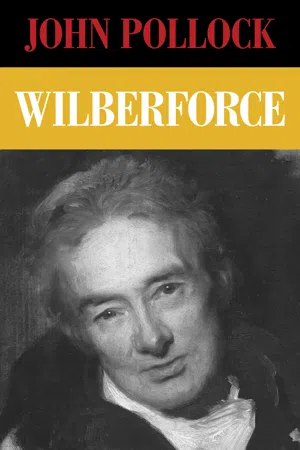
"Vivid and painstakingly researched biography." —Daily Telegraph "Wilberforce modeled a combination of Christian principle and tactical genius as relevant in the twenty-first century as in his own time." —William Hague"The biography is the product of much painstaking research. John Pollock has made use of virtually all the extant manuscript collections containing Wilberforce materials. He gives a detailed picture of his life and character which includes some important new information." —Observer William Wilberforce was at the heart of British politics for over forty years but is chiefly remembered as the reformer who campaigned for the abolition of the slave trade in England. This intriguing and insightful biography of his life will inspire you to find ways to stand on your convictions and make a difference wherever you are.
- 384 pages
- English
- ePUB (mobile friendly)
- Available on iOS & Android
eBook - ePub
Wilberforce
About this book
Information
Subtopic
Historical BiographiesIndex
HistoryPart One
THE YOUNG MEMBER
1759–1788
1759–1788
1
Two Guineas a Vote
A huge bonfire blazed beyond the walls of Hull on the night of 24 August 1780. An ox roasted whole. Citizens danced, ate, got drunk, and roared huzzas for their host, the young head of the house of Wilberforce, whose coming of age feast begged their votes in the imminent General Election.
No one round the bonfire that summer evening, least of all himself, could have guessed how William Wilberforce would achieve his fame. To seek election so very young was strange for one of his background, for the Wilberforces were mercantile men. They came from Wilberfoss near York to Beverley in the mid-sixteenth century, and flourished modestly until young William’s grandfather, also named William, who was born in 1690, pushed the few miles south to Kingston upon Hull to build a great fortune in the Baltic trade.
Hull was the fourth port of England, ranking after London, Bristol and Liverpool (which was growing to greatness by the Slave Trade) and this earlier William Wilberforce had a red brick mansion in the High Street. The other front overlooked the staiths on the River Hull a few hundred yards from its outflow into the Humber; he could watch his ships unload hemp and timber from Riga and St. Petersburg, and iron ore from Sweden, and load again with every kind of Yorkshire product, from Sheffield knives to ponies.
Alderman Wilberforce owned land in three parishes around Hull and, through his mother, the estate of Markington near Harrogate, which had tenant farms but no country house. He was a man of very vigorous mind who became mayor of Hull at the early age of thirty-two and, in 1745 was mayor a second time: had the Young Pretender come that way he would have been confounded by the old civil war ramparts repaired and manned; the volunteers even had muskets. The Alderman married into another prosperous Hull family in the Baltic trade, the Thorntons, and had two sons and two daughters. The elder son, William, married his first cousin Hannah Thornton and joined his father-in-law, a great Russia merchant, director of the Bank of England and Member of Parliament, in London. The second son, Robert, stayed in Hull and became managing partner, probably at the age of twenty-seven in 1755 when the Alderman, at sixty-five, handed over the High Street mansion and counting house and went to live nearby at North Ferriby on the Humber.
Robert Wilberforce married Elizabeth Bird from London; and his sister married her brother; and the Birds and the house of Wilberforce were even more confusingly intertwined since Elizabeth’s sister had married the other partner in the firm, Abel Smith, a younger son of the banker of Nottingham whose numerous descendants have been important in banking ever since. Abel founded two banks himself, in Hull and in London, which were ancestors of the National Westminster. His large family included Bob Smith, Pitt’s friend whom he ennobled as Lord Carrington.
Thus, when the third child and only son of Robert and Elizabeth Wilberforce was born in the Wilberforce house at Hull on 24 August 1759, and christened William, he had a network of uncles, aunts and cousins.
The eldest sister died, and another who had followed William after a long interval; only Sarah (Sally) survived childhood. William’s early days at Hull were normal enough for a rich merchant’s son, despite puny size, indifferent health and weak eyesight, offset by a hot temper, a kind heart, and mental and physical energy. In 1767 he went to Hull Grammar School as a dayboy. That same year his grandfather foisted on the mayor and corporation a new and young headmaster, a poor weaver’s son of Leeds named Joseph Milner who had won the Chancellor’s Medal at Cambridge and was curate of North Ferriby. Milner’s large, uncouth eighteen-year-old brother Isaac, on the path from the woollen trade to an academic distinction even more marked than Joseph’s, came too as a temporary usher. Isaac would one day influence William Wilberforce profoundly, but their paths crossed only briefly at Hull Grammar School.
Next summer when William was turning nine, his father died at the age of forty. Abel Smith became head of the business; the firm changed its name to Wilberforce and Smith, and William’s life changed too. Not merely because he would be independent and quite rich when he came of age, but because he was sent, a year after his father’s death, to live with his childless uncle and aunt, William and Hannah Wilberforce, at their Wimbledon villa in the Surrey countryside and their London house in St. James’s Place. They put him to boarding school at Putney. ‘It was one of those little schools,’ he would tell his sons long afterwards, ‘where a little of everything, reading, writing, arithmetic, etc. is taught: a most wretched little place. I remember to this day the Scotch usher we had, a dirty disagreeable man. To show what kind of place it was, there were charity boys there, only they lived at the top of the house, we at the bottom.’1 Vacations were enjoyable, for he adored the uncle and aunt.
They ‘were great friends of Mr. Whitefield’, the first ‘Methodist’ (in the usual eighteenth-century sense before any denomination existed) who had sparked an evangelical revival in Bristol and London at the age of twenty-two, a full year before the conversion of John Wesley. The two evangelists were close friends though disagreeing on points of doctrine, but George Whitefield made more impression among the richer London merchants than Wesley, and in 1754 he had won a convert in Hannah’s half-brother, John Thornton, whom the Secretary of the Treasury afterwards described as ‘very rich, in great credit and esteem, and of as much weight in the City as any one man I know’.2 Thornton was one of the most generous men of his day, though considered rather vulgar, and he lived just south of the Thames on the country estate which his father had bought at Clapham, the village linked more than any other with the names of Thornton and Wilberforce.
Hannah probably took her small nephew to Clapham but almost certainly he never heard Whitefield, who in the early autumn of 1769, at about the time of William’s coming south, left for his sixth and last visit to America, where he died. William remembered a younger Evangelical, John Newton, the parson of Olney in Buckinghamshire who often preached in London and was soon to be famous as a hymn-writer. A boy could hardly fail to be impressed by this jolly, affectionate ex-sea captain and slaver, who as a youth had been flogged in the Royal Navy for desertion and later suffered as the virtual slave of a white man’s native mistress in West Africa. Wilberforce listened enthralled to his sermons and his stories, even ‘reverencing him as a parent when I was a child’.3
Mrs. Robert Wilberforce became alarmed. By William’s letters and his behaviour on visits home he might be ‘turning Methodist’. She was more churchgoing than many of her circle but shared the widespread prejudice against any form of Enthusiasm, whether the Whitefield brand or the Wesleyan; and after consulting the Alderman she took a coach to London and rescued her son ‘before I should imbibe what she considered was little less than poison, which indeed I at that time had done. Being removed from my uncle and aunt affected me most seriously. It almost broke my heart, I was so much attached to them.’4
His mother did not return William to Hull Grammar School since the Master, Joseph Milner, had unexpectedly turned ‘Methodist’ too, and preached afternoon sermons in the parish church at variance with his vicar’s in the morning. Instead she chose the grandfather’s old school at Pocklington, a small town thirteen miles from York at the foot of the Wolds; the hill behind the town provided a fine view of York Minster.
Here William spent the next five years, 1771–1776, as a boarder. Founded in 1514, Pocklington had risen by the mid-seventeenth century to be a grammar school of 125 boys, and in the twentieth century is an independent school of 300. In Wilberforce’s time, however, attendance had dropped to about thirty, ranging in age from six to seventeen, and the fees were exorbitant. He sums up the place succinctly: ‘The Master was a good sort of man and rather an elegant scholar but the boys were a sad set. . . . I did nothing at all there.’5 The Master was a former Fellow of St. John’s, the Reverend Kingsman Baskett, who had been at the school seventeen years and would stay another thirty-six, by which time it lay even more in the doldrums.6
Wilberforce’s quick mind masked his idleness. He grew into a fair classicist, stuffed his memory with much classical and English verse, and learned to write a good hand: even before worsening eyesight in middle age forced him to use black ink and a bold script, his handwriting was clearer than most of his contemporaries so that the manuscripts remain easier to read than Pitt’s less rounded hand or the hasty large scrawl of Dundas, or scores of others. Only his diaries, written very small, presumably by using a glass, are difficult to decipher.
In the holidays the Wilberforce family began to scrub William’s soul clear of Wimbledon and Clapham, a slow process: he wrote manfully to his uncle of endurance under persecution, and of increasing ‘in the knowledge of God and Christ Jesus whom he sent, whom to know is life eternal.’7 The Theatre Royal manager described Hull as the Dublin of England for its ‘hospitality, plenty of good cheer, with too much welcome’; and if stage plays distressed pious William at first, in time he enjoyed the visits to the family box at Finkle Street and the Assembly Rooms in Digger Lane. He was taught to play cards, young as he was, for this was the normal practice among the gentry. Fashionable Hull dined at two. When business shut at six ‘we went up and drank tea: after tea we played cards till nine: then there was a great supper, game, turkey etc. This used to go on all the time I was at home.’8
Hull was more than a mercantile town, since county families wintered there and William mixed with them on easy terms. Out of season when the county returned to its estates, ‘we were the aristocracy of the place’—that is, the Wilberforces, along with the eccentric Sir Henry Etherington, a warm-hearted baronet who never went out in an east wind and who allowed his servants a table even more luxurious than his own; and the Joseph Sykes of West Ella. Sykes was a native of Leeds who had secured the lease of the white-iron mines in Sweden which produced the best ore for Sheffield steel, and owned the ships to carry it. The Sykes and the Wilberforces were in and out of each other’s houses until William looked on the numerous Sykes children, little Marianne especially, as half-brothers and sisters.
He developed a fine singing voice of considerable range. He had quick wit, a merry affectionate nature, and charm. ‘In this idle way did they make me live. . . . I was naturally a high spirited boy and fiery. This pushed me forward and made me talk a great deal and made me very vain. This idle way of living at home, of course, did not dispose me for exertion when I returned to school.’9
In late November 1774 Alderman Wilberforce died, aged 86, and was buried at St. Mary’s, Beverley. Uncle William of Wimbledon nearly followed him into the grave the next week, but on 9 December Bob Smith wrote from London, ‘Mr. Wilberforce was yesterday declared to be out of danger from his carbuncle; he mends very fast, but his friends are a good deal alarmed at his dropsical symptoms.’10 Had the uncle gone, William would have been a rich youth indeed.
In October 1776 at the age of seventeen, small in size but a young man in mind and manner, William went up to Cambridge, the first of his name, and entered St. John’s College, with which Pocklington had links, as a fellow-commoner.
‘The first night I arrived at Cambridge I supped with my tutor and was introduced to two of the most gambling vicious characters perhaps in all England. There was also a set of Irishmen of this sort to whom I was introduced. There I used to play at cards a great deal and do nothing else and my tutor who ought to have repressed this disposition, if not by his authority at least by his advice, rather encouraged it: he never urged me to attend lectures and I never did. And I should have done nothing all the time I was at [Cambridge] but for a natural love of classical learning, and that it was necessary for a man who was to be publicly examined to prevent his being disgraced. . . .’11 The tutor was William Arnald, then aged about thirty. He was appointed sub-preceptor in natural science to the Prince of Wales and in 1782 went mad.12
Within a few years Wilberforce would bitterly regret that Arnald and his colleagues never taught him to work hard or systematically. Eighteenth-century dons allowed men of independent means, if not reading for the Church or the Bar, to treat a university as a place to acquire a little civilization and a smattering of classics and mathematics. Fellow-commoners were exempt from lectures, yet Wilberforce’s good memory and quick intellect enabled him to pass examinations, if without glory: in December 1776 he was not classed with the Honours men but received a place, which would have been higher ‘if he had prepared himself in Stanyan [Grecian History] as well as he had done in every other subject’.13 In his first year’s examination in June 1777 he was again not classed but received a mention with five other unclassed men, and again in the following December, when he was reported to be ‘good in the Classics’.14
The man in the neighbouring set of rooms on his staircase was a Harrovian, Thomas Gisborne, a Staffordshire squire’s son reading for holy orders, who won the Chancellor’s Medal in classics and was placed Sixth Wrangler in mathematics. Men would say behind Wilberforce’s back but meaning him to hear, ‘Gisborne is very clever, but then he fags, whereas Wilberforce can do as much without working at all.’15
Gisborne in old age recalled Wilberforce as the most agreeable and popula...
Table of contents
- Cover
- Contents
- Acknowledgments
- Preface to the Bicentenary Edition
- Preface
- Part One: THE YOUNG MEMBER1759–1788
- Part Two: SORROWS OF AFRICA1789–1807
- Part Three: THE ARBITER OF ENGLAND1807–1825
- EPILOGUE 1825–1833
- References and Notes
- Note on Transcription of Manuscript Sources
- Select Bibliography
- Extras
Trusted by 375,005 students
Access to over 1.5 million titles for a fair monthly price.
Study more efficiently using our study tools.
Frequently asked questions
Yes, you can cancel anytime from the Subscription tab in your account settings on the Perlego website. Your subscription will stay active until the end of your current billing period. Learn how to cancel your subscription
No, books cannot be downloaded as external files, such as PDFs, for use outside of Perlego. However, you can download books within the Perlego app for offline reading on mobile or tablet. Learn how to download books offline
Perlego offers two plans: Essential and Complete
- Essential is ideal for learners and professionals who enjoy exploring a wide range of subjects. Access the Essential Library with 800,000+ trusted titles and best-sellers across business, personal growth, and the humanities. Includes unlimited reading time and Standard Read Aloud voice.
- Complete: Perfect for advanced learners and researchers needing full, unrestricted access. Unlock 1.5M+ books across hundreds of subjects, including academic and specialized titles. The Complete Plan also includes advanced features like Premium Read Aloud and Research Assistant.
We are an online textbook subscription service, where you can get access to an entire online library for less than the price of a single book per month. With over 1.5 million books across 990+ topics, we’ve got you covered! Learn about our mission
Look out for the read-aloud symbol on your next book to see if you can listen to it. The read-aloud tool reads text aloud for you, highlighting the text as it is being read. You can pause it, speed it up and slow it down. Learn more about Read Aloud
Yes! You can use the Perlego app on both iOS and Android devices to read anytime, anywhere — even offline. Perfect for commutes or when you’re on the go.
Please note we cannot support devices running on iOS 13 and Android 7 or earlier. Learn more about using the app
Please note we cannot support devices running on iOS 13 and Android 7 or earlier. Learn more about using the app
Yes, you can access Wilberforce by John Pollock in PDF and/or ePUB format, as well as other popular books in History & Historical Biographies. We have over 1.5 million books available in our catalogue for you to explore.