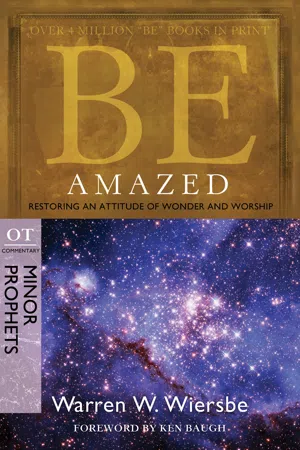
Prepared to be awed by our God. The books of Hosea, Joel, Jonah, Nahum, Habakkuk, and Malachi are viewed by Biblical scholars as the Minor Prophets. Yet the insights and messages contained within these books are anything but minor. These prophets offer a unique, firsthand view of an all-powerful God who longs to intimately connect with His people. This study examines their personal stories to discover how He interacts with our world in truly amazing ways. Part of Dr. Warren W. Wiersbe's best-selling "BE" commentary series, BE Amazed has now been updated with study questions and a new introduction by Ken Baugh. A respected pastor and Bible teacher, Dr. Wiersbe explores the Minor Prophets to uncover remarkable truths about our awesome God. What you'll find will provoke wonder, inspire worship, and cause you to be amazed at what God is doing in our world.
- 224 pages
- English
- ePUB (mobile friendly)
- Available on iOS & Android
eBook - ePub
About this book
Information
Topic
Theology & ReligionSubtopic
Biblical CommentaryChapter One
You Married a What?
(Hosea 1—3)
Prophets sometimes do strange things. For three years, Isaiah embarrassed people by walking the streets dressed like a prisoner of war. For several months, Jeremiah carried a yoke on his shoulders. The prophet Ezekiel acted like a little boy and “played war,” and once he used a haircut as a theological object lesson. When his wife suddenly died, Ezekiel even turned that painful experience into a sermon.1
Why did these men do these peculiar things?
“These peculiar things” were really acts of mercy. The people of God had become deaf to God’s voice and were no longer paying attention to His covenant. The Lord called His servants to do these strange things—these “action sermons”—in hopes that the people would wake up and listen to what they had to say. Only then could the nation escape divine discipline and judgment.
But no prophet preached a more painful “action sermon” than Hosea. He was instructed to marry a prostitute named Gomer, who subsequently bore him three children, and he wasn’t even sure the last two children were fathered by him. Then Gomer left him for another man, and Hosea had the humiliating responsibility of buying back his own wife.
What was this all about? It was a vivid picture of what the people of Israel had done to their God by prostituting themselves to idols and committing “spiritual adultery.” Since God’s people today face the same temptation (James 4:4), we need to heed what Hosea wrote for his people. Each of the persons in this drama—Hosea, Gomer, and the three children—teach us important spiritual lessons about the God whom Israel was disobeying and grieving.
THE CHILDREN: GOD IS GRACIOUS (1:1—2:1)
The times (1:1). Hosea names four kings of Judah and only one king of Israel, Jeroboam II. The kings of Judah, of course, belonged to David’s dynasty, the only dynasty the Lord accepted (1 Kings 11:36; 15:4). The kings of Israel were a wicked lot who followed the sins of Israel’s first king, Jeroboam I, and refused to repent and turn to God (2 Kings 13:6).
After Jeroboam II died, his son Zechariah reigned only six months and was assassinated by his successor, Shallum, who himself was assassinated after reigning only one month. Menahem reigned for ten years; his son Pekahiah ruled two years before being killed by Pekah, who was able to keep the throne for twenty years. He was slain by Hoshea, who reigned for ten years, the last of the kings of Israel. During his evil reign, the nation was conquered by Assyria, the Jews intermingled with the foreigners the Assyrians brought into the land, and the result was a mixed race known as the Samaritans.
What a time to be serving the Lord! Murder, idolatry, and immorality were rampant in the land, and nobody seemed to be interested in hearing the Word of the Lord! On top of that, God told His prophet to get married and raise a family!
The marriage (1:2). Here we meet a bit of a problem because not every Bible student agrees on the kind of woman Hosea married. Hosea either married a pure woman who later became a prostitute, or he married a prostitute who bore him three children.2
In the Old Testament, prostitution is symbolic of idolatry and unfaithfulness to God (Jer. 2—3; Ezek. 16; 23). Since the Jews were idolatrous from the beginning (Josh. 24:2–3, 14), it seems likely that Gomer would have to be a prostitute when she married Hosea, for this would best symbolize Israel’s relationship to the Lord. God called Israel in the idolatry; He “married” them at Mount Sinai when they accepted His covenant (Ex. 19—21); and then He grieved over them when they forsook Him for the false gods of the land of Canaan. Like Gomer, Israel began as an idolater, “married” Jehovah, and eventually returned to her idolatry.
If Hosea had married a pure woman who later became unfaithful, “wife of whoredoms” in 1:2 has to mean “a wife prone to harlotry who will commit it later” but this seems to be a strained reading of the verse.3 But could God ask His faithful servant to marry a defiled woman? Why not? We might as well ask, “Could God permit Ezekiel’s wife to die?” Though marrying a prostitute might not be the safest step to take, such marriages were forbidden only to priests (Lev. 21:7). Salmon married Rahab the harlot, who became the great-grandmother of King David and an ancestress of Jesus Christ (Matt. 1:4–5).
The names (1:3–9). As with Isaiah’s two sons (Isa. 7:3; 8:3), and numerous other people in Scripture, Gomer’s three children were given meaningful names selected by the Lord.
The first child, a son, was called Jezreel (Hos. 1:4–5), which means “God sows” or “God scatters.” Jezreel was a city in the tribe of Isaachar, near Mount Gilboa, and is associated with the drastic judgment that Jehu executed on the family of Ahab (2 Kings 9—10; and see 1 Kings 21:21–24). So zealous was Jehu to purge the land of Ahab’s evil descendants that he murdered far more people than the Lord commanded, including King Ahaziah of Judah and forty-two of his relatives (2 Kings 9:27—10:14).
Through the birth of Hosea’s son, God announced that He would avenge the innocent blood shed by Jehu and put an end to Jehu’s dynasty in Israel. This was fulfilled in 752 BC when Zechariah was assassinated, the great-great-grandson of Jehu and the last of his dynasty to reign. God also announced that the whole kingdom of Israel would come to an end with the defeat of her army, which occurred in 724 BC.
The second child was a daughter named Lo-ruhamah (Hos. 1:6–7), which means “unpitied” or “not loved.” God had loved His people and proved it in many ways, but now He would withdraw that love and no longer show them mercy. The expression of God’s love is certainly unconditional, but our enjoyment of that love is conditional and depends on our faith and obedience. (See Deut. 7:6–12; 2 Cor. 6:14—7:1.) God would allow the Assyrians to swallow up the northern kingdom, but He would protect the southern kingdom of Judah (Isa. 36—37; 2 Kings 19).
Lo-ammi (Hos. 1:8–9) was the third child, a son, and his name means “not My people.” Not only would God remove His mercy from His people, but He would also renounce the covenant He had made with them. It was like a man divorcing his wife and turning his back on her, or like a father rejecting his own son (see Ex. 4:22; Hos. 11:1).
The new names (1:10—2:1). Here is where the grace of God comes in, for God will one day change these names.4 “Not my people” will become “My people,” and “unloved” will become “My loved one.” These new names reflect the nation’s new relationship to God, for all of them will be “the sons of the living God.”5 Judah and Israel will unite as one nation and will submit to God’s ruler, and the centuries’ old division will be healed.
Instead of “Jezreel” being a place of slaughter and judgment, it will be a place of sowing, where God will joyfully sow His people in their own land and cause them to prosper. Today, the Jews are sown throughout the Gentile world (Zech. 10:9), but one day God will plant them in their own land and restore to them their glory. As God promised to Abraham, Israel will become like the sand on the seashore (Gen. 22:17).
When will these gracious promises be fulfilled for the Jews? When they recognize their Messiah at His return, trust Him, and experience His cleansing (Zech. 12:10—13:1). Then they will enter into their kingdom, and the promises of the prophets will be fulfilled (Isa. 11—12; 32; 35; Jer. 30—31; Ezek. 37; Amos 9:11–15).
The three children teach us about the grace of God. Now we’ll consider the lesson that Gomer teaches us.
GOMER: GOD IS HOLY (2:2–13)
Hosea is preeminently the prophet of love, but unlike some teachers today, he doesn’t minimize the holiness of God. We’re told that “God is love” (1 John 4:8, 16), but we’re also reminded that “God is light, and in him is no darkness at all” (1:5). God’s love is a holy love, not a sentimental feeling that condones sin and pampers sinners.
The prophet focuses on three particular sins: idolatry (spiritual a...
Table of contents
- Cover
- Title
- Copyright
- Contents
- The Big Idea
- A Word from the Author
- Hosea in His Time
- A Suggested Outline of the Book of Hosea
- 1-You Married a What
- 2-What Will I Do with You
- 3-Love So Amazing
- Joel in His Time
- A Suggested Outline of the Book of Joel
- 4-Watching the Day of the Lord
- 5-Expecting the Day of the Lord
- Jonah in His Time
- A Suggested Outline of the Book of Jonah
- 6-Patience and Pardon
- 7-Preaching and Pouting
- Nahum in His Time
- A Suggested Outline of the Book of Nahum
- 8-The City Is No More
- Habakkuk in His Time
- A Suggested Outline of the Book of Habakkuk
- 9-The Prophet Worrying
- 10-The Prophet Watching and Waiting
- 11-The Prophet Worshipping
- Malachi in His Time
- A Suggested Outline of the Book of Malachi
- 12-The Sins of God's People Part 1
- 13-The Sins of God's People Part 2
- Notes
Trusted by 375,005 students
Access to over 1.5 million titles for a fair monthly price.
Study more efficiently using our study tools.
Frequently asked questions
Yes, you can cancel anytime from the Subscription tab in your account settings on the Perlego website. Your subscription will stay active until the end of your current billing period. Learn how to cancel your subscription
No, books cannot be downloaded as external files, such as PDFs, for use outside of Perlego. However, you can download books within the Perlego app for offline reading on mobile or tablet. Learn how to download books offline
We are an online textbook subscription service, where you can get access to an entire online library for less than the price of a single book per month. With over 1.5 million books across 990+ topics, we’ve got you covered! Learn about our mission
Look out for the read-aloud symbol on your next book to see if you can listen to it. The read-aloud tool reads text aloud for you, highlighting the text as it is being read. You can pause it, speed it up and slow it down. Learn more about Read Aloud
Yes! You can use the Perlego app on both iOS and Android devices to read anytime, anywhere — even offline. Perfect for commutes or when you’re on the go.
Please note we cannot support devices running on iOS 13 and Android 7 or earlier. Learn more about using the app
Please note we cannot support devices running on iOS 13 and Android 7 or earlier. Learn more about using the app
Yes, you can access Be Amazed (Minor Prophets) by Warren W. Wiersbe in PDF and/or ePUB format, as well as other popular books in Theology & Religion & Biblical Commentary. We have over 1.5 million books available in our catalogue for you to explore.