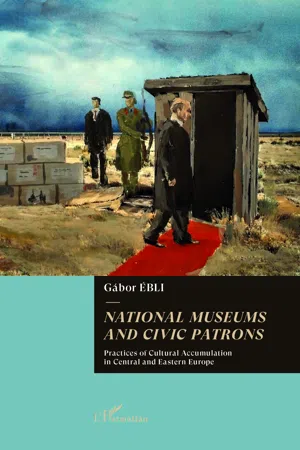
Eager to present their cultural assets, most nations in Eastern Europe, while ruled by foreign empires, were setting up museums from the 19th century on. With many of them attaining national sovereignty in the 20th century only, the museum expansion in this region has been taking new twists and turns to date. Much of this development has relied on private initiatives, even under Communism when defiant cohorts of the suppressed civil society helped art patronage survive. By spanning two-hundred years and integrating numerous case studies, this volume examines public institutions and private collections in their historical progress and in a coherent, unified approach, as equal pillars of national heritage as much as of contemporary art.
eBook - ePub
National museums and civic patrons
Practices of cultural accumulation in Central and Eastern Europe
- 280 pages
- English
- ePUB (mobile friendly)
- Available on iOS & Android
eBook - ePub
National museums and civic patrons
Practices of cultural accumulation in Central and Eastern Europe
About this book
Trusted by 375,005 students
Access to over 1.5 million titles for a fair monthly price.
Study more efficiently using our study tools.
Information
Subtopic
SociologyIndex
Social SciencesI. INTEGRATION AND ISOLATION IN HUNGARIAN MUSEUM HISTORY AND ART PATRONAGE
1. Universal Culture and National Identity.
The Configuration of National Museums in 19th Century Hungary1
Walking up the staircase of the National Museum in Sofia, Bulgaria, visitors come across a set of golden objects from the Avar period. Found in Nagyszentmiklós (1799), a village in the Kingdom of Hungary, today situated in Romania, this treasure is an outstanding example of Migration Period hoards, which may have been hidden by its former owner in the context of the Bulgarian invasion of the territory. Awed by the shimmer of the griffin-decorated jugs and bull-headed drinking bowls, altogether 23 items that weigh 10 kilograms, most visitors may not notice the inscription at the bottom specifying that this is a modern replica of the originals held in the Kunsthistorisches Museum in Vienna. Another replica of the set can be seen in the National Museum of Budapest, where, unlike Sofia, it is shown not as part of the permanent exhibition among originals, but in the corridor. The three museums mobilise different messages of this heritage of the Danube Basin. The original in Vienna is an imperial trophy, proof of the power of the Habsburg Empire and of its cultural institutions, as much as of the artistic creativity of the centuries that had followed the decline of the Roman Empire. The copy in Sofia refers to the heyday of Bulgarian history when early Bulgarians were expanding their state by defeating Avars and other tribes far north of the borders of today’s Bulgaria. In Budapest, the copy is linked to the history of the Hungarian National Museum as the discovery of the treasure two centuries ago had implicitly motivated establishing the museum.
Unearthed by a Serbian inhabitant of the village, the golden vessels came by way of Greek merchants to Pest; from there the Mayor sent them to Vienna.2 A decree established in 1776 guaranteed that archaeological finds were to enrich the k.u.k. Münzund Antikenkabinett. Similarly to the Osztrópatka finds of 1791 and the Szilágysomlyó treasure of 1797, the Avar treasures were sent to the Imperial Treasury, thus raising awareness in Hungary for the need of a museum in the country. The Habsburgs being on the Hungarian throne since the sixteenth century, no royal collections were available, which prompted Count Ferenc Széchényi (1754– 1820) to establish a museum in 1802. Two-hundred years later, in 2002, to celebrate the bi-centenary of his donation, the Hungarian National Museum devoted an exhibition to the Nagyszentmiklós treasure, and the original was lent for this occasion by the Kunsthistorisches Museum. It is a rare occurrence to see a national museum look back upon its foundation by exhibiting a set of works of art that belongs to the leading museum of another country (Austria) and that is related to the history of another population (the Avars). This gesture indicates the mission of the Hungarian National Museum, to be in charge of the treasures of the historical territory of the Hungarian Kingdom.3 While the Avars had dispersed and are not related directly to any of Eastern Europe’s population, their treasure remains a shared, as much as contested, element of the historical identity of several nations. As the following study of the public collections in Hungary aims to show, museums in these countries, as much as elsewhere, often came into being to claim objects from the past of their region – for the sake of the future identity of their nation.
Coming from one of the wealthiest families of the country, Ferenc Széchényi began to collect systematically in the 1780s. An enlightened aristocrat, he had first envisaged a universal collection, planning to offer it to the public from 1786 onwards. In reaction to the centralising politics of the Habsburgs, by the middle of the 1790s he had focused on objects of Hungarian relevance. This was designed to foster the cultural self-appreciation of a nation only just in formation according to the modern sense of the word. In a third step, perhaps in reaction to the archaeological finds ending up in Vienna, he had realised that no matter how ambitious the collecting programme at his estate in Western Hungary was, an official institution was needed to gather and safeguard hungarica – defined at the time as objects of and about Hungarian history and culture. The shift from individual passion to an institutionalised national level implied his determination to save his private programme from potential discontinuation by placing it in an administrative public framework. We can also interpret his decision as an act of political responsibility. Having served on various high duties of the Habsburg Empire, Széchényi was a well-known public figure, who had retired from the active political and administrative career, and returned to public life now with his act of setting up a museum as a private benefactor of a cause for his nation. His move was a model for being influential by far-sighted activity in the terrain of culture, rather than by having high political positions.4
When the Emperor consented to his petition to allow him to offer part of his family collection to the Hungarian public, in November 1802 Széchényi donated to the nation mostly a library, as well as a numismatic collection and a selection of other items, mainly but not exclusively pertaining to Hungarian history, while he retained the bulk of his universal collections for the family. Already as a private collector he had begun publishing the catalogues of his holdings, and the title of the first volume, printed in Sopron in 1799, Catalogus Bibliothecae Hungaricae Francisci Com. Széchényi. Tomus I. Scriptores Hungaros et Rerum Hungaricorum shows that manuscripts, prints and books by Hungarian authors and about Hungary stood in focus.5 The Latin wording of his founding declaration – ‘I irrevocably donate to my dear fatherland and for the use and benefit of the community’ – indicates his wish to further the public good of a country the autonomous statehood of which had been suspended for two-and-a-half centuries and was substituted for this reason by the legally vague, yet emotionally cohesive force of patriotism.6
As the Emperor convened the Hungarian Assembly (seated in Pressburg/ Pozsony, today Bratislava, capital of Slovakia) sparsely, the institutionalisation of the collection moved ahead slowly. The museum functioned until 1807 as a private initiative, when the Hungarian Assembly accepted the donation in Act 1807/XXIV, and by naming the institution Museum Nationale Hungaricum, strengthened its national character. A private mission had shifted to become a public programme, its national character assuming a further meaning: not only had it been founded for the nation, now it was to be sustained by this community. Soon, Act 1808/VIII spelt out that the museum had ‘to incorporate all that can be related to national scholarship [nemzeti literatura]’. As Hungary was a subordinate part of the Habsburg Empire, neither regulation conferred the status of a governmental institution on the museum, which was to function as a public foundation until the Compromise with Austria. Before independent Hungarian government was set up in 1867, allotting a yearly budget to the museum, and turning it into a state museum, over the first 65 years of its existence the museum operated as a non-governmental body, funded by the Hungarian public, and controlled by Habsburg administration.
For the first time in 1812 it received the right to have a say in where findings from Hungarian soil would end up. The institution was gradually heading for partnership with the Viennese Treasury, coming step by step closer to fulfilling its raison d’être, the responsibility for objects of Hungarian relevance. Although this was a prolonged process, its aims seem to have been clear from the beginning to various strata of the Hungarian population, as suggests the declaration of the representatives of Szabolcs County at the 1808 National Assembly. This praised the threefold function of the museum: ‘the refinement of our nation [nemzetünk pallérozására], the blossoming of our mother tongue and the true knowledge of the history of our fatherland’. Just as ‘nation’ [nemzet] repeatedly surfaced in these early documents, so did ‘museum’: being overseen by the Habsburg Governor of Hungary, Palatine Joseph (1776-1847), before 1807 the institution was tentatively named Museum Statuum et Ordinuum Regni Josephinum Palatinale. Széchényi himself had placed greater emphasis on the library, but also appended to it a numismatic collection, and in 1802 formally baptised these Bibliotheca Hungarica cum Numophylacio Familiae Comitum Széchényi Patriae Sacrata. First as a collection of written documents related to Hungary, along with groups of other items, the set-up of the institution was to change fast into mainly a museum in the broad sense, incorporating a library. Early documents often attached a telling adjective to the title of the library, naming it Bibliotheca Regnicolaris, which highlighted that although the Habsburgs were on the throne and therefore this was no royal Hungarian collection, nonetheless it aimed to represent the intellectual heritage of the Kingdom of Hungary. Documents also used the expression Instituto Nationalis, suggesting that the Latin ‘natio’ referred to the community of Hungary while the country did not enjoy autonomous statehood.
This is an essential difference to other early museum foundations in the Habsburg Empire in cities other than Vienna, notably the Joanneum in Graz, 1811 and the Ferdinandeum – established as Tirolisches Nationalmuseum in 1823 – in Innsbruck, which were called into life by members of the Habsburg family and, although showing local specificities of their region, did not stand for a nation as an imagined community.7 When in 1802 Samuel Bruckenthal (1721-1803), former Governor of Transylvania, in his testament donated his valuable European collections of art and science, acquired over decades in Vienna, along with the palace he had erected to house them, to the Saxon community of Transylvania, this museum foundation was closer to Széchényi’s concept, except that the Saxons had never had autonomous statehood in this region. According to Bruckenthal’s will, the Saxon Lutheran community assumed responsibility for the collection in Nagyszeben / Hermannstadt (today Sibiu, Romania) under Habsburg and, from 1867, Hungarian auspices. Bruckenthal’s achievement shows not only the close interrelation of religious, ethnic, regional and political aspects in setting up museums in this part of Europe, but also sheds light on the fact that promoting education and identity in a community by way of museums did not necessarily require collections of a specifically national perspective. Instead, Bruckenthal had chosen to strengthen his Saxon community intellectually in the supra-national sense of the Enlightenment, by calling into life a museum that represented the various strands of European knowledge at the time. For him, the attachment to the European model of collecting, classifying and showing artificialia et naturalia, was just as powerful a tool for elevating his community, a would-be nation, as a clear, but narrow focus on a nation’s own heritage.
Likewise, Széchényi’s donation also included holdings of no Hungarian specificity, for instance antique Roman coins. In the year following his founding act, his wife, Júlia Festetich (1753-1824) gifted her natural science collection to the National Museum in Pest. The same year, the museum opened to the public free of charge in the halls of the Pauline Cloister in downtown Pest. When the first Ordo Dierum was printed – in Latin, Hungarian and German in 1811 – the three pillars of the collections could be clearly identified: ‘constituti sunt Dies Lunae et Jovis pro inspicienda Bibliothecae, Martis et Veneris pro Cimelio Rei nummariae et antiquariae, Mercurii et Sabbathi pro Camera Naturae Productorum’.8 By this time, the institution had evolved from a private entity to a public body, from a library to a museum, and in its collections, from a dominantly, almost exclusively national historical orientation to a broader scientific perspective. The affairs of the museum were slow to progress – its building was completed only by 1847, its financial resources remained scant until 1867 – yet further acquisitions from private collections helped the museum continue to build up a varied collection of partly Hungarian focus and partly wider outlook.
In the largest expansion of the collections in the first, semi-autonomous phase of the museum (1802-1867), Miklós Jankovich (1772-1846), of the landed gentry, sold his vast collections to the museum at a modest price (1832-1836), paid by subscription of the Hungarian nobility.9 This donation, larger in size, broader in scope and superior in quality to the collection given by Széchényi, extended the profile of the museum. It also raised its scholarly standards as Jankovich had grown into a connoisseur and his collections came to be catalogued more systematically than had been the case with earlier acquisitions. Trained by leading professors of his time, Jankovich, after briefly working at the Treasury in Buda, devoted his whole life to collecting on a professional scale. While his prime concern remained the completion of his library, the nearly 70.000 items of which included a large number of manuscripts and first prints, he collected arms and armour, goldsmith’s works, archaeological finds, stone-carvings, musical instruments, jewellery and other artefacts. His interest in this spectrum of what we today call material culture was already manifest in his proclamation-like article, entitled ‘Yearning for Hungarian Antiquities’, where he called upon his ‘Readers in the Hungarian fatherland as well as in Transylvania and other lands affiliated in earlier times with the Hungarian Crown […] to supply us with remnants of all kinds […] of HUNGARIAN ANTIQUITIES [capitalised in the original], be they either in our homeland or abroad, moreover with remnants of the Greek, Roman and barbarian nations left here at home’.10
His other novelty lay in reaching beyond a preference for Hungarian heritage, and embracing the culture of many other “nations”, from Slavs to the Germanspeaking territories, mainly in Central Europe. By retaining the preference for Hungarian heritage, he showed that two strategies of collecting could supplement each other for the National Museum. The continued national focus was to enhance the institution’s role as a custodian of the cultural canon of a nation necessary in building up its identity in the absence of a form of political independence, meanwhile opening the collections to a European dimension was to help fulfil the educational promises of the Enlightenment, and thereby contribute to the modernisation of the nation.
This broader perspective allowed him to collect the documents and objects of various ethnic and religious groups in Hungary.11 Acknowledging multi-ethnic heritage suggested that he regarded the museum to be national in the political, rather than in the ethnic, sense of the word, and wanted it to cater for all nationalities of the Carpathian Basin. His vision of ‘seizing from the whirl of dispersal the heroic deeds, fashions and works of our ancestors […] detecting and returning their MEMORIES [capitalised in the original]’ was so strong that he published in printed form in Pest in 1830 a description of his holdings and his offer to place these in the National Museum, and applied for the directorship of the museum 1844.12 Although he was not given the chance to try his hand at managing the museum he had helped to boost, we recognise him as the second founder of the National Museum, considering that his contribution allowed the institution to develop at the pace that followed.
Jankovich had immediate followers, most spectacularly in an area of collecting that he had newly established in the museum. Paintings and other works of fine art had barely featured in the museum so far, with the exception of a few canvases as part of donations and portraits commissioned for the institution. Having an eye for painting, Jankovich had assembled a Collectio imaginum – as the inventory of 1838 labelled it – including numerous Gothic panel paintings from the Germanic countries, the value of which was even in Germany only being re-discovered at that time. These paintings were scattered in his collection among mixed other works of art, such as Hungarian portraits of lesser aesthetic, and more historical, value. Yet establishing this new direction of collecting in the museum impressed a professional collector of European Old Masters. In 1836, during the year-long session of the Hungarian Assembly that had perfected the Jankovich acquisition, János Pyrker (1772-1847) decided to donate 190 Old Master paintings to the museum. Archbishop of Eger, a city in Northern Hungary, Pyrker had bought most of the works during his time as Patriarch of Venice in the 1820s. Having carried the collection to Eger, in 1830 he opened the South wing of his palace there to the public to show a permanent arrangement of the pictures, but now offered them to the National Museum.13 Pyrker’s offer is best seen not as patriotic. As an Archbishop, he had had a career at various posts in the Habsburg Empire, and shared the overall values of European civilisation and humanism, rather than those of a national Hungarian programme. His intention had been to turn the collection public, and the sudden development of the National Museum persuaded him that this insti...
Table of contents
- Couverture
- 4e de couverture
- Titre
- Copyright
- Table of Contents
- Introduction
- I. Integration and Isolation in Hungarian Museum History and Art Patronage
- II. Current Museum Issues in Central and Eastern Europe
- III. Private Collecting and the Art Market
- IV. Strategies for Collecting Contemporary Art
- Adresse
Frequently asked questions
Yes, you can cancel anytime from the Subscription tab in your account settings on the Perlego website. Your subscription will stay active until the end of your current billing period. Learn how to cancel your subscription
No, books cannot be downloaded as external files, such as PDFs, for use outside of Perlego. However, you can download books within the Perlego app for offline reading on mobile or tablet. Learn how to download books offline
Perlego offers two plans: Essential and Complete
- Essential is ideal for learners and professionals who enjoy exploring a wide range of subjects. Access the Essential Library with 800,000+ trusted titles and best-sellers across business, personal growth, and the humanities. Includes unlimited reading time and Standard Read Aloud voice.
- Complete: Perfect for advanced learners and researchers needing full, unrestricted access. Unlock 1.5M+ books across hundreds of subjects, including academic and specialized titles. The Complete Plan also includes advanced features like Premium Read Aloud and Research Assistant.
We are an online textbook subscription service, where you can get access to an entire online library for less than the price of a single book per month. With over 1.5 million books across 990+ topics, we’ve got you covered! Learn about our mission
Look out for the read-aloud symbol on your next book to see if you can listen to it. The read-aloud tool reads text aloud for you, highlighting the text as it is being read. You can pause it, speed it up and slow it down. Learn more about Read Aloud
Yes! You can use the Perlego app on both iOS and Android devices to read anytime, anywhere — even offline. Perfect for commutes or when you’re on the go.
Please note we cannot support devices running on iOS 13 and Android 7 or earlier. Learn more about using the app
Please note we cannot support devices running on iOS 13 and Android 7 or earlier. Learn more about using the app
Yes, you can access National museums and civic patrons by Gabor Ebli in PDF and/or ePUB format, as well as other popular books in Social Sciences & Sociology. We have over 1.5 million books available in our catalogue for you to explore.