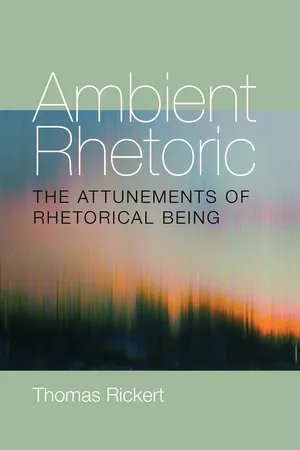
In Ambient Rhetoric, Thomas Rickert seeks to dissolve the boundaries of the rhetorical tradition and its basic dichotomy of subject and object. With the advent of new technologies, new media, and the dispersion of human agency through external information sources, rhetoric can no longer remain tied to the autonomy of human will and cognition as the sole determinants in the discursive act.
Rickert develops the concept of ambience in order to engage all of the elements that comprise the ecologies in which we exist. Culling from Martin Heidegger's hermeneutical phenomenology in Being and Time, Rickert finds the basis for ambience in Heidegger's assertion that humans do not exist in a vacuum; there is a constant and fluid relation to the material, informational, and emotional spaces in which they dwell. Hence, humans are not the exclusive actors in the rhetorical equation; agency can be found in innumerable things, objects, and spaces. As Rickert asserts, it is only after we become attuned to these influences that rhetoric can make a first step toward sufficiency.
Rickert also recalls the foundational Greek philosophical concepts of kairos (time), chora (space/place), and periechon (surroundings) and cites their repurposing by modern and postmodern thinkers as "informational scaffolding" for how we reason, feel, and act. He discusses contemporary theory in cognitive science, rhetoric, and object-oriented philosophy to expand his argument for the essentiality of ambience to the field of rhetoric. Rickert then examines works of ambient music that incorporate natural and artificial sound, spaces, and technologies, finding them to be exemplary of a more fully resonant and experiential media.
In his preface, Rickert compares ambience to the fermenting of wine—how its distinctive flavor can be traced to innumerable factors, including sun, soil, water, region, and grape variety. The environment and company with whom it's consumed further enhance the taste experience. And so it should be with rhetoric—to be considered among all of its influences. As Rickert demonstrates, the larger world that we inhabit (and that inhabits us) must be fully embraced if we are to advance as beings and rhetors within it.
- English
- ePUB (mobile friendly)
- Available on iOS & Android
eBook - ePub
About this book
Information
Subtopic
LinguisticsTable of contents
- Cover Page
- Title Page
- Copyright Page
- Dedication
- Contents
- Preface
- Acknowledgments
- Abbreviations
- Introduction. Circumnavigation: World/Listening/Dwelling
- Part 1. Diffractions of Ambience
- Part 2: Dwelling with Ambience
- Conclusion. Movement, Heidegger's Silence, Disclosure
- Notes
- Works Cited
- Index
Trusted by 375,005 students
Access to over 1.5 million titles for a fair monthly price.
Study more efficiently using our study tools.
Frequently asked questions
Yes, you can cancel anytime from the Subscription tab in your account settings on the Perlego website. Your subscription will stay active until the end of your current billing period. Learn how to cancel your subscription
No, books cannot be downloaded as external files, such as PDFs, for use outside of Perlego. However, you can download books within the Perlego app for offline reading on mobile or tablet. Learn how to download books offline
Perlego offers two plans: Essential and Complete
- Essential is ideal for learners and professionals who enjoy exploring a wide range of subjects. Access the Essential Library with 800,000+ trusted titles and best-sellers across business, personal growth, and the humanities. Includes unlimited reading time and Standard Read Aloud voice.
- Complete: Perfect for advanced learners and researchers needing full, unrestricted access. Unlock 1.5M+ books across hundreds of subjects, including academic and specialized titles. The Complete Plan also includes advanced features like Premium Read Aloud and Research Assistant.
We are an online textbook subscription service, where you can get access to an entire online library for less than the price of a single book per month. With over 1.5 million books across 990+ topics, we’ve got you covered! Learn about our mission
Look out for the read-aloud symbol on your next book to see if you can listen to it. The read-aloud tool reads text aloud for you, highlighting the text as it is being read. You can pause it, speed it up and slow it down. Learn more about Read Aloud
Yes! You can use the Perlego app on both iOS and Android devices to read anytime, anywhere — even offline. Perfect for commutes or when you’re on the go.
Please note we cannot support devices running on iOS 13 and Android 7 or earlier. Learn more about using the app
Please note we cannot support devices running on iOS 13 and Android 7 or earlier. Learn more about using the app
Yes, you can access Ambient Rhetoric by Thomas Rickert,Thomas J. Rickert in PDF and/or ePUB format, as well as other popular books in Languages & Linguistics & Linguistics. We have over 1.5 million books available in our catalogue for you to explore.