- English
- ePUB (mobile friendly)
- Available on iOS & Android
eBook - ePub
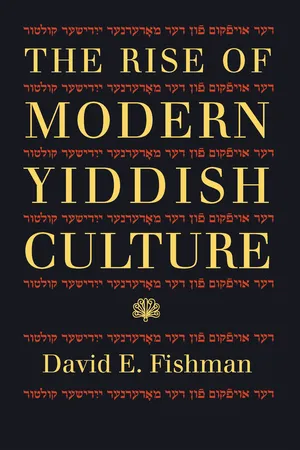
The Rise of Modern Yiddish Culture
About this book
The Rise of Modern Yiddish Culture explores the transformation of Yiddish from a low-status vernacular to the medium of a complex modern culture. David Fishman examines the efforts of East European Jews to establish their linguistic distinctiveness as part of their struggle for national survival in the diaspora. Fishman considers the roots of modern Yiddish culture in social and political conditions in Imperial Tsarist and inter-war Poland, and its relationship to Zionism and Bundism. In so doing, Fishman argues that Yiddish culture enveloped all socioeconomic classes, not just the proletarian base, and considers the emergence, at the turn of the century, of a pro-Yiddish intelligentsia and a Yiddishist movement.As Fishman points out, the rise of Yiddishism was not without controversy. Some believed that the rise of Yiddish represented a shift away from a religious-dominated culture to a completely secular, European one; a Jewish nation held together by language, rather than by land or religious content. Others hoped that Yiddish culture would inherit the moral and national values of the Jewish religious tradition, and that to achieve this result, the Bible and Midrash would need to exist in modern Yiddish translation. Modern Yiddish culture developed in the midst of these opposing concepts.Fishman follows the rise of the culture to its apex, the founding of the Yiddish Scientific Institute (YIVO) in Vilna in 1925, and concludes with the dramatic story of the individual efforts that preserved the books and papers of YIVO during the destruction and annihilation of World War II and in postwar Soviet Lithuania. The Rise of Modern Yiddish Culture, like those efforts, preserves the cultural heritage of east European Jews with thorough research and fresh insights.
Information
Subtopic
European HistoryIndex
HistoryTable of contents
- Cover Page
- Title Page
- Copyright Page
- Contents
- Preface
- Part I: Tsarist Russia
- Part II: Poland Between The World Wars
- Notes
- Selected Bibliography
- Index
Trusted by 375,005 students
Access to over 1.5 million titles for a fair monthly price.
Study more efficiently using our study tools.
Frequently asked questions
Yes, you can cancel anytime from the Subscription tab in your account settings on the Perlego website. Your subscription will stay active until the end of your current billing period. Learn how to cancel your subscription
No, books cannot be downloaded as external files, such as PDFs, for use outside of Perlego. However, you can download books within the Perlego app for offline reading on mobile or tablet. Learn how to download books offline
Perlego offers two plans: Essential and Complete
- Essential is ideal for learners and professionals who enjoy exploring a wide range of subjects. Access the Essential Library with 800,000+ trusted titles and best-sellers across business, personal growth, and the humanities. Includes unlimited reading time and Standard Read Aloud voice.
- Complete: Perfect for advanced learners and researchers needing full, unrestricted access. Unlock 1.5M+ books across hundreds of subjects, including academic and specialized titles. The Complete Plan also includes advanced features like Premium Read Aloud and Research Assistant.
We are an online textbook subscription service, where you can get access to an entire online library for less than the price of a single book per month. With over 1.5 million books across 990+ topics, we’ve got you covered! Learn about our mission
Look out for the read-aloud symbol on your next book to see if you can listen to it. The read-aloud tool reads text aloud for you, highlighting the text as it is being read. You can pause it, speed it up and slow it down. Learn more about Read Aloud
Yes! You can use the Perlego app on both iOS and Android devices to read anytime, anywhere — even offline. Perfect for commutes or when you’re on the go.
Please note we cannot support devices running on iOS 13 and Android 7 or earlier. Learn more about using the app
Please note we cannot support devices running on iOS 13 and Android 7 or earlier. Learn more about using the app
Yes, you can access The Rise of Modern Yiddish Culture by David E. Fishman in PDF and/or ePUB format, as well as other popular books in History & European History. We have over 1.5 million books available in our catalogue for you to explore.