eBook - ePub
The Voice of Science
British Scientists on the Lecture Circuit in Gilded Age America
- English
- ePUB (mobile friendly)
- Available on iOS & Android
eBook - ePub
The Voice of Science
British Scientists on the Lecture Circuit in Gilded Age America
About this book
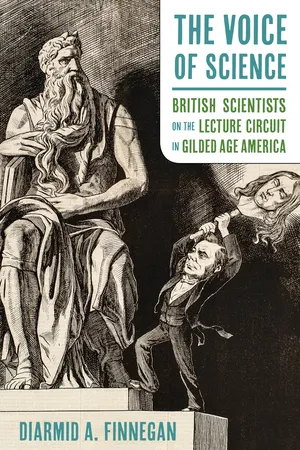
For many in the nineteenth century, the spoken word had a vivacity and power that exceeded other modes of communication. This conviction helped to sustain a diverse and dynamic lecture culture that provided a crucial vehicle for shaping and contesting cultural norms and beliefs. As science increasingly became part of public culture and debate, its spokespersons recognized the need to harness the presumed power of public speech to recommend the moral relevance of scientific ideas and attitudes. With this wider context in mind, The Voice of Science explores the efforts of five celebrity British scientists—John Tyndall, Thomas Henry Huxley, Richard Proctor, Alfred Russel Wallace, and Henry Drummond—to articulate and embody a moral vision of the scientific life on American lecture platforms. These evangelists for science negotiated the fraught but intimate relationship between platform and newsprint culture and faced the demands of audiences searching for meaningful and memorable lecture performances. As Diarmid Finnegan reveals, all five attracted unrivaled attention, provoking responses in the press, from church pulpits, and on other platforms. Their lectures became potent cultural catalysts, provoking far-reaching debate on the consequences and relevance of scientific thought for reconstructing cultural meaning and moral purpose.
Information
Subtopic
Science HistoryIndex
HistoryCHAPTER 1
SCIENCE, SPEECH AND CHARACTER
John Tyndall’s Lectures on Light
It was John Tyndall’s firmly held conviction that character was the wellspring of scientific endeavor. Without a moral charge, and a call to act, his career in science would never have begun. The inspiration came from “three unscientific men,” Thomas Carlyle, Ralph Waldo Emerson and Johann Gottlieb Fichte. They pointed Tyndall to “what I ought to do in a way that caused me to do it.”1 There was something inscrutable about this. The origins of moral impulse terminated in mystery. But even if shrouded in darkness, the decision to act could be released by “the proper word spoken.”2 Tyndall was careful to stress that once activated, the individual will and the feelings that directed it must submit to the scientific method and the physical reality it alone was competent to describe and comprehend. As Tyndall warned in an essay on Goethe’s theory of colors, not doing so risked overextending subjectivity and mingling self and science, to the detriment of both.3 Despite this risk, it was essential to affirm the two cardinal components of the human constitution—the affections and reason. Character was the matrix that bound them together.4
Tyndall’s conviction that good character was the bedrock of culture was widely shared.5 The language of character provided, in Stefan Collini’s words, the “chief structuring vocabulary of political reflection” in Victorian Britain. However, as Collini further observes, character discourse, while pervasive, was fundamentally unstable and ambiguous. Character determined the will and yet was formed by consciously chosen habitual action. It was never clear whether habit or character had primacy and the specter of determinism lurked in the background. This was true of Tyndall’s reflections on the subject. Character, he argued, was inherited, a product “of all the ages that preceded us.”6 We are, he suggested, “indubitably bound by our organisation.”7 He echoed Ralph Waldo Emerson’s definition of character as an “undemonstrated force,” a “natural power” and a preexisting “moral element.”8 At the same time, the unknown “potentialities” of character could be released through the work of clearing away obstacles.9 This work was secular in more than one sense. Like changes in the physical world, it was slow work. But it was also radically independent of religion, which could not alter character.10
Whether philosophically coherent or not, making character fundamental to cultural life raised crucial questions. How does individual character manifest itself? And what was its measure? Emerson’s view, given its influence on Tyndall, is instructive. In his essay on character, Emerson argued that it could be discerned in “a sense of mass.” A person of strong and good character “shall stand stoutly in [their] place.” They will not conform to convention but will present “resistance” and “a new and positive quality.” Evidence could also be found in a person’s bearing. In a man of genius, his character could be looked for, “agitating and embarrassing his demeanour.”11 Tyndall seems to have concurred and was convinced that good character could be emotionally discerned. In an essay published in 1871, he avers that the “affections or sympathies” offer the “best guide [to] . . . moral goodness.” There was, he argued, a “moral congruity between outward goodness and inner life.”12
When it came to lecturing, Tyndall believed that the character of a speaker, or their ability to be true to themselves and speak truthfully about the world, was key to success or failure. As he noted in remarks on his philosophy of education written in 1874, “instruction is only half the battle.” Borrowing directly from Emerson, Tyndall argued that the other half consisted in “provocation,” or the “power of the teacher, in the force of his character.”13 This conviction was articulated again in a lecture delivered at the Birkbeck Institution in October 1884. There Tyndall noted that “knowledge is not all. There may be knowledge without power . . . a power of character must underlie and enforce the work of the intellect.” This was a lesson he had learned as a lecturer at Queenwood College in the late 1840s. Without resolve and a “strong and earnest character,” intellectual “expertness” was but “the bright foam of the wave without its rock shaking momentum.” With character, the lecturer could operate a “lever to lift . . . growing minds.”14 The centrality Tyndall gave to character made attention to self-presentation crucial in the lecture theater. It was vital that a speaker signal his earnestness, sincerity and honest manliness. The ideal teacher should, as Tyndall expressed it, “merge” themselves with their subjects. In doing so, they would energize and animate scientific knowledge and connect emotionally with their audience.15 Lecturing, even on science (or, to follow Tyndall’s logic, especially on science), ought to be a manifestation of character.
In making this argument, Tyndall was, once again, articulating a common view. The importance of oratory in the mid- to late nineteenth century was often tied to the belief that it could be a powerful expression of character. Taking the celebrated orator and Liberal MP John Bright as an example, Patrick Joyce notes how his admirers thought of him as an icon or talisman of the kind of moral self necessary for progress in a democratic age.16 Bright’s reliance on the spoken more than the printed word facilitated this presumption. Oratory was assumed to permit access to inner character, and the orator’s body and words were received as the incarnation of deeply held moral convictions. This was true of lecture culture in the United States in the same period. Emerson, among the most celebrated speakers on the American lecture circuit, provides a noteworthy example. Tom Wright, for instance, has noted that Emerson’s body presented a “beguiling social text” that was scrutinized by his audiences.17 Bonnie O’Neill, too, has noted that “audiences consistently looked to Emerson’s physical presence in the lecture hall for evidence of his moral character.”18
The relations between science, speech and character surfaced in a variety of ways in Tyndall’s lecturing. One of these was his command of his nerves. In Emerson’s influential view, self-restraint was a preeminent trait of good character. This kind of mastery was often associated with the practice of science itself. The strength of will required to patiently investigate the operations of nature without succumbing to personal predilections or passions was relevant to the sphere of moral action.19 That same resolution of will could be applied to the threat of extreme nervousness. Writing shortly after Tyndall’s death, Thomas Henry Huxley noted that one of the secrets of Tyndall’s lecturing career was his abiding fear of public speaking. Huxley confessed that he “had never met with anyone to whom an impending discourse was the occasion of so much mental and physical disturbance.”20 Tyndall himself had described this turmoil when he relayed the feelings he experienced just before the delivery of his first lecture at the Royal Institution in 1853. He felt like “a prisoner going to be hanged.”21 These preperformance nerves were described in a language reminiscent of the terror Tyndall experienced during his Alpine climbs. Controlling such powerful feelings of nervousness represented a remarkable strength of character. When Huxley spoke of Tyndall’s “lecture fever,” he was not seeking to undermine his compatriot. Rather, he was reminding readers of his friend’s marvellous capacity to sublimate his emotions.
The kind of resolve that Tyndall exhibited in the lecture theater did not mean that his manner of speaking was dispassionate in style, tone or substance. On the contrary, his lectures, as one admirer put it, were a “work of enthusiasm,” able to stimulate an audience without risking a loss of control. In his own reflections on effective lecturing, Tyndall confirmed this view. Commenting in 1855 on a discourse delivered by the Italian scholar James Laciata on Dante’s Divine Comedy, Tyndall noted that it gave him “great satisfaction” even while he struggled to determine its worth. The “secret,” he decided, lay in the lecturer’s “assured and animated” delivery and in his ability to “keep . . . sympathy from running into extravagance.”22
A balance between restraint and the free flow of enthusiasm was also perceived in the kinesics of Tyndall’s lecture room performances. As numerous observers noted, in keeping with his suspicion of artifice, Tyndall avoided choreographed bodily action. There was no conscious use of formal gestures to drive home a point or to stir his audience’s passions. He lectured, one report noted, with his hands behind his back, folded across his chest or with his elbows leaning on a lectern.23 A parallel can be drawn here with Emerson, also known for his infrequent use of oratorical gestures. The stillness of his body concentrated the attention of his audience on the power of the words uttered. Emerson’s bodily stillness was not, however, absolute. According to one observer, his left hand was often in motion “as if the intensity of his thought were escaping, like the electricity from a battery.”24 Another auditor noticed a continual rocking motion, with Emerson standing on his tiptoes for emphasis. These subtle movements were frequently interpreted as the natural outflow of his thought rather than as the conscious acts of a polished orator.
Like Emerson’s, Tyndall’s body was rarely motionless. His apparently involuntary movements suggested to some observers a man possessed by his subject. The American editor and popular science lecturer Edward Youmans noted that, while lecturing, Tyndall “was not still a moment, but bending in all possible shapes, as if he had the St. Vitus’s dance twisting his legs together . . . and working and jerking himself in all directions.”25 This outflow of physical energy was read as a sign of Tyndall’s felt commitment to his science. It was a side to Tyndall’s lecturing that was perhaps less often noticed than his perspicacity, cogency and dramatic verbal imagery. But the kinesics of Tyndall’s platform performances was not simply an unconscious physiological reaction unrelated to his lecture. His edgy and fidgety movements created an impression of a performer utterly absorbed by, and devoted to, his subject.
Among the other material indicators of the character of a lecturer was their voice. During John Tyndall’s celebrated career as a lecturer, this conviction was commonplace.26 Speech revealed degrees of civility, authority and authenticity. “Savages” spoke coarsely, the civilized with polish and refinement. A weak, faltering voice suggested timidity or vanity. A clear and confident voice was a mark of intelligence and benevolence. Or as Ralph Waldo Emerson put it in a lecture on eloquence first delivered in 1867, “The voice, like the face, betrays the nature and disposition, and soon indicates what is the range of the speaker’s mind.”27 Such assumptions invested layers of social and cultural meaning in vocal performances and were tied to a pervasive culture of oratory.
Whether or not Tyndall fully subscribed to such views, he was certainly convinced of the need to attend to the effective use of his voice and took steps to ensure he spoke with sufficient volume and verve to be heard and admired. A revealing letter written by the botanist Joseph Hooker to Charles Darwin in 1866 offers some confirmation of this point. Hooker described an encounter with Tyndall shortly before Hooker was due to give an evening discourse as part of the program of public lectures organized for that year’s meeting of the British Association:
He [Tyndall] came up to me in the forenoon, evidently most anxious for my success, & questioned me about it. When I told him it was a written discourse, & that I intended to read it, his countenance fell & I saw he was cut.—he turned away first, but came back & with great delicacy & loving kindness gave me some hints; to learn passages by heart &c—(I had done this copiously already) & to put myself en rapport with the audience &c &c. I saw in short that he prognosticated a dead failure, & I spared no pains that afternoon in preparing myself to succeed in his eyes. I hope I did.28
Tyndall was clearly agitated, caught between a desire not to offend or patronize and an aspiration to offer advice about what made for an effective vocal performance. It was the latter that won out. By this time, Tyndall was acknowledged by people as prominent within science as Hooker and Darwin to be a consummate public lecturer. Still, according to the remembrance of at least one commentator, even Tyndall was not always successful. In an obituary, the zoologist Chalmers Mitchell noted that Tyndall’s voice had been “not notably sonorous” and that “on several famous occasions his efforts to be heard were unsuccessful.”29 Criticisms of Tyndall’s voice were, however, rare. Like everything else about his lectures, he made careful preparations to ensure effective vocal delivery. To take just one example, before delivering a lecture on matter and force to working men during the meeting of the British Association in Dundee in 1867, Tyndall positioned himself “at the most distant point from the platform, to get some idea of the strength of voice necessary to fill it.”30 His expertise in acoustics placed Tyndall in a good position to ensure his voice was sufficiently strong to avoid charges that he lacked vocal strength and, by extension, strength of conviction.
As well as addressing concerns about volume, Tyndall was conscious of judgements that might be made based on his accent. Writing in 1862, Edward Youmans observed that while Tyndall had “Irish blood and temperament,” there was no indication of an Irish brogue when he spoke.31 During his American lecture tour ten years later, his “strong English accent” attracted comment, something that amused close friends like Thomas Henry Huxley, either because his accent was so obviously Irish not English or because Tyndall’s efforts to efface his origins by altering his accent made them chuckle.32 In 1886 Tyndall’s Irish accent was detected in the last lecture he delivered at the Royal Institution, but only “now and then.”33 In at least some people’s hearing, Tyndall’s transformation from the son of an Irish shoemaker to England’s most celebrated science lecturer could be detected in his voice.
In addition to accent, the tone of Tyndall’s voice was subject to scrutiny. On at least one occasion, a sharp rebuke directed at one of his technical assistants, William Barrett, not only sparked a breakdown in relations between the two men (and one that ultimately led to Barrett’s resignation) but also, according at least to Barrett, “caused a ‘jar’ in the audience.” This incident threatened Tyndall’s standing as a speaker of charm and grace and he acknowledged that his habit of complaining “in a low tone” when something was not right with an experiment was a bad one that “must be got over.”34 The more significant threat, however, was to Barrett, whose reputation as a competent experimentalist in his own right was still in the making. A public admonishment from Tyndall could do serious damage and demonstrated the influence of the inflections of his voice, even those apparently incidental to the lecture being delivered.
The paralinguistic indicators of character ran alongside, and at times reinforced, signals found in the cognitive content of Tyndall’s lectures. One of the important considerations in composing them was the fine line between manly and offensive speech. The difficulties of this task were most acutely felt when Tyndall stepped beyond what he took to be strictly scientific concerns to comment on subjects of a more controversial nature. It might be argued, however, that Tyndall’s reputation as a brilliant and brave lecturer was not so much endangered by his forays into public controversies as, in part, built upon it. There are reasons to argue that this was...
Table of contents
- Cover Page
- Title Page
- Copyright Page
- Dedication
- Contents
- Preface and Acknowledgments
- Introduction: Science Lectures in an Age of Oratory
- Chapter 1: Science, Speech and Character: John Tyndall’s Lectures on Light
- Chapter 2: Reason’s Rhetor: The Scientific Oratory of Thomas Henry Huxley
- Chapter 3: Richard Proctor and the Tempo of Science
- Chapter 4: Alfred Russel Wallace, Anticelebrity
- Chapter 5: Evolution’s Evangelist: The American Addresses of Henry Drummond
- Conclusion: Science, Historically Speaking
- Notes
- Bibliography
- Index
Trusted by 375,005 students
Access to over 1.5 million titles for a fair monthly price.
Study more efficiently using our study tools.
Frequently asked questions
Yes, you can cancel anytime from the Subscription tab in your account settings on the Perlego website. Your subscription will stay active until the end of your current billing period. Learn how to cancel your subscription
No, books cannot be downloaded as external files, such as PDFs, for use outside of Perlego. However, you can download books within the Perlego app for offline reading on mobile or tablet. Learn how to download books offline
Perlego offers two plans: Essential and Complete
- Essential is ideal for learners and professionals who enjoy exploring a wide range of subjects. Access the Essential Library with 800,000+ trusted titles and best-sellers across business, personal growth, and the humanities. Includes unlimited reading time and Standard Read Aloud voice.
- Complete: Perfect for advanced learners and researchers needing full, unrestricted access. Unlock 1.5M+ books across hundreds of subjects, including academic and specialized titles. The Complete Plan also includes advanced features like Premium Read Aloud and Research Assistant.
We are an online textbook subscription service, where you can get access to an entire online library for less than the price of a single book per month. With over 1.5 million books across 990+ topics, we’ve got you covered! Learn about our mission
Look out for the read-aloud symbol on your next book to see if you can listen to it. The read-aloud tool reads text aloud for you, highlighting the text as it is being read. You can pause it, speed it up and slow it down. Learn more about Read Aloud
Yes! You can use the Perlego app on both iOS and Android devices to read anytime, anywhere — even offline. Perfect for commutes or when you’re on the go.
Please note we cannot support devices running on iOS 13 and Android 7 or earlier. Learn more about using the app
Please note we cannot support devices running on iOS 13 and Android 7 or earlier. Learn more about using the app
Yes, you can access The Voice of Science by Diarmid A. Finnegan in PDF and/or ePUB format, as well as other popular books in History & Science History. We have over 1.5 million books available in our catalogue for you to explore.