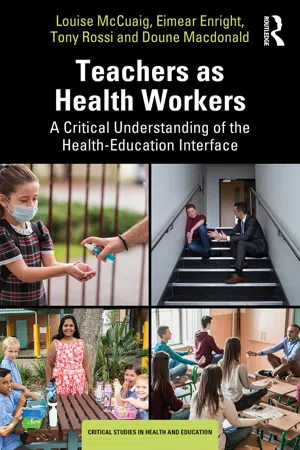
Since the introduction of mass schooling across the globe, schools and their teachers have delivered programs of health education and health promotion according to policy expectations, curriculum arrangements or school pastoral care (Hunter, 1994; Gard & Pluim, 2014; Kirk, 1998). For many students in wealthy countries, the concept of a school nurse would not be unfamiliar nor would dental inspections or checks for head lice and, if we travel back far enough, postural checks. Some 40 years ago, Aldridge (1981) remarked on the increased expectancy for schools to assume responsibility for the health of children, a role she argued would fall to teachers whose training had provided little to no preparation for these responsibilities. Aldridge’s comments were not only prophetic, but as the incidence and breadth of health concerns has expanded exponentially, so too has the expectation for/on schools to contribute to better health through health promotion and health education strategies. A clear consequence of this is the commensurate increase in the ‘health workload’ on teachers (see Rossi et al., 2016). In some respects, this has evolved gradually through a process of incrementalism, where changes are small and emerge over extended time periods.
More recently, however, schools have been identified as being on the front line of health promotion. From the 1990s onwards, key agencies in various jurisdictions have emphasised the role of schools in the general well-being of the nation. For example, a joint statement by the American Heart Association, the American Cancer Society and the American Diabetes Association declared that ‘Not only do schools provide critical outlets to reach millions of children and adolescents to promote lifelong healthy behaviors, they also provide a place for students to engage in these behaviors, such as eating healthy and participating in physical activity’ (ACS, ADA, AHA, n.d., para. 2). In Australia, where this book’s research project took place, health sector advocates have argued that the ‘interaction between schools and young people, and the overall experience of attending school, provides unique opportunities for health promotion which can be sustained and reinforced over time’ (National Health and Medical Research Council [NHMRC], 1996, p. 1). The later National Health and Hospitals Reform Commission [NHHRC] (2009) stated that one way to strengthen consumer engagement within a health system is to ensure that schooling is integral to health promotion.
Against this background of an increasingly explicit concern about the health of school-age children and young adults, we introduced the term ‘teachers’ health work’ into the literature (see Rossi et al., 2016). Originally, our use of this term was speculative. We felt that if schools were being positioned on the health promotion front line, then, it stood to reason that teachers were being called upon to invest increasing attention to the health and well-being of the students in their care. Moreover, a strengthening advocacy for healthy schools and schooling, and the role of these in shaping productive, high-achieving citizens, make it prudent and compelling to pose an important philosophical question. If the primary purpose of teachers’ work is educative, is it appropriate for teachers to be engaged in work that might be considered peripheral to their purpose and often beyond the realm of teachers’ professional preparation? If deemed appropriate, then it is imperative we understand what and how much ‘health work’ is being undertaken by teachers.
Addressing this imperative was the driver of our research agenda and the rationale for this book. We suggest that if the work of teachers contributes profoundly to the well-being of school children and represents a significant investment in national well-being, then it is vital we better understand the conditions that enable or constrain this work. As Westhall (2009) indicates, cross-sectoral relationships and partnerships are increasingly blurring the organisational boundaries between various service sectors. Consequently, we contend that the assumed membrane separating young people’s education and health, and the responsibility for securing these, is more and more challenging to discern.
It is within this complex milieu of policies and expectations for schools to educate healthy citizens that the Teachers as Health Workers project sought answers to the following research questions:
- What do national and state policies prescribe as the health work to be undertaken in and by schools?
- What health work do teachers do and how much time and resources are committed to it?
- How prepared are teachers to undertake this work and upon what resources (intellectual, personal, external organisations) they draw to enact this work?
- How does the field of education interface with the field of health?
- What bio-pedagogical practices are employed by teachers in their efforts to do health work and how are they executed?
The remainder of this chapter delves a little deeper into the intersections of schooling, health and teachers’ work and the key theoretical concepts that we have employed to consider these intersections. It concludes with an overview of the book and high-level responses to our research questions.
Teachers’ health work: what’s the problem?
More than a decade ago, the ‘World Health Organisation (WHO) declared a crisis in the global health workforce, characterised by severe shortages, inappropriate skill mixes, and gaps in service coverage’ (Olaniran et al., 2017, p. 1). Recent projections indicate ‘that the supply of health workers will not keep pace for about half the countries in the world. By 2030, we estimate a net global demand-based shortage of over 15 million workers’ (Liu et al., 2017...