- 249 pages
- English
- ePUB (mobile friendly)
- Available on iOS & Android
eBook - ePub
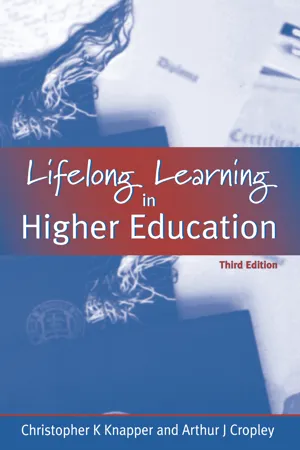
Lifelong Learning in Higher Education
About this book
This text examines how colleges and universities might respond to the increasing need for people to take responsibility for their own education and to remain motivated. It devotes attention to teaching methods, organizational structures and the goals of higher education.
Information
1Lifelong learning: basic concepts
DOI: 10.4324/9780203969281-1
The basic idea behind the term ‘lifelong learning’ is simple. It is that deliberate learning can and should occur throughout each person’s lifetime. This view is by no means new It is found in ancient writings, and was emphasized in the works of earlier European educational theorists such as Comenius and Matthew Arnold. The term ‘lifelong education appeared in English language writings about 75 years ago, and many of the main contemporary ideas about lifelong education were stated immediately after the Second World War (Jacks, 1946). Since about 1970 the idea has been the object of intense attention, resulting in a flood of conferences and publications, as well as calls for its implementation from politicians, industrialists and educators. These have occurred in waves, with peaks and troughs of attention alternating over the last 30 years. In both 1985 and 1991 – in the first and second editions of this book – we reviewed discussions of lifelong learning since the mid-1960s, and concluded that thinking had advanced sufficiently to define a new educational principle. Despite this, in 1991 we continued to refer to emphasis on lifelong learning as ‘an emerging approach’. There was substantial theory and widespread discussion, but effects on practice were superficial.
Recently there has been a renewed peak of interest at the level of international policy-making bodies. The European Union (EU) designated 1996 ‘the year of lifelong learning’. The meeting of the education ministers of the Organization for Economic Co-operation and Development (OECD) in January of the same year used the slogan ‘Making lifelong learning a reality for all’. The 1996 report of the United Nations Educational, Scientific, and Cultural Organization’s (Unesco’s) International Commission on Education for the Twenty-first Century adopted ‘learning throughout life’ as its key concept. At their meeting in Cologne in June 1999 the members of the Group of Eight (G8) (the UK, Canada, France, Germany, Italy, Japan, Russia and the USA – essentially the world’s greatest powers) agreed to promote mass education throughout the world, and named ‘lifelong retraining’ as a major priority.
In addition to being the subject of statements of political will, lifelong learning has also established itself as a topic of scholarly interest. There are numerous lifelong learning World Wide Web sites and several journals that include the term in their titles (eg The International Journal of Lifelong Learning, The Journal of Continuing Engineering Education and Life-Long Learning), and at least one Professor of Lifelong Learning (at Birkbeck College of the University of London). Thus, it is tempting to assume that lifelong learning has well and truly arrived. Indeed, Hasan (1996, p 33) came to the optimistic conclusion that ‘lifelong learning has become a pivotal framework for educational reforms in a large number of countries’. However, while it is true that the idea is an ancient one that has received considerable attention in the last 75 years and has aroused renewed interest in the last few, our observation of higher education, especially in Western societies, suggests it is premature to draw overly optimistic conclusions.
The first step in answering the question of whether lifelong learning has now become the accepted norm in practice – as against rhetoric – involves examining the felt need for change in education that led to calls for the adoption of lifelong learning. An assessment of how well these needs are being met would help in judging the extent to which the implementation of lifelong learning has actually occurred. Unesco, the OECD and the EU all foresee widespread, if not worldwide, application of the principle. Thus, it is also interesting to ask whether it is possible to work out a concept of lifelong learning that transcends regional and cultural traditions, needs and interests.
The focus of this book
Focus on practice
About 25 years ago, Cropley (1977) published an early attempt to sort out the practical issues arising from the theory of lifelong learning. He dealt with psychological questions such as whether adults really are capable of or willing to learn throughout life, the differences between adults and children as learners and the effects of school learning on adult learning. He also developed ‘action guidelines’ for a school curriculum oriented towards fostering lifelong learning (see Chapter 3 for an example). These guidelines related to, among other things, learning materials, teacher activities, pupil activities and assessment methods. Subsequently, the present authors looked at the implications of adopting the principle of lifelong learning for schools (Cropley and Knapper, 1982), teacher training (Cropley, 1981) and higher education (Cropley and Knapper, 1983). The question we posed was: ‘What would schools, teachers’ colleges and universities be like within a system dedicated to lifelong learning?’
In this book, we do not ignore the conceptual, social and political debate about lifelong learning. Especially in the first three chapters, many such issues are reviewed, because they were at the heart of the surge of interest in modern times and cannot be regarded as trivial. However, here we go beyond theoretical discussions to consider what adoption of the idea of lifelong learning would mean for the practice of teaching and learning. This includes issues that are psychological, paedagogical and organizational. For example, do adults learn differently from children and, if so, what are the implications for a theory and definition of lifelong learning? Does technology facilitate lifelong learning, and in what ways? How should institutions of lifelong learning be coordinated with one another, who is to be given access to such institutions and how are they to be financed? The dominant orientation of this book is psychological, which is scarcely surprising in view of the fact that both authors are psychologists. However, other perspectives are by no means ignored, especially as they relate to issues of effective teaching and learning.
Focus on higher education
Higher education merits special study because of its particular importance in helping to develop and implement a system of lifelong education, and thus provide the necessary organizational framework for lifelong learning. This importance derives from the prestige and influence of universities and colleges within the educational systems of most countries and from their role in developing theory and conducting research. What universities teach, investigate and promote influences knowledge, attitudes, values and practices in many areas of society. Tertiary institutions educate the people who will later shape the development of society (see later discussions of change and lifelong learning).
They also play a major role in the training of teachers, where they provide not only knowledge, but also theoretical principles (such as belief in the importance of lifelong learning), and practical experience. In addition, university teachers can serve as important role models by employing teaching strategies that are oriented to learning throughout life. Higher education is what Williams (1977, p 17) referred to as the ‘dominant force’ in education, or the National Research Council (1996) called the ‘springboard’ for entering the world of work. As a result, it seems plausible that learners’ experiences in higher education will have ramifications for the practice of teaching and learning at all levels.
Focus on traditional learners in traditional institutions
More or less inevitably, a major thrust of this book is provision of higher education to new groups of learners, especially those who are often called ‘mature-age’ students – people beyond the conventional age for tertiary education. At present, taking a worldwide perspective, this group is still dominated by people who have already had a high level of contact with the formal educational system and are returning after a break during which they pursued a career or raised a family (van der Kamp and Scheeren, 1997). At the same time, the proportion of people who have never previously experienced tertiary education has risen in recent years.
However, our main focus here is not on these special learners or on special programmes and institutions to meet their needs. Rather, we are concerned principally with the implications of lifelong learning for conventional universities and traditional students. We see a role for universities not only as providers of lifelong learning opportunities but also as an important preparation for lifelong learning in other settings. In this sense, this study differs sharply from many other discussions of lifelong learning, which have been primarily interested in non-traditional learners and new institutions that may serve them better.
The educational crisis
According to Coombs (1982, p 145), education in general has been facing a crisis since the late 1960s. This has intensified, and has yielded ‘critical educational challenges’ that are making themselves felt not only in highly industrialized Western European and North American societies, but in virtually all nations. Since 1950, Coombs has documented the huge increases in the number of potential learners worldwide. He also drew attention to continuing social inequalities in access to higher education, and (p 145) called for ‘a much more comprehensive, flexible and innovative educational strategy in the coming two decades’. Such a strategy would involve ‘radical changes in conventional educational thinking, methods, organizations, structures and practices’. In other words, perceived shortcomings in existing education mean that a new approach is needed, touching upon virtually all aspects of systematic education.
The challenges observed by Coombs included:
- changed learning needs (more people wanting to learn different things);
- problems of financing (reduced funding, demands for more effective use of resources);
- increased concern about democratization and fairness (elimination of socioeconomic, gender and geographic inequities);
- a perceived need for closer ties to day-to-day life (harmonizing education and culture, relating education to work, linking education to peace and preservation of the ecosystem);
- a need for changed teaching and learning strategies (flexible and democratic educational planning, more self-direction in learning, team learning, problem-based learning, learning through case studies).
More recent challenges arise from:
- the emergence of new forms of communication other than written language;
- new methods of educational delivery, such as home-based learning or learning via the World Wide Web;
- changing demands of work, such as the need for periodic retraining as existing job skills become obsolete;
- new career patterns, such as women alternating work and child-raising;
- home-based work;
- changing clientele for education, in particular large increases in mature-age students resulting from both the work and career changes already mentioned and also from demographic trends.
Coombs demanded radical change within 20 years. This period is coming to its end, but the challenges remain. At the same time, Lynch (1982) applied the idea of an educational crisis directly to higher education. He spoke of a ‘legitimation crisis’ (p 8), and listed some of its dimensions, including:
- financial stringencies and related cutbacks in higher education;
- failure of higher education to accommodate later practical training needs of individuals or the needs of industry;
- a lack of response of post-school education to industrial and economic
- inability of higher education to take account of rising unemployment and the educational needs which this gives rise to;
- the need for higher education to offer some kind of adaptive response to social unrest and growing alienation among the young.
Lynch argued that what is needed in higher education is not simply more of the same, albeit with a few minor modifications, but ‘wider structural and systematic change’ (p 12). Echoing this view, Mezirow (1990) endorsed the earlier call by Botkin, Elmandjra and Malitza (1979, p 10) for education ‘... that can bring change, renewal, restructuring ...’. More recently, the Wingspread Group on Higher Education (Johnson Founda-tion, 1993) called for ‘a simultaneous renewal’ of school and higher level education, and linked this to the organization of learning over time by arguing that the two should form ‘one continuous learning system’. Resnick and Wirth (1996, p 1) also emphasized the importance of the temporal aspect, and identified the central ideal of recent educational theory as ‘the idea of maximum access to education for all, of keeping options open for everyone well into adulthood’ (our italics). Although their discussions focused on linking school and work, Resnick and Wirth, without mentioning it specifically, summarized clearly what the changes demanded by Lynch should lead to: lifelong learning. Unfortunately, they were forced to conclude that ‘the dream has turned sour’. In other words, the task still lies before us. What is required are forms of education that will solve what Lynch called the crisis or, in the terms of Resnick and Wirth, will restore the dream.
Lifelong education: an alternative approach
Almost 30 years ago, Faure (1972) suggested that the concept of lifelong education offered a possible solution to the crisis described above, and indeed should be adopted as the guiding principle for reforming education at all levels and in all countries. Since then the notion of lifelong education has been the subject of considerable discussion, and has been spelt out in terms of its implications for schooling, teacher training and adult education. Its interest for the present discussion derives from the fact that lifelong education is a set of organizational, financial and didactic principles established with the aim of fostering lifelong learning. Life-long education is the system and lifelong learning is the content, the goal and the result.
The meaning of lifelong education
Different writers use the term ‘lifelong education in various ways. In Europe, the concept has most frequently been associated with the linking of learning and work, especially through provision of paid educational leave, recurrent education or open learning – as exemplified by the British Open University. In the USA it was initially regarded as simply a new term for traditional adult education (as in the 1976 Lifelong Learning Act). However, more recent discussions in that country have also promoted lifelong education as a way of responding to changes in the workplace (Resnick and Wirth, 1996), and have suggested that education in schools and universities should ‘proceed in tandem’ with changes in the organization of work.
In a more conceptual vein, Rüegg (1974, p 7) referred to lifelong education as ‘a utopian idea’ whose main function is stimulating people to think critically about learning. As Long (1974) pointed out, the idea of lifelong education also reflects a belief in ‘the mystique of education’: since education is self-evidently good, lifelong education must be even better! At the same time the idea was criticized by Pucheu (1974, p 375) as an ‘elastic concept’ which means whatever the person using the term wants it to mean.
One way of looking at lifelong education is to regard it as a rationalization of a number of existing trends in contemporary educational theory and practice. These emerged in a variety of settings without necessarily any reference to the concept as defined by Faure and others. The trends include expansion of educational services beyond the conventional school ages (ie for adults and for preschool children), greater interest in education as an instrument for improving the quality of life, concern for the development of forms of education that are more closely linked with the needs of everyday life, participation in decisions about education by workers, parents, and members of the public, greater opennes...
Table of contents
- Cover Page
- Half-Title Page
- Title Page
- Copyright Page
- Table of Contents
- Preface
- List of figures
- List of tables
- Preface to the third edition
- Preface to the second edition
- Chapter 1 Lifelong learning: basic concepts
- Chapter 2 Lifelong education as a system
- Chapter 3 The nature of lifelong learning
- Chapter 4 Lifelong learning and higher education institutions
- Chapter 5 Lifelong learning and instructional methods: some promising approaches
- Chapter 6 Changing institutions to lifelong education
- Chapter 7 Evaluating lifelong learning
- Chapter 8 A stocktaking: continuing problems in implementing lifelong education
- Appendix Promoting lifelong learning: some practical ideas for academics
- References
- Index
Trusted by 375,005 students
Access to over 1.5 million titles for a fair monthly price.
Study more efficiently using our study tools.
Frequently asked questions
Yes, you can cancel anytime from the Subscription tab in your account settings on the Perlego website. Your subscription will stay active until the end of your current billing period. Learn how to cancel your subscription
No, books cannot be downloaded as external files, such as PDFs, for use outside of Perlego. However, you can download books within the Perlego app for offline reading on mobile or tablet. Learn how to download books offline
Perlego offers two plans: Essential and Complete
- Essential is ideal for learners and professionals who enjoy exploring a wide range of subjects. Access the Essential Library with 800,000+ trusted titles and best-sellers across business, personal growth, and the humanities. Includes unlimited reading time and Standard Read Aloud voice.
- Complete: Perfect for advanced learners and researchers needing full, unrestricted access. Unlock 1.5M+ books across hundreds of subjects, including academic and specialized titles. The Complete Plan also includes advanced features like Premium Read Aloud and Research Assistant.
We are an online textbook subscription service, where you can get access to an entire online library for less than the price of a single book per month. With over 1.5 million books across 990+ topics, we’ve got you covered! Learn about our mission
Look out for the read-aloud symbol on your next book to see if you can listen to it. The read-aloud tool reads text aloud for you, highlighting the text as it is being read. You can pause it, speed it up and slow it down. Learn more about Read Aloud
Yes! You can use the Perlego app on both iOS and Android devices to read anytime, anywhere — even offline. Perfect for commutes or when you’re on the go.
Please note we cannot support devices running on iOS 13 and Android 7 or earlier. Learn more about using the app
Please note we cannot support devices running on iOS 13 and Android 7 or earlier. Learn more about using the app
Yes, you can access Lifelong Learning in Higher Education by A Cropley,Chris Knapper in PDF and/or ePUB format, as well as other popular books in Education & Education General. We have over 1.5 million books available in our catalogue for you to explore.