The period of Roman history on which we now enter is, like so many that had preceded it, a period of revolt, directly aimed against the existing conditions of society and, through the means taken to satisfy the fresh wants and to alleviate the suddenly realised, if not suddenly created, miseries of the time, indirectly affecting the structure of the body politic. The difference between the social movement of the present and that of the past may be justly described as one of degree, in so far as there was not a single element of discontent visible in the revolution commencing with the Gracchi and ending with Caesar that had not been present in the earlier epochs of social and political agitation. The burden of military service, the curse of debt, the poverty of an agrarian proletariate, the hunger for land, the striving of the artisan and the merchant after better conditions of labour and of trade—the separate cries of discontent that find their unison in a protest against the monopoly of office and the narrow or selfish rule of a dominant class, and thus gain a significance as much political as social—all these plaints had filled the air at the time when Caius Licinius near the middle of the fourth century, and Appius Claudius at its close, evolved their projects of reform. The cycle of a nation's history can indeed never be broken as long as the character of the nation remains the same. And the average Roman of the middle of the second century before our era[1] was in all essential particulars the Roman of the times of Appius and of Licinius, or even of the epoch when the ten commissioners had published the Tables which were to stamp its perpetual character on Roman law. He was in his business relations either oppressor or oppressed, either hammer or anvil. In his private life he was an individualist whose sympathies were limited to the narrow circle of his dependants; he was a trader and a financier whose humanitarian instincts were subordinated to a code of purely commercial morality, and who valued equity chiefly because it presented the line of least resistance and facilitated the conduct of his industrial operations. Like all individualists, he was something of an anarchist, filled with the idea, which appeared on every page of the record of his ancestors and the history of his State, that self-help was the divinely given means of securing right, that true social order was the issue of conflicting claims pushed to their breaking point until a temporary compromise was agreed on by the weary combatants; but he was hampered in his democratic leanings by the knowledge that democracy is the fruit of individual self-restraint and subordination to the common will—qualities of which he could not boast and symbols of a prize which he would not have cared to attain at the expense of his peculiar ideas of personal freedom—and he was forced, in consequence of this abnegation, to submit to an executive government as strong, one might almost say as tyrannous, as any which a Republic has ever displayed—a government which was a product of the restless spirit of self-assertion and self-aggrandisement which the Roman felt in himself, and therefore had sufficient reason to suspect in others.
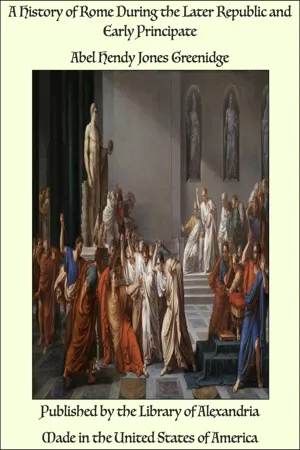
eBook - ePub
A History of Rome During the Later Republic and Early Principate
- 213 pages
- English
- ePUB (mobile friendly)
- Available on iOS & Android
eBook - ePub
A History of Rome During the Later Republic and Early Principate
About this book
Information
Subtopic
Literature GeneralIndex
LiteratureTable of contents
- A History of Rome During the late Republic and Early Principate
- By Abel Hendy Jones Greenidge
Trusted by 375,005 students
Access to over 1.5 million titles for a fair monthly price.
Study more efficiently using our study tools.
Frequently asked questions
Yes, you can cancel anytime from the Subscription tab in your account settings on the Perlego website. Your subscription will stay active until the end of your current billing period. Learn how to cancel your subscription
No, books cannot be downloaded as external files, such as PDFs, for use outside of Perlego. However, you can download books within the Perlego app for offline reading on mobile or tablet. Learn how to download books offline
Perlego offers two plans: Essential and Complete
- Essential is ideal for learners and professionals who enjoy exploring a wide range of subjects. Access the Essential Library with 800,000+ trusted titles and best-sellers across business, personal growth, and the humanities. Includes unlimited reading time and Standard Read Aloud voice.
- Complete: Perfect for advanced learners and researchers needing full, unrestricted access. Unlock 1.5M+ books across hundreds of subjects, including academic and specialized titles. The Complete Plan also includes advanced features like Premium Read Aloud and Research Assistant.
We are an online textbook subscription service, where you can get access to an entire online library for less than the price of a single book per month. With over 1.5 million books across 990+ topics, we’ve got you covered! Learn about our mission
Look out for the read-aloud symbol on your next book to see if you can listen to it. The read-aloud tool reads text aloud for you, highlighting the text as it is being read. You can pause it, speed it up and slow it down. Learn more about Read Aloud
Yes! You can use the Perlego app on both iOS and Android devices to read anytime, anywhere — even offline. Perfect for commutes or when you’re on the go.
Please note we cannot support devices running on iOS 13 and Android 7 or earlier. Learn more about using the app
Please note we cannot support devices running on iOS 13 and Android 7 or earlier. Learn more about using the app
Yes, you can access A History of Rome During the Later Republic and Early Principate by Abel Hendy Jones Greenidge in PDF and/or ePUB format, as well as other popular books in Literature & Literature General. We have over 1.5 million books available in our catalogue for you to explore.