eBook - ePub
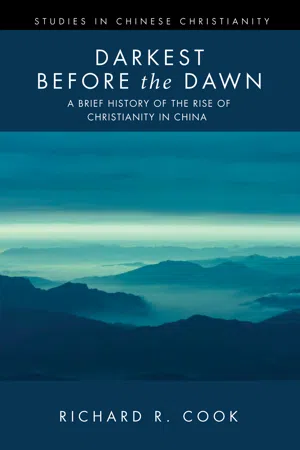
Darkest before the Dawn
A Brief History of the Rise of Christianity in China
- 230 pages
- English
- ePUB (mobile friendly)
- Available on iOS & Android
eBook - ePub
About this book
The Christian church was always destined to find its way to China. Long before the birth of the church, China existed, coalescing around profound philosophical concepts and powerful cultural symbols. It developed into a dynamic and enduring civilization. In time, Christian missionaries arrived on its shores, driven to bring the gospel to this people. This book starts with the story of that journey: the arrival of the missionaries who planted the seeds of the gospel in Chinese soil. As the seeds sprouted and grew, a new story of a unique and distinct Chinese church began. The epic narrative opens from uncertain beginnings in darkness, passes through intense hardship and years of struggle, and culminates with the triumphal emergence of the Chinese church from the shadows into the light of the global stage.
Information
Topic
Theology & ReligionSubtopic
Christian MinistryPart One
Pre-Protestant Missions (Beginnings–1807)
Where does the story of Chinese church history begin?
The logical place to begin might be with the first arrival of Christianity in China, and numerous textbooks and courses do begin with the arrival of the Nestorian1 Christians in the seventh century during the Tang Dynasty. However, the church started by Alopen did not survive. Likewise, the Roman Catholic mission work inaugurated in the thirteenth century by the Franciscan missionary John of Montecorvino during the Yuan Dynasty did not survive. Later, Roman Catholics would need to plant churches once again in the sixteenth century during the Ming Dynasty.
In this book, the first chapter will cover the story of Alopen and the Nestorians during the Tang Dynasty, and the second chapter will move on to the Yuan Dynasty and the arrival of the Franciscans.
A second sensible starting point might be the story of the arrival of the Jesuit missionary Matteo Ricci into China in the sixteenth century. His missionary endeavors, begun in 1582, planted the Roman Catholic Church in China that survives today. Chapter 3 tells of the efforts of Ricci and the Jesuits.
Another way to conceive of the story, however, is to see Chinese Christianity as continuous with early church history. Thus, a study of Chinese church history could start during the early church, the first three centuries of Christianity. The story of the early church raises intriguing questions for Chinese Christians today. For instance, why did the gospel first go to the West rather than the East? There is scholarship that shows that the Silk Route was open during the first century, and so it is not impossible that Christian missionaries could have traversed from Jerusalem all the way to China. The apostle Thomas is reported to have gone as far as India in the first century, but there is no record of any missionaries moving on to China.
By the fourth century, the Roman Empire had adopted Christianity, and yet the gospel still had not spread to China. What was God’s plan for China? China, it seemed, was ripe for a new religion, and Buddhist emissaries from India had successfully planted Buddhism in China during the first and second centuries because the Silk Route was, in fact, open. Buddhism persisted in China for several centuries, and during the seventh and eighth centuries, during the Tang Dynasty, Buddhism became part of the indigenous religious culture in China. If Christianity had spread to the East rather than the West during the first few centuries, one can imagine a very different world today.
Chinese church history ultimately begins with the birth of the church at Pentecost in Acts 2. From its very beginning, Christianity was a missionary faith. Paul, the missionary to the Gentiles, carried the Christian church from the Jewish believers into the Gentile world. In the book of Acts, Christianity was already set on a trajectory to expand to all nations around the entire globe. The very nature of Christianity and the church assured the eventual arrival of Christianity to the shores of China. And, of course, the church in China is part of a universal and catholic church that stretches back to the book of Acts. Everything that happened in the book of Acts is part of Chinese church history.
Finally, it is also essential to note that Chinese Christianity did not merely emerge out of the expansion of missionary outreach into the country; but, more importantly, the gospel that was planted produced an indigenous church that grew out of Chinese soil.
To understand Christianity in China, one needs also to understand Chinese history and culture. Like any people group, the Chinese people viewed the gospel through indigenous eyes. When the gospel arrived in the land, it had to interact with Chinese people and a Chinese culture which were completely unfamiliar with its message. In that exchange, both China and the universal Christian church were to be transformed.
This book tells that story. Missions history is an extraordinary saga that involves the unpredictable interaction of foreign missionaries with indigenous peoples who are enmeshed in a different worldview and culture, often radically so. The story of the arrival of Western missionaries onto the shores of China was destined to produce a remarkable tale. This tale does not begin with the landing of the missionaries upon foreign soil, but it has its origins in the ancient history of the land and people receiving those missionaries.
Suggested Reading for Part One
Millward, James A. Eurasian Crossroads: A History of Xinjiang. New York: Columbia University Press, 2007.
Ruokanen, Miika, and Paulos Huang, eds. Christianity and Chinese Culture. Grand Rapids: Eerdmans, 2010.
Thong, Chan Kei, and Charlene L. Fu. Finding God in Ancient China: How the Ancient Chinese Worshipped the God of the Bible. Grand Rapids: Zondervan, 2009.
General Books on China and Chinese Christianity
Each chapter provides a small list of recommended books relevant to the time and subject matter discussed, and below are some of the best comprehensive books on Chinese History and Chinese Church History.
Aikman, David. Jesus in Beijing. 2nd rev. ed. Oxford: Monarch, 2006.
Bays, Daniel H. A New History Christianity in China. West Sussex, UK: Wiley-Blackwell, 2012.
Charbonnier, Jean-Pierre. Christians in China: A.D. 600–2000. Translated by M. N. L. Couve de Murville. San Francisco: Ignatius, 2007.
Fairbank, John King, and Merle Goldman. China: A New History. 2nd ed. Cambridge, MA: Belknap, 2006.
Latourette, Kenneth S. A History of Christian Missions in China. Taipei: Ch’eng Wen, 1973.
Moffett, Samuel Hugh. A History of Christianity in Asia: Beginnings to 1500. Vol 1. Maryknoll, NY: Orbis, 1998.
———. A History of Christianity in Asia: 1500 to 1900. Vol. 2. Maryknoll, NY: Orbis, 2005.
Spence, Jonathan D. The Search for Modern China. 3rd ed. New York: Norton, 2012.
1. I am following the convention in Chinese church history of referring to this as the “Nestorian” Church, but it is also known as the Assyrian Church of the East.
1
Alopen and the First Christian in China
China boasts of fertile soil in many ways. The geography, history, and culture vary brilliantly and colorfully. The arrival of the gospel through foreign missionaries would certainly transform and enrich Chinese civilization. From ancient times, Christianity was also destined to be shaped by this people. Through centuries of excruciating effort, a tender indigenous church would be born in the land.
This chapter begins with a glimpse into ancient China, commenting on its rich culture and remarkable history before the arrival of Christianity. Next, we explore New Testament Christianity, with its designer DNA intended to multiply and mature around the world. Although the faith might have traveled from Palestine toward China in the first and second centuries, it instead eventually put down its roots in the Roman Empire. The second part of the chapter then turns to the momentous arrival of Christianity in the Chinese Empire during the Tang Dynasty in the seventh century as it tells the story of the Nestorian Christians and the first Christian in China.
Before Christianity Arrived in China
In the first century, the stage for the dramatic arrival of Christianity into China was being set. Under the influence of the Apostle Paul, Christianity emerged as an indomitable missionary faith, while under the administration of the great Han Dynasty emperors, China enjoyed a golden age. The meeting of China and Christianity was inevitable.
History and Culture of China
Long before the arrival of the gospel, the story of China was one of the longest, most complex, and most fascinating stories in the world. Chinese people, steeped in thousands of years of Chinese language, culture, and their own worldview, would inevitably understand the message of the Christian gospel only through their own unique cultural lenses. The arrival of the Christian gospel in China was a pivotal moment because the gospel enriched an already vibrant culture. Missi...
Table of contents
- Title Page
- Preface
- Introduction
- Part One: Pre-Protestant Missions (Beginnings–1807)
- Part Two: Protestant Missions and Chinese Angst (1807–1900)
- Part Three: Independent Chinese Churches (1900–1949)
- Part Four: From 1949 to the Present, and Prospects for the Future (1949–Present)
- Bibliography
Trusted by 375,005 students
Access to over 1.5 million titles for a fair monthly price.
Study more efficiently using our study tools.
Frequently asked questions
Yes, you can cancel anytime from the Subscription tab in your account settings on the Perlego website. Your subscription will stay active until the end of your current billing period. Learn how to cancel your subscription
No, books cannot be downloaded as external files, such as PDFs, for use outside of Perlego. However, you can download books within the Perlego app for offline reading on mobile or tablet. Learn how to download books offline
Perlego offers two plans: Essential and Complete
- Essential is ideal for learners and professionals who enjoy exploring a wide range of subjects. Access the Essential Library with 800,000+ trusted titles and best-sellers across business, personal growth, and the humanities. Includes unlimited reading time and Standard Read Aloud voice.
- Complete: Perfect for advanced learners and researchers needing full, unrestricted access. Unlock 1.5M+ books across hundreds of subjects, including academic and specialized titles. The Complete Plan also includes advanced features like Premium Read Aloud and Research Assistant.
We are an online textbook subscription service, where you can get access to an entire online library for less than the price of a single book per month. With over 1.5 million books across 990+ topics, we’ve got you covered! Learn about our mission
Look out for the read-aloud symbol on your next book to see if you can listen to it. The read-aloud tool reads text aloud for you, highlighting the text as it is being read. You can pause it, speed it up and slow it down. Learn more about Read Aloud
Yes! You can use the Perlego app on both iOS and Android devices to read anytime, anywhere — even offline. Perfect for commutes or when you’re on the go.
Please note we cannot support devices running on iOS 13 and Android 7 or earlier. Learn more about using the app
Please note we cannot support devices running on iOS 13 and Android 7 or earlier. Learn more about using the app
Yes, you can access Darkest before the Dawn by Richard R. Cook in PDF and/or ePUB format, as well as other popular books in Theology & Religion & Christian Ministry. We have over 1.5 million books available in our catalogue for you to explore.