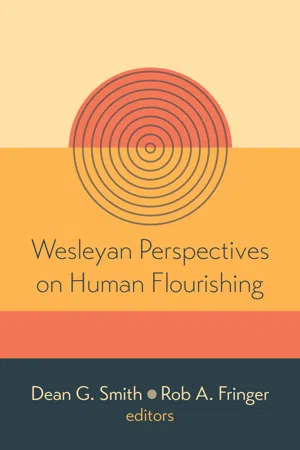
eBook - ePub
Wesleyan Perspectives on Human Flourishing
- 246 pages
- English
- ePUB (mobile friendly)
- Available on iOS & Android
eBook - ePub
Wesleyan Perspectives on Human Flourishing
About this book
Human flourishing is an ever-expanding concept that crosses geographic, ethnic, cultural, and religious lines as persons, both individually and corporately, seek to find happiness, fulfillment, and purpose. This book brings together well-established and burgeoning Wesleyan scholars to consider not only John and Charles Wesley's understanding of human flourishing but the broader Wesleyan perspectives on contemporary issues such as calling, creation care, healthcare, education, technological enhancements, death and dying, and more. Throughout these chapters the complexities and challenges of life, both past and present, are explored and grappled with, and we are reminded over and again that God is the ultimate source of flourishing.
Information
Topic
Theology & ReligionSubtopic
Christian Denominations1
Salvation as Flourishing for the Whole Creation
A Wesleyan Trajectory
When the elderly John Wesley contemplated the mediocrity of moral character and the ineffectiveness in social impact of Christians in eighteenth-century England, he listed a major cause as inadequate understanding of doctrine.1 By this he meant the broad lack of knowledge of Scripture among those claiming adherence to Christianity. But at times he highlighted specifically the inadequacy of the reigning popular understanding of “salvation,” insisting that salvation involved “not barely (according to the vulgar notion) deliverance from hell, or going to heaven” but a restoration to health or wholeness.2 More to the point, he joined his brother Charles in stressing that Christians can “anticipate your heaven below,”3 or enjoy significant degrees of this health and wholeness now.
Background: The “Vulgar” Embrace of a Transcendent and Spiritualized Eschatology
The Wesley brothers’ suggestion that authentic Christian salvation involves anticipation of heaven below reflects their awareness of—and resistance to—a tendency to transfer much of God’s saving work to the realm of heaven above. This tendency permeated Christian circles in their day and remains prevalent today, so it would be helpful to begin by reminding ourselves that the tendency stands in tension with central elements of Scripture and early Christian belief, and tracing how it became prominent in later Christian understanding.4
Hebraic Hope for Long Life in an Ideal Creation
One of the most central convictions running through the Old Testament is affirmation of God’s “covenant faithfulness”—that the holy and loving God will honor those who live in the ways that make for justice and peace (shalom). In the earliest parts of the Old Testament this is expressed in a claim that the just will live long lives and be blessed with prosperity, while the wicked will die young (e.g., Prov 10:22, 27). The focus is on this life, with any suggested afterlife presented as a “shade” or faint image of present existence.
Over time it became clear that immediate blessing and retribution are often not evident in the present age. In the book of Job we see the deep perplexity that this realization created, but we also see Job’s refusal to surrender his conviction about God’s justice! This same conviction permeates the Old Testament prophets. At times it led them to explain to the Israelite nations that the reason for their current misfortunes was their failure to live within the guidelines of God’s covenant. But more deeply it brought the prophets to insist that God would soon act in a new way in history to remove current injustices, change people’s hearts (Jer 31:31–34; Ezek 36:24–35), and restore creation to its intended state of peace and flourishing. Isaiah 11:6–8 paints a vivid image of such a creation where wolves dwell peacefully alongside lambs, children play harmlessly among snakes, and all manner of plants and animals flourish. Isaiah 65:18–25 details some of the social-political dimension of God’s promised redemption:
But be glad and rejoice forever in what I am creating;
for I am about to create Jerusalem as a joy, and its people as a delight.
I will rejoice in Jerusalem, and delight in my people;
no more shall the sound of weeping be heard in it, or the cry of distress.
No more shall there be in it an infant that lives but a few days,
or an old person who does not live out a lifetime; . . .
They shall build houses and inhabit them;
they shall plant vineyards and eat their fruit. . . .
They shall not hurt or destroy on all my holy mountain, says the Lord. (Isa 65:18–20a, 21, 25b)
Apocalyptic and New Testament Vision of Resurrected Life in Renewed Creation
For all of its grandeur, Isaiah’s visionary hope remains set in the present age, assuming the current realities of birth and death. One might be blessed with long life, but not eternal life. More importantly, Isaiah’s vision does not address how things might be made right for those who suffered unjust...
Table of contents
- Title Page
- Preface
- List of Contributors
- Chapter 1: Salvation as Flourishing for the Whole Creation
- Chapter 2: Health of Soul and Health of Body
- Chapter 3: Divine Joy and Human Gladness in Life in Christ
- Chapter 4: John Wesley on the State of the Nation and Its People
- Chapter 5: Care of Souls in the Classic Tradition
- Chapter 6: Human Technological Enhancement and Christian Perfection
- Chapter 7: Healing our Intellectual Ambivalence
- Chapter 8: Human Flourishing until Death
- Chapter 9: Exploring Salvationist Understandings of Holiness in the Anthropocene
- Chapter 10: How Relationality Facilitates Human Flourishing
- Chapter 11: “Let Our Anger Cease”
- Chapter 12: Aspects of Believers’ Flourishing in Paul’s Language of Call/Calling
Trusted by 375,005 students
Access to over 1.5 million titles for a fair monthly price.
Study more efficiently using our study tools.
Frequently asked questions
Yes, you can cancel anytime from the Subscription tab in your account settings on the Perlego website. Your subscription will stay active until the end of your current billing period. Learn how to cancel your subscription
No, books cannot be downloaded as external files, such as PDFs, for use outside of Perlego. However, you can download books within the Perlego app for offline reading on mobile or tablet. Learn how to download books offline
Perlego offers two plans: Essential and Complete
- Essential is ideal for learners and professionals who enjoy exploring a wide range of subjects. Access the Essential Library with 800,000+ trusted titles and best-sellers across business, personal growth, and the humanities. Includes unlimited reading time and Standard Read Aloud voice.
- Complete: Perfect for advanced learners and researchers needing full, unrestricted access. Unlock 1.5M+ books across hundreds of subjects, including academic and specialized titles. The Complete Plan also includes advanced features like Premium Read Aloud and Research Assistant.
We are an online textbook subscription service, where you can get access to an entire online library for less than the price of a single book per month. With over 1.5 million books across 990+ topics, we’ve got you covered! Learn about our mission
Look out for the read-aloud symbol on your next book to see if you can listen to it. The read-aloud tool reads text aloud for you, highlighting the text as it is being read. You can pause it, speed it up and slow it down. Learn more about Read Aloud
Yes! You can use the Perlego app on both iOS and Android devices to read anytime, anywhere — even offline. Perfect for commutes or when you’re on the go.
Please note we cannot support devices running on iOS 13 and Android 7 or earlier. Learn more about using the app
Please note we cannot support devices running on iOS 13 and Android 7 or earlier. Learn more about using the app
Yes, you can access Wesleyan Perspectives on Human Flourishing by Dean G. Smith,Rob A. Fringer, Dean G. Smith, Rob A. Fringer in PDF and/or ePUB format, as well as other popular books in Theology & Religion & Christian Denominations. We have over 1.5 million books available in our catalogue for you to explore.