An inspiring personal testimonial woven with political analysis, Community as Rebellion offers a meditation on the possibilities of creating spaces of freedom within the university for students and faculty of color who often experience violence and unbelonging due to the colonizing, racializing, classist, and unequal structures that sustain academia and the university.
Sharing stories, personal reflections, and experiences, the author invites readers—in particular Black, Indigenous, Latinx, and Asian women—to engage in liberatory practices of boycott and abolition, in contrast with the university's tokenizing and exploitative structures that shape our experiences in the academy, and hinder our possibilities of survival and success. Paired with radical community building, these practices are necessary for survival and critical for fighting back against a system that destroys us. One key site of freedom-making in the university is the classroom. Meditating on teaching ethnic studies, the author invites teachers to think about activism and social justice as central to what she calls "teaching in freedom," a progressive form of collective learning that prioritizes subjugated knowledge, silenced histories, and the epistemologies that come from the Global South and from Indigenous, Black, and brown communities. By teaching in and for freedom we not only acknowledge the harm that the university has inflicted on our persons and our ways of knowing since its inception, but also create alternative ways to be, to create, to live, and to succeed through our work.
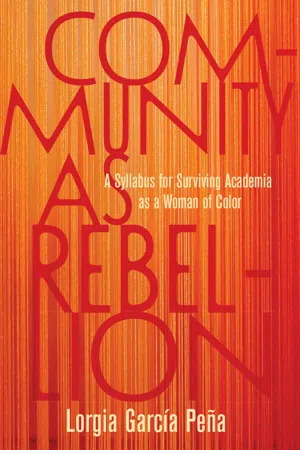
eBook - ePub
Community as Rebellion
A Syllabus for Surviving Academia as a Woman of Color
- 120 pages
- English
- ePUB (mobile friendly)
- Available on iOS & Android
eBook - ePub
About this book
Information
Subtopic
African American StudiesIndex
Social Sciences1.
COURSE OBJECTIVE
On Being “The One”
Whiteness can be a situation we have or are in; when we can name that situation (and even make jokes about it) we recognize each other as strangers to the institution and find in that estrangement a bond…. We also want there to be more than one; we want not to be the one.
—Sara Ahmed, On Being Included: Racism and Diversity in Institutional Life (emphasis added)
Soon after I was hired as assistant professor of Latinx studies, my department, Romance Languages and Literatures, was presented with what in the university we refer to as a “line,” the opportunity to hire a full-time tenured or tenure-track professor. Tenure is an unusual system, unique to academia, that guarantees lifetime employment for faculty. It was designed to protect academic freedom and the intellectual work of faculty from external pressures, allowing for necessary but often controversial work to be done without fear of losing employment. In principle, tenure is supposed to protect professors who may criticize the government, shed light onto corrupt systems, or write about things that upset the structures of power. In reality, tenure functions as a reward, a sign of prestige vested upon the few faculty who are able to publish with prestigious presses, secure grants, and make an impact in their respective fields. Sadly, controversial scholars who rock the boat are, more often than not, denied tenure.1 Tenure lines are coveted in academic departments, particularly in the humanities, for they potentially attract prestigious, well-established scholars who can build up the reputation of the department, support ongoing research agendas, advise students, and serve in the various administrative roles within the unit. Lines include tenured associate (midcareer level) and full professors (who have already found the holy grail), as well as assistant professors (usually newly minted PhDs who are working toward tenure).
Over the last two decades, tenure lines have become scant. According to the American Association of University Professors, only 21 percent of faculty are tenured.2 The scarcity of tenure lines often causes rivalry between departments competing to obtain them. Following the neoliberal trend that affects all industries across the globe, the modern university is more concerned with cost reduction and the amassing of its endowment than with the production of knowledge and the well-being of its students. To maintain its neoliberal model, the university has significantly reduced its investment in full-time tenured professors, who cost more money and teach fewer courses as they are required or expected to conduct research and publish. Instead, universities employ low-paid graduate students and temporary, part-time teaching staff, such as adjunct professors and instructors, to teach the majority of the undergraduate courses. Even though adjuncts—like tenure-track and tenured professors—have doctoral degrees, they are paid less. Oftentimes adjuncts are paid a flat rate per course rather than a salary or a per hour rate. These flat rates amount to outrageously low wages, below the federal minimum, and put adjuncts’ pay below the poverty line. Adjuncts are not offered health care benefits, research support, or at times even an office space. In the humanities and social sciences, temporary, contingent, or part-time employment is most common.3
In this dire employment climate in which humanities units such as Romance Languages, English, and Comparative Literatures, have been hemorrhaging student enrollment for decades all across the United States, hearing that our Romance languages and literatures department had received the approval of a tenured line was beyond exciting. During the faculty meeting, the chair asked all tenured and tenure-track faculty to offer our input to determine the specialization we should search for in the new hire. Romance languages departments are tricky, as they merge language learning and the literary and cultural studies of the Spanish-, French-, Italian-, and Portuguese-speaking world. The dynamics at play between, for example, scholars of France and specialists in Francophone Caribbean studies often mimic the very problematic colonial and racial tendencies that have shaped the unequal relationship between the European and US empires and the colonized sites. Think, for example, about the media portrayal of Haiti. The news cycle following the 2010 earthquake or, more recently, after the murder of Haitian president Jovenel Moïse in 2021, consistently referred to Haiti as the so-called “poorest country in the Western Hemisphere.” By contrast, France is more often than not portrayed as a site of civility and culture, a country of beautiful, romantic cities, amazing wine, and great literature. The colonial structures that produce France as a site of civilization and Haiti as a hopeless location of underdevelopment are also at play in academic departments in ways that shape who is hired, what courses are taught, and which scholars are more valued, regardless of where students’ interest lie. The biggest and most ridiculous irony of Romance languages departments is that those who do the most—usually professors who teach the literature of colonized countries—to serve the largest number of students also have the lowest salaries, are less likely to be tenured, and experience daily microaggressions from colleagues, administrators, and students. They are also more likely to be professors of color.
Over the past two decades, departments of Romance languages and literatures have been attracting Latinx students who, due to language and cultural affinity to Spanish and Portuguese, gravitate toward courses that focus on contemporary topics such as literatures of migration and postcolonial studies. At Harvard, where I worked for eight years in the Department of Romance Languages and Literatures, courses on Latin American and Latinx studies often sustained an enrollment of fifty-plus students per semester, while a course focusing on, let’s say, the Italian Renaissance would have an enrollment of three students. At the University of Georgia where I also worked in the Romance Languages Department, our largest course was an introduction to Latinx literature—the course consistently enrolled 125 students per semester. Given this trend, and being the only Latinx studies scholar in the school’s entire faculty of arts and sciences and one of only two Latinas teaching in the humanities at the time, when asked whom we should hire for the line, I raised both hands and insisted we prioritize hiring a Latinx studies scholar.4 I suggested, too, that we make an effort to attract women candidates of color. Spoiler alert: the department instead chose to hire another expert in European literature, a white man.
Harvard, like many other elite schools throughout the United States, has significantly increased its admissions of students of color. By the beginning of fall 2021, 54 percent of undergraduate students identified as nonwhite; yet the number of faculty of color is still dismal. As a result, the few of us POC working in the university found ourselves overwhelmed by requests from students, administrators, and colleagues scrambling to serve the growing student of color population. Amid such inequality, it was logical to me that when presented with the opportunity to hire a full-time professor, we should prioritize the needs of the underserved student population. But, as I soon realized, logic and students’ needs are not exactly how departmental decisions are made.
At the end of the meeting, a well-intentioned white senior colleague pulled me aside and told me that to protect my tenure, the department should not be hiring anyone else in Latinx studies, and especially not another Latina. They were sincere and well-meaning in their desire to protect me; they knew that in the eyes of the administration, there could be only one of us. I left the meeting perplexed, my hands shaking and sweating from the shock the encounter produced. I immediately summoned my support system—the other three women of color on the tenure track I knew at Harvard—to join me for a debriefing over dinner. While I was stunned about the realization that the university was actively making sure racial diversity among faculty did not grow beyond the representational (in opposition to the narrative of diversity and inclusion it professed), my colleagues were clear that having only “one of us” was indeed the modus operandi of the institution. Looking around the table, we were, as one of my friends put it, “a United Colors of Benetton ad,” each of us exemplifying a different racialized ethnic minority. “Really? This is how they see us?” I asked, with a mixture of disbelief and disgust, as my friends laughed at my naivete.
My experience, while singular, is not unique. The pervasiveness of the “The One” model is all too familiar to women of color professionals working in competitive fields in the United States and other Global North countries. A Latina friend of mine once told me that her experience of working in a major financial institution had prepared her for war. We met in New York one afternoon, and as we walked along the pier, I asked her what it was like to be a Latina analyst at such a prestigious institution. I have to admit, I was in awe of her success and curious about what I presumed was a glamorous life. I had not yet told her about my experience of being The One. I remember she was eating an ice-cream cone and accidentally dropped it as I asked the question. She was laughing, maybe at having dropped the ice cream, maybe at my question, as she answered. But in my memory the laughter made her answer even more gutting:
It’s like being in a war zone. This job has conditioned me to receive so much violence, and to be triggered in so many ways, that I, sadly, can withstand the worst. Let me correct myself—working in my office is the worst; it is war. They spit at you without saliva. They question your intelligence, your right to be there. Someone actually told me once that they preferred [to hire] a different candidate, pero, you know, since I checked the diversity box, they had to hire me. They had to. I am convinced my colleagues resent and punish me just because I am not white.
My friend says I grew pale hearing her speak. “You’re white like a ghost!” she said, which made her laugh even more. When I finally caught my breath, I asked her a question I have been asked whenever I speak publicly about the institutional violence academia inflicts on women of color: “Why don’t you quit?” She rolled her eyes at me, before saying, “Tú sabes por qué no (you know why not). Why don’t you leave Harvard? Ajá, and then what? Leave the next university and the next. You know they are all the same, right? For us, it is all the same shit.” I smiled and rolled my eyes back at her. As two Latinas of working-class immigrant background, we shared a tacit knowledge: our careers are not only careers; they are jobs that support multigenerational members of our families. We cannot just quit, as we, contrary to some of our colleagues who have generational wealth, are the ones in our family who “made it.” Financial constraints aside, the challenges of being “The One” for professional women of color transcends academia. Or as my friend put it, “I look around. Is it any better in other professions? Let’s face it, unless I am making their beds or caring for their kids, I am going to be perceived as incompetent. There is nothing to do but fight. We gotta fight back. This is war.”
The experiences of unbelonging that my dear friend and I lived through in completely different institutional spaces are sustained by white supremacy, by the belief that we, as minoritized women of color, do not belong; that we are only allowed to be part of these institutions because of our race and gender rather than despite them; that we are the “diversity hires.” This belief shapes every aspect of our work as women of color: it disturbs our physical movements through spaces, while it also burdens us with responsibility for institutional labor regarding issues of race, diversity, and inclusion. That is, we are asked to lead the task forces on “diversity issues,” speak to our boards about “equity and inclusion,” and serve as mentors, leaders, liaisons for any and all conversations, plans, and institutional efforts to save face regarding racial inequality. We are then Band-Aids they hope to put on their hemorrhaging racial wounds.
Sara Ahmed has written extensively about the university and academia in the United Kingdom and Australia. Describing what she calls the “stranger experience” in those institutions, what some of us who cannot pass as white go through when we become noticeable to our institutions precisely because our bodies are assumed to not belong in the whiteness of that space.5 For me, a light-skinned Black Latina from a working-class background, an immigrant with a Latinx accent, and a graduate of a public university in New Jersey, my strangeness has marked me as lacking what my colleagues often refer to as the “pedigree” required to succeed in the elite university (whiteness, wealth, an Ivy League education, a recognizable last name, maleness, and the support of powerful mentors).6 In their introduction to Presumed Incompetent II: Race, Class, Power, and Resistance of Women in Academia, Yolanda Flores Niemann, Gabriella Gutiérrez y Muhs, and Carmen G. González argue that when it comes to diversity and belonging, the university is “the last bastion of elitism and sanctioned racism in the United States.”7 It is a hostile environment “grounded on racism, sexism, homophobia, and classism” where violence—which takes many forms, as the examples I have shared thus far illustrate—against faculty and students of color is naturalized.
My unbelonging to the university shaped my relationship to colleagues, the administration, and the institution to one of tacit, yet mutual, discomfort. That is, my daily encounters with white colleagues at department meetings and other institutional spaces highlighted how whiteness—being or “acting” white, speaking through whiteness, and performing white civility—was clearly a prerequisite to succeeding as a woman of color scholar in the university. This manifested in subtleties like the colors, brands, and style of our clothes and accessories; our hairdos; and the speech tone, diction, mannerisms, and affect used while speaking in public. I remember, for example, one day at the beginning of a faculty meeting, I bumped into a friend who teaches at a different department and whom I had not seen in almost a year. We hugged and verbally expressed our happiness to see each other. A white male professor looked at us in surprise before stating, “I believe this room has never seen such expressions and effusiveness.” He was clearly made uncomfortable by our expressions of affection. I am by nature a warm person. I express care to people. The comment took me by surprise, as it made me realize how much of who I am and how I move in the world is unacceptable within these spaces of whiteness. My failure to perform, understand, speak, and be in harmony with whiteness made me, in Ahmed’s term, a “stranger” to the institution: an irreconcilable body that both carried and spread discomfort. As Ahmed writes, “A stranger experience can be an experience of becoming noticeable, of not passing through or passing by, of being stopped or being held up.”8 My strangeness fueled my unbelonging.
While “strangers” like myself are sometimes invited to be part of the elite university through neoliberal practices of diversity and inclusion, ultimately, to preserve the harmony of the institution, we are also asked to assimilate via silence or erasure. Over the years, I have been advised by colleagues to “smile more,” “be careful not to let people know you’re a single parent,” “make sure you don’t speak Caribbean Spanish with your colleagues,” and perhaps “lose a little weight.” Over the years I have also seen other women of color attempt to assimilate to whiteness through both their affect and their bodily performance. One Asian American woman scholar told me she spent hours practicing “the hand gestures white women in my department use to explain theory” after someone let her know that her mannerisms were “too distracting.”
We are expected to make white people comfortable with our presence, or we risk being expunged. My unwillingness or inability to be in harmony with whiteness—to mute my strangeness in the institution and accept its implicit white supremacy in all aspects of institutional, curricular, and academic life—culminated in my dismissal from Harvard via tenure denial in 2019.
Being expunged by whiteness via tenure denial was one of the most violent and difficult yet edifying experiences of my career. After spending eight years building up Harvard, working for and with my students, exceeding every expectation in my research, teaching, and service, I received a call, the night before Thanksgiving 2019, from the chair of my department. He said, “Lorgia, dear, I have terrible news. I am so sorry, but you have been denied tenure.” I thought he was joking. Weeks prior, my chair, who was a supporter of my work and truly believed I deserved tenure, had sent me a champagne bottle emoji following a message that assured me “everything is going spectacularly” in my tenure process. His assurances and those of the deans made the denial even more cruel. But it took a while for the news to sink in; it took even longer to understand the extent of the violence implicit in this news. As a survivor of emotional and sexual violence, I know all too well how draining and complex the process by which we come to terms with the effects of violence is on our bodies and psyche. How long it takes before we finally see that the harm done is not our fault. The guilt and shame we feel is weaponized by our abusers. It takes distance, time, work, and support to really see ourselves as survivors and to appreciate the courage that it takes to survive.
Institutional violence manifests in multiple insidious ways: denial of equal treatment, abuses in labor practices, unequal pay, unfair amounts of labor, microaggressions, and most of all, cruelty. The cruelty of ending my eight years of service with a phone call on the night before a holiday was yet another example of institutional violence. But my tenure denial was the most rational finale to what I often describe as a long-term abusive relationship with my employer—one in which I was simultaneously at the receiving end of both violence and adulation.
Over my years as a tenure-track professor at Harvard University, I was regaled with awards, fellowships, an endowed chair, and other forms of recognition. Senior colleagues and administrators often called me “a star” and assured me of how much I mattered to the future of the “new and more diverse institution”—to the deferred project of belonging we were building “together” with and through my labor. Many times, these adulations were contradicted by hate and violence that manifested through human interactions with people in the university community as well as through encounters with the institution via its representatives, my colleagues and administrators.
Some of these interactions shook me to my core, like the instance in which I was attacked on campus in 2016 by two men who threw hot coffee at me while yelling, “Build the wall!” Or ...
Table of contents
- Cover
- Copyright
- Contents
- Course Requirements
- Preface
- 1. Course Objective: On Being “The One”
- 2. Reading List: Complicity with Whiteness Will Not Save You
- 3. Midterm: Teaching as Accompaniment
- 4. Final Exam: Ethnic Studies as Anticolonial Method
- Acknowledgments
- Notes
- Index
- Back Cover
Trusted by 375,005 students
Access to over 1.5 million titles for a fair monthly price.
Study more efficiently using our study tools.
Frequently asked questions
Yes, you can cancel anytime from the Subscription tab in your account settings on the Perlego website. Your subscription will stay active until the end of your current billing period. Learn how to cancel your subscription
No, books cannot be downloaded as external files, such as PDFs, for use outside of Perlego. However, you can download books within the Perlego app for offline reading on mobile or tablet. Learn how to download books offline
Perlego offers two plans: Essential and Complete
- Essential is ideal for learners and professionals who enjoy exploring a wide range of subjects. Access the Essential Library with 800,000+ trusted titles and best-sellers across business, personal growth, and the humanities. Includes unlimited reading time and Standard Read Aloud voice.
- Complete: Perfect for advanced learners and researchers needing full, unrestricted access. Unlock 1.5M+ books across hundreds of subjects, including academic and specialized titles. The Complete Plan also includes advanced features like Premium Read Aloud and Research Assistant.
We are an online textbook subscription service, where you can get access to an entire online library for less than the price of a single book per month. With over 1.5 million books across 990+ topics, we’ve got you covered! Learn about our mission
Look out for the read-aloud symbol on your next book to see if you can listen to it. The read-aloud tool reads text aloud for you, highlighting the text as it is being read. You can pause it, speed it up and slow it down. Learn more about Read Aloud
Yes! You can use the Perlego app on both iOS and Android devices to read anytime, anywhere — even offline. Perfect for commutes or when you’re on the go.
Please note we cannot support devices running on iOS 13 and Android 7 or earlier. Learn more about using the app
Please note we cannot support devices running on iOS 13 and Android 7 or earlier. Learn more about using the app
Yes, you can access Community as Rebellion by Lorgia García Peña in PDF and/or ePUB format, as well as other popular books in Social Sciences & African American Studies. We have over 1.5 million books available in our catalogue for you to explore.