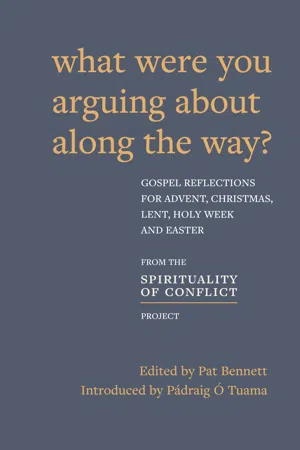
What Were You Arguing About Along The Way?
eBook - ePub
Available until 23 Dec |Learn more

What Were You Arguing About Along The Way?

Gospel Reflections for Advent, Christmas, Lent and Easter

  1. 192 pages
  2. English
  3. ePUB (mobile friendly)
  4. Available on iOS & Android
eBook - ePub
Available until 23 Dec |Learn more

What Were You Arguing About Along The Way?

Gospel Reflections for Advent, Christmas, Lent and Easter

About this book

Created by PΓ‘draig Γ“ Tuama five years ago, the Spirituality of Conflict website is one of the most exciting and vibrant online lectionary resources. For each Sunday there is an extended reflection, a prayer, and questions for lectio divina or group discussion. Featuring Catholic, Anglican, Presbyterian and Pentecostal writers from Corrymeela, the Iona Community, Holy Island, Coventry Cathedral's Centre for Reconciliation, the Church of Scotland and elsewhere, it reflects the broad nature of the witness to peace.Approaching conflict in its various forms - personal, social, global - through the lens of the gospels, conflict, it explores the conflicted nature of Jesus' world and how people navigated routes through it. It enables the scriptures to speak to the conflicts in our lives and reveals how they can have positive as well as negative outcomes.This volume of collected material focuses on the beginning and the end of Jesus' human life and covers the gospels for Advent, Christmas. Lent, Holy Week and Easter.

Frequently asked questions

Yes, you can cancel anytime from the Subscription tab in your account settings on the Perlego website. Your subscription will stay active until the end of your current billing period. Learn how to cancel your subscription.
No, books cannot be downloaded as external files, such as PDFs, for use outside of Perlego. However, you can download books within the Perlego app for offline reading on mobile or tablet. Learn more here.
Perlego offers two plans: Essential and Complete
  • Essential is ideal for learners and professionals who enjoy exploring a wide range of subjects. Access the Essential Library with 800,000+ trusted titles and best-sellers across business, personal growth, and the humanities. Includes unlimited reading time and Standard Read Aloud voice.
  • Complete: Perfect for advanced learners and researchers needing full, unrestricted access. Unlock 1.4M+ books across hundreds of subjects, including academic and specialized titles. The Complete Plan also includes advanced features like Premium Read Aloud and Research Assistant.
Both plans are available with monthly, semester, or annual billing cycles.
We are an online textbook subscription service, where you can get access to an entire online library for less than the price of a single book per month. With over 1 million books across 1000+ topics, we’ve got you covered! Learn more here.
Look out for the read-aloud symbol on your next book to see if you can listen to it. The read-aloud tool reads text aloud for you, highlighting the text as it is being read. You can pause it, speed it up and slow it down. Learn more here.
Yes! You can use the Perlego app on both iOS or Android devices to read anytime, anywhere β€” even offline. Perfect for commutes or when you’re on the go.
Please note we cannot support devices running on iOS 13 and Android 7 or earlier. Learn more about using the app.
Yes, you can access What Were You Arguing About Along The Way? by Pat Bennett in PDF and/or ePUB format, as well as other popular books in Theology & Religion & Biblical Criticism & Interpretation. We have over one million books available in our catalogue for you to explore.
Advent 2 – Matthew 3.1–12
Janet Foggie
Introduction
John the Baptist was a forager and believer in a natural lifestyle. The protest elements of his ministry were wearing clothes of leather and eating foraged food, locusts and wild honey. He might fit well today with those who practise β€˜die-ins’, lying on the road to prevent fossil fuels being burned, or who inhabit trees to prevent road or runway construction. He was a protester, a voice shouting in the wilds. Jesus was the prophet, the son of God, the man with the radical message. The protester John grabbed attention, Jesus followed and hammered home his gospel: good news for some, and the end of entitlement and entrenched power for others. Sometimes conflict or dissonance is a necessary precursor to change.
Comment
If we take the role of protester and prophet for our reflection this week then it might be illustrative to look at the impact of the Youth Climate Strikes and the work of Greta Thunberg who addressed the United Nations on 23 September 2019. Just as with John and the Pharisees and Sadducees, the protesters have roundly criticized the adult leaders of their communities. Greta Thunberg said, β€˜How dare you!’ with her whole person filled with emotion as she described the leaders of the world as obsessed with money and careless of the future of the planet. Those leaders, and many who subscribe to their values, have not been slow to excoriate her and she has faced a barrage of insults on social media and in mainstream media. But the powerful message she brings has the force of truth: the polar regions have a crisis we cannot control; the Amazon is burning; the people who live by the Zambezi fear they will never see its annual floods again in their lifetime.
The radical protester who has a plant-based diet, or who only eats foraged foods, or sustainably raised meat, or whatever the protest is, is a necessary part of a society facing a crisis. We need to see extremes in order to get the main body of opinion to shift. In this current case, we have known the facts of climate change since I was Greta’s age, more than a quarter of a century ago. What we have been unable to do is to get the environmental science to influence the majority of ordinary citizens. In all those years, even knowing what I know, I have bought and sold cars, taken flying for granted and only made those changes which it was easy to make.
John uses the analogy of a tree that needs to be cut down. The petrol-based economy is literally cutting down trees that bear good fruit. We want to be able to clear our own consciences, and so going on a litter pick might salve the soul but it doesn’t cancel the impact of commuting, using a petrol car for short urban journeys, buying single-use plastic or flying for holidays or work. We also like to point to the complexity of the problems in order to excuse ourselves from doing the little we can. Just because a vegan burger might contain imported soya from more than one country doesn’t excuse the purchasing of junk food with intensively farmed and processed beef (which is probably fed the same imported soya). Both the soya and the beef need to be more sustainably farmed and eaten more locally.
Equally, the human justice required of our world leaders is for them to ensure that the world’s wealth, food, health resources, and even those few oil-based products we really do need and can afford to keep, are more fairly redistributed. A good example is the need for accessible and widely used public transport as a viable option for the majority of urban journeys. Many people cite the inadequacy of public transport as a reason for taking the car on an urban journey. These sort of β€˜helpless cycles’ are really easy excuses for not mobilizing a bigger social change. If we improve public transport, we also need to incentivize the use of it in order to ensure cars are not being used in urban areas where the effects of the air pollution are greatest.
If we want to hear the voice of John the Baptist today, we need look no further than Greta Thunberg. The question for us, as it was in Jesus’ day, is: are we wheat to be gathered into the granary, caring about our world neighbours; or are we chaff to be thrown into the global winnowing fire?
Response
Consider any actions you can take to reduce your CO2 emissions. These might be turning down your thermostat, car sharing, using public transport, taking a β€˜no-fly’ holiday.
Alternatively, think about the similarities between Greta Thunberg and John the Baptist. What can you do to add your voice to the prophetic call to action to slow the climate crisis? Is speaking out enough? What other actions could you take?
Prayer
God of eternity, we come before you today
sorry for all those children who could turn to us and say,
β€˜You have stolen my dreams and my childhood.’
For children facing an uncertain world due to climate crisis,
and our part in burning the fossil fuels of our planet.
We are sorry for the wrong we have done to the children
whose future we have gobbled up in shopping,
and using the earth’s resources.
We hear the children saying, β€˜How dare you!’
And we are sorry
Sorry to the pit of our stomachs
Sorry to the bottom of our hearts.
Forgive us, gracious God,
and let that forgiveness be neither easy nor quickly forgotten.
Silence
We pray to you, our God who forgives before we ask,
however little we deserve it.
As we step towards you to receive that forgiveness
so may we be enabled to live more humbly,
consume less and grow more like Jesus every day.
Amen.
Advent 3 – Matthew 11.2–11
Janet Foggie
Introduction
At Christmas time, a lot of people, for whom it isn’t a usual part of their week, temporarily β€˜notice’ Christians and Christianity more. Sometimes this leads to an over-sentimentalizing of religion, but also sometimes to a criticism of β€˜religious people’. Jesus questions the expectations that people had of John, and similarly we too need to query our own expectations.
The conflict this week is between the pious, the holy, the prophet trying to live a better life, and those whom they hope to inspire yet often alienate instead. The challenge of this week is not to obsess about the people who find us difficult but rather to think of the places where we ourselves are challenged.
Comment
One of the most interesting features of this passage is that the supposedly unshakable John the Baptist is sending his disciples to query whether Jesus is β€˜the one’ or whether they are to wait for β€˜another’. It isn’t often we get to see the insecurities of a prophet. Last week in the desert, proud and vocal, John had seemingly unmovable faith in Jesus as the Messiah. This week, in prison and alone, he isn’t so sure. Jesus reassures his imprisoned friend. He talks of the things God does to bring in his kingdom: the blind are healed, the lame walk, the poor receive good news … Jesus does not refer to himself, his preaching or his authority, but instead reassures John, through his disciples, by listing the effects of the kingdom, a ministry of praxis, or practical activity.
Last week we compared the Baptist to Greta Thunberg and considered her prophetic voice in a world of climate crisis. We thought about the need to hear her words not just as a rousing speech but as a call to personal action. Jesus adds to his reassurance to John the sentence, β€˜And blessed is anyone who takes no offense at me.’ People had taken offence at John’s message and indeed had imprisoned him; people would take offence at Jesus and his ministry of healing or his focus on the poor. In the same way, a great many people, from celebrities to world leaders to ordinary folks, have taken offence at the words of Greta Thunberg. Many of the insults hurled at her are too offensive to repeat here.
However, taking offence can be an all-too-easy escape from the challenge of m...

Table of contents

  1. Copyright information
  2. Contents
  3. Acknowledgements
  4. Introduction
  5. Exploring the Space Between
  6. Introducing a Spirituality of Conflict
  7. Introducing the Selections in this Volume
  8. Reflections for the Season of Advent and the Nativity of the Lord
  9. Advent Year A
  10. Advent Sunday – Matthew 24.36–44
  11. Advent 2 – Matthew 3.1–12
  12. Advent 3 – Matthew 11.2–11
  13. Advent 4 – Matthew 1.18–25
  14. Advent Year B – β€˜Looking and Seeing’
  15. Introduction to the Set
  16. Advent Sunday – Mark 13.24–37
  17. Advent 2 – Mark 1.1–8
  18. Advent 3 – John 1.6–8, 19–28
  19. Advent 4 – Luke 1.26–38
  20. Nativity of the Lord Propers 1 and 2 – Luke 2.1–20
  21. Advent Year C
  22. Advent Sunday – Luke 21.25–36
  23. Advent 2 – Luke 3.1–6
  24. Advent 3 – Luke 3.7–18
  25. Advent 4 – Luke 1.39–55
  26. The Nativity of the Lord – Years A, B and C
  27. Nativity of the Lord Proper 1 – Luke 2.1–14
  28. Nativity of the Lord Proper 2 – Luke 2.1–20
  29. Nativity of the Lord Proper 3 – John 1.1–14
  30. The Holy Name of Jesus – Luke 2.15–21
  31. Reflections for Ash Wednesday and the Season of Lent
  32. Lent Year A
  33. Ash Wednesday – Matthew 6.1–6, 16–21
  34. Lent 1 – Matthew 4.1–11
  35. Lent 2 – John 3.1–17
  36. Lent 3 – John 4.5–42
  37. Lent 4 – John 9.1–41
  38. Lent 5 – John 11.1–45
  39. Lent 6 Liturgy of the Palms – Matthew 21.1–11
  40. Lent Year B – β€˜Private and Public’
  41. Introduction to the Set
  42. Ash Wednesday – Matthew 6.1–6, 16–21
  43. Lent 1 – Mark 1.9–15
  44. Lent 2 – Mark 9.2–9
  45. Lent 3 – John 2.13–22
  46. Lent 4 – John 3.14–21
  47. Lent 5 – John 12.20–33
  48. Lent 6 Liturgy of the Palms – Mark 11.1–11
  49. Lent Year C
  50. Ash Wednesday – Matthew 6.1–6, 16–21
  51. Lent 1 – Luke 4.1–13
  52. Lent 2 – Luke 13.31–35
  53. Lent 3 – Luke 13.1–9
  54. Lent 4 – Luke 15.1–3, 11b–32
  55. Lent 5 – John 12.1–8
  56. Lent 6 Liturgy of the Palms – Luke 19.28–40
  57. Reflections for Holy Week and Easter
  58. Liturgy of the Passion Year A – Matthew 27.15–23
  59. Liturgy of the Passion Year B – Mark 15.1–15
  60. Monday of Holy Week – John 12.1–11
  61. Tuesday of Holy Week – John 12.20–36
  62. Wednesday of Holy Week – John 13.21–32
  63. Maundy Thursday – John 13.1–7, 31b–35
  64. Good Friday – John 18.1β€”19.42
  65. Good Friday – John 18.1β€”19.42
  66. Holy Saturday – John 19.38–42
  67. Holy Week – β€˜The Spaces We Inhabit’
  68. Introduction to the Set
  69. Monday of Holy Week – John 12.1–11
  70. Tuesday of Holy Week – John 12.20–36
  71. Wednesday of Holy Week – John 13.21–32
  72. Maundy Thursday – John 13.1–17, 31b–35
  73. Good Friday – John 18.1β€”19.42
  74. Holy Saturday – John 19.38–42
  75. Resurrection of the Lord Year A – Matthew 28.1–10
  76. The Resurrection of the Lord
  77. Resurrection of the Lord Years A, B, C – John 20.1–18
  78. Resurrection of the Lord Year B – Mark 16.1–8
  79. Resurrection of the Lord Year C – Luke 24.1–12
  80. Easter Evening – Luke 24.13–49
  81. Easter Evening – Luke 24.13–35
  82. Easter 2 – John 20.19–31
  83. Easter 2 – John 20.19–31
  84. Contributors