Die Buchreihe Linguistische Arbeiten hat mit über 500 Bänden zur linguistischen Theoriebildung der letzten Jahrzehnte in Deutschland und international wesentlich beigetragen. Die Reihe wird auch weiterhin neue Impulse für die Forschung setzen und die zentrale Einsicht der Sprachwissenschaft präsentieren, dass Fortschritt in der Erforschung der menschlichen Sprachen nur durch die enge Verbindung von empirischen und theoretischen Analysen sowohl diachron wie synchron möglich ist. Daher laden wir hochwertige linguistische Arbeiten aus allen zentralen Teilgebieten der allgemeinen und einzelsprachlichen Linguistik ein, die aktuelle Fragestellungen bearbeiten, neue Daten diskutieren und die Theorieentwicklung vorantreiben.
eBook - PDF
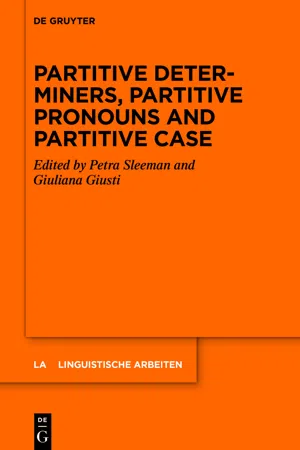
Partitive Determiners, Partitive Pronouns and Partitive Case
- 372 pages
- English
- PDF
- Available on iOS & Android
eBook - PDF
Partitive Determiners, Partitive Pronouns and Partitive Case
About this book
Information
Table of contents
- Preface
- Contents
- Introduction: Partitive elements in the languages of Europe
- Part I: Setting the diagnostics for partitivity in Romance languages
- Partitivity in Italian
- Du/des-NPs in French
- Part II: The diachrony of partitivity
- Diachronic typology of partitives
- The partitive article in Old Italian
- Part III: The acquisition of partitivity
- The L2 acquisition of the partitive pronoun en in French by L1 speakers of German and the role of the L1
- The L2 acquisition of the referential semantics of Dutch partitive pronoun ER constructions
- Part IV: The syntax-semantics correlations of case in partitivity
- Turkish partitive constructions and (non-)exhaustivity
- Longitudinal or transverse?
- The partitive marker in Basque, and its relation to bare nouns and the definite article
- Index
Trusted by 375,005 students
Access to over 1.5 million titles for a fair monthly price.
Study more efficiently using our study tools.
Frequently asked questions
Yes, you can cancel anytime from the Subscription tab in your account settings on the Perlego website. Your subscription will stay active until the end of your current billing period. Learn how to cancel your subscription
No, books cannot be downloaded as external files, such as PDFs, for use outside of Perlego. However, you can download books within the Perlego app for offline reading on mobile or tablet. Learn how to download books offline
Perlego offers two plans: Essential and Complete
- Essential is ideal for learners and professionals who enjoy exploring a wide range of subjects. Access the Essential Library with 800,000+ trusted titles and best-sellers across business, personal growth, and the humanities. Includes unlimited reading time and Standard Read Aloud voice.
- Complete: Perfect for advanced learners and researchers needing full, unrestricted access. Unlock 1.5M+ books across hundreds of subjects, including academic and specialized titles. The Complete Plan also includes advanced features like Premium Read Aloud and Research Assistant.
We are an online textbook subscription service, where you can get access to an entire online library for less than the price of a single book per month. With over 1.5 million books across 990+ topics, we’ve got you covered! Learn about our mission
Look out for the read-aloud symbol on your next book to see if you can listen to it. The read-aloud tool reads text aloud for you, highlighting the text as it is being read. You can pause it, speed it up and slow it down. Learn more about Read Aloud
Yes! You can use the Perlego app on both iOS and Android devices to read anytime, anywhere — even offline. Perfect for commutes or when you’re on the go.
Please note we cannot support devices running on iOS 13 and Android 7 or earlier. Learn more about using the app
Please note we cannot support devices running on iOS 13 and Android 7 or earlier. Learn more about using the app
Yes, you can access Partitive Determiners, Partitive Pronouns and Partitive Case by Petra Sleeman, Giuliana Giusti, Petra Sleeman,Giuliana Giusti in PDF and/or ePUB format, as well as other popular books in Languages & Linguistics & Linguistics. We have over 1.5 million books available in our catalogue for you to explore.