In the first half of the eighteenth century, Central Asia's Bukharan Khanate descended into a crisis from which it would not recover. Bukharans suffered failed harvests and famine, a severe fiscal downturn, invasions from the north and the south, rebellion, and then revolution. To date, efforts to identify the cause of this crisis have focused on the assumption that the region became isolated from early modern globalizing trends. The Bukharan Crisis exposes that explanation as a flawed relic of early Orientalist scholarship on the region.
In its place, Scott Levi identifies multiple causal factors that underpinned the Bukharan crisis. Some of these were interrelated and some independent, some unfolded over long periods while others shocked the region more abruptly, but they all converged in the early eighteenth century to the detriment of the Bukharan Khanate and those dependent upon it. Levi applies an integrative framework of analysis that repositions Central Asia in recent scholarship on multiple themes in early modern Eurasian and world history
eBook - ePub
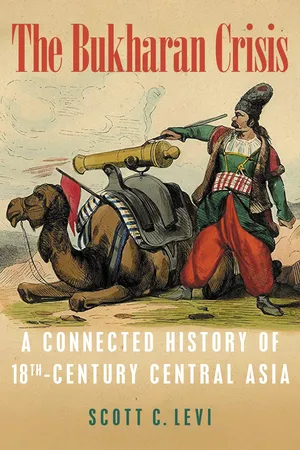
The Bukharan Crisis
A Connected History of 18th Century Central Asia
- English
- ePUB (mobile friendly)
- Available on iOS & Android
eBook - ePub
About this book
Information
Subtopic
Central Asian HistoryIndex
HistoryINDEX
Note: Page numbers in italics refer to figures.
Abbas, Shah I, 77n14, 80, 136
‘Abbasid Caliphate, 56, 58–59
‘Abd al-’Aziz Khan, 22, 35–36, 131, 147, 164
‘Abd al-’Aziz Khan Madrasa, 22, 81
‘Abd al-Karim, 123–25, 127
‘Abdallah Khan, 19–20, 154
‘Abdallah Khan II, 19, 78–81
‘Abd al-Munim, 19–20, 162n127
Abu’l Fayz Khan, 24–26, 123, 132; efforts to maintain authority, 166, 170–72, 178; execution of, 27, 168, 178; rebellions against, 24–25
Abu’l Khayr Khan, 13
Adichie, Chimamanda, 173–74
Afghanistan, 14, 70, 72, 81, 93, 116, 133
Afghans, 26, 82, 135–36, 139, 168
Afsharid dynasty, 26
agriculture, 115; contribution to economy, 49, 165; decline in, 136–37, 140; effects of climate crisis on, 141–42, 149–52, 177; food crops vs. cash crops, 95, 118; increasing, 96–98; land used for, 7, 21, 88; loans by Indians for, 83, 97; plantation-style, 73–74
Akbar, Emperor, 78–81
Alam, Muzaffar, 31, 135
Altishahr, 37, 91, 91n59, 91n61, 93, 95–97, 119
Amanat, Abbas, x, 136, 146
Americas, silver from, 74–76, 118–19, 176
Andijanis, trade networks of, 92–95, 94, 118–19, 176
An Lushan rebellion, 59
Anusha Muhammad Khan, 22
appanage system, 16, 18–19, 35, 122–23, 177
Astrakhan, 20, 103–4, 110–11, 111n118
Astrakhan Khanate, 19, 92, 98
Atwell, William, 144
Aurangzeb, 75, 81, 85, 134–35, 146–47
Babur, Zahir al-Din Muhammad, 12, 17, 72–73, 78, 85, 96n71
Balkh, 16, 20, 22–24, 35, 81, 147,...
Table of contents
- Cover Page
- Title Page
- Copyright Page
- Dedication
- Contents
- Acknowledgments
- Note on Geographic Terminology
- Introduction
- One. Bukhara in Crisis
- Two. Silk Roads, Real and Imagined
- Three. The Early Modern Silk Road
- Four. The Crisis Revisited
- Conclusion
- Bibliography
- Index
Trusted by 375,005 students
Access to over 1.5 million titles for a fair monthly price.
Study more efficiently using our study tools.
Frequently asked questions
Yes, you can cancel anytime from the Subscription tab in your account settings on the Perlego website. Your subscription will stay active until the end of your current billing period. Learn how to cancel your subscription
No, books cannot be downloaded as external files, such as PDFs, for use outside of Perlego. However, you can download books within the Perlego app for offline reading on mobile or tablet. Learn how to download books offline
Perlego offers two plans: Essential and Complete
- Essential is ideal for learners and professionals who enjoy exploring a wide range of subjects. Access the Essential Library with 800,000+ trusted titles and best-sellers across business, personal growth, and the humanities. Includes unlimited reading time and Standard Read Aloud voice.
- Complete: Perfect for advanced learners and researchers needing full, unrestricted access. Unlock 1.5M+ books across hundreds of subjects, including academic and specialized titles. The Complete Plan also includes advanced features like Premium Read Aloud and Research Assistant.
We are an online textbook subscription service, where you can get access to an entire online library for less than the price of a single book per month. With over 1.5 million books across 990+ topics, we’ve got you covered! Learn about our mission
Look out for the read-aloud symbol on your next book to see if you can listen to it. The read-aloud tool reads text aloud for you, highlighting the text as it is being read. You can pause it, speed it up and slow it down. Learn more about Read Aloud
Yes! You can use the Perlego app on both iOS and Android devices to read anytime, anywhere — even offline. Perfect for commutes or when you’re on the go.
Please note we cannot support devices running on iOS 13 and Android 7 or earlier. Learn more about using the app
Please note we cannot support devices running on iOS 13 and Android 7 or earlier. Learn more about using the app
Yes, you can access The Bukharan Crisis by Scott C. Levi,Scott Levi in PDF and/or ePUB format, as well as other popular books in History & Central Asian History. We have over 1.5 million books available in our catalogue for you to explore.