Winner, 2021 CCL J. B. Jackson Book Prize | Winner, 2020 Jon Gjerde Prize from the Midwestern History Association
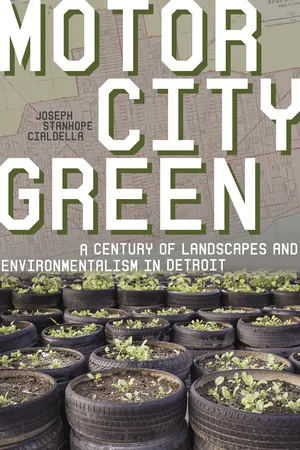
Motor City Green is a history of green spaces in metropolitan Detroit from the late nineteenth to the early twenty-first century that focuses on the creation and use of parks, gardens, yards, and other designed landscapes. Joseph Stanhope Cialdella argues that generations of residents and communities in the region turned to these outdoor spaces to relieve problems created by the city's industrial rise and decline, racial segregation, and economic inequality. As Detroit continues toward a green future, Motor City Green looks to the past to demonstrate how the city's urban gardens of today evolved from, but are also distinct from, the urban green spaces that came before them.
eBook - ePub
Motor City Green
A Century of Landscapes and Environmentalism in Detroit
- English
- ePUB (mobile friendly)
- Available on iOS & Android
eBook - ePub
Motor City Green
A Century of Landscapes and Environmentalism in Detroit
About this book
Information
Index
Social SciencesNOTES
INTRODUCTION: GREENING DETROIT’S HISTORY
1. Andrew Moore, Detroit Disassembled, 122, 119.
2. For critiques and deeper analysis of “ruin porn” imagery of Detroit and other cities, see Dora Apel, Beautiful Terrible Ruins: Detroit and the Anxiety of Decline (New Brunswick: Rutgers University Press, 2015), esp. ch. 4; Rebecca Kinney, Beautiful Wasteland: The Rise of Detroit as America’s Postindustrial Frontier (Minneapolis: University of Minnesota Press, 2016); Sara Safransky, “Greening the Urban Frontier: Race, Property, and Resettlement in Detroit,” Geoforum 56 (2014): 237–48; George Steinmetz, “Harrowed Landscapes: White Ruingazers in Namibia and Detroit and the Cultivation of Memory,” Visual Studies 23, no. 3 (December 2008).
3. John Gallagher, “Wide Open Detroit,” Detroit Free Press, April 1, 2012.
4. Betsy Stevens. “Detroit Urban Farm and Garden Tour,” You Tube, 2007, http://www.youtube.com/watch?v=pzX-XKw2D04&feature=channel_page/. For more on Peacemakers garden, see Andy McGlashen, “Urban Pioneers Turn Vacant Lots Verdant,” Great Lakes Echo, September 8, 2009, https://greatlakesecho.org/2009/09/08/urban-pioneers-turn-vacant-lots-verdant/.
5. Paul Harris, “Detroit Gets Growing,” Guardian, July 10, 2010, http://www.theguardian.com/environment/2010/jul/11/detroit-urban-renewal-city-farms-paul-harris/.
6. Moore, Detroit Disassembled, 119; Solnit, “Detroit Arcadia.”
7. Helphand, Defiant Gardens, 9.
8. Scholars important to the field of American Studies have long been concerned with the idea of place and landscapes in American culture, although their works often lacked a focus on the diversity of actors and ideas outside of Anglo-American culture. For example, see Marx, Machine in the Garden. Marx’s work, in particular, uses the idea of the “machine in the garden”—technology intruding upon an idealized landscape—to examine Americans’ literary fascination with the pastoral “middle landscapes” in the context of industrial transformation brought about by technology. The way Americans imagined the land as an idealized “landscape of reconciliation” that balanced nature and culture in a harmonious way, Marx argues, was in stark contradiction to the way industrialization was changing the land. Additionally, see Peter J. Schmitt, Back to Nature: The Arcadian Myth in Urban America (Baltimore: Johns Hopkins University Press, 1969); Annette Kolondy, The Land before Her: Fantasy and Experience of the American Frontiers, 1630–1860 (Chapel Hill: University of North Carolina Press, 1984); Roderick Frazier Nash, Wilderness and the American Mind (New Haven: Yale University Press, 1967).
9. “Weeds Are Thriving on City’s Vacant Lots,” Detroit Free Press, July 11, 1908. Battles against weeds, a central feature of the urban landscape, have shaped environmental and urban change across metropolitan America, as historian Zachary Falck argues. Gardeners and civic leaders in Detroit also reacted in response to happenstance plants, which to them often represented abandonment, neglect, and lack of economic value. See Falck, Weeds.
10. Dudley Randall, “Vacant Lot,” in Roses and Revolutions: The Selected Writings of Dudley Randall, ed. Melba Joyce Boyd (Detroit: Wayne State University Press, 2009), 48.
11. In his work titled Concrete and Clay, Matthew Gandy advances the concept of “rustbelt ecology” to describe environmental justice activism in the Bronx. Here, the term is helpful for drawing attention to the connections between nature and industry and material practices that create shared, if competing stories about the cultural landscape in cities such as Detroit.
12. Matthew Klingle, in Emerald City, for example, looks at Seattle over a long period of time to examine how reworking nature had perpetuated inequalities. Some scholars have focused on writing histories of familiar places from an environmental perspective. They look more at the cultural and social dimensions of nature in the city, particularly around public space. For example, see Kelman, A River and Its City; David Scobey, Empire City: The Making and Meaning of the New York City Landscape (Philadelphia: Temple University Press, 2002); Rawson, Eden on the Charles; Catherine McNeur, Taming Manhattan; Ellen Stroud, Nature Next Door: Cities and Trees in the American Northeast (Seattle: University of Washington Press, 2012); Falck, Weeds; Gandy, Concrete and Clay. For a comprehensive study looking at inequality and environment in American cities, see Dorceta E. Taylor, The Environment and the People in American Cities: Disorder, Inequality, and Social Change, 1600s–1900s (Durham: Duke University Press, 2009).
13. Urban environmental history has grown into a well-developed subfield. William Cronon’s Nature’s Metropolis: Chicago and the Great West (New York: Norton 1992) was among the first environmental histories of a major city. He takes a bird’s-eye view of the city and focuses primarily on how both the city and its hinterland were transformed by industrial development as natural resources were brought to the city. Stradling, in Making Mountains, looked at the relationship between the city and outlying regions, this time through the lens of tourism. Reflecting recent trends in the field to look at power relations and structures more intensely, Andrew Needham, in Power Lines: Phoenix and the Making of the Modern Southwest (Princeton, NJ: Princeton University Press, 2014), has examined more closely how the cultural and social relationships between cities and nature drive imperial nations. Even before these works, Anne Spirn, in The Granite Garden: Urban Nature and Human Design (New York: Basic Books, 1985), emphasized the role of nature in an urban environment. For a study of how cities form a foundation of American environmental thought, see Shen Hou, The City Natural. Other historians have taken the field of urban environmental history in new directions by investigating sensory aspects of the environment. See Melanie Kiechle, Smell Detectives: An Olfactory History of Nineteenth Century Urban America (Seattle: University of Washington Press, 2017).
14. For other recent studies on Detroit’s environmental history, see Cooper-McCann, “The Promise of Parkland”; Rector, “Accumulating Risk”; Ward, “Detroit Wild.” For a chapter on connections between the United Automobile Workers and the environmental movement in Detroit, see Chad Montrie, Making a Living: Work and Environment in the United States (Chapel Hill: University of North Carolina Press, 2008), 91–112. For a historical and sociological study of African Americans’ connections to agriculture nationally and in Detroit, see White, Freedom Farmers.
15. Wilderness has historically played an important if overbearing role in American environmentalism. Environmental historians and particularly some recent urban environmental scholarship have challenged wilderness as the dominant environmental framework. For example, see Fisher, Urban Green, especially the introduction. On challenging the idea of wilderness as an organizing framework more broadly, see William Cronon, ed., Uncommon Ground: Rethinking the Human Place in Nature (New York: W. W. Norton, 1995).
16. For a comprehensive study of the multiple factors that led to Detroit’s decline, see Sugrue, Origins of the Urban Crisis. For an analysis of urban planning and race, see Thomas, Redevelopment and Race. On postwar politics, see Heather Ann Thompson, Whose Detroit? Politics, Labor, and Race in a Modern American City (Ithaca: Cornell University Press, 2001). For a study of the first half of the twentieth century, see Zunz, The Changing Face of Inequality. The historian Tiya Miles has recently reexamined Detroit’s early years with an eye toward the city’s colonial era populations of indigenous Anishinaabe peoples, enslaved and free African Americans, and Anglo and French settlers. See Miles, The Dawn of Detroit. On the Great Migration, African American women, and cultural politics in Detroit, see Wolcott, Remaking Respectability.
17. Scholars of vernacular architecture and cultural landscapes have studied and theorized the connections between landscapes and culture. As Dell Upton defines it, the cultural landscape ...
Table of contents
- Cover Page
- Title Page
- Copyright Page
- Dedication
- Contents
- Acknowledgments
- Introduction. Greening Detroit’s History
- One. Parks and Potatoes
- Two. “You Cannot Grow Lilies in Ash-Barrels”
- Three. Greener Pastures
- Four. Metropolitan Parks and Regional Inequality
- Five. Community Gardening and Urban Revitalization
- Epilogue. Learning with Detroit
- Notes
- Bibliography
- Index
Trusted by 375,005 students
Access to over 1.5 million titles for a fair monthly price.
Study more efficiently using our study tools.
Frequently asked questions
Yes, you can cancel anytime from the Subscription tab in your account settings on the Perlego website. Your subscription will stay active until the end of your current billing period. Learn how to cancel your subscription
No, books cannot be downloaded as external files, such as PDFs, for use outside of Perlego. However, you can download books within the Perlego app for offline reading on mobile or tablet. Learn how to download books offline
Perlego offers two plans: Essential and Complete
- Essential is ideal for learners and professionals who enjoy exploring a wide range of subjects. Access the Essential Library with 800,000+ trusted titles and best-sellers across business, personal growth, and the humanities. Includes unlimited reading time and Standard Read Aloud voice.
- Complete: Perfect for advanced learners and researchers needing full, unrestricted access. Unlock 1.5M+ books across hundreds of subjects, including academic and specialized titles. The Complete Plan also includes advanced features like Premium Read Aloud and Research Assistant.
We are an online textbook subscription service, where you can get access to an entire online library for less than the price of a single book per month. With over 1.5 million books across 990+ topics, we’ve got you covered! Learn about our mission
Look out for the read-aloud symbol on your next book to see if you can listen to it. The read-aloud tool reads text aloud for you, highlighting the text as it is being read. You can pause it, speed it up and slow it down. Learn more about Read Aloud
Yes! You can use the Perlego app on both iOS and Android devices to read anytime, anywhere — even offline. Perfect for commutes or when you’re on the go.
Please note we cannot support devices running on iOS 13 and Android 7 or earlier. Learn more about using the app
Please note we cannot support devices running on iOS 13 and Android 7 or earlier. Learn more about using the app
Yes, you can access Motor City Green by Joseph S. Cialdella,Joseph Stanhope Cialdella in PDF and/or ePUB format, as well as other popular books in Social Sciences & City Planning & Urban Development. We have over 1.5 million books available in our catalogue for you to explore.