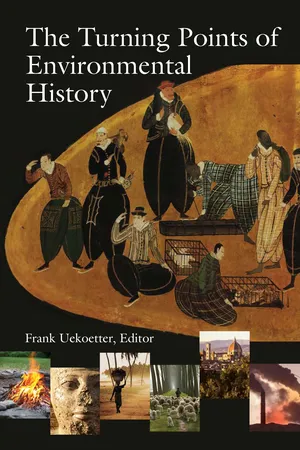
From the time when humans first learned to harness fire, cultivate crops, and domesticate livestock, they have altered their environment as a means of survival. In the modern era, however, natural resources have been devoured and defiled in the wake of a consumerism that goes beyond mere subsistence. In this volume, an international group of environmental historians documents the significant ways in which humans have impacted their surroundings throughout history.
John McNeill introduces the collection with an overarching account of the history of human environmental impact. Other contributors explore the use and abuse of the earth's land in the development of agriculture, commercial forestry, and in the battle against desertification in arid and semi-arid regions. Cities, which first appeared some 5,500 years ago, have posed their own unique environmental challenges, including dilemmas of solid waste disposal, sewerage, disease, pollution, and sustainable food and water supplies.
The rise of nation-states brought environmental legislation, which often meant "selling off" natural resources through eminent domain. Perhaps the most damaging environmental event in history resulted from a "perfect storm" of effects: cheap fossil fuels (especially petroleum) and the rapid rise of personal incomes during the 1950s brought an exponential increase in energy consumption and unforseen levels of greenhouse gasses to the earth's atmosphere. By the 1970s, the deterioration of air, land, and water due to industrialization, population growth, and consumerism led to the birth of the environmental and ecological movements.
Overall, the volume points to the ability and responsibility of humans to reverse the course of detrimental trends and to achieve environmental sustainability for existing and future populations.
- 219 pages
- English
- PDF
- Available on iOS & Android
eBook - PDF
The Turning Points of Environmental History
About this book
Information
Subtopic
World HistoryIndex
HistoryTable of contents
- Contents
- Acknowledgments
- 1. Thinking Big: The Broad Outlines of a Burgeoning Field
- 2. The First Hundred Thousand Years
- 3. Agriculture
- 4. Forest History
- 5. The Nation-State
- 6. Urban Environmental History
- 7. The “1950s Syndrome” and the Transition from a Slow-Going to a Rapid Loss of Global Sustainability
- 8. Modern Environmentalism
- 9. The Knowledge Society
- 10. Desertification
- Notes
- List of Contributors
- Index
Trusted by 375,005 students
Access to over 1.5 million titles for a fair monthly price.
Study more efficiently using our study tools.
Frequently asked questions
Yes, you can cancel anytime from the Subscription tab in your account settings on the Perlego website. Your subscription will stay active until the end of your current billing period. Learn how to cancel your subscription
No, books cannot be downloaded as external files, such as PDFs, for use outside of Perlego. However, you can download books within the Perlego app for offline reading on mobile or tablet. Learn how to download books offline
Perlego offers two plans: Essential and Complete
- Essential is ideal for learners and professionals who enjoy exploring a wide range of subjects. Access the Essential Library with 800,000+ trusted titles and best-sellers across business, personal growth, and the humanities. Includes unlimited reading time and Standard Read Aloud voice.
- Complete: Perfect for advanced learners and researchers needing full, unrestricted access. Unlock 1.5M+ books across hundreds of subjects, including academic and specialized titles. The Complete Plan also includes advanced features like Premium Read Aloud and Research Assistant.
We are an online textbook subscription service, where you can get access to an entire online library for less than the price of a single book per month. With over 1.5 million books across 990+ topics, we’ve got you covered! Learn about our mission
Look out for the read-aloud symbol on your next book to see if you can listen to it. The read-aloud tool reads text aloud for you, highlighting the text as it is being read. You can pause it, speed it up and slow it down. Learn more about Read Aloud
Yes! You can use the Perlego app on both iOS and Android devices to read anytime, anywhere — even offline. Perfect for commutes or when you’re on the go.
Please note we cannot support devices running on iOS 13 and Android 7 or earlier. Learn more about using the app
Please note we cannot support devices running on iOS 13 and Android 7 or earlier. Learn more about using the app
Yes, you can access The Turning Points of Environmental History by Frank Uekötter, Frank Uekotter,Frank Uekötter in PDF and/or ePUB format, as well as other popular books in History & World History. We have over 1.5 million books available in our catalogue for you to explore.