- English
- ePUB (mobile friendly)
- Available on iOS & Android
eBook - ePub
About this book
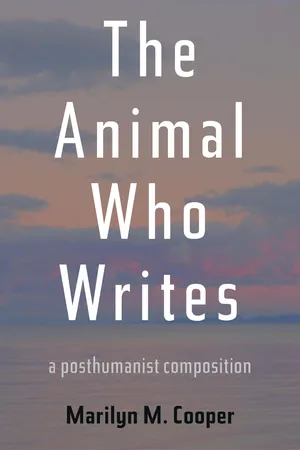
Writing begins with unconscious feelings of something that insistently demands to be responded to, acted upon, or elaborated into a new entity. Writers make things that matter—treaties, new species, software, and letters to the editor—as they interact with other humans of all kinds. As they write, they also continually remake themselves. In The Animal Who Writes, Cooper considers writing as a social practice and as an embodied behavior that is particularly important to human animals. The author argues that writing is an act of composing enmeshed in nature-cultures and is homologous with technology as a mode of making.
Information
Subtopic
Rhetoric1
Enchanted Writing
Enchantment ontology suggests new, unfamiliar ways to think about what writing is and what we are doing when we write, ways of thinking that can be hard to change, especially for those of us in the West. It suggests that writing is not an epistemic or even a socio-epistemic practice of interpreting the world but rather a behavior of intra-acting in the world, not a behavior dominantly driven by intentions or purposes but rather by responding to possibilities that arise through intra-actions, and finally not a behavior governed by effectiveness or efficiency but rather by creativity and accountability. Our habitual focus on specificity, purpose, and the effective communication of information in writing makes it difficult to perceive how all writing begins in intra-action and is realized through accountability “for what materializes, for what comes to be” (Barad 361) in the telling. These are the aspects of writing that enchantment ontology inspires us to focus on.
Robin Wall Kimmerer’s essay “In the Footsteps of Nanabozho: Becoming Indigenous to Place” (Braiding Sweetgrass) demonstrates how habits of writing such as paying attention to and corresponding with all kinds of other beings, being open to learning from intra-actions, and connecting the past and present can generate possibilities for new futures. In her essay, Kimmerer, a botanist and member of the Citizen Potawatomi Nation, muses on the situation of immigrants as she walks through a spruce forest to a bluff over the Pacific Ocean, an area new to her. She tells of her encounters with the unfamiliar beings she corresponds with and relates them to the Anishinaabe story of Original Man (Nanabozho), who, as the last of all beings created, is also an immigrant. From these intra-actions, a new way of thinking about immigration and becoming indigenous arises, and her writing creates and accounts for this realization. Her new understanding of becoming indigenous also derives from her connections of her present situation with the origin story of Nanabozho. As she explains, for her people, time is not linear, and such “stories are both history and prophecy, stories for a time yet to come” (207).
Kimmerer tells how Nanabozho received instructions from the Creator “to walk in such a way ‘that each step is a greeting to Mother Earth,’” which he understood to mean that he should learn the true names of all the beings, not so that he could master them but so that he might learn from them (206).1 As Nanabozho greeted all the beings, they greeted him in return and he began to feel at home. As Kimmerer walks in the Pacific Coast forest where “no one knows [her] name,” she follows Nanabozho by greeting “my Sitka Spruce grandmother” whose “swaying foliage is constantly murmuring to her neighbors”; she says the spruce will “eventually pass the word and my name on the wind” (206). “Names are the way we humans build relationship, not only with each other but with the living world” (208), Kimmerer says. The immigrant human and native plant are now corresponding, to use Tim Ingold’s term for a kind of intra-action in which beings pay attention to one another by “moving along together” in “a dance of animacy” (M 106–7). As Ingold observes, the pattern is the same as in written correspondence, writing and reading, writing and responding.
Sitting under the sitka spruce and listening to the wind, Kimmerer ponders how immigrants might become indigenous to place. As she walks back to the trail, she recognizes a plant she had not noticed before, an immigrant from the east: the common plantain, called by the Potowatomis “White Man’s Footstep” and by Linnaeus Plantago major, which refers to the sole of a foot. Plantain followed the white settlers west, and everywhere else they went, and made itself at home. Unlike other nonnative plants like loosestrife and kudzu that “have the colonizing habit of taking over others’ homes and growing without regard for limits,” plantain is a good neighbor: “Its strategy is to be useful, to fit into small places, to coexist with others around the dooryard, to heal wounds” (214). After five hundred years, plantain became a naturalized member of the community. Kimmerer remembers that, just as for Nanabozho, “the plants are our oldest teachers” (213). Out of her intra-action with her “old friend” plantain emerges a new possibility: maybe human immigrants could “follow the teachings of White Man’s Footstep” (214). It is “by honoring the knowledge in the land, and caring for its keepers [that] we start to become indigenous to place” (210).
Kimmerer says that her book offers “a braid of stories meant to heal our relationship with the world” (x). Stories, even when they do not address humans’ estrangement from the natural world, best exemplify the intra-active and creative aspects of writing. Rather than informing readers, stories engage readers by suggesting a path for them to follow, as Ingold explains: “The telling of stories is an education of attention. . . . To tell, in short is not to explicate the world, to provide the information that would amount to a complete specification, obviating the need for would-be practitioners to inquire for themselves. It is rather to trace a path that others can follow” (M 110). Ingold sees stories not as fictional accounts but as means of teaching, as do many Native American communities (cf. Basso 57–60). By tracing a path, pointing out “where to go and what to look out for” (Ingold, M 110), they encourage the habit of paying attention.
Introducing her book that addresses “the possibility of life in capitalist ruins,” Anna Lowenhaupt Tsing also emphasizes the importance of being open to intra-actions. She asks, “What do you do when your world starts to fall apart?” and answers, “I go for a walk, and if I’m really lucky, I find mushrooms” (Mushroom 1). She argues that finding oneself “without the handrails of stories that tell where everyone is going and, also, why” (2), one can realize that “there are still pleasures amidst the terrors of indeterminacy” (1). Coming upon mushrooms that “pop up unexpectedly” reminds her of how indeterminacy engenders “multiple futures [that] pop in and out of possibility” (viii). She comments, “The uncontrolled lives of mushrooms are a gift—and a guide” (2), and she hopes her readers will follow where they lead her. Her writing thus begins not with intentions but with intra-actions: her response to the specific “autumn aroma” of matsutake mushrooms and the different stories this entanglement engenders.
Assumptions of Enchantment Ontology
Kimmerer’s and Tsing’s books not only highlight the enchanted aspects of writing, they also exhibit the central assumptions of enchantment ontology that are crucial to understanding this shift in perspective. When I began introducing the idea of how enchantment ontology could reorient our thinking about writing, I realized that it was not easy for others to grasp how great a shift it required. Responses of those attending my presentations and presentations of similarly oriented colleagues left us puzzling: why don’t they get it? Though enchantment ontology has been developing over the past century, it still offers radical challenges to Western thought, challenges to the sharp division between the human and natural worlds, to essential and unchanging forms as the basis of reality, and to change as a difficult process involving external causes. Instead, it assumes:
Entanglement: parts of reality are entangled in intra-active phenomena from which emerge individual entities;
Becoming: reality is a process of unceasing and contingent change in which everything is always in the process of becoming; and
Creativity: novelty is immanent, inevitably emerging in a self-organizing world.
These assumptions also envision the universe as a single system, a cosmos, not divided into the separate realms of nature and society.
As Kimmerer relates how she and Nanabozho learn from the teachings of other beings, she affirms that humans are entangled in the cosmos, corresponding with sitka spruces, plantains, the sounds of the wind, the story of Nanabozho. His story is part of the intra-action, the past entangled with present and future—Nanabozho’s footprints “lie on the path behind us and on the path ahead” (207)—and is changing, becoming, along with Kimmerer and other entities in the intra-action. And her realization of how immigrants can become indigenous demonstrates the creativity of intra-action. The assumptions describe overlapping aspects of enchantment ontology, not a linear process, and Tsing’s recognition of the positive aspects of indeterminacy encapsulates how the assumptions work together: when entities are understood not as essential and separate unities but as constantly intra-acting and becoming, possible futures continually “pop in and out of possibility.”
The concept of entanglement goes beyond the posthumanist acknowledgment of the existence and relevance of other beings and cultures in dispelling the specter of the rational, free man as the universal condition of human existence. Entanglement is not just a way of saying that we’re all in this together, that everything is connected in causal chains. As Karen Barad explains, it is a perspective drawn from quantum mechanics, which understands “the primary ontological unit to be phenomena, rather than independent objects with inherent boundaries and properties” (333). Subjects, objects, and agents emerge from specific phenomena of novel becoming, which entangle some “parts” of the material world, a process Barad calls intra-action. All “entities” change and become something else in intra-action; Donna Haraway, who calls this process reciprocal induction,2 describes her training with her dog Cayenne as “partners-in-the-making through the active relations of co-shaping, not [as the interaction of] possessive human or animal individuals whose boundaries and natures are set in advance of the entanglements of becoming together” (When 208).
The ongoing becoming of entities through intra-action is captured in Alfred North Whitehead’s concept of concrescence: “The actual world is a process, and . . . the process is the becoming of actual entities . . . also termed ‘actual occasions’” (PR 22). Concrescence is the “production of novel togetherness”: “The novel entity is at once the togetherness of the ‘many’ which it finds, and also it is one among the disjunctive ‘many’ which it leaves; it is a novel entity. . . . The many become one, and are increased by one” (21). Whitehead asserts, “How an actual entity becomes constitutes what that actual entity is. . . . Its ‘being’ is constituted by its ‘becoming’” (23). Each entity, as an actual occasion, is a specific, unique holding together of disparate entities. Concrescence is somewhat analogous to Martin Heidegger’s equally enigmatic notion of the fourfold, in which things come to presence through gathering aspects of the world “into something that stays for a while: into this thing, that thing” (“Thing” 172). The bridge “gathers the earth as a landscape around the stream”; it “escorts the lingering and hastening ways of men to and fro, so that they may get to other banks and in the end, as mortals, to the other side”; the bridge is an actual entity that “gathers to itself in its own way earth and sky, divinities and mortals” (“Building” 150–51). Whitehead says, “In their natures, entities are disjunctively ‘many’ in process of passage into conjunctive unity” (PR 21). In the “creative advance” of concrescence, a novel entity, the one, arises from a gathering of some of the many already existing actual entities and thereby adds one more entity to the world.
Creativity follows logically from the first two assumptions: the singleness of reality in which entanglement results in a continual and irreversible becoming of new entities. Intra-action, or concrescence, explains the creativity inherent in the cosmos. Change and creativity are no longer seen as motivated by some external cause but are events in which multiple agents participate and for which they are jointly responsible. Everything is becoming as intra-acting entities respond to one another and “trade their stuff,” as complexity theorist Stuart Kauffman puts it (HU 129). Complex systems theory, which developed in computing, biology, and other fields in the mid-twentieth century, explains how “order for free” emerges from intra-action with no need for central control or separate instigating agents. Many more entities are acknowledged as agents, or actants, as Bruno Latour calls them, since agency is understood as involving affective entanglements rather than conscious purpose.
The understanding of systems as open, entangling natural and social systems, also distinguishes enchantment ontology from social constructionism and most versions of postmodernism which, in contrast, assume a divide between natural and socially constructed realms. Arguing forcefully against the bifurcation of nature into “the nature apprehended in awareness and the nature which is the cause of awareness,” Whitehead maintained that perceiving the red sunset is “not an action of nature on the mind. It is an interaction within nature” (CN 31). The experience of “the red glow of the sunset” is as much a part of nature as are “the molecules and electric waves” by which science explains the glow (28). Kimmerer also recognizes what she learns from intra-acting with plants as on a par with what she knows from studying them scientifically. Thus when Humberto Maturana and Francisco Varela say that “every act of knowing brings forth a world” (Tree 26), they do not mean that our minds or society or culture creates a representation of the world, an alternate or shadow world with a tenuous connection to reality, a world of infinite and endless relativity.3 As Barad says, “Realism, then, is not about representations of an independent reality but about the real consequences, interventions, creative possibilities, and responsibilities of intra-acting within and as part of the world” (37). Steven Shaviro, too, observes that the pragmatic consequences of Whitehead’s and Gilles Deleuze’s rejection of essentialism are quite different from the aporias of the deconstructionists and the polite conversation of Richard Rorty (Without Criteria 145–46). For process philosophers, “evanescence, becoming, incessant novelty, and ‘perpetual perishing’ do not make reference and grounding impossible. Rather, these experiences are themselves our fundamental points of reference” (Shaviro, Without Criteria 151). All our experiences tell of what we know about the world and support our becoming. In writing as in living, we intra-act within one world, and our intra-actions create the patterns in time that compose our world.
In what follows, in order to more fully elucidate how enchantment ontology reorients our understanding of writing, I trace its origins in complexity theory and process philosophy. I then contrast my approach with that of two other scholars in rhetoric and composition who also draw on versions of enchantment ontology. And finally, I address the question of how habits such as paying attention and being open to possibilities can transform effective writing into enchanted writing.
Origins of Enchantment Ontology
The roots of enchantment ontology go deep into Western intellectual history.4 The assumption of a single reality can be traced at least to the end of the nineteenth century as thinkers in both the sciences and humanities began undermining what Latour famously called the modern constitution, the rigorous distinction between human society and nonhuman nature that defines the project of humanism, in favor of a vision of “the common production of societies and natures” (WM 141). In the nineteenth century, Charles Darwin, along with Lamarck and Alfred Russel Wallace, unsettled the belief in the great chain of being by suggesting that species arise and die out in interaction with each other and their environments. At the turn of the twentieth century, a group of German-speaking scientists comprising the “Wholeness” movement argued that viewing “phenomena less atomistically and more ‘holistically,’ less mechanistically and more ‘intuitively’ . . . could lead to the rediscovery of a nurturing relationship with the natural world” (Harrington xii). As they said, “It would ‘reenchant’ the world,” voicing the idea long before Morris Berman’s best-selling book (Harrington xii). Wholeness began with Hans Dreisch’s fin-de-siècle revival of vitalism and was elaborated not only in the work of scientists such as Jacob von Uexküll but also in the process philosophy of Henri Bergson and Alfred North Whitehead. Uexküll’s observations of how organisms interacted with their environments to create functional circles, or “soap bubbles,” later inspired Heidegger’s concept of being-in-the-world, Maurice Merleau-Ponty’s notion of the intercorporeal self, and, in part, Deleuze’s concept of affect.5
Uexküll, in turn, had been inspired by Immanuel Kant, who, in the Critique of Judgment, had suggested that humans in the mode of aesthetic response interact with the world much as do other animals. The aesthetic subject, as Shaviro describes it, “neither comprehends nor legislates, but only feels and responds . . . this subject is itself informed by the world outside, a world that (in the words of Wallace Stevens) ‘fills the being before the mind can think’” (Without Criteria 13). William Connolly suggests that Kant also saw animal behavior as not simply driven by natural laws but as purposive, like that of humans. An organism, according to Kant, “exists as a natural purpose . . . [it] is both cause and effect, both generating itself and being generated by itself ceaselessly” (249; qtd. in Connolly, Fragility 106).
As Anne Harrington explains, Uexküll’s concept of a functional circle uniting organism and environment arose out of his close study of these openings in Kant’s thought: “It now seemed self-evident to him that every animal, every living thing, far from being a passive product of an external world . . . was also, in fact, an active creator of its own ‘external reality’” (41). For Uexküll, every living thing, all organisms, human and nonhuman, are both products and creators, and reality is the experiencing of this process. In his Theoretical Biology, he extends this idea to encompass scientists themselves, arguing that “Nature imparts no doctrines: she merely exhibits changes in her phenomena. We may so employ these changes that they appear as answers to our questions” (ix). The natural world responds to the natural scientists’ questions, just as the garden responds to the gardener, creating “doctrine” (theories) and beauty and sustenance. For Whitehead, Uexküll’s functional circles coalesce into nature as a system of interrelated and responding attributes, much as it does in Deleuze (see Buchanan 174–76).
Whitehead also cleaves to the second assumption of enchantment ontology, the understanding of change as an arc of becoming: “It is nonsense to conceive of nature as a static fact, even for an instant devoid of duration. There is no nature apart from transition, and there is no transition apart from temporal duration” (MT 152; and see CN 54). Whitehead got the idea of duration from Bergson, who conceived of time as no longer “a mere quantitative measurement” but rather “an inner principle of existence” (Shaviro, Without Criteria 76). Bergson argues that existence is a matter of change: things that do not change do not endure. Thinking of time as a neutral succession of instants strung on a cord is an illusion of consciousness, an abstraction from our inner experience of time, which is duration: “The continuous progress of the past which gnaws into the future and which swells as it advances . . . all that we have felt, thought and willed from our earliest infancy is there, leaning over the present which is about to join it, pressing against the portals of consciousness that would fain leave it outside” (4–5). We cannot relive any past moment because we cannot erase our subsequent formative experiences. Thus time is irreversible; each moment “is something new added to what was before” (Bergson 6). What is true of human existence is also true of everything in the universe, he argues, concluding, “The universe endures. The more we study the nature of time, the more we shall comprehend that duration means invention, the creation of forms, the continual elaboration of the absolutely new” (Bergson 11). As Shaviro says, with the notion of duration, “becoming is liberated from static being, and the new can be privileged over the eternal” (Without Criteria 76). The continual elaboratio...
Table of contents
- Cover Page
- Half Title Page
- Title Page
- Copyright Page
- Dedication
- Contents
- Acknowledgments
- Abbreviations
- Introduction
- 1. Enchanted Writing
- 2. Writing as Entangled
- 3. Writing as Making
- 4. The Dynamics of Becoming
- 5. The Agency of Writing
- 6. The Creativity of Writing
- 7. Ethical Persuasion
- Conclusion: Good Writing Is Well Made
- Notes
- Works Cited
- Index
Trusted by 375,005 students
Access to over 1.5 million titles for a fair monthly price.
Study more efficiently using our study tools.
Frequently asked questions
Yes, you can cancel anytime from the Subscription tab in your account settings on the Perlego website. Your subscription will stay active until the end of your current billing period. Learn how to cancel your subscription
No, books cannot be downloaded as external files, such as PDFs, for use outside of Perlego. However, you can download books within the Perlego app for offline reading on mobile or tablet. Learn how to download books offline
Perlego offers two plans: Essential and Complete
- Essential is ideal for learners and professionals who enjoy exploring a wide range of subjects. Access the Essential Library with 800,000+ trusted titles and best-sellers across business, personal growth, and the humanities. Includes unlimited reading time and Standard Read Aloud voice.
- Complete: Perfect for advanced learners and researchers needing full, unrestricted access. Unlock 1.5M+ books across hundreds of subjects, including academic and specialized titles. The Complete Plan also includes advanced features like Premium Read Aloud and Research Assistant.
We are an online textbook subscription service, where you can get access to an entire online library for less than the price of a single book per month. With over 1.5 million books across 990+ topics, we’ve got you covered! Learn about our mission
Look out for the read-aloud symbol on your next book to see if you can listen to it. The read-aloud tool reads text aloud for you, highlighting the text as it is being read. You can pause it, speed it up and slow it down. Learn more about Read Aloud
Yes! You can use the Perlego app on both iOS and Android devices to read anytime, anywhere — even offline. Perfect for commutes or when you’re on the go.
Please note we cannot support devices running on iOS 13 and Android 7 or earlier. Learn more about using the app
Please note we cannot support devices running on iOS 13 and Android 7 or earlier. Learn more about using the app
Yes, you can access The Animal Who Writes by Marilyn M. Cooper in PDF and/or ePUB format, as well as other popular books in Languages & Linguistics & Rhetoric. We have over 1.5 million books available in our catalogue for you to explore.