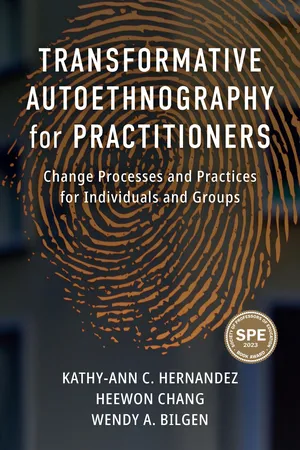
Can transformation be the primary goal of autoethnographic research? In this book, the authors present a compelling case that this is indeed possible. Since autoethnography first appeared as a nascent approach to social inquiry, much has been written about it as a useful addition to the field of qualitative research methods. Over the years, its usage has been extended across various disciplines including the humanities, human services, social sciences, leadership studies, engineering, education, counseling, and even medical education. Notably, the primary function of autoethnography to advance our understanding around sociocultural phenomena has been increasingly paired with a parallel function of the many ways in which this research method can also contribute to practice. However, though its contribution to scholarship is well documented, less has been written about its practical usage as the focal point of inquiry. Yet there is growing evidence that one of the emerging strengths of autoethnography is its transformative capabilities. In Transformative Autoethnography for Practitioners, Hernandez, Chang and Bilgen turn the spotlight on autoethnography as a tool for practitioners where the primary goal is to solve real world problems by facilitating transformational change at the individual, group and/or organizational levels. They draw on existing scholarship as well as their collective work and expertise to provide a Transformative Autoethnographic Model (TAM) for use by practitioners who are intent on effecting such changes in their respective contexts.
The book contains seven chapters. Chapters One through Three provide the theoretical grounding for a transformative autoethnography model. Chapter One begins with a broad overview of autoethnographic research and the unique characteristics of this method that makes it especially suited for effecting transformational learning. In chapters Two and Three, the authors provide a quick review of the literature relevant to individual autoethnography and collaborative autoethnography respectively. Each chapter discussion is centered around explicating the transformative elements of the method as well as how it is able to effect change at the individual, group, and organizational level. Chapters Four through Six focus on the praxis of transformative autoethnography. In Chapter Four, the transformative autoethnography model (TAM) is presented in detail and templates are provided for its application. Chapters Five and Six show the application of the TAM in a variety of settings. The book ends with a final chapter discussion on the continuing evolution of autoethnographic explorations, as well as future applications for the TAM model in a fast changing digital landscape.
Perfect for courses such as: Research Methods in the Social Sciences | Qualitative Research Methods | Narrative Research | Advanced Qualitative Research Methods | Coaching and Consulting | Leading Change
eBook - ePub
Transformative Autoethnography for Practitioners
Change Processes and Practices for Individuals and Groups
- 160 pages
- English
- ePUB (mobile friendly)
- Available on iOS & Android
eBook - ePub
Transformative Autoethnography for Practitioners
Change Processes and Practices for Individuals and Groups
About this book
Information

A
Abes, E.S., 110
Acosta, S., 10, 21
action research, 83, 99
Adams, T.E., 3, 5, 7, 9, 18, 33, 42, 100, 163, 164
adjourning, 70
Akehi, M., 9, 61
Alexander, B.K., 10, 44
Allen-Collinson, J., 68
American Educational Research Association, 163
analytical autoethnography, 4
Anderson, L., 4, 5, 36, 80
Anfara, Jr., V.A., 60
Anzaldua, G., 18–19, 45–46
artifact collection, 89
Atkinson, P., 4
AutoEthnographer, The, 163
autoethnographers, 6
living the life of, 164–65
transformation to, 17–18
autoethnographic I, 35
autoethnographic writing, 33
autoethnography, xiv
analytical, 4
as an artful science, 164–65
as catalyst for self-improvement and change, 14
characteristics of, 5–10
critical, 5
definition, 2–3
different approaches to, 4–5
disability and, 41
diverse end products, 10
evocative, 4
examination of self and, 11
four approaches to writing, 5
honest and transparent self-discovery, 13
individual or collaborative interrogation and, 8–9
inquiry method for in-depth understanding, 6–7
interpretive, 5
intersectional analysis and, 44
new groups of researchers and practitioners, 33
performative, 5
personal experience as primary data, 7
process for research and praxis, 9–10
professional lives and, 165–66
qualitative research ...
Table of contents
- Cover
- Halftitle
- Title
- Copyright
- Contents
- List of Figures and Tables
- Acknowledgments
- Preface
- ONE: Transformative Autoethnography
- TWO: Individual Autoethnography (IAE) for Transformation
- THREE: Collaborative Autoethnography (CAE) for Transformation
- FOUR: Transformative Autoethnography Model
- FIVE: TAM Applications for Individual Autoethnography
- SIX: TAM Applications for Collaborative Autoethnography
- SEVEN: TAM and Future Directions
- About the Authors
- Index
Trusted by 375,005 students
Access to over 1.5 million titles for a fair monthly price.
Study more efficiently using our study tools.
Frequently asked questions
Yes, you can cancel anytime from the Subscription tab in your account settings on the Perlego website. Your subscription will stay active until the end of your current billing period. Learn how to cancel your subscription
No, books cannot be downloaded as external files, such as PDFs, for use outside of Perlego. However, you can download books within the Perlego app for offline reading on mobile or tablet. Learn how to download books offline
We are an online textbook subscription service, where you can get access to an entire online library for less than the price of a single book per month. With over 1.5 million books across 990+ topics, we’ve got you covered! Learn about our mission
Look out for the read-aloud symbol on your next book to see if you can listen to it. The read-aloud tool reads text aloud for you, highlighting the text as it is being read. You can pause it, speed it up and slow it down. Learn more about Read Aloud
Yes! You can use the Perlego app on both iOS and Android devices to read anytime, anywhere — even offline. Perfect for commutes or when you’re on the go.
Please note we cannot support devices running on iOS 13 and Android 7 or earlier. Learn more about using the app
Please note we cannot support devices running on iOS 13 and Android 7 or earlier. Learn more about using the app
Yes, you can access Transformative Autoethnography for Practitioners by Kathy-Ann C. Hernandez,Heewon Chang,Wendy A. Bilgen, Kathleen deMarrais, Melissa Freeman, Jori Hall, and Kathy Roulston in PDF and/or ePUB format, as well as other popular books in Education & Research in Education. We have over 1.5 million books available in our catalogue for you to explore.