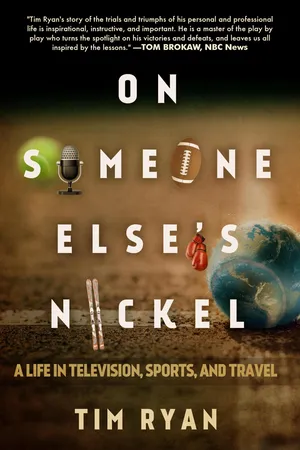
The legendary commentator recounts his adventuresome life in the ever-changing world of sport broadcasting in this lively memoir: "I couldn't put it down" (John McEnroe).
Tim Ryan is no doubt the only sportscaster who has crash-landed in the Namib desert, been charged by a rhino in Zimbabwe, herded sheep at the beginning of a Winter Olympics telecast, and dodged flying bottles at a professional boxing match. In his new memoir, Ryan recounts all of these tales and more in the personable, trustworthy voice that sports fans will recognize from his countless television appearances.
Armchair travelers and sports enthusiasts alike will be taken on a riveting journey as Ryan shares anecdotes from his adventures in broadcasting that span thirty sports in more than twenty countries over fifty years. And while the events themselves are impressive—ten Olympic Games, more than three hundred championship boxing matches, Wimbledon and US Open tennis, World Cup Skiing, just to name a few—it's the lesser-known stories that happened along the way that really stand out in Ryan's telling.
As he details how he came to call the first Ali-Frazier fight for the Armed Forces Network, or hosted a tennis tournament featuring the McEnroe brothers to raise money for the Alzheimer's Association, Ryan shines a light on sports and the world beyond sports—the world of family, friends, colleagues, and connections that endure when the game has been won and the mic turned off.
- 314 pages
- English
- ePUB (mobile friendly)
- Available on iOS & Android
eBook - ePub
About this book
Trusted by 375,005 students
Access to over 1.5 million titles for a fair monthly price.
Study more efficiently using our study tools.
Information
Topic
Personal DevelopmentSubtopic
Social Science BiographiesCHAPTER 1
Who Is This Guy Anyway?
The esteemed sports broadcaster Curt Gowdy, who was the top-gun announcer at NBC Sports early in my career, was once being interviewed by a journalist who asked where he was from. Curt’s reply began: “Well I was originally born in… and then…”
Normally an articulate and grammatically informed announcer, Gowdy managed to imply that he was born twice, presumably in two different locations.
I recollect that I heard that story from an NBC stage manager, Jim O’Gorman, who worked with both Curt and me and others over many years. O’Gorman was a calm, reassuring presence in the broadcast booths of live events who could be counted on to not only give accurate counts on his fingers (albeit only from ten on down) but to have in his kit-bag everything an announcer could need while tethered to a microphone cable for three hours or more: hangover cures, Band-Aids®, Preparation H®, and Imodium®, among other creative necessities.
But I digress.
I was “originally born” in Winnipeg Manitoba, in 1939. My father Joe Ryan, son of a wheat farmer, met and married my mother Helen Killeen in Ironwood, Michigan where he had been working in the lumber business. After a brief time in Chicago, Joe and Helen moved to Winnipeg where my father—with a law school degree and an accounting background—took a job with the Manitoba Wheat Pool. A sports fan but not an athlete, he also managed minor-league sports teams in Winnipeg. His interest in sports landed him a job as a sportswriter, and then as a columnist with the Winnipeg Free Press.
When Winnipeg’s first professional football team was being formed in 1933, he helped find investors and became the first general manager of the team when it joined Calgary and Regina as the western cities in the Canadian Rugby Union. The CRU later morphed into the Canadian Football League.
Joe went on to win three Grey Cup championships with Winnipeg in 1935, ’39 and ’41.
After the war years (during which he served in a civilian government job in Ottawa) he was the first general manager of the Montreal Alouettes. We moved there from Ottawa in 1946. The Alouettes won Dad’s fourth Grey Cup in 1949.
After a ten-year hiatus from football when he was a stock-brokerage executive in Toronto, where we moved to in 1951, he returned to football as the GM of the Edmonton Eskimos and he finished his career there, as a famous sports figure in Canada.
During his tenure as a financier in Toronto, Joe remained well-known to football fans. He got special attention in favored cocktail lounges and even from cab drivers, whom he hired most days to take him to work downtown from our home in North Toronto.
We had a dog at the time—a Kerry Blue Terrier named Molly Dooley. While she had very good bloodlines, she had no serious training from the Ryans. A gregarious and inquisitive girl, she regularly took off on jaunts near and far. Most often someone smitten by her charms would rub her curly coat and check her collar for an ID. We would get a call and send a taxi to pick her up.
One morning Joe was on his way to his office. The cab driver opened the car door for him. “Oh I know who you are,” he said, and Dad—pleased to be recognized—was about to ask if the driver was a football fan, when the cabbie added, “I drive your dog!”
For his exploits as a “Builder” in the CFL, Joe Ryan is in the Canada Sports Hall of Fame in Calgary, the Canadian Football Hall of Fame in Hamilton and the Manitoba Sports Hall of Fame in Winnipeg. Among his distinctions are hiring the first American coach in the league, Carl Cronin from Notre Dame, importing the first U.S. Player, halfback Fritzie Hanson from North Dakota State, serving as chairman of the CFL Rules Committee, and creating a revenue-sharing fiscal policy that enabled the smaller cities to compete with Toronto, Montreal, and Vancouver. He died in Victoria B.C. in 1979 at the age of seventy-seven.
My mother and father were married for fifty years. Helen became a minor celebrity in the Winnipeg area when the press made it known that after the Bombers games, Joe brought the muddy uniforms home and she washed them in her machine—readying them for the next game.
Helen, a schoolteacher, was a demanding parent, an accomplished tournament bridge player, an avid football fan and a political critic. She also raised three daughters—the eldest Mary Jo now lives in Ireland in retirement, an adopted sister Kathleen, who with her late husband Ron raised three girls in Toronto, and my youngest sister Cindy, a schoolteacher who died of melanoma at the age of 56, leaving her husband Terry and two grown children.
Obviously sports had a major influence on me as I grew up in Montreal and Toronto. I played all the sports through my high-school days at De la Salle “Oaklands” in Toronto, although with my father’s skinny frame and a decided lack of talent—just making the teams was my greatest accomplishment as an athlete. I did have the distinction of being the smartest of three quarterbacks on my high-school team, which still left me third-string. Our starter, Paul Palmer, actually went on to play at the University of Michigan and then as a defensive back in the Canadian League at Hamilton.
Dad’s journalism gene also had its influence. By my senior year in high school I decided that was what I wanted to pursue—on the news side. With the help of my student-advisor, Brother Stephen of the Christian Brothers, I applied to the top journalism schools in the U.S.: Missouri, Columbia, Fordham, and Northwestern, along with Canada’s only reputed one, Western Ontario.
When my Father got wind of the plans (he was not a particularly hands-on dad) he said, “Why not Notre Dame?” This surprised me, until I remembered that he was a die-hard “subway alumnus” of ND, having worked in the States for several years during the Depression and fallen for the Fighting Irish.
So we sent an application there, and I was accepted. Having had my seventeenth birthday in May of 1956, I started as a freshman in South Bend in the fall.
CHAPTER 2
“Cheer, Cheer For Old…”
My college life began with a dispute between a cocky Canadian student (me) and an arrogant Holy Cross cleric (him).
I had arrived expecting to begin my sophomore year, having completed five years of high school in the Canadian system and believing, wrongly as it turned out, that my credits for Grade 13 would count for my Freshmen year at Notre Dame. It came as a big shock when Father Sheedy, Dean of Students, coldly informed me otherwise.
Unimpressed with my case for skipping freshmen year, and unsympathetic with my distress over the fact, Father Sheedy offered me a deal. Make the Dean’s List my first semester—scoring an average of 88 on a scale of 100—and I could start my sophomore year in the spring.
Angry and upset, once back in my dorm in Breen-Phillips Hall, I threw up.
The hall rector sent me to the infirmary where I spent the next two days seriously considering taking the next train back to Toronto. Getting no encouragement whatsoever from my parents to do so, I got over my nausea and my teenage tantrum. I would stay at ND, determined to show the S.O.B. Sheedy that I could make his damn Dean’s List.
I didn’t. Well at least not the first semester. It was football season of course, and I was a wide-eyed freshman, immediately caught up in the atmosphere of the Fighting Irish. Terry Brennan was the coach, the team wasn’t up to the standards of the Frank Leahy years, but it had the brilliant Paul Hornung.
Football Saturdays in South Bend sent an electric charge through campus that was palpable. Classes Monday through Friday that first semester were just about getting to Saturday, when thousands of families and fans poured onto the leafy grounds of the university to follow the marching band of the Irish from the quadrangle of residence halls to Notre Dame Stadium.
Swallowing my juvenile antipathy to Father Sheedy, I decided there was too much fun and excitement to miss with my head buried in the books. I would enjoy this freshman year in full.
Unfortunately, fans of the football team didn’t have much to enjoy.
Despite Hornung’s heroics, the Irish weren’t very good. Alumni and media were screaming for Brennan’s head. But the atmosphere and legendary spirit still made getting up early on Saturday mornings an easy thing to do. It was a two-minute walk to the venerable seniors’ hall, Sorin, from my freshman hall and that’s where the action was on football Saturdays. A makeshift band of student-musicians would assemble on the porch of the stately old building, a party would ensue—happily supplemented by the girls of St. Mary’s College nearby. (ND was still an all-male student body in the fifties and sixties.)
Of course a party there didn’t include alcohol in any form (except for a few surreptitious shots smuggled in discreetly), but still good times were had by all—until the games started!
The most fun I had with the football team was trying to recruit Hornung for the Canadian Football League. My father had contacted me on behalf of the team that was going to draft the Heisman quarterback, hoping he might consider the CFL over the NFL. The theory was that since the Irish had had such a poor season, he might have dropped down the ranks in the eyes of NFL teams. The CFL would give him the chance to use his triple-threat talents on the wider field where QBs who can run can thrive. Then if he showed his stuff in Canada as a rookie he would still attract NFL interest.
My job was to get friendly with him and cajole him into considering going to Canada.
I did my bit. I knocked on his door in his senior hall one day after the season, introduced myself, and told him why I was there. He didn’t close the door—either on me or the CFL idea—and we became friends. But as the school year wore on, I had the sense that he believed he would go high in the NFL draft despite Notre Dame’s 2 and 8 season—one of the worst ever for the Fighting Irish.
He was right, Green Bay picked him, and the rest as they say, is history.
As it turned out, our friendship was renewed years later at CBS when we were both football broadcasters on NFL and college games.
Meanwhile, I didn’t make the Dean’s List that first semester, but used my freshman writing class to create an opportunity to meet the legendary Notre Dame Coach Frank Leahy. There was a writing contest for freshmen, and I chose to write about the firing of Terry Brennan, in the context of Notre Dame’s long history of renowned coaches. Through the Sports Information office I was able to make contact with Coach Leahy, explain what I was doing, and ask if I could get some comments from him.
To my surprise, he invited me to lunch at his home in nearby Michigan City! Mrs. Leahy prepared lunch, and Frank was friendly and helpful—while careful not to be too critical of Brennan. All the while I was nervously scribbling down notes, and left after lunch thrilled by the experience.
My classmates were mightily impressed that I had pulled off the interview—at Leahy’s home no less!
I didn’t win the contest.
Social life at ND was limited. It was after all a boys-only university until the 1970s. St. Mary’s College is an all-girls school a twenty-minute walk across campus. Visiting restrictions were rigid at both Catholic schools, although there were frequent “mixers” and of course prom nights.
Some more adventurous guys risked suspension by sneaking a girl into their dorm room for overnight trysts, or organized sleepovers at houses of student friends who lived off-campus. But our hero was a classmate by the name of Jim Ausum, who in our senior year billeted his St. Mary’s girlfriend in his room for a full week over the Easter Holidays, somehow managing to avoid scrutiny from the priest-rectors in Sorin Hall. I will spare you the details.
As for off-campus entertainment, occasional weekend trips to Chicago—ninety minutes away by train—could offer the chance to drink beer, hear some live jazz and maybe even see a strip show, pretty exciting stuff for a teenaged college kid. Many of the saloons were owned by the Chicago mob—at one of them one night, the star of the show was an amply endowed lady of some renown, Tempest Storm.
Joined at the bar by a couple of my classmates, I showed my fake ID and ordered a Budweiser as Ms. Storm’s backup band warmed up the crowd. (The drummer was Barrett Deems who had played with Louis Armstrong and was clearly down on his luck playing in a strip bar.)
“I’ll have a Budweiser,” I said to the bartender with authority.
“Fox Head,” came the gruff reply.
“No, Budweiser,” I said bravely.
“Fox Head, kid, that’s what we serve here.” And he slapped down a bottle of Fox Head in front me.
Even an ingenue like me could figure out that the mob owned the bar, and the beer distributorship for Fox Head, a beer I had never heard of before.
Meanwhile, Tempest, partially wrapped in a long fake-fur stole, strutted to the stage to a dramatic drum-roll by Barrett Deems and proceeded to mesmerize us with a strip routine that introduced me to the dazzling technique of twirling a tassel affixed on one glorious breast in one direction, and a tassel on the other in the opposite direction.
In the late fifties college kids out on the town were easily impressed.
CHAPTER 3
Finding the Path
Despite the worst four-year record for a Notre Dame Football team in its then history, I loved every minute of my time in South Bend. I majored in Communication Arts with the intention of becoming a news reporter after graduation. Summers I worked as a copy boy at Canadian Press in Toronto, then as a rewrite man on the overnight desk at the Toronto Star, where a young Ernest Hemingway had once toiled.
My highlights at the Star were having a Page One bylined story about a convention of Jehovah’s Witnesses being held in Toronto; beating the police to a 3 a.m. crime scene and finding the body of a murder victim before the cops did; and convincing the entertainment editor to use me as his jazz critic.
My love of jazz has stayed with me over a lifetime and I have made many friends in that world. More on that later on.
Also in the summer, I began my career behind a microphone, although at the time it was just for fun. My sister Mary Jo had recommended me to the creators of a radio show that used high school kids on the air discussing teenage topics. I was one of the moderators. I enjoyed it, but my goal going off to college was still to ...
Table of contents
- On Someone Else’s Nickel: A Life in Television, Sports, and Travel
- Copyright
- Dedication
- Frontispiece
- Preface
- 1. Who Is This Guy Anyway?
- 2. “Cheer, Cheer For Old…”
- 3. Finding the Path
- 4. “Lights, Camera…”
- 5. Hockey With “Peanuts”
- 6. High Anxiety
- 7. Helluva Town
- 8. Artistic Athletes and an Artist of Sport
- 9. Boxing’s Bad Bedfellows and “The Fight of the Century”
- 10. Big Breaks In The Big Apple
- 11. Entering the Golden Age of Sports TV
- 12. Lord Stanley’s Cups
- 13. A Love Affair With Europe
- 14. CBS and the Eighties
- 15. More Football—Coaches and Characters
- 16. Basketball—NBA And NCAA
- 17. Tennis: All About Love
- 18. Boxing: A Life Changer
- 19. Arum’s Fistic Follies
- 20. Difficult and Delicate Decisions
- 21. From the Nile to the Thames
- 22. Bordeaux and Bikes
- 23. Boxing and Bikinis
- 24. Two Micks Visit the Old Sod
- 25. Trinidad, Toilets, and Rahway
- 26. The Man With the Golden Gun
- 27. Fan-Man Takes a Dive
- 28. Witness to Ring Tragedy
- 29. “And Now For Something Completely Different…”
- 30. Into Africa
- 31. They Are Called “Wild Beasts” For a Reason
- 32. “The Heart of Darkness”
- 33. Ice Follies and the Fall of the Wall
- 34. More Snow, and Sake the Hard Way
- 35. Other Icy Endeavors
- 36. Lucking Into America’s Cup History
- 37. A Family Copes as Olympics Approach
- 38. Loveable Lillehammer
- 39. Picabo and “The Herminator” Do Nagano
- 40. A Very Busy Decade
- 41. People of Good Value
- 42. A Diamond Investment
- 43. Promises Kept and Class Prevails
- 44. Dinner with “The Chairman of the Board”
- 45. Changes
- 46. Can’t We Do More?
- 47. New Beginnings
- 48. The Gift of Lee
- 49. Horses, Courses, and Courts
- 50. Carwashes, Bode-Bites, and the Dancing Horse
- 51. Athens: Hot Winds, Hot Horses, and Death-Defying Waiters
- 52. The ESPN Years: “Who Knew?”
- 53. I Love Paris…and London When It Doesn’t Rain
- 54. Why Switzerland?
- 55. Boondoggles and Bangkok
- 56. Bad Times For Bode
- 57. Baubles and Beads
- 58. Home Sweet Homes
- 59. “The Second Time Around…”
- 60. Ski Racing and Porno??
- 61. Beijing Smog and Peking Duck
- 62. Christmas in Klammer’s Austria
- 63. Homecoming in My Homeland
- 64. Ski Racers Are Special
- 65. Not All Horses Are Created Equal
- 66. “Chateau Pour Le Loyer”
- 67. Musings While Sipping Swiss Wines
- 68. London Bridges Not Falling Down
- 69. Okay, What Now?
- 70. “Old Soldiers Never Die…”
- 71. “A” For Alaska, “Z” For Zimbabwe
- 72. Encounters: Good and Bad…
- 73. Closing the Circle
- Acknowledgements
- Connect with Radius Book Group
Frequently asked questions
Yes, you can cancel anytime from the Subscription tab in your account settings on the Perlego website. Your subscription will stay active until the end of your current billing period. Learn how to cancel your subscription
No, books cannot be downloaded as external files, such as PDFs, for use outside of Perlego. However, you can download books within the Perlego app for offline reading on mobile or tablet. Learn how to download books offline
Perlego offers two plans: Essential and Complete
- Essential is ideal for learners and professionals who enjoy exploring a wide range of subjects. Access the Essential Library with 800,000+ trusted titles and best-sellers across business, personal growth, and the humanities. Includes unlimited reading time and Standard Read Aloud voice.
- Complete: Perfect for advanced learners and researchers needing full, unrestricted access. Unlock 1.5M+ books across hundreds of subjects, including academic and specialized titles. The Complete Plan also includes advanced features like Premium Read Aloud and Research Assistant.
We are an online textbook subscription service, where you can get access to an entire online library for less than the price of a single book per month. With over 1.5 million books across 990+ topics, we’ve got you covered! Learn about our mission
Look out for the read-aloud symbol on your next book to see if you can listen to it. The read-aloud tool reads text aloud for you, highlighting the text as it is being read. You can pause it, speed it up and slow it down. Learn more about Read Aloud
Yes! You can use the Perlego app on both iOS and Android devices to read anytime, anywhere — even offline. Perfect for commutes or when you’re on the go.
Please note we cannot support devices running on iOS 13 and Android 7 or earlier. Learn more about using the app
Please note we cannot support devices running on iOS 13 and Android 7 or earlier. Learn more about using the app
Yes, you can access On Someone Else's Nickel by Tim Ryan in PDF and/or ePUB format, as well as other popular books in Personal Development & Social Science Biographies. We have over 1.5 million books available in our catalogue for you to explore.