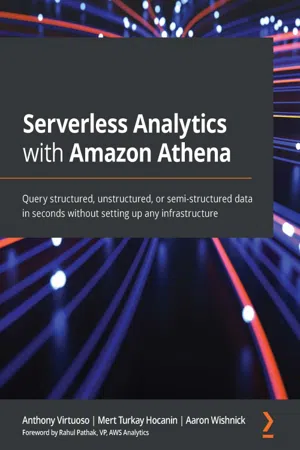
Get more from your data with Amazon Athena's ease-of-use, interactive performance, and pay-per-query pricingKey Features• Explore the promising capabilities of Amazon Athena and Athena's Query Federation SDK• Use Athena to prepare data for common machine learning activities• Cover best practices for setting up connectivity between your application and Athena and security considerationsBook DescriptionAmazon Athena is an interactive query service that makes it easy to analyze data in Amazon S3 using SQL, without needing to manage any infrastructure. This book begins with an overview of the serverless analytics experience offered by Athena and teaches you how to build and tune an S3 Data Lake using Athena, including how to structure your tables using open-source file formats like Parquet. You'll learn how to build, secure, and connect to a data lake with Athena and Lake Formation. Next, you'll cover key tasks such as ad hoc data analysis, working with ETL pipelines, monitoring and alerting KPI breaches using CloudWatch Metrics, running customizable connectors with AWS Lambda, and more. Moving on, you'll work through easy integrations, troubleshooting and tuning common Athena issues, and the most common reasons for query failure. You will also review tips to help diagnose and correct failing queries in your pursuit of operational excellence. Finally, you'll explore advanced concepts such as Athena Query Federation and Athena ML to generate powerful insights without needing to touch a single server. By the end of this book, you'll be able to build and use a data lake with Amazon Athena to add data-driven features to your app and perform the kind of ad hoc data analysis that often precedes many of today's ML modeling exercises.What you will learn• Secure and manage the cost of querying your data• Use Athena ML and User Defined Functions (UDFs) to add advanced features to your reports• Write your own Athena Connector to integrate with a custom data source• Discover your datasets on S3 using AWS Glue Crawlers• Integrate Amazon Athena into your applications• Setup Identity and Access Management (IAM) policies to limit access to tables and databases in Glue Data Catalog• Add an Amazon SageMaker Notebook to your Athena queries• Get to grips with using Athena for ETL pipelinesWho this book is forBusiness intelligence (BI) analysts, application developers, and system administrators who are looking to generate insights from an ever-growing sea of data while controlling costs and limiting operational burden, will find this book helpful. Basic SQL knowledge is expected to make the most out of this book.
eBook - ePub
Serverless Analytics with Amazon Athena
- 438 pages
- English
- ePUB (mobile friendly)
- Available on iOS & Android
eBook - ePub
Serverless Analytics with Amazon Athena
About this book
Information
Section 1: Fundamentals Of Amazon Athena
In this section, you will run your first Athena queries and establish an understanding of key Athena concepts that will be put into practice in later sections.
This section consists of the following chapters:
- Chapter 1, Your First Query
- Chapter 2, Introduction to Amazon Athena
- Chapter 3, Key Features, Query Types, and Functions
Chapter 1: Your First Query
This chapter is all about introducing you to the serverless analytics experience offered by Amazon Athena. Data is one of the most valuable assets you and your company generate. In recent years, we have seen a revolution in data retention, where companies are capturing all manner of data that was once ignored. Everything from logs to clickstream data, to support tickets are now routinely kept for years. Interestingly, the data itself is not what is valuable. Instead, the insights that are buried in that mountain of data are what we are after. Certainly, increased awareness and retention have made the information we need to power our businesses, applications, and decisions more available but the explosion in data sizes has made the insights we seek less accessible. What could once fit nicely in a traditional RDBMS, such as Oracle, now requires a distributed filesystem such as HDFS and an accompanying Massively Parallel Processing (MPP) engine such as Spark to run even the most basic of queries in a timely fashion.
Enter Amazon Athena. Unlike traditional analytics engines, Amazon Athena is a fully managed offering. You will never have to set up any servers or tune cryptic settings to get your queries running. This allows you to focus on what is most important: using data to generating insights that drive your business. You can just focus on getting the most out of your data. This ease of use is precisely why this first chapter is all about getting hands-on and running your first query. Whether you are a seasoned analytics veteran or a newcomer to the space, this chapter will give you the knowledge you need to be running your first Athena query in less than 30 minutes. For now, we will simplify things to demonstrate why so many people choose Amazon Athena for their workloads. This will help establish your mental model for the deeper discussions, features, and examples of later sections.
In this chapter, we will cover the following topics:
- What is Amazon Athena?
- Obtaining and preparing sample data
- Running your first query
Technical requirements
Wherever possible, we will provide samples or instructions to guide you through the setup. However, to complete the activities in this chapter, you will need to ensure you have the following prerequisites available. Our command-line examples will be executed using Ubuntu, but most flavors of Linux should also work without modification.
You will need internet access to GitHub, S3, and the AWS Console.
You will also require a computer with the following installed:
- Chrome, Safari, or Microsoft Edge
- The AWS CLI
In addition, this chapter requires you to have an AWS account and accompanying IAM user (or role) with sufficient privileges to complete the activities in this chapter. Throughout this book, we will provide detailed IAM policies that attempt to honor the age-old best practice of "least privilege." For simplicity, you can always run through these exercises with a user that has full access, but we recommend that you use scoped-down IAM policies to avoid making costly mistakes and to learn more about how to best use IAM to secure your applications and data. You can find the suggested IAM policy for this chapter in this book's accompanying GitHub repository, listed as chapter_1/iam_policy_chapter_1.json:
https://github.com/PacktPublishing/Serverless-Analytics-with-Amazon-Athena/tree/main/chapter_1
This policy includes the following:
- Read and Write access to one S3 bucket using the following actions:
- s3:PutObject: Used to upload data and also for Athena to write query results.
- s3:GetObject: Used by Athena to read data.
- s3:ListBucketMultipartUploads: Used by Athena to write query results.
- s3:AbortMultipartUpload: Used by Athena to write query results.
- s3:ListBucketVersions
- s3:CreateBucket: Used by you if you don't already have a bucket you can use.
- s3:ListBucket: Used by Athena to read data.
- s3:DeleteObject: Used to clean up if you made a mistake or would like to reattempt an exercise from scratch.
- s3:ListMultipartUploadParts: Used by Athena to write a result.
- s3:ListAllMyBuckets: Used by Athena to ensure you own the results bucket.
- s3:ListJobs: Used by Athena to write results.
- Read and Write access to one Glue Data Catalog database, using the following actions:
- glue:DeleteDatabase: Used to clean up if you made a mistake or would like to reattempt an exercise from scratch.
- glue:GetPartitions: Used by Athena to query your data in S3.
- glue:UpdateTable: Used when we import our sample data.
- glue:DeleteTable: Used to clean up if you made a mistake or would like to reattempt an exercise from scratch.
- glue:CreatePartition: Used when we import our sample data.
- glue:UpdatePartition: Used when we import our sample data.
- glue:UpdateDatabase: Used when we import our sample data.
- glue:CreateTable: Used when we import our sample data.
- glue:GetTables: Used by Athena to query your data in S3.
- glue:BatchGetPartition: Used by Athena to query your data in S3.
- glue:GetDatabases: Used by Athena to query your data in S3.
- glue:GetTable: Used by Athena to query your data in S3.
- glue:GetDatabase: Used by Athena to query your data in S3.
- glue:GetPartition: Used by Athena to query your data in S3.
- glue:CreateDatabase: Used to create a database if you don't already have one you can use.
- glue:DeletePartition: Used to clean up if you made a mistake or would like to reattempt an exercise from scratch.
- Access to run Athena queries.Important NoteWe recommend against using Firefox with the Amazon Athena console as we have found, and reported, a bug associated with switching between certain elements in the UX.
What is Amazon Athena?
Amazon Athena is a query service that allows you to run standard SQL over data stored in a variety of sources and formats...
Table of contents
- Serverless Analytics with Amazon Athena
- Foreword
- Preface
- Section 1: Fundamentals Of Amazon Athena
- Chapter 1: Your First Query
- Chapter 2: Introduction to Amazon Athena
- Chapter 3: Key Features, Query Types, and Functions
- Section 2: Building and Connecting to Your Data Lake
- Chapter 4: Metastores, Data Sources, and Data Lakes
- Chapter 5: Securing Your Data
- Chapter 6: AWS Glue and AWS Lake Formation
- Section 3: Using Amazon Athena
- Chapter 7: Ad Hoc Analytics
- Chapter 8: Querying Unstructured and Semi-Structured Data
- Chapter 9: Serverless ETL Pipelines
- Chapter 10: Building Applications with Amazon Athena
- Chapter 11: Operational Excellence – Monitoring, Optimization, and Troubleshooting
- Section 4: Advanced Topics
- Chapter 12: Athena Query Federation
- Chapter 13: Athena UDFs and ML
- Chapter 14: Lake Formation – Advanced Topics
- Other Books You May Enjoy
Trusted by 375,005 students
Access to over 1.5 million titles for a fair monthly price.
Study more efficiently using our study tools.
Frequently asked questions
Yes, you can cancel anytime from the Subscription tab in your account settings on the Perlego website. Your subscription will stay active until the end of your current billing period. Learn how to cancel your subscription
No, books cannot be downloaded as external files, such as PDFs, for use outside of Perlego. However, you can download books within the Perlego app for offline reading on mobile or tablet. Learn how to download books offline
Perlego offers two plans: Essential and Complete
- Essential is ideal for learners and professionals who enjoy exploring a wide range of subjects. Access the Essential Library with 800,000+ trusted titles and best-sellers across business, personal growth, and the humanities. Includes unlimited reading time and Standard Read Aloud voice.
- Complete: Perfect for advanced learners and researchers needing full, unrestricted access. Unlock 1.5M+ books across hundreds of subjects, including academic and specialized titles. The Complete Plan also includes advanced features like Premium Read Aloud and Research Assistant.
We are an online textbook subscription service, where you can get access to an entire online library for less than the price of a single book per month. With over 1.5 million books across 990+ topics, we’ve got you covered! Learn about our mission
Look out for the read-aloud symbol on your next book to see if you can listen to it. The read-aloud tool reads text aloud for you, highlighting the text as it is being read. You can pause it, speed it up and slow it down. Learn more about Read Aloud
Yes! You can use the Perlego app on both iOS and Android devices to read anytime, anywhere — even offline. Perfect for commutes or when you’re on the go.
Please note we cannot support devices running on iOS 13 and Android 7 or earlier. Learn more about using the app
Please note we cannot support devices running on iOS 13 and Android 7 or earlier. Learn more about using the app
Yes, you can access Serverless Analytics with Amazon Athena by Anthony Virtuoso,Mert Turkay Hocanin,Aaron Wishnick,Rahul Pathak in PDF and/or ePUB format, as well as other popular books in Computer Science & Data Modelling & Design. We have over 1.5 million books available in our catalogue for you to explore.