The author of
The Singing Guru shares the journey of Bhai Lehna to becoming Guru Angad in a tale that's part history, legend, and fiction.
Into the Great Heart carries forward and concludes the stories of Guru Nanak and Bhai Mardana, his favorite minstrel, from the first volume of the Sikh Founder Series,
The Singing Guru.
History, legend, and fiction merge to populate this book with fascinating personalities from Sikh history. Pivotal to this narrative are forgotten female luminaries such as Guru Nanak's wife, Mata Sulakhni, his sister, Bebe Nanaki, Bhai Lehna's wife, Khivi, and daughter, Amro.
Brought to the foreground, their wisdom and insights as they overcome obstacles to spiritual growth embody the basic tenets of Sikhism in everyday living. They enhance Guru Nanak and Bhai Lehna's tale with their diverse approach to life.
Filled with captivating characters that enrich the tapestry of this compelling narrative,
Into the Great Heart is a must-read for anyone who loves a rich story about human nature in its search for spiritual awareness.
"A poetic and moving evocation of the life and spirit of Guru Nanak." —Alex Rutherford, author of Empire of the Moghul series
eBook - ePub
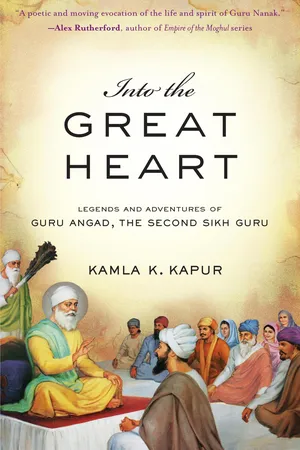
Into the Great Heart
Legends and Adventures of Guru Angad, the Second Sikh Guru
- 286 pages
- English
- ePUB (mobile friendly)
- Available on iOS & Android
eBook - ePub
About this book
Trusted by 375,005 students
Access to over 1.5 million titles for a fair monthly price.
Study more efficiently using our study tools.
Information
PART I THE DANCING GURU: LEHNA
Prologue
Guru Nanak survived longer than anyone thought he would. Even at sixty-three, he passionately wrote, composed, and preached his message through songs, and engaged with every aspect of life in the township that he had founded, Kartarpur, the City of God. From working in the fields to the common kitchen called langar, he was constantly involved in the lives of his devotees. Over time, Kartarpur become the focal point of the Sikhs, expanding and growing through the emigrations of thousands of devotees, each contributing labor, love, food supplies, and wealth.
But Guru’s Nanak’s two sons, Sri Chand and Lakhmi Das, were openly at war with each other for succession to the guruship. The populace, too, had taken sides. While Lakhmi Das was eyeing the wealth of the position, Sri Chand, shunning material wealth, wanted the power and prestige of being the guru of the Sikhs.
Sri Chand was already a guru of sorts. He had started a sect of Sikhism quite different from his father’s, called the Udaasis.1 Though his followers came from different castes, classes, and races, contrary to his father’s preference that his devotees engage wholeheartedly in all aspects of the life that human nature needs and demands while being detached from outcomes and desires, Sri Chand mandated that his followers be celibate, vegetarian, and abstain from alcohol. He did, however, allow smoking and eating intoxicants, such as bhang, charas,2 and opium. Most of his followers went naked while some wore loincloths, smeared ashes from crematoria on their bodies and hair, and wore brass chains around their necks and cords across their bodies.
Lakhmi Das, on the other hand, was married, and though he engaged in all aspects of life except manual labor, he barely had a spiritual spark. He was pleasure-seeking, hotheaded, and impulsive, and his passions were hunting, eating, and living well. Neither of Guru Nanak’s sons believed in honest labor, though they both made a pretense of it to win the favor of their father, who believed exercise of the body was essential for spiritual progress. Sri Chand’s purpose was renunciation, meditation, control of the mind through physical restraints, severe austerities like abstinence from food and drink, hanging upside down from trees for days and weeks, sitting on beds of nails, and acquisition of occult powers. Lakhmi Das, in addition to spending most of his waking life hunting, liked expensive horses, fancy outfits, and good food.
A vanguard of Sri Chand’s followers trooped into Kartarpur one day in a cloud of smoke from their smoldering pipes. They had come to announce, with the blowing of horns and beating of drums, the arrival of their guru.
People from the township gathered around them and listened to the miraculous stories recounted by Sri Chand’s followers, who called him Baba Sri Chand. They were stories of how he could disappear before their eyes, appear at different places at the same time, bring dead people to life, materialize things out of air, and even levitate and fly.
Then Sri Chand himself arrived, wearing a red loincloth, looking like Shiva.3 His body strong, muscular, and lean from his many austerities, smeared with ash, hair matted like snakes, eyes sharp and piercing. People bowed to him, touched his feet, told him about their troubles and sought his advice. They believed he was Guru Nanak’s true heir.
Soon, like a destined entrance, Lakhmi Das—short, a little plump, fine-featured, clad in expensive woolen clothes, leather boots—rode in on his Arabian horse, wearing a cap with feathers and singing a secular song. The hunting party carried the bloody carcasses of deer and various birds slung on their saddles. Lakhmi Das rolled his eyes at the sight of his older brother and dismounted, barely acknowledging the presence of Sri Chand, whose visits to Kartarpur had become more frequent in order to stake his claim to his inheritance.
Sri Chand’s eyes sparked fire as he saw the dead animals and birds; he walked up to his younger brother and slapped him so hard that Lakhmi Das stumbled back and fell in the slush of the recent rains. Lakhmi Das’s companions leapt from their horses, weapons drawn; Sri Chand’s followers, their muscles bulging with strength, lined up on the other side. A battle ensued, in which many an injury was inflicted on both sides.
It didn’t take long for word to reach their mother, Sulakhni, and Nanaki, their father’s sister, to run out of the house screaming and shouting at them to “Stop! Stop! Stop! You are brothers!” But their pleas for a truce were muffled in the turbulence of both parties’ inflamed and pent-up rage.
The women ran into the dogfight, parrying the blows and getting hurt in their attempt to separate the brothers. In her rage and fear that her sons might kill each other, Sulakhni began to hit Sri Chand with her fists, convinced that it was he who had started the fight. The two women’s presence brought a temporary halt to the hostilities. However, the brothers still shouted abuses at each other. Nanaki ministered to Sri Chand and Sulakhni to Lakhmi Das. Though Nanaki bestowed a great deal of tenderness and loving care on Sri Chand, wiping his wounds with her veil, Sri Chand’s gaze was riveted on the sight of his mother wailing, cooing over, and kissing Lakhmi Das. He pulled away from Nanaki, ran to his mother, pulled her away from his younger brother with force, shook her up, and shouted, “Witch! You gave me away as a child!”
Into this battlefield that Kartarpur had become came a stranger, a pilgrim, priest, dancer with bells on his ankles, and feathers in his cap. He was a worshipper of fire, a spark seeking to obliterate itself in a flame, a singer with Nanak’s songs reverberating in the chambers of his heart. The stranger, with a little girl astride the saddle of his white horse, rides joyously into the scene of our story, his greatest longing about to be fulfilled.
1. From Sanskrit udasin: one who is above worldly attachments.
2. Hashish.
3. The Hindu god of destruction and creation.
CHAPTER 1 Lehna Comes to Give and Take
The sun, setting after a blazing display of color, has left behind a luminous sky awash with gentle clouds seemingly without plan, purpose, or symmetry, yet with a beauty so stunning as to captivate the eye of the beholder riding toward it, making him marvel at the miracle of light and the succeeding darkness in which seeds quicken, take root, germinate. The stars appear to him like seeds of light scattered in the field of an indigo firmament in which the barely visible luminous arc of the new moon floats like a feather.
In the cobbled streets of Kartarpur, the stranger meets an old farmer in mud-stained clothes and a beard the color of the moon, accompanied by a young boy.
“Could you please show me the way to Guru Nanak’s house?” He asks. The old man and young boy smile at each other in complicity. Silently, they take the reins of the stranger’s horse and lead him on.
“Do you know Guru Nanak?” the little girl, sitting on the saddle before her father, asks excitedly.
“A little bit,” the old man replies. “He is not easy to know. The older he becomes, the more eccentric he gets. Almost like a fool.”
“That’s not true!” the young boy responds. “I don’t think he is eccentric at all, but becoming more and more divinely mad. I am Guru Nanak’s slave. He calls me Buddha, the Ancient One, herder of cows and buffaloes.”
“You? Ancient?” the girl laughs.
“Guru Nanak has slaves?” the stranger asks disappointedly.
“Voluntary ones that have given all of themselves to him.”
“Buddha,” says the old man, “if you give everything to that man, Nanak, what do you give to your Maker?”
“Nanak is the Maker’s slave. So to be Nanak’s slave is to be His slave’s slave,” the young boy says, skipping along the horse and stroking his muzzle.
The old man smiles affectionately and puts his arm across the young boy’s shoulders. The rider, too, is impressed by the boy, who could not have been more than twelve or thirteen years of age. So childlike and so wise.
“I’ve been waiting a long, long time to meet Guru Nanak,” the stranger says with barely concealed excitement.
“Why?” the old man asks.
“I am a priest and dancer in the temple of Durga4 Ma in Khadur, which is a village by the river Beas. Takht Mal, the head of the city, has constructed a beautiful temple made of marble, with niches for idols of all the various manifestations of Durga.”
“The Warrior Goddess! Kali! Sati! Chandi!5 They all wear such pretty clothes and necklaces and rings and bangles! Bee jee6 says she will buy some more bangles for me,” the child prattles, jangling them on her arm.
“You worship idols?” the boy asks. “Then why do you want to see Guru Nanak? He is the breaker of idols!”
“One evening, I had just finished washing the utensils for my aarti,7 scrubbing the sacred silver salver clean with soft ash till I could see my face in it, then filled the lamps with oil and wick, lit them, and scattered some hibiscus in the plate.”
“They are red flowers and have thin yellow tongues with a bodi8 at the end of them,” the girl adds.
Everyone laughs and then the stranger continues.
“It was that time in the evening which is the portal between day and night, the sky neither light nor dark, but both, a sapphire-blue fabric embroidered faintly with flowers of light. Crossing the courtyard toward the temple, I heard the enchanting strains of a song pouring into my ears like ambrosia. The youthful, feminine voice of the singer was so alluring that every string of my heart pulled me in its direction. The salver fell from my hands, and like a gopi 9 crazed by Krishna’s flute, I left the temple and went in search of the song and the angel who was singing it. It was Jodha, the young son of my neighbor.”
“Bhai10 Jodha! He is my friend! He comes to the dera11 whenever he can and teaches me archery and swordsmanship! He is a singer and a warrior,” Buddha cries excitedly. “There are some people in whose company the world vibrates on a high, clear, pure note, like Guru Nanak, Nanaki, Aziza, and Bhai Jodha! Everything that happens in their presence is magic!”
“I stood at his open door, enraptured, as if I had found the source of all my searching. When the song tapered into silence I asked, ‘Whose music, whose words?’ and he replied, ‘My guru, Baba Nanak’s.’
“Whenever I met Jodha in the gully, he would tell me about Guru Nanak and Kartarpur, but his descriptions didn’t mean anything to me. But the words ‘Baba Nanak’ and ‘Kartarpur’ burst into life with Jodha’s song. The descriptions began to breathe. Ever since then I have been on fire to meet him.”
“What were the words?” the old man asks.
“It was a long song, but I have memorized a stanza.” The young man clears his throat and sings:
Har charan kamal makarand lobhit mano
Andi no mohair ae epiyasa
Kirpa jal dai Nanak sa...
Table of contents
- Cover
- Title Page
- Dedication
- Acknowledgments
- Introduction
- Part I: The Dancing Guru: Lehna
- Part II: Into the Great Heart
- Epilogue: Transformation
- About the Author
- Bibliography
- Copyright
Frequently asked questions
Yes, you can cancel anytime from the Subscription tab in your account settings on the Perlego website. Your subscription will stay active until the end of your current billing period. Learn how to cancel your subscription
No, books cannot be downloaded as external files, such as PDFs, for use outside of Perlego. However, you can download books within the Perlego app for offline reading on mobile or tablet. Learn how to download books offline
Perlego offers two plans: Essential and Complete
- Essential is ideal for learners and professionals who enjoy exploring a wide range of subjects. Access the Essential Library with 800,000+ trusted titles and best-sellers across business, personal growth, and the humanities. Includes unlimited reading time and Standard Read Aloud voice.
- Complete: Perfect for advanced learners and researchers needing full, unrestricted access. Unlock 1.5M+ books across hundreds of subjects, including academic and specialized titles. The Complete Plan also includes advanced features like Premium Read Aloud and Research Assistant.
We are an online textbook subscription service, where you can get access to an entire online library for less than the price of a single book per month. With over 1.5 million books across 990+ topics, we’ve got you covered! Learn about our mission
Look out for the read-aloud symbol on your next book to see if you can listen to it. The read-aloud tool reads text aloud for you, highlighting the text as it is being read. You can pause it, speed it up and slow it down. Learn more about Read Aloud
Yes! You can use the Perlego app on both iOS and Android devices to read anytime, anywhere — even offline. Perfect for commutes or when you’re on the go.
Please note we cannot support devices running on iOS 13 and Android 7 or earlier. Learn more about using the app
Please note we cannot support devices running on iOS 13 and Android 7 or earlier. Learn more about using the app
Yes, you can access Into the Great Heart by Kamla A. Kapur in PDF and/or ePUB format, as well as other popular books in Literature & Historical Fiction. We have over 1.5 million books available in our catalogue for you to explore.