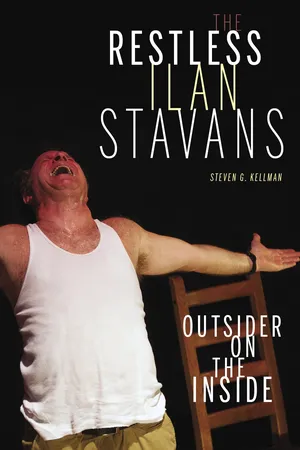
This is the first book-length study of one of the most prominent and prolific Latino academics, Ilan Stavans. He has written extensively on Latino culture, Jewish culture, dictionaries, immigration, language, Spanglish, soccer, translation, travel, selfies, and God. The Restless Ilan Stavans surveys his interests, achievements, and flaws while he is still in the midst of an extraordinarily productive career. A native of Mexico who became a U.S. citizen, he is an outsider to both the Chicano community that often resents him as an interloper and the American Jewish community that he, who grew up speaking Yiddish in Mexico City, often chides. The book examines his unlikely rise to prominence within the context of the spread of multiculturalism as a seminal principle within American culture. A self-proclaimed cosmopolitan who rejects borders, Stavans is both insider and outsider to the myriad of subjects he approaches.
The opening pages of A Most Imperfect Union (2014), Ilan Stavans’s graphic contrarian history of the United States, focus on immigration—“a vital part of the American fabric” (7)—and the author’s own experience as a twenty-four-year-old immigrant from Mexico. Stavans exploits the opportunity for self-promotion with a cartoon panel depicting three of his own books—The Hispanic Condition, The Norton Anthology of Latino Literature, and El Iluminado. A sign advertises: “The Ten Thousand Books of Ilan Stavans,” and another sign explains: “New titles added hourly” (8).
It is one of many metafictional moments scattered throughout the volume that interrupt the historical narrative to comment on the narrative itself. It is also a refreshing bit of self-mockery, one that pokes fun at Stavans’s own image as the Balzac of contemporary American critics, a dynamo of maniacal productivity whom Carolyn See called “a powerhouse of energy,” and Reynolds Smith, the executive editor at Duke University Press, described as “more ambitious than 10 men and a mule” (Richardson). In an essay on his experience reading Jewish literature, Stavans identifies himself as a writer of books and then drolly adds: “(perhaps I write too many books”) (Singer’s Typewriter 160). In addition, for a reviewing prank, his Borgesian account of a nonexistent novel by Philip Roth, The Plagiarist, he appended a byline that caricatures himself with the claim: “He was described as using performance-enhancing drugs to keep up a frantic, absurd pace of writing. Stavans adamantly denied these allegations before a Congressional committee. His latest book is My Life as an Insomniac (Hyperactive Press, 2008)” (“Philip Roth’s New Novel”). Stavans’s own father teases him by exclaiming: “What you don’t write about, Professor Prolifico!” (Return to Centro 25).
Stavans is the author of more than forty books and the editor or translator of more than sixty others, in English and Spanish. In addition to his own titles, Stavans has contributed introductions to dozens of books by other authors, including: Jorge Amado, Homero Aridjis, Mariano Azuela, Jimmy Santiago Baca, Nina Barragán, Alvar Núñez Cabeza de Vaca, Calvert Casey, Cesar Chavez, Martin A. Cohen, Julio Cortázar, Euclides da Cunha, Paquito D’Rivera, John Gregory Dunne, Ricardo Feierstein, Alicia Freilich, Ernesto Galarza, Alberto Gerchunoff, Isaac Goldemberg, H. M. Hudson, Efraín Huerta, Sor Juana Inés de la Cruz, Esther Kreitman, Peter Matthiessen, Octavio Paz, Teresa Porzecanski, Mauricio Rosencof, Domingo F. Sarmiento, Moacyr Scliar, Ana María Shúa, Jacobo Timerman, and César Vallejo. Nevertheless, portraying himself as a disciple of Flaubert and le mot juste, Stavans declares without irony: “I’m allergic to verbal excess” (Disappearance xi). He has been treating the allergy homeopathically, with a profusion of words.
As far back as 1995, very early in his verbal spree, Stavans began Bandido, his study of Chicano activist Oscar “Zeta” Acosta, with the prophetic words: “Excess. Nothing works like excess” (1). If, as William Blake proclaimed, “The road of excess leads to the palace of wisdom,” Stavans has, along with Stephen King and Joyce Carol Oates, paved his own path to enlightenment. He has also aroused suspicion, envy, and resentment. As John Updike observed about Oates, “The writers we tend to universally admire, like Beckett, or Kafka, or T. S. Eliot, are not very prolific” (Johnson 216).
Certainly, Samuel Johnson, whom Stavans—calling him “one of the most verbally sensitive, intellectually lucid minds ever to walk this earth” (Knowledge and Censorship 76)—reveres above all other lexicographers, might have been wary of such fecundity. “Sir,” observed Dr. Johnson to James Boswell, “I never desire to converse with a man who has written more than he has read” (Boswell 41). Stavans’s voracity as a reader does exceed his fecundity as a writer—“Being a passionate reader is more liberating, and thus more rewarding, than being a passionate writer,” he declares (Knowledge and Censorship 112). Nevertheless, he would not have escaped censure by Ben Jonson. “I remember the Players have often mentioned it as an honour to Shakespeare,” Jonson recalled, “that in his writing, (whatsoever he penn’d), hee never blotted out line. My answer hath beene, Would he had blotted a thousand” (Jonson 583). Stavans names Gustave Flaubert, who had the luxury to linger for days over a single sentence, as one of his favorite writers, but the blottable errors, calques, and other infelicities scattered throughout thousands of Stavans’s pages testify to Balzacian industry more than Flaubertian finesse.
For Gary Saul Morson, a prominent Slavicist at Northwestern University, the man’s astounding feracity is largely verbosity: “As Cervantes inserts tedious tales,” he says of Stavans’s book on Don Quixote, “Stavans seems to be filling as many pages as possible” (13). The translator Eliot Weinberger denounced Stavans’s short book on Octavio Paz as “unbelievably sloppy” (120). Raphael Folsom, a specialist in Latin American history, arrives at a similar assessment while reviewing two Stavans works, Art and Anger and Imagining Columbus. “Stavans is an intelligent and learned writer, but not a very careful one,” Folsom writes, “and the many errors of fact and style found in these books combined with Stavans’s rash judgments and careless analyses to distract the reader from their merits” (361). Furthermore, Bryan Cheyette, a professor at the University of Reading, faults his edition of the Oxford Book of Jewish Stories for “critical sloppiness” and “editorial sloppiness” and berates the publisher, Oxford University Press, for having “forgotten the first principles of scholarly rigour.”
At twenty-four, Stavans, who was born in 1961, vowed that if he had not published “a major book” by age thirty-three, he would shoot himself (On Borrowed Words 6). He repeated that anecdote in Spanish, recounting that “alguna vez me dije que si al cumplir los treinta y tres años no había escrito algo de valor, debía usar la pistol que mi padre guardaba en una caja fuerte” (Stavans and Zurita 46). Though not major in comparison to its successors, his first book in English, Imagining Columbus: The Literary Voyage, a study of representations of the Genoese mariner, appeared just in time, in 1993, for its author to bite the bullet. Except for 2013, no subsequent year has lacked a new volume with the byline Ilan Stavans. Into his fifties, he continues to project the aura of enfant terrible, a prodigious generator of youthful energy and ideas who is extravagantly manic even in recreation. He reports that he watched all 64 games leading up to the 2014 World Cup. “It was an exuberant and exhilarating endeavor. An average of one hour and 45 minutes for each meant I was hooked to the TV screen for 112 hours, or 4.66 days” (“Languages of the World Cup”).
Acknowledging that he suffers from terrible fear in the face of death and the unanswered questions—“Suffro de un terrible temor hacia la muerte y ante las preguntas incontestadas” (Prontuario 138–39)—Stavans declares that he writes in order to be immortalized not in a pantheon but a library: “Si escribo, es porque no quiero terminar en un pantéon sino en una biblioteca” (Prontuario 139). He conceives of writing as defiance of mortality. I write, he writes, in order to challenge death, in order to know that time does not pass in vain: “I write in order to prove to myself that I’m not dead, that I’m still here, that every minute I have is mine and that I need to use it in the best possible way in order for the game not to be finished” (Thirteen Ways 70). Elsewhere, he writes, in Spanish, that he writes in order to confront death, in order to assure himself that time does not pass in vain: “Yo escribo para enfrentarme a la muerte, para saber que el tiempo no pasa en vano” (Stavans and Zurita 67).
Though he conceives of writing as an attempt to defy death, he also sees it as courting death. “Authors are born with a limited number of sentences to use in a lifetime,” he contends. “Once the amount allowed is exhausted, death settles in” (Sokol 194). Writers remain ignorant of the quota each has been assigned, but Stavans has already exceeded the allotment for most other writers—easily more than Emily Brontë, Georg Büchner, Thomas Chatterton, Raymond Radiguet, and Arthur Rimbaud combined. In Balzac’s 1831 novel La Peau de chagrin (The Wild Ass’s Skin), a young man chances upon a magical piece of shagreen that possesses the power to grant any wish. However, each wish that is granted causes the shagreen to shrink, along with the life of the young man. Similarly, Stavans concludes his performance piece The Oven (2018) with a mathematical parable about how life is a matter of ergonomics, of deciding when to take the finite actions that are allotted to each of us: “We are all born with a number in our forehead. The number is the total amount of words we have been allocated. Every time we use one, we lose it too. Death is the arrival of zero” (25). With each new sentence that Stavans produces, he thumbs his nose at mortality.
He has frequently described how the loneliness of his first months in the United States was exacerbated by his primitive command of English. Ignorance of the local language meant condemnation to solitude. While wandering the streets of New York, Stavans dared not speak to strangers lest his halting language betray him as a fool. Believing that “el tamaño de nuestro mundo es el tamaño de nuestro vocabulario” (Stavans and Zurita 78), that the breadth of our world is the breadth of our vocabulary, he—already an accomplished writer in Spanish—must have been frustrated by the meagerness of his lexicon in English. It meant that his universe had contracted into the size of a pocket language primer. However, like Joseph Conrad, Aleksander Hemon, Ha Jin, and others, Stavans set himself to mastering the language. Eventually, he was able to anchor his career and his life in English. And, as if to compensate for the reticence of the new immigrant, he became a Niagara of surging words.
The man who admits, “I disliked books when I was a child” (Art and Anger 31), developed markedly different passions as an adult. In his study of Acosta, Stavans locates a moment at which the discovery of writing provided purpose to the self-dubbed Brown Buffalo’s shiftless life; and the Cartesian motto he ascribes to Acosta could just as well apply to him: “Escribo, luego existo” (Bandido 48). He exists by and through writing. Stavans marvels at Pablo Neruda, who left behind six thousand pages of poetry, as “impossibly hyperkinetic” (Preface xiv) and, editing a huge selection of the Chilean’s poems, puts himself in awe of the “astonishing output” (Neruda xxxix). Elsewhere, he discusses “the astonishingly prolific Argentine César Aira” (Critic’s Journey 135). In his biography of Gabriel García Márquez, he characterizes the Colombian author as “astoundingly prolific” (Gabriel García Márquez 7). His verdict on the productivity of Octavio Paz, who published some 150 titles, is: “simply stunning” (Octavio Paz 71).
Stavans’s own prolific output is astonishing, astounding, and stunning. It is easy to understand his fascination with Sor Juana Inés de la Cruz, who dazzled her contemporaries in seventeenth-century New Spain with the brilliance of her numerous writings in several genres. But he begins the extensive Introduction he wrote for the Penguin edition of Sor Juana’s selected works with a discussion of her famous palinode, La Respuesta a Sor Filotea (Response to the Most Illustrious Poetess Sor Filotea de la Cruz). Sor Juana, who had succeeded in overcoming the obstacles to a literary woman in a repressive, patriarchal society, was only forty-three when she composed her letter of renunciation. Though she had already produced a substantial oeuvre, she now dedicated her few remaining months to obedience and silence. Stavans is particularly attuned to how, in complying with her religious superior’s demand that she cease writing, “she was signing her own death sentence” (Introduction to Poems, Protest xi). He himself was thirty-six and not yet ready for silence, not even about Sor Juana, about whom he would publish a monograph, Sor Juana: Or, the Persistence of Pop, in 2018.
“Tenet insanabile multos scribendi cacoethes,” wrote Juvenal (Juvenal, Satire VII 140); many suffer from the incurable itch to write. Not many, though, are as hopelessly afflicted as Stavans is with cacoethes scribendi. “Everyone is mad,” he observes, “the real question is what kind of madness each of us suffers” (Quixote 37). Stavans’s benign madness is a compulsion to fill page after page after page. According to tradition, Thomas Aquinas said: “Hominem unius libri timeo”—I fear the man of one book. Aquinas would have had nothing to fear from Stavans, a man of dozens of books.
In On Borrowed Words, the autobiography he published at forty, Stavans attributes his verbosity to growing up in what was, except for his brother Darián, a garrulous family. Every gathering was a gab fest. “How exhausting it all was!” he recalls, as if he were a reader confronting the grown-up Stavans’s copious bibliography. “How intimidating!” (141). More generally, Stavans suggests that Jews are genetically talky people. “I wondered,” he asked himself as a child, “did G-d deliberately endow us Jews with a tendency not to stop shvitzing and schmoozing?” (141). “No” would have been the reply from Bontsha the Silent, the character in the I. L. Peretz story who, amid overwhelming misfortune, says nothing—if he would have replied at all.
The memoir presents Darián, his junior by only eighteen months, as a kind of inverted doppelgänger. Ilan and Darián grew up together sharing the same bedroom and attending the same school. They were, Stavans recalls, “simply inseparable—como uña y carne, as the Spanish popular saying goes, or, in its English counterpart: ‘joined at the hip’” (On Borrowed Words 133). However, whereas his brother was a musical prodigy who had no taste or talent for literature or languages, Ilan would excel in both. Whereas Darián suffered from a debilitating stutter, Ilan would never be at a loss for words.
Stavans was hailed in the pages of the Los Angeles Times as “a polyglot master of many literary trades” (Tobar) and of the Washington Post as: “Latin America’s liveliest and boldest critic and most innovative cultural enthusiast” (Manrique). However, part of the price of prolificacy is a certain sloppiness. Homer might not have nodded if he had contented himself with a few haiku. But the abundant Stavans books are riddled with moot assertions and outright errata that might be the products of a hasty pace. It is likely not true that, as Stavans says of “The New Colossus” by Emmas Lazarus: “It’s probably the most famous poem in the United States” (Most Imperfect Union 108). More famous than “Stopping by Woods on a Snowy Evening”? “The Waste Land”? “The Raven”? “Daddy”? “The Star Spangled Banner”? And it is simply wrong to claim, as Stavans does in Resurrecting Hebrew (19), that Old English is a Celtic language. Though he refers to “the endless amendments” to the United States Constitution (Knowledge and Censorship 41), there are only twenty-seven. His ecstasy over the figure of Don Quixote leads Stavans to point to “a single, shocking fact: in all of the Western canon, no other novelistic character has ever been adjectivized” (Quixote 81). What about Pecksniffian? Gargantuan? Snopesian? Holmesian? Pickwickian? Pollyannish?
In two books (Latino USA 40 and Hispanic Condition 141), he repeats the legend made famous by a corrido that Abraham Lincoln’s daughter asked the governor of Texas to pardon the Chicano outlaw Gregorio Cortez—without acknowledging that in reality the Great Emancipator had four sons but no daughter. More embarrassing is an error that shows up at a crucial point in Golemito, an illustrated children’s version of the Jewish Golem legend with a Latino twist. Two boys in Mexico City construct a champion to avenge themselves against bullies. What gives the creature its potency is the Hebrew word for truth, emet—
—inscribed on its forehead. We are told that the Hebrew word is spelled out “aleph, mem, and tet” (Golemito 14). However, the final letter of emet is not, in fact, tet (
), but rather taf (
). The truth (
) is inadvertently muddled as
.
Stavans reveres Don Quixote, which he considers one of only two masterpieces in Spanish (Gabriel García Márquez 2). (The other is One Hundred Years of Solitude, about which he tweeted on February 22, 2017: “It’s easier for me to imagine the world without the colour yellow than without this novel”). His enthusiasm for Don Quixote leads him to devote an entire volume to the novel as well as to write at length about Domingo F. Sarmiento’s Facundo as “el Quijote de América” (Introduction to Facundo viii), an idealist’s vision of how civilization jousted with barbarism in the Argentine pampa. It also sometimes propels him into making hyperbolic assertions. Exulting in the twenty different translations into English of Cervantes’s novel, Stavans proclaims, inaccurately: “In fact, other than the Bible, no book has been translated into Shakespeare’s tongue as often” (Quixote 176–77). Yet the Divine Comedy has more than ninety-five English translations, the Odyssey seventy. As Stavans reminds us: “Cervantes was not a meticulous craftsman” (Quixote 11). And perhaps his passionate contemporary champion ought not to be held to a higher standard.
The Stavans oeuvre has come into the world through some of the most influential publishing houses, including Basic Books, Duke University Press, Farrar, Straus & Giroux, HarperCollins, Houghton Mifflin, Library of America, New Directions, W. W. Norton, Oxford University Press, Penguin, Routledge, Schocken, University of California Press, University of Texas Press, University of Pittsburgh Press, and Yale University Press. In 2010, a particularly productive year, Stavans brought out nine new books, whereas the median number of books read by an American in a year is only four (“Mean and Median”). The Stavans engine, w...
Table of contents
Cover Page
Title Page
Copyright Page
Contents
Preface
Acknowledgments
1. The Prodigy
2. The Stavans Paradox
3. Stavans the Hispanic
4. Stavans the Jew
5. The Multicultural Moment
6. The Immigrant Melt
7. Lion Prowling the Academy
8. Ilan Stavans Tongue Snatcher
9. Chameleon Man
Works Cited
Index
Trusted by 375,005 students
Access to over 1.5 million titles for a fair monthly price.
Study more efficiently using our study tools.
Frequently asked questions
Yes, you can cancel anytime from the Subscription tab in your account settings on the Perlego website. Your subscription will stay active until the end of your current billing period. Learn how to cancel your subscription
No, books cannot be downloaded as external files, such as PDFs, for use outside of Perlego. However, you can download books within the Perlego app for offline reading on mobile or tablet. Learn how to download books offline
Perlego offers two plans: Essential and Complete
Essential is ideal for learners and professionals who enjoy exploring a wide range of subjects. Access the Essential Library with 800,000+ trusted titles and best-sellers across business, personal growth, and the humanities. Includes unlimited reading time and Standard Read Aloud voice.
Complete: Perfect for advanced learners and researchers needing full, unrestricted access. Unlock 1.5M+ books across hundreds of subjects, including academic and specialized titles. The Complete Plan also includes advanced features like Premium Read Aloud and Research Assistant.
Both plans are available with monthly, semester, or annual billing cycles.
We are an online textbook subscription service, where you can get access to an entire online library for less than the price of a single book per month. With over 1.5 million books across 990+ topics, we’ve got you covered! Learn about our mission
Look out for the read-aloud symbol on your next book to see if you can listen to it. The read-aloud tool reads text aloud for you, highlighting the text as it is being read. You can pause it, speed it up and slow it down. Learn more about Read Aloud
Yes! You can use the Perlego app on both iOS and Android devices to read anytime, anywhere — even offline. Perfect for commutes or when you’re on the go. Please note we cannot support devices running on iOS 13 and Android 7 or earlier. Learn more about using the app
Yes, you can access The Restless Ilan Stavans by Steven G. Kellman in PDF and/or ePUB format, as well as other popular books in Literature & North American Literary Criticism. We have over 1.5 million books available in our catalogue for you to explore.