Honorable Mention, 2022 Rhetoric Society of America Book Award
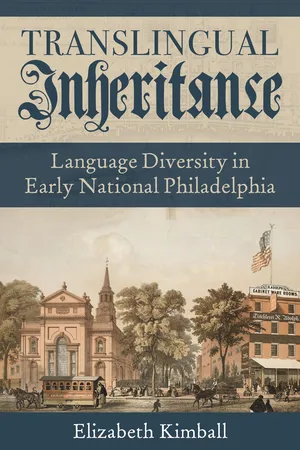
Translingual Inheritance tells a new story of the early days of democracy in the United States, when English had not yet become the only dominant language. Drawing on translingual theory, which exposes how language use contrasts with the political constructions of named languages, Elizabeth Kimball argues that Philadelphians developed complex metalinguistic conceptions of what language is and how it mattered in their relations. In-depth chapters introduce the democratically active communities of Philadelphia between 1750 and 1830 and introduce the three most populous: Germans, Quakers (the Society of Friends), and African Americans. These communities had ways of knowing and using their own languages to create identities and serve the common good outside of English. They used these practices to articulate plans and pedagogies for schools, exercise their faith, and express the promise of the young democracy. Kimball draws on primary sources and archival texts that have been little seen or considered to show how citizens consciously took on the question of language and its place in building their young country and how such practice is at the root of what made democracy possible.
eBook - ePub
Translingual Inheritance
Language Diversity in Early National Philadelphia
- English
- ePUB (mobile friendly)
- Available on iOS & Android
eBook - ePub
About this book
Trusted by 375,005 students
Access to over 1.5 million titles for a fair monthly price.
Study more efficiently using our study tools.
Information
Subtopic
Early American History1
LEARNING TO SEE A TRANSLINGUAL PAST
Consciousness is reflected in a word as the sun in a drop of water. A word relates to consciousness as a living cell relates to a whole organism, as an atom relates to the universe. A word is a microcosm of human consciousness.
L. S. Vygotsky, “Thought and Word”
L. S. VYGOTSKY AND M. NOURBESE PHILIP SUGGEST THAT words—even a single word—lie at the center of memory, like atoms to a universe. Words, it is often said, are what make the United States exceptional: it was the first modern nation to be founded by virtue of written documents rather than evolving history. These documents contain the words that Americans cling to: “truth,” “happiness,” “self-evident,” “created equal,” “We the people.” They are words subject, necessarily, to both the initial and ongoing work of democracy. They are invoked, argued over, lamented, deconstructed, cried about, revered, worshiped, cursed, rejected, doubted, prayed over, and entrusted with faith. They are used to bring people in and to shut people out. But there is something about these words that has not often been considered, a fact about them so obvious that it seems strange to notice: these words are in English.
What if we imagined a United States of America not in English? What words would we discover that are also a part of the founding of the country? How would these words change our memory, our understanding, of what was going on when the country was founded, and thus our understanding of what has been since then? As Philip (1989) suggests (as she writes from the Black Caribbean experience, linking the theft of language with the theft of culture, history, and family that came with the slave trade), some words become severed from their source, and that severing is a form of violence that is experienced as a tragic forgetting. Finding and reconnecting some of the words of people in the early national United States is the project of this book, which examines the communities of early Philadelphia to create a vibrant vision of how the United States became what it is. Challenging assumptions that English was the inevitable medium of communication for the new nation, I show how, in fact, the busy, central city of Philadelphia harbored a diverse range of languages. There was little consensus or consciousness that English would be the language to dominate all others. More significantly, the words used to debate the place of language in these new communities constitute a set of words that we can add to our lexicon of U.S. founding vocabulary; they draw from the rhetorical history of African American, Quaker, and German communities of Philadelphia.
For my methodology in this historical re-visioning, I draw on thought in the fields of applied linguistics and writing and rhetoric studies that challenge our assumptions of what language is and where its boundaries lie. These perspectives represent a “translingual approach” (Horner et al. 2011) to language, a perspective that scholars have used to describe the fluid, flexible communication practices of people in the contemporary globalized world, where contact zones (Pratt 1991, 34) and border areas (Anzaldúa 2007) abound in both material and digital realms. I adapt this translingual approach as a methodology for doing history and use it to compose a new vision of early national Philadelphia. Drawing from a variety of recovered archival sources, I show how we can read these sources in ways that go beyond their previously assumed meanings, so that as our new readings accumulate, we find we are reconstructing our understanding of how the city overall—a place of many communities—must have looked, sounded, and functioned. This new vision of the city asks us to rethink our assumptions of the U.S. past, with its centers of power and its seemingly inevitable English-only ideology, and to imagine a national origin story that includes all languages. This national origin story decenters the founding discourses—the Declaration of Independence and the U.S. Constitution—and their power brokers, the people we have called the founding fathers, and places them in the context of a myriad of translingual communication practices. My research represents a new way of doing history because it reveals how we can take the concept of translingual practices and historicize them, showing how translingual practice has always been a part of human experience. My research helps us to reimagine a model for a U.S. pluralist democracy that starts at the very beginning, in the way we tell the story of the founding city.
I write this book with several audiences in mind. First and foremost is the general public, including the university students I know, insightful young people who have been raised in a world of pluralism and engage every day in deliberation and protest around identity, freedom, and community. I have not assumed that these readers know much about early U.S. history or about rhetorical and linguistic perspectives on culture. Therefore, I have tried to be as transparent as possible, to begin at the beginning with both the events of history and the concepts of theory. At the same time, I am aware that I write also for experts well versed in the linguistic and rhetorical perspectives that I bring to the material. My aim is to contribute much-needed historical perspective to the ongoing project of naming and recognizing translingual practice. I speak to the latter expert audience in chapter 2, where I lay out the theoretical framework of this research. I hope that both audiences have patience with my writing style as I try to speak to these differing contexts.
Thinking of my general audience, I continue this first chapter with a series of stories about what the city of Philadelphia was like at the time of the nation’s founding. As you read each account, you will see that I use the we pronoun. I understand that we is a problematic term: people are different, and making statements about “our” collective experience or understanding has been a common means of erasing difference. I have chosen to use we, though, as a rhetorical feature of something like stage directions in a screenplay, explaining to the audience how we are expected to fill in the gaps of the scenes being crafted. When you, the reader, see we, then, recognize that you as an individual likely will not match up in reality with this generic, imagined audience. The we is intentionally invoking a generic “American” viewer, no one particular individual, but people who grew up and went to school in the United States, the collective public for the industry of textbooks, history tourism, and films and media. It is a problematic construction, of course, born of dominant master narratives about U.S. history and a multiculturalism that evades difference.1 But my choice here is intended to reveal, and then challenge, mainstream perspectives on history.
I engage a translingual methodology that draws from theories of language contact. A translingual approach takes time as its axis, in dynamic interaction with space. Recently taken up widely in the field of rhetoric and composition, where it has been worked out largely in the context of contemporary writing classrooms, the term translingual has been particularly advanced by linguist Suresh Canagarajah. He writes that when communicating translingually,
people are not relying on ready-made meanings and forms (as posited by Structuralist language models) for communicative success in contact zones. Rather than moving top down to apply predefined knowledge from their language or cognitive system, people are working ground up to collaboratively construct meaning for semiotic resources which they are borrowing from diverse languages and symbol systems. They are co-constructing meaning by adopting reciprocal and adaptive negotiation strategies in their interactions. They are also not relying on words alone for meaning. They are aligning features in their environment, such as objects, bodies, setting, and participants to give meaning to words. All these strategies point to the need for an analytical trajectory diametrically opposed to the one adopted by modernity. We have to move away from system, cognition, and form to focus on practice in order to explain how communication works in the contact zone. (Canagarajah 2013b, 26–27)
In other words, in a contact zone (Pratt 1991)—a place where cultures and languages are coming into contact, such as in the marketplaces in Canagarajah’s native Sri Lanka, or in cities such as Juarez and El Paso on the U.S.-Mexico border—people figure out how to communicate not by achieving native-like fluency in the so-called other language, but by bringing all their meaning-making tools together for shared use. A translingual approach examines how people practice communication, and how such communication transcends what we think of as formal, recognizable, and inevitable language boundaries. These boundaries include those of the named languages like English, Spanish, and so on, as well as language varieties and discourses like Black English and Standard American English, and even discourse varieties like “lawyerese” or “motherese.” In other words, monolingualist thinking (and by extension multilingualism) assumes it is natural to “switch” from one language to another or one variety to another, depending on the situation one finds oneself in, and when we switch, we are entering an entirely different territory, or space. Translingual thinking differs even from multilingual understandings, which turn out to be rooted in a monolingual orientation. A monolingual approach to language is fundamentally cognitive, positing that different languages exist within different spaces within the mind of any one individual, or in the space of any one community. A translingual approach, on the other hand, sees language and other forms of communications as being generated between and across individuals and communities over time and space (Canagarajah 2013a, 6–7). Translingually focused researchers seek to recognize how people are able to use many different languages and language varieties, focusing more on the broad “linguistic repertoires” (Otheguy, García, and Reid, 2015) people draw on to make meaning over, around, and within the structures of power and segregation that demand people choose one form over another.
A translingual framework also includes those aspects of communication that transcend language, including the ways people use their own embodiment, the environment around them, and visual rhetorics to create meaning together. It works to undo logocentric models of culture. But it is important to recognize that the “lingual” part of the term is just as important as the “trans-” part of the term, because a translingual approach focuses deliberately on how people deploy language as a resource and, more importantly, how they consciously choose from among a vast library of communicative possibilities, both linguistic and nonlinguistic (that is, either using words and sentences or using other kinds of signs), to mediate meaning. To make a comparison to a term more widely discussed in mainstream culture, we can see that the term translingual centers language in our consciousness in the way that the term transgender centers gender in our consciousness, rather than keeping these aspects of social life in a kind of perpetual peripheral vision. A transgender understanding recognizes that gender is not fixed or natural (as it might appear to many people) but rather something to be performed, played with, and questioned, as Judith Butler (1999) has shown. It is not just a matter of switching from masculine to feminine or vice versa. Gender does not so much go away as it is foregrounded, and a transgender understanding changes the rules not just for those individuals who name themselves as transgendered but for everybody. Likewise, language, and its restrictive ideologies, do not go away in a translingual approach, so much as they are (as with gender) performed, played with, and questioned. It is not just a matter of switching from, say, English to Spanish or Spanish to English. The translingual approach changes the game for everyone, even—and especially—monolingual people.
Thus, “translingual practice” is something that a researcher seeks to reveal, by adopting what B. Horner and colleagues (2011, 311) call a “disposition” known as the “translingual approach.” Rather than celebrating the linguistic and rhetorical activities of people in separate spaces, the translingual approach examines the ways people come in contact through language and assumes that most of the world’s peoples, through much of the world’s history, have used language in multiple and varied ways. The translingual approach, then, posits a particular methodology, an analytical framework for discovering, reading, interpreting, and making arguments about texts and practices. It is a deliberately progressive methodology, one which assumes that people can and do use tools creatively to assert their own agency and to make change in the world.
For these reasons, a verb often associated with the translingual approach is languaging, or the producing of language, a term “which does not carry with it the conduit metaphor,” as linguist Merrill Swain (2006, 95) puts it.2 In other words, when we shift our attention to language as a resource that one uses or a performance that one performs or a production that people create dialogically, we can discard the common assumption that meaning exists someplace (in the mind, presumably, or in the universe) and that language simply shuttles that meaning to listeners to take in. Instead of being just an instrumental vehicle, language mediates our understanding and our learning. Swain (2006, 96) points out that the term languaging is particularly apt in that people “language about language” and that “in fact, it is precisely when language is used to mediate problem solutions, whether the problem is about which word to use, or how best to structure a sentence so it means what you want it to mean, or how to explain the rules of an experiment, or how to make sense of the action of another, or . . . that languaging occurs.” Translingual practice is thus often—if not always—meta: metacognitive, metalinguistic, and metadiscursive, taking place when people think about their own thinking, their own language, their own communication.
As a method of writing history, the “languaging about language” aspect of the translingual approach is particularly salient because we cannot always know the embodied or environmental aspects of communication that surrounded the texts left to us in the archive. That is, we can’t see speech as it occurred in its first context; we can’t see the languaging in full. But the written word leaves many traces of the languaging about language, the meta aspects of translingual practice. With analysis, the archives do show how writers grappled with questions of language: what it is; how it functions in spheres such as civics, education, and religion; and how it ought best to be taught to the next generation. These translingual rhetorics demonstrate that the English language was not accepted uncritically as an inevitability for the American nation. More significantly, these rhetorics show how to decenter—without discounting—the discourses at the centers of power where the founding documents were formed (Trimbur 2010).
PHILADELPHIA: A SERIES OF STORIES
First, let’s visualize the historical Philadelphia we think we know—the one between 1776 and 1800, when the Declaration of Independence was signed, and the city was known as the “Athens of America.” By this time, Philadelphia had been in existence for more than a century, since William Penn had arrived and made a treaty with the Lenni Lenape in 1682. In this early national Philadelphia, between the signing of the Declaration of Independence and the start of the nineteenth century, we would have found neat rows of brick buildings, combining residences with workshops. William Penn’s idealistic Quaker vision grounded the city, in both its tolerance for religious diversity as well as its material plan, with square blocks and straight streets (a plan that would be followed in expansion westward to the Schuylkill River to create the Center City we know today). By now, the indigenous people have been absented from the scene. By this time, the culture was commercial, extending from the busy riverfront on the east side and on to High Street, which would later be named Market Street, already lined with market stalls, about seven or eight blocks west. The State House, now called Independence Hall, had been built on Chestnut Street between Fifth and Sixth, and in this building, leaders of the colonies gathered for the Second Continental Congress to debate, write, and eventually sign the Declaration (the first Continental Congress met in Carpenter Hall, a similar building one block to the east). A block west, at Seventh Street, Thomas Jefferson labored in a handsome brick house to compose the right language that would shuttle a nation into the next several hundred years. Just north on Arch Street, Betsy Ross was busy sewing flags. On Market at Fourth, Benjamin Franklin’s printing business stamped out newspapers night and day, his workers sliding the paper in and out of the press as quickly as machines. Christ Church stood at Second, just above Market, its plate glass windows, especially the large Palladian window behind the altar, letting in the light of reason to the practice of the English church—the church that would carry on the tradition of the Anglican communion, but in which the wardens boldly edited the Book of Common Prayer, striking out the king’s name in the prayers. Other institutions were coming along—the bank, the tavern, many more churches, and many, many more workshops. The first lending library had been founded in 1731, and the American Philosophical Society in 1743. Franklin himself would be responsible for much of what makes a community even today: the Library of Philadelphia, the post office, the insurance company, the fire company (tied up with the insurance company), and the school, called the Academy of Philadelphia, that would become today’s University of Pennsylvania.
With our cinematic minds, we can easily imagine these cobbled streets with their horse-drawn carriages, the inevitable smell of manure, the formally styled eighteenth-century rooms where these men collectively came up with the vision of a nation. We continue to admire their wisdom, even their creative imagination, their extraordinary good luck in coming together in the time and place that they did, even as their faults have come into view and changed the narrative in recent decades. Franklin may have been a scientist and statesman, but he was also a philanderer, probably not so good to his wife, and certainly a broker of racist ideology, as we will see in his writings about the German community. Jefferson enslaved people even as he wrote that all men are created equal. Washington stayed in Philadelphia but cycled his Virginia-based slaves in and out of the city every six months, so as to circumvent the Pennsylvania laws that would have allowed them their freedom.3 Depending on who we are, our personal understandings of the people of this city have grown more complicated, our responses angrier and more resistant. But the master narrative—the one that brings tourists, the one that shores up textbooks and television shows—settles on the exceptional nature of the founders in this place, and their racism, if acknowledged, is something mostly something to be atoned for, unfortunate sins at the edges of great lives.4 The busy, growing city, the workshop of democracy and innovation, was what it was because of the remarkable founders of this nation, we are told. Indeed, one could argue that the movements for liberation that came after the founding would not have been possible without the mandates for freedom written into those documents—that, flawed as this time was, it created the rhetorical space for future improvements.5
Of course, those remarkable people were white, male, and native English speakers. Even if their words created the grounds for future movements for liberation (such as those for women’s right to vote at the turn of the twentieth century or for civil rights for Black peo...
Table of contents
- Cover Page
- Title Page
- Copyright Page
- Dedication
- Contents
- Acknowledgments
- 1. Learning to See a Translingual Past
- 2. Toward a Translingual Historiography
- 3. Language and Education among Philadelphia Germans: The Hermeneutics of Context
- 4. Quakerly Genres and the Language of Liberal Learning
- 5. African American Language: Sameness and Difference in the Democratic Space
- 6. Making and Doing Language History
- Notes
- References
- Index
Frequently asked questions
Yes, you can cancel anytime from the Subscription tab in your account settings on the Perlego website. Your subscription will stay active until the end of your current billing period. Learn how to cancel your subscription
No, books cannot be downloaded as external files, such as PDFs, for use outside of Perlego. However, you can download books within the Perlego app for offline reading on mobile or tablet. Learn how to download books offline
Perlego offers two plans: Essential and Complete
- Essential is ideal for learners and professionals who enjoy exploring a wide range of subjects. Access the Essential Library with 800,000+ trusted titles and best-sellers across business, personal growth, and the humanities. Includes unlimited reading time and Standard Read Aloud voice.
- Complete: Perfect for advanced learners and researchers needing full, unrestricted access. Unlock 1.5M+ books across hundreds of subjects, including academic and specialized titles. The Complete Plan also includes advanced features like Premium Read Aloud and Research Assistant.
We are an online textbook subscription service, where you can get access to an entire online library for less than the price of a single book per month. With over 1.5 million books across 990+ topics, we’ve got you covered! Learn about our mission
Look out for the read-aloud symbol on your next book to see if you can listen to it. The read-aloud tool reads text aloud for you, highlighting the text as it is being read. You can pause it, speed it up and slow it down. Learn more about Read Aloud
Yes! You can use the Perlego app on both iOS and Android devices to read anytime, anywhere — even offline. Perfect for commutes or when you’re on the go.
Please note we cannot support devices running on iOS 13 and Android 7 or earlier. Learn more about using the app
Please note we cannot support devices running on iOS 13 and Android 7 or earlier. Learn more about using the app
Yes, you can access Translingual Inheritance by Elizabeth Kimball in PDF and/or ePUB format, as well as other popular books in Languages & Linguistics & Early American History. We have over 1.5 million books available in our catalogue for you to explore.