eBook - ePub
Victory Banner Over the Reichstag, The
Film, Document and Ritual in Russia's Contested Memory of World War II
- English
- ePUB (mobile friendly)
- Available on iOS & Android
eBook - ePub
Victory Banner Over the Reichstag, The
Film, Document and Ritual in Russia's Contested Memory of World War II
About this book
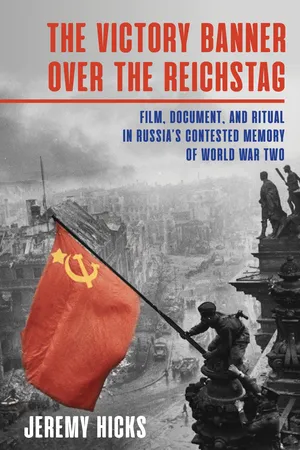
In one of the most iconic images from World War II, a Russian soldier raises a red flag atop the ruins of the German Reichstag on April 30, 1945. Known as the Victory Banner, this piece of fabric has come to symbolize Russian triumph, glory, and patriotism. Facsimiles are used in public celebrations all over the country, and an exact replica is the centerpiece in the annual Victory Parade in Moscow's Red Square. The Victory Banner Over the Reichstag examines how and why this symbol was created, the changing media of its expression, and the contested evolution of its message. From association with Stalinism and communism to its acquisition of Russian nationalist meaning, Jeremy Hicks demonstrates how this symbol was used to construct a collective Russian memory of the war. He traces how the Soviets, and then Vladimir Putin, have used this image and the banner itself to build a remarkably powerful mythology of Russian greatness.
1
THE RAISING OF THE VICTORY BANNER
A red banner was raised over Berlin’s Reichstag on 30 April 1945 at 22:40 in the evening by soldiers from the Third Strike Army of the First Belorussian Front.1 This triumphal effort came after a brutal frontal assault by thousands of men from at least four regiments (674th and 756th Rifle Regiments of the 150th Rifle Division; 380th and 525th Regiments of the 171st Rifle Division) against the well-defended building.2 As many as 2,500 German defenders were killed or wounded, with a further 2,604 taken prisoner, and the Red Army’s losses were also huge.3
While credit for raising what has come to be called the Victory Banner is conventionally attributed to Sergeant Mikhail Egorov and Junior Sergeant Meliton Kantariia of the 150th Rifle Division, the unit credited on the official Victory Banner, there are many conflicting accounts as to exactly who raised the first flag and on what part of the building. It has been now established that in fact the first flag was raised on the roof over the front of the building on an equestrian statue, an allegory of Germania, usually referred to as the Goddess of Victory in Russian accounts. It was followed by others later that night, on 1 May, including Egorov and Kantariia’s official banner of the 150th Division, which was moved to the cupola the following day and became known as the Victory Banner (see below, this chapter, and chapters 3 and 5).4 These disputes are indicative of the chaotic, messy situation of combat, and their resolution into a neat narrative is part of the process of disciplining memory of the war so that it becomes a clear and resonant symbol. Rather than relying on the neat resolutions, we need to understand how this symbol was first constructed and to ask why the Reichstag was chosen as the background for this emotive symbol of victory.
THE DIPLOMATIC BATTLE FOR BERLIN
As the center of Nazi power, Berlin itself had a symbolic significance that outweighed military concerns, even possibly political ones and the desire to capture nuclear scientists and technology.5 Despite Churchill’s desire for the British and American troops to take Berlin, concerns over a regrouping of Nazi forces in a so-called “Bavarian redoubt,” as well as the Americans’ desire not to antagonize Stalin, led Eisenhower to cable Stalin on 28 March 1945 and propose that the Americans and Soviets link up to the south of Berlin, near Leipzig and Dresden.6 Yet, although Eisenhower had promised Stalin at a secret one-on-one meeting at Yalta in February 1945 that the Soviets could enter Berlin first, there was room for ambiguity and distrust, so the matter was really only resolved by the Soviets’ decisive advance on the German capital in April 1945.7 Stalin had underscored Berlin’s symbolic importance in a widely quoted speech on 6 November 1944, when he stated that Soviet territory (what he called “our earth”) had now been entirely liberated from German occupation and that the red flag would fly over Berlin as a symbol of victory.8
But the problem was, what building symbolized Berlin? Probably the city’s most famous landmark was (and still is) the Brandenburg Gate, and the seat of the Nazis’ power was the Reich Chancellery, beneath which Hitler spent his final days in a bunker. It could be argued that the Reichstag was particularly unsuited to serve as a symbol of Nazi power and Soviet conquest, since, as the seat of the German parliament, it was associated with German democracy until it was gutted by fire in 1933. Indeed, a number of English-language sources comment on the incongruity of the Soviets’ choice of the Reichstag as the symbol of victory, since it was less fitting than the Brandenburg Gate or the Reich Chancellery, and they attribute this misunderstanding to the fact that the Soviets were unaware it had stood empty during the years of the Third Reich.9
However, the notion that the Reichstag was chosen as a result of the Soviets’ confusion is unlikely and not a little insulting to Red Army intelligence staff; it is belied, for example, by Marshal Georgii Zhukov’s memoir.10 While there is no available definitive document that makes the rationale clear, it is nevertheless possible to surmise a number of reasons why it was chosen as a symbol for the battle and the war, combining as it did both military and symbolic dimensions, as did the battle for Berlin itself. Ultimately, however, one of the sources of confusion is the fact that the elevation of the Reichstag to act as a symbol of victory emerged in the days after its seizure, rather than before, and the symbolic considerations were of greater significance than the military ones. It should be added here that one needs to tread carefully throughout, because many of the memoirs of participants filter their accounts of the past through a contemporary sense of the importance of the storming of the Reichstag.
THE NEED FOR A MILITARY OBJECTIVE
A number of sources claim that the Reichstag was designated a prime or even the prime military objective in the battle for Berlin.11 As one of the tallest buildings in the center of the German capital, it was a candidate to be a military objective because it could be clearly identified. It, along with other prominent buildings, was given a number; the Reichstag was number 105.12 It was common practice in the Red Army for units to take a red flag into combat and raise it on a prominent building, thus motivating competition between units and boosting the general fighting spirit.13 This was also part of the political preparation of units for battle; plain red calico “battle flags,” typically with no writing or other symbols on them, were usually given by political officers (politruks) to Communist Party members in each unit, for whom the act of raising the flag was an honor and responsibility.14 This was a means of raising fighting spirit that, according to the First Belorussian Front’s political directorate, was particularly effective in the battle for Berlin, as, for the soldiers, each flag planted symbolized a step toward the end of the war.15 It would seem that many soldiers also brought their own unofficial red flags into battle, improvised from whatever material was available.
From a military perspective, there was also the need to have an easily identifiable central objective and to foster rivalry both between the two commanders, Marshal Zhukov and Marshal Ivan Konev, and their competing units, the First Belorussian and First Ukrainian Fronts, so as to ensure that the city was captured swiftly, before the Western Allies could intervene.16 The Third Strike Army on 22 April 1945 issued nine official Soviet state flags, each bearing a star above the hammer and sickle—one flag to each of its rifle divisions that were to storm the building. The first to be hoisted on the Reichstag was to become the Victory Banner, thus further stimulating the sense of a race between these smaller units as well (the official flag raised was the fifth of these).17 Although the idea may have come straight from Stalin, as some sources claim, the notion that this was a military objective, singled out not even at the level of the First Belorussian Front but at the lower level of the Third Strike Army, might explain why there were no references to the raising of the flag specifically over the Reichstag in the Soviet press during the battle.18 The press in fact stressed a general image of Berlin, usually in ruins, with a red flag flying over it: on 24 April the newspaper of the First Ukrainian Front, one of the units involved in the battle, had a header calling for the flag to be raised over “Berlin” and did not mention the Reichstag. A cartoon illustrating this shows a Red Army man raising a flag over an unidentified neoclassical structure.19 Even in the 1 May edition of Pravda a cartoon by the famous Kukryniksy triumvirate of cartoonists and verses by the celebrated poet Samuil Marshak do not depict or mention the Reichstag.20 Likewise, on 1 May 1945 on the front page of the Red Army daily newspaper Krasnaia zvezda we see an enormous full-length portrait of Stalin, striking a Napoleonic pose with his hand across his chest. In his address (or “order”) summarizing the successes of the Red Army, Stalin refers to them having occupied the main areas of the German capital and “having put up the flag of victory over Berlin.”21 The flag was already up, so there was no need for military secrecy in references to the Reichstag anymore, which suggests it was selected as a symbol after the battle.

1.1. V. Briskin, “Let Us Raise the Victory Banner over Berlin!” Za chest´ rodiny, 24 April 1945.

1.2. “Defeated Berlin,” poem by Samuil Marshak, as printed in Pravda, 1 May 1945, 4.
Moreover, while there were many published images of the raising of the flag over the Reichstag in early May, they were at first accompanied by images of flags and Red Army men next to the Brandenburg Gate and other symbols of Berlin. Indeed, the photographer whose image of the flag over the Reichstag became the most renowned, Evgenii Khaldei, himself took photographs of the three red flags he had specially prepared in Moscow (supposedly from a tablecloth): one over Tempelhof Airport, one over the Brandenburg Gate, and the third at the Reichstag.22 Days later, an article in Pravda on 9 May had to make it clear that the Reichstag was a symbol of the center of Berlin.23 Similarly, the original headline above Khaldei’s photograph read, “The Victory Banner over Berlin,” and only in the smaller text of the caption beneath the image is the Reichstag mentioned: “The crimson flag flies above the Reichstag, in the center of the Fascist capital—Berlin.”24 This suggested that the Soviet reading public would not recognize the Reichstag: the building’s symbolic importance was evidently shaped after the 30 April flag raising.
Further evidence that the choice of the Reichstag as a symbol was part of a retrospective, postbattle rationalization can be found in another source, one relying on eyewitness accounts from German participants in the battle. It reflects how strange it was that the building became such a symbol but speculates that this was because fighting had actually taken place there.25 Certainly, it was very heavily defended and thus had to be stormed in a heroic infantry engagement. Moreover, according to a number of memoirs, the soldiers charged with capturing the structure had no idea what it looked like and did not even recognize it when they first saw it.26 This was also a point made by a number of participants at the secret 1960 and 1961 special conferences convoked by the History of the Great Patriotic War Section of the Institute of Marxism-Leninism to establish what had happened in the storming of the Reichstag (see below, chapter 3): they state that it had political and symbolic but not military importance.
Whether or not it was a significant military objective, the Reichstag was clearly chosen to become a symbol, probably after 1 May, because it could serve to illustrate key themes in Soviet propaganda’s shaping of the meaning of the war for posterity. There were two key explanations for the Reichstag’s symbolic potential: its association with the Nazis’ rise to power and its capacity to suggest an analogy with the Kremlin.
THE SOVIETS’ NEED FOR A SYMBOL OF VICTORY
In seeking a symbol of the glorious, uplifting end of the war, the Soviets were looking for images of the raising of the red flag: drawing on the rich heritage of filmic red flags, most notably the hand-tinted red flag in Sergei Eisenstein’s 1926 film Battleship Potemkin (Brononosets Potemkin), they had celebrated the triumphant raising of the red flag over their own liberated cities, such as Stalingrad, Kalinin, Rostov, and Simferopol, in newspaper articles and photographs and especially in film.27 Correspondingly, they wanted to turn the battle of Berlin, and the Reichstag, into a broader political symbol.
Since the revolution of 1917, the Bolsheviks had excelled in symbolic politics, which they skillfully employed to legitimize their rule.28 They had successfully found images evoking insurrection and thus formed those events into a picture. Echoing the French revolutionaries’ storming of the Bastille, they had chosen to make the storming of the Winter Palace the embodiment of the culminating point of revolutionary change.29 It was difficult and somewhat arbitrary to isolate such a moment. As Leon Trotsky put it,
The final act of the revolution seems . . . too brief, too dry, too business-like—somehow out of correspondence with the historic scope of the events. The reader experiences a kind of disappointment. He is like a mountain climber, who, thinking the main difficulties are still ahead, suddenly discovers that he is already on the summit or almost there. Where is the insurrection? There is no picture of the insurrection. The events do not form themselves into a picture. A series of small operations, calculated and prepared in advance, remain separated one from another both in space and time. A unity of thought and aim unites them, but they do not fuse in the struggle itself. There is no action of great masses. There are no dramatic encounters with the troops. There is nothing of all that which imaginations brought up upon the facts of history associate with the idea of insurrection.30
Soviet dramatists such as Nikolai Evreinov, whose 1920 reenactment, The Storming of the Winter Palace, “distilled and improved” the historical event on the very site of the Winter Palace, and Sergei Eisenstein, director of the 1927 film October (Oktiabr´), made the storming of the Winter Palace into a universally recognized symbol of the culmination of the revolution.31 As film scholar Robert Rosenstone wrote of October, the scene of the storming of the Winter Palace fulfilled the need for a conclusive ending, as “a dramatic film must have a pay off . . . a catharsis. On the screen, as in reality: the revolution must have a climax.”32 Indeed, Stalin had even ordered director Mikhail Romm to insert a scene of the storming of the Winter Palace into his 1937 film Lenin in October (Lenin v oktiabre), arguing that the depiction of the revolution made no sense without it.33 The images of the storming of the Reichstag thus function as a partial quotation from October. This symbolism was made all the more powerful by the building...
Table of contents
- Cover Page
- Title Page
- Copyright Page
- Contents
- Acknowledgments
- A Note on Transliteration and Document Citation
- Introduction
- 1. The Raising of the Victory Banner
- 2. Victory and the Postwar Stalin Cult
- 3. The Death of Stalin and Birth of the Victory Cult
- 4. The Victory Cult in the Age of Television
- 5. Iconoclasm, Resanctification, and the Post-Soviet Victory Cult
- Conclusion
- Notes
- Bibliography
- Index
Trusted by 375,005 students
Access to over 1.5 million titles for a fair monthly price.
Study more efficiently using our study tools.
Information
Publisher
University of Pittsburgh PressYear
2020Topic
HistorySubtopic
Russian HistoryeBook ISBN
9780822987963
Index
HistoryFrequently asked questions
Yes, you can cancel anytime from the Subscription tab in your account settings on the Perlego website. Your subscription will stay active until the end of your current billing period. Learn how to cancel your subscription
No, books cannot be downloaded as external files, such as PDFs, for use outside of Perlego. However, you can download books within the Perlego app for offline reading on mobile or tablet. Learn how to download books offline
Perlego offers two plans: Essential and Complete
- Essential is ideal for learners and professionals who enjoy exploring a wide range of subjects. Access the Essential Library with 800,000+ trusted titles and best-sellers across business, personal growth, and the humanities. Includes unlimited reading time and Standard Read Aloud voice.
- Complete: Perfect for advanced learners and researchers needing full, unrestricted access. Unlock 1.5M+ books across hundreds of subjects, including academic and specialized titles. The Complete Plan also includes advanced features like Premium Read Aloud and Research Assistant.
We are an online textbook subscription service, where you can get access to an entire online library for less than the price of a single book per month. With over 1.5 million books across 990+ topics, we’ve got you covered! Learn about our mission
Look out for the read-aloud symbol on your next book to see if you can listen to it. The read-aloud tool reads text aloud for you, highlighting the text as it is being read. You can pause it, speed it up and slow it down. Learn more about Read Aloud
Yes! You can use the Perlego app on both iOS and Android devices to read anytime, anywhere — even offline. Perfect for commutes or when you’re on the go.
Please note we cannot support devices running on iOS 13 and Android 7 or earlier. Learn more about using the app
Please note we cannot support devices running on iOS 13 and Android 7 or earlier. Learn more about using the app
Yes, you can access Victory Banner Over the Reichstag, The by Jeremy Hicks in PDF and/or ePUB format, as well as other popular books in History & Russian History. We have over 1.5 million books available in our catalogue for you to explore.