A case of mistaken identity leads to death and deception in this classic "three-ringed thriller . . . [with] plenty of shocks and jolts" (
New York Herald Tribune).
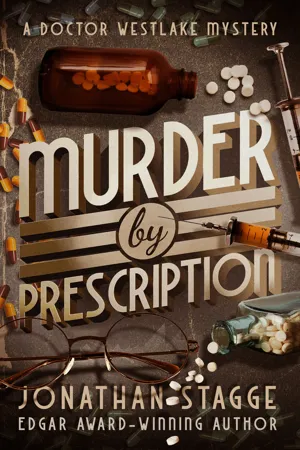
It's not the first time the local press has made a mistake, but this one has consequences for Dr. Hugh Westlake. An article about an advocate of euthanasia has switched the name of the old quack named Westbrook to "Westlake," which leads to Hugh getting summoned in the middle of an icy winter night for a mercy killing.
The poor, fatally ill woman is the matriarch of a new, wealthy family in town. Ethically, all Hugh can do is ease her pain, so he leaves her with some morphine tablets and in the care of her beautiful daughter Hermia, a sight for sore eyes to the widower of eight years. But Mrs. Talbot's unexpected death on the following morning—and her will—draw Hugh into the secrets of the odd household, which consists of her much younger husband, an adopted sibling, a flighty nurse, and a couple of mad scientists. And when another of Hugh's terminally ill patients is found dead from a morphine overdose, he becomes the prime suspect in a case that comes down to the question of mercy—or murder . . .
"This detective novel is teeming with nail biting thrills. . . . For a book written in the 1930s it still has some resonance for a 21st century reader." —
Pretty Sinister Books
"One of those 'one in a million' mysteries that has everything . . . one can't help enjoying it." —
Worcester Telegram
- 194 pages
- English
- ePUB (mobile friendly)
- Available on iOS & Android
eBook - ePub
Murder by Prescription
About this book
Information
Subtopic
Crime & Mystery LiteratureIndex
Literature1
My daughter’s symptoms were not difficult to diagnose. Every year, with the uncomfortable regularity of a hay-fever victim, Dawn became affected with a strange condition which began to manifest itself about the middle of January—roughly a week before her birthday.
The first signs were punctuality, passing things unasked at meals and unusual solicitude for my health. If I failed to show due cognizance of the approaching anniversary, she would work herself up to a pitch where she became the Angel in the Home—an angel with one eye distinctly open for the main chance.
That night at dinner she was being particularly angelic. I had had a hard day chasing over Kenmore’s primitive roads after the influenza bug which had perversely settled on the most distant and inaccessible of my patients. But even so, I did not want to be treated like an elderly invalid.
Things reached a climax when Dawn put cream in my coffee, which I loathe, and said for the third time:
“I do hope you won’t be called out again tonight, Daddy. You look awfully tired.”
“Listen, brat,” I said ruthlessly, “I know the day after tomorrow is your eleventh birthday. I know exactly what I’m going to give you. So switch off the excess devotion.”
My remark was not precisely true. I had not the faintest idea of what I was going to give Dawn, and she knew it. But she had been waiting for just such an opening.
“I’m sorry, Daddy,” she said contritely. “But there isn’t anything else to be devoted to since my rabbits died.”
“I’m glad,” I said with wasted sarcasm, “that a mere father can compete with rabbits.”
“Not rabbits, Daddy. Belgian hares.”
And through the rest of dinner she rhapsodized over Belgian hares, carefully slipping in the name and address of a man near Ploversville who bred them and had a pair for sale.
My daughter’s keen insight must have told her that the shaft had gone home but she continued in her campaign of good works. Cigarettes and matches appeared as by magic at my hand. The fire was kept roaring and comfortable. Then, as bedtime approached, Dawn announced:
“I’m sure your eyes are tired, Daddy. I’ll read the paper out loud to you.”
Dawn adored reading out loud and my tiring day made me a defenseless victim. I
handed her the Grovestown Times.
My daughter’s choice of news items is always feminine and capricious. Ignoring wars and political crises, she turns to the page devoted to the tiny doings of our minuscule community. The only piece of Kenmore news that night was singularly uninteresting.
It was a statement that Mr. Raynor Talbot, New York decorator who had recently purchased the old Gregory house on the Ploversville Road, had completed his work of modernization with the exception of the lighting fixtures.
Dawn paused over this item for a moment of mellow reflection upon the Gregory house where she and the Gregory brood had played hide-in-the-dark. I had just reached that pleasant stage of midevening somnolence when a sudden shrilling in my daughter’s voice aroused me.
“Daddy, have you really killed more than six people?”
“I expect so, brat,” I said sleepily. “Most doctors have, but it doesn’t usually get into the papers.”
“But you are—it is in the papers!” exclaimed my daughter. “On the back page with the Deaths and Marriages.”
“You’re cuckoo,” I said mildly.
“Couldn’t they put you in prison?” Dawn went on. “I mean, for making speeches like that? And, Daddy, you didn’t tell me you’d even made a speech.”
“If anyone said I made a speech, it’s just a lie, brat.”
“But it can’t be a lie if it’s in the paper,” said
Dawn reprovingly. “Listen.‘Why should the body
live on when the heart is dead?’” she enunciated.
“‘Doctor Westlake speaks on euthan
…’” She stumbled. “It’s an
awful long word, Daddy, but it’s spelled like that thing
we say in church on Easter Sunday.”
I didn’t know, though finally it occurred to me that she was referring to the Athanasian Creed.
“You don’t mean euthanasia by any chance?” I asked.
“Yes, that’s it. It sounds awful, though of course it’s nice for you to have your name in the paper.”
“Lovely,” I replied hollowly. “Let’s hear what I said.”
Dawn read:
“A sensational plea for mercy killing was made yesterday by Doctor Westlake, veteran local practitioner, at the Science Marches On Congress held in Grovestown. Urging his colleagues to take the law into their own hands when faced with incurable disease, Doctor Westlake concluded: ‘am proud to admit that I have been in a position to despatch at least six of my patients for whom science could do nothing and for whom life was an agony. Why should the body live on when the heart is dead? Why should—’”
“For the love of Pete,” I broke in, “stop reading that junk.”
“But it isn’t junk,” complained my daughter.
“I didn’t say it.” I took the paper and looked at it indignantly. “Besides no newspaper could be dumb enough to call a man under forty a veteran practitioner.”
“But you’ll be forty next birthday,” said my child.
As she spoke, it struck me that the perpetrator of those lurid sentiments was doubtless an old quack called Westbrook. He was the medical bore of Grovestown and had a passion for getting into the newspapers.
I explained to my daughter the fallibility of the press.
“I’ll call them up tomorrow and re-establish the Westlake respectability.”
Dawn looked disappointed to discover her father was neither a mass-murderer nor even a person of sufficient stature to rate a paragraph in the paper. Then, seeing that my gaze was resting on the clock she began brightly:
“But, Daddy, isn’t it all right for a doctor to give people things if they’re going to die anyhow?”
I knew that she was merely trying to lure me into an argument in order to put off the evil hour of bedtime.
“It’s a very technical subject,” I said loftily.
“Well, I know if I was a doctor and someone had pain like I had that time with my earache and there was no chance of ever getting better—I’d do what that man did.”
“You certainly practiced what you preach on your last rabbits,” I said. “You saved them from old age by selling them off before they’d even tasted the pleasure of adolescence.”
Dawn was highly delighted that the conversation had returned to her own back yard. Nevertheless, I had impugned her integrity as a rabbit fancier and, since I was her prospective backer for fresh ventures in this field, she apparently felt an explanation was due to me.
“I know I made a dreadful mistake with the last two. You see, the buck had started to molt and the doe was going to have another family.” She paused a moment, then added: “I thought it might be catching, so I told Lucinda she could take him away for—for fifty cents. But the doe started to molt, too, and there wasn’t any family so—”
“Why should the doe live on when the buck is dead?” I parodied flippantly. “Euthanasia has its drawbacks even when it is committed with the best intentions.”
“But it will be different when—if I have Belgian hares.”
Dawn’s parthian propaganda didn’t make any sense at all, but she had gotten in the last word—as usual.
I got out my pipe and fixed a highball. As I set the glass down on the paper, it made a spreading stain over the paragraph about my near namesake, Doctor Westbrook.
I was reminded of another occasion when Dr. Henry Westlake, from Edinburgh, had read a paper on the treatment of leukemia. His paper had been conservative and scientific, but the lay press, always eager to put overoptimistic constructions upon medical discoveries, had immediately announced that Dr. H. Westlake had found a cure for leukemia.
The result had been embarrassing and a little pathetic. I felt uneasiness as I remembered the imploring letters, telegrams and telephone calls I had received in the weeks following that announcement. The garbled newspaper account of another man’s work had kindled a cruel flame of hope, and it had been my misfortune to be obliged to extinguish it.
Once again the newspapers were carrying a syndicated article which implied that a Dr. Westlake was ready with a cure for all incurables. Would that foolish misprint involve me in as much trouble as the other article?
What were my real views on mercy killing? I had been flippant with Dawn, but I could not be flippant if I were to be faced with such appeals.
The harsh ringing of the telephone broke into my musings.
I jumped up, breathing a silent prayer that no one would be wanting me to go out into that icy January night. As I picked up my glass to carry it with me I noticed that the stain on the newspaper had widened considerably.
It had completely covered the wretched article on mercy killing. Only the headline stood out, unstained.
Why should the body live on when the heart is dead?
2
My irritation vanished when I heard the voice from the other end of the wire. It was a woman’s soft contralto with a faint hint of the South.
“This is Hermia Landreth, Mrs. Talbot’s daughter. My mother is in terrible pain. The nurse is out and I don’t know what to do for her. Could you come, please?”
“Did you say the name was Talbot or Landreth?” I asked.
“My name is Landreth. My mother is Mrs. Talbot. She and my stepfather have taken the Gregory house.”
I remembered then. Dawn had read me a reference to the Talbots from the paper that evening.
“I’ll be right around.”
“Thank you.” There was a little catch of relief in Hermia Landreth’s voice. “Thank you so much. And hurry—please.”
I hurried down to the surgery for my medical bag. A swift examination of its contents showed me that I was running out of morphine. Since Hermia Landreth had told me her mother was in pain, I unlocked my drug closet and took out a bottle of a hundred tablets. These I slipped into my bag, together with some tablets for hypodermic injection.
The car engine acted up a bit, but at last I got it started. As I nosed out onto the treacherous ice of the road, I tried to remember the stray facts I had heard about the Talbot family. They had been in the neighborhood only a few months. Mrs. Talbot, a confirmed invalid, was said to have come from an extremely wealthy Southern family. Talbot was her second husband and, reputedly, far younger than she. Someone had referred to three daughters, one of them married.
Hermia Landreth … I racked my brain to think who had mentioned that beautiful name to me recently. Then I remembered that it had been Bill Strong, one of my oldest and poorest patients who eked out a sparse living in a cottage on the Gregory—or, rather, the Talbot—estate. He was a pathetic figure, alone in the world, half blind and crippled with arthritis. Last time I had stopped off to see him, he had been full of Hermia Landreth’s visit. She had brought him food, let him talk about his dead wife, and praised his cat. Yes, that was Hermia Landreth.
I had passed Bill Strong’s cottage now and was slithering up the drive to the Talbots’ large rambling house. To my surprise, I noticed only a few dim lights in the windows.
This was explained to me by the gaunt, unhealthy-looking butler who opened the door, candle in hand. Mr. Talbot, it appeared, was putting indirect lighting into his old-modern house. The men had not yet finished the fixtures.
The butler’s manner was grave and aloof. With a stiff little bow he whispered me into the living room.
“Poor Madam is in great distress. If you will kindly wait a moment, Doctor, I will fetch Miss Hermia.”
I had known the house well when the Gregorys had li...
Table of contents
- Cover
- Title Page
- 1
- 2
- 3
- 4
- 5
- 6
- 7
- 8
- 9
- 10
- 11
- 12
- 13
- 14
- 15
- 16
- 17
- 18
- 19
- 20
- 21
- 22
- 23
- 24
- 25
- 26
- 27
- 28
- Preview: Turn of the Table
- About the Author
- Copyright
Trusted by 375,005 students
Access to over 1.5 million titles for a fair monthly price.
Study more efficiently using our study tools.
Frequently asked questions
Yes, you can cancel anytime from the Subscription tab in your account settings on the Perlego website. Your subscription will stay active until the end of your current billing period. Learn how to cancel your subscription
No, books cannot be downloaded as external files, such as PDFs, for use outside of Perlego. However, you can download books within the Perlego app for offline reading on mobile or tablet. Learn how to download books offline
Perlego offers two plans: Essential and Complete
- Essential is ideal for learners and professionals who enjoy exploring a wide range of subjects. Access the Essential Library with 800,000+ trusted titles and best-sellers across business, personal growth, and the humanities. Includes unlimited reading time and Standard Read Aloud voice.
- Complete: Perfect for advanced learners and researchers needing full, unrestricted access. Unlock 1.5M+ books across hundreds of subjects, including academic and specialized titles. The Complete Plan also includes advanced features like Premium Read Aloud and Research Assistant.
We are an online textbook subscription service, where you can get access to an entire online library for less than the price of a single book per month. With over 1.5 million books across 990+ topics, we’ve got you covered! Learn about our mission
Look out for the read-aloud symbol on your next book to see if you can listen to it. The read-aloud tool reads text aloud for you, highlighting the text as it is being read. You can pause it, speed it up and slow it down. Learn more about Read Aloud
Yes! You can use the Perlego app on both iOS and Android devices to read anytime, anywhere — even offline. Perfect for commutes or when you’re on the go.
Please note we cannot support devices running on iOS 13 and Android 7 or earlier. Learn more about using the app
Please note we cannot support devices running on iOS 13 and Android 7 or earlier. Learn more about using the app
Yes, you can access Murder by Prescription by Jonathan Stagge in PDF and/or ePUB format, as well as other popular books in Literature & Crime & Mystery Literature. We have over 1.5 million books available in our catalogue for you to explore.