- 256 pages
- English
- ePUB (mobile friendly)
- Available on iOS & Android
eBook - ePub
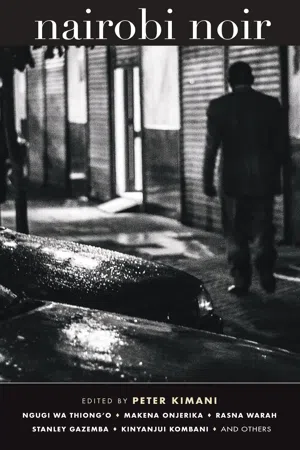
Nairobi Noir
About this book
Nairobi Noir brings together some of Kenya's most exciting and acclaimed writers, in this celebration of noir writing, played out on the streets of Nairobi. "Although the range of issues explored in Nairobi Noir is as diverse as its contributors, it all gestures toward a common theme. In this concrete jungle, the hunters and herders live on. As do the hunted..."- Peter Kimani, introduction Featuring brand new stories from: Ngugi wa Thiong'o, Stanley Gazemba, Ngumi Kibera, Peter Kimani, Winfred Kiunga, Kinyanjui Kombani, Caroline Mose, Kevin Mwachiro, Wanjiku wa Ngugi, Faith Oneya, Makena Onjerika, Troy Onyango, J.E. Sibi-Okumu, and Rasna Warah.
Information
PART I
The Hunters
SHE DUG TWO GRAVES
Eastleigh
Her brother’s body was found in a dark alley in Eastleigh Section One, near the old post office. His torso was a collage of torture marks and bruises, already dark blue against his light-brown skin. Were it not for the notable birthmark on his neck, Ahmed would have been unrecognizable. It was the local imam who saw the body as he was going to make the morning call to prayer.
“Eebe naxariiso! Allah, have mercy!” he screamed, waking up the sleepy neighborhood. Most of the tenements lit up and a few faces cautiously emerged from the small barred windows.
“What’s going on?” asked Fartun, the number one Eastleigh gossip. Everyone called her CNN, a title she accepted. No one answered. The streets were now empty as the imam had hurriedly left for the mosque to avoid the police. He had firsthand experience with their brutal force.
Fartun quickly put on a hijab and ran down the stairs, making an awful lot of noise as she heaved her body against metal doors when she briefly paused to catch her breath on every floor. She was the only one courageous enough to leave the confines of her apartment at that hour. She had to get the latest information, she always argued. Neighbors depended on her to bring fresh and juicy news every day. Two stray cats were gnawing and fighting over the body but Fartun’s approach scared them off. They stayed close by, though, their yellow-green eyes creating an eerie feel in the dark and smelly alley.
After poking and inspecting the body like a seasoned mortician, Fartun shouted her discovery to the waiting faces up above: “It is Ahmed!”
“Which Ahmed?” someone inquired.
“A fair question, Imran, as Section One has over a thousand Ahmeds. It is Ahmed Farah, brother to that pleasant woman called Fawzia, the refugee who refused to spit on her former husband when he begged her to take him back. If I was her, I would have spit on his henna-dyed beard. I hear that he pleaded with her like a dog and—”
“Relevance!” Imran interrupted, halting what would have been a long story of Fawzia’s entire marital history. “We are only interested in the body and the cause of death.”
“Stop badgering me. Are you not the one who wanted to know whose body this is? Don’t interrupt me when I am adding details to the story. Don’t you know that a good story must be embellished, seasoned a bit with other niceties to keep listeners engaged? I am not called CNN for nothing. I do my research, I dig deeper, and I unearth all the details.”
She paused to let that sink in among her attentive listeners above. Most people regarded her as a gossip, but Fartun considered herself a community reporter.
“I heard that this young man was among those arrested last week by the antiterror police unit. I need to talk to a few people to figure out exactly what happened.”
At that, everyone retreated to their apartments. They knew that Fartun would go out to gather more “intel,” as she usually referred to her gossip, and would update them before sunup.
* * *
When Fawzia received news of her brother’s brutal murder, she lay prostrate on her carpet, crying and rocking sideways in deep anguish. Her grief came in torrents, like a dam that had burst its banks, spewing the slush that had accrued on the bottommost part of her being. There was no grip, no foothold, so she let the floodwaters engulf her body and soul. She sank in the miry depths, and for the next hour she just lay there in the obscurity, in the nothingness. She awoke from the hollow pit, eyes swollen like Sodom apples, head throbbing like Burundi drums. She rose slowly and walked toward the mirror. Just two hours ago, before the news about Ahmed, the mirror had reflected a beautiful woman with sparkling eyes. That aspect of her life was a lie, always fleeting. Her true reflection was what she saw now—a crushed woman whom calamity had trampled on, over and over. Happiness was elusive; it came rarely, like Atacama Desert rains.
Now tragedy had completely overshadowed her recent accomplishment. Just three days before, she had bought her own apartment. Now, looking around at the place, a sense of despondency overcame her again. Why even bother? There was no man to share her home with, no husband to make basta for, and no children to liven the huge space. Due to her childlessness, her husband Ibrahim had given her talaq, usually considered a disgraceful means of divorce in Islam.
But she had not always been barren. When the doctor announced that she was pregnant with twins at the turn of the century, the women at the Dadaab refugee camp where they were living at the time began saying that she was as fertile as Mahmoud’s camels. Mahmoud was a Somali refugee whose camels had had twin calves four times. Camels seldom bear twins, so it was a rare phenomenon and one that had amazed the whole camp. But her luck was abruptly changed one fateful night. Instead of double cries expected from a healthy set of twins, there were two small bodies on the doctor’s operating table.
Neither of the twins survived due to intrapartum complications related to female genital mutilation (FGM), a procedure that Fawzia, like other Somali girls, had undergone when she was eleven. The doctor at the camp hospital had tried deinfibulation in the hopes of saving the babies, but it did not work. Postpartum hemorrhage further prompted him to remove her uterus to save her life. This was the worst possible outcome, of course. Without a baby in her arms, what was she? Who was she? Among Somalis, a woman is only worth her children. Minus a womb, she was as good as dead. She wanted to punish the good doctor for saving and killing her at the same time.
Her husband gave talaq even before she left the camp hospital. There was no iddah, the waiting period intended to give the couple an opportunity for reconciliation and to confirm that the wife is not pregnant. For the months that followed, Fawzia was the object of ridicule from the very neighbors who had broken into ululations when they had learned of the pregnancy. It was her best friend Marian who eventually saved her. Marian now lived and worked in Toronto after getting resettled through a scholarship. She had heard of her friend’s predicament and had committed to removing her from the deep mire she was in. She sent Fawzia an e-mail.
My dear Abaayo,
I cannot believe that you did not tell me of the calamity that has befallen you. Am I not your bond sister? Did we not play on the same streets in Kismayo? Didn’t our families leave our motherland on the fateful night of guns? Did we not survive the treacherous journey to Liboi and finally to Dada-ab? Did we not share our shah, our anjera, our buskut? Did we not go to the same school? Were we not subjected to the knife on the same day? Did they not remove our “thing” by that same knife? Did you not weep with me when my brother Karim died of cholera?
Why then would you, Abaayo, not allow me to weep with you? Why would you deny me the opportunity to hold you, so that your tears can fall and form trails on my hijab?
I have sent you 1,500 Canadian dollars. I want you to leave Dadaab, travel to Eastleigh, and stay with my sister Ayan for a while. Register as an urban refugee with UNHCR at the Nairobi office. The money is for you to start a business. I recall that you trained at the camp to be a masseuse. Remember how other girls frowned at the course, saying that it was a dhillo, a whore’s job, to touch another’s body? And how you didn’t care what people thought about it? Why is it that now you believe in the blinkered words of the doom prophets at the camp? What happened to the strong woman I once knew? Have misfortunes put a veil on her face and faith?
I may not be able to actually cross the ocean and the vast lands that separate us. But I will do anything for you, as long as I am able to. So take the money and run. Run from those big-lipped women, run from that dog Ibrahim, run from the mockery. Who are we, if we do not put our feet into the waters? How will we discover new lands, new frontiers, if we grow afraid of the waves?
I dare you to find joy in the unknown.
Your four-leaf clover,
Marian
Marian
Fawzia remembered how Marian was always there for her. She shouldn’t forget to e-mail her and let her know of Ahmed’s death. She needed somebody who would grieve with her without judgment.
Relatives had already prepared Ahmed’s body for burial when Fawzia arrived at her father’s home. As a woman, she could not be involved, but she knew the process since she had been part of prepping her mother for burial a year before. She remembered how she and her aunt had closed her moth-er’s eyes and mouth, straightened her limbs, and then gently washed the body with warm water as they recited prayers. Once they were done and the body had been sprayed with a perfume called Adar, they wrapped it with white cotton cloths from head to foot. It was such a tender process, one that allowed the living to show love, one last time, to those who had gone back to Allah.
Now, as the men took Ahmed to the mosque, Marian wished that she could be allowed to say janaaso, the goodbye prayer for him. She wished that she could be there to bind his body in the green cloth with Allah’s name stitched in gold yarn. She wished she could see her brother’s face, just one more time. But women were not allowed to attend the funeral or the burial, so she stayed at home. She was jealous of the linen, the grass, and the soil that would cover Ahmed’s body. It would be closer to him than she would ever be.
They had been close friends growing up, even though Ahmed was five years younger than Fawzia. He was born on the road between Liboi, a town on the Kenya-Somalia border and the Dadaab refugee camp. A Médecins Sans Frontières doctor assisted in his delivery. The doctor was part of a refugee rescue mission after a resurgence of conflict in Somalia in July 2006. Ethiopian troops, sponsored by the United States, had entered Somalia to buttress the Transitional Federal Government (TFG) in Baidoa. Sheik Hassan Dahir Aweys, then leader of the Islamic Courts Union (ICU), declared war against Ethiopia and forced civilians to join the bloody conflict. Thousands fled to neighboring countries, especially Kenya, which was already hosting over four hundred thousand refugees at the time. Fawzia’s family was among the hundreds of refugees that arrived at Dadaab on July 29 of that year.
They had grown up in the camp, playing shax and Layli Goobalay. Sometimes people thought they were twins as they were always together. As teenagers, they discovered they had different dreams: Fawzia wanted to be an entrepreneur and Ahmed wanted to be a doctor. Fawzia did not like history and often quoted Thomas Jeffeson: “I like the dreams of the future better than the history of the past.” She was not proud of her conflict-ridden nation’s history, or her people’s. Ahmed, on the other hand, believed like Marcus Garvey that “a people without the knowledge of their past history, origin, and culture is like a tree without roots.” So he read about Somalia, the land of his fathers, and about Kenya, his adopted motherland. It is not a wonder then that when Fawzia invited him to Eastleigh, he—the history buff—wrote to her in response:
My dear walaashaa,
You say that you don’t like the past, yet you are living in a place that reflects where our fathers came from. Eastleigh is referred to as “Little Mogadishu” because 90% of the people who live there are Somalis. And doesn’t that place remind you of the stories that mother used to tell us? Of mosques, of bazaars, of women dressed in hijabs, of orange-bearded men spitting on the streets during Ramadan? Doesn’t the call to prayer, doesn’t the gathering of faithfuls for salat, remind you of home—the home we may never see?
I know you don’t like history lessons, b...
Table of contents
- Title Page
- Dedication
- Also in the Akashic Noir Series
- Map
- Table of Contents
- Introduction
- Part I: The Hunters
- Part II: The Hunted
- Part III: The Herders
- About the Contributors
- Copyright
- Advertisement
Trusted by 375,005 students
Access to over 1.5 million titles for a fair monthly price.
Study more efficiently using our study tools.
Frequently asked questions
Yes, you can cancel anytime from the Subscription tab in your account settings on the Perlego website. Your subscription will stay active until the end of your current billing period. Learn how to cancel your subscription
No, books cannot be downloaded as external files, such as PDFs, for use outside of Perlego. However, you can download books within the Perlego app for offline reading on mobile or tablet. Learn how to download books offline
Perlego offers two plans: Essential and Complete
- Essential is ideal for learners and professionals who enjoy exploring a wide range of subjects. Access the Essential Library with 800,000+ trusted titles and best-sellers across business, personal growth, and the humanities. Includes unlimited reading time and Standard Read Aloud voice.
- Complete: Perfect for advanced learners and researchers needing full, unrestricted access. Unlock 1.5M+ books across hundreds of subjects, including academic and specialized titles. The Complete Plan also includes advanced features like Premium Read Aloud and Research Assistant.
We are an online textbook subscription service, where you can get access to an entire online library for less than the price of a single book per month. With over 1.5 million books across 990+ topics, we’ve got you covered! Learn about our mission
Look out for the read-aloud symbol on your next book to see if you can listen to it. The read-aloud tool reads text aloud for you, highlighting the text as it is being read. You can pause it, speed it up and slow it down. Learn more about Read Aloud
Yes! You can use the Perlego app on both iOS and Android devices to read anytime, anywhere — even offline. Perfect for commutes or when you’re on the go.
Please note we cannot support devices running on iOS 13 and Android 7 or earlier. Learn more about using the app
Please note we cannot support devices running on iOS 13 and Android 7 or earlier. Learn more about using the app
Yes, you can access Nairobi Noir by Peter Kimani in PDF and/or ePUB format, as well as other popular books in Literature & Literature General. We have over 1.5 million books available in our catalogue for you to explore.