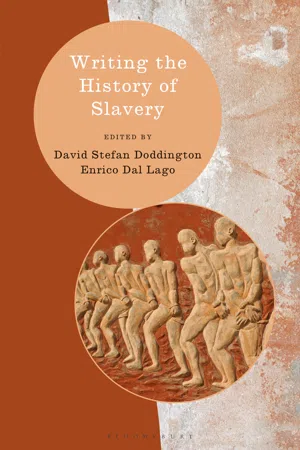
Exploring the major historiographical, theoretical, and methodological approaches that have shaped studies on slavery, this addition to the Writing History series highlights the varied ways that historians have approached the fluid and complex systems of human bondage, domination, and exploitation that have developed in societies across the world. The first part examines more recent attempts to place slavery in a global context, touching on contexts such as religion, empire, and capitalism.
In its second part, the book looks closely at the key themes and methods that emerge as historians reckon with the dynamics of historical slavery. These range from politics, economics and quantitative analyses, to race and gender, to pyschohistory, history from below, and many more. Throughout, examples of slavery and its impact are considered across time and place: in Ancient Greece and Rome, Medieval Europe, colonial Asia, Africa, and the Americas, and trades throughout the Atlantic and Indian Oceans. Also taken into account are thinkers from Antiquity to the 20th century and the impact their ideas have had on the subject and the debates that follow.
This book is essential reading for students and scholars at all levels who are interested in not only the history of slavery but in how that history has come to be written and how its debates have been framed across civilizations.
eBook - ePub
Writing the History of Slavery
- 480 pages
- English
- ePUB (mobile friendly)
- Available on iOS & Android
eBook - ePub
Writing the History of Slavery
About this book
Information
Part I
Global approaches
1
Defining slavery in global perspective
The more we learn about slavery the more difficulty we have defining it
– David Brion Davis1
Let us begin with the stories of four individuals, picked more or less at random. Our first individual lived in Assyria and was named Ahat-abiša. Her father owed thirty silver shekels to a man named Zabdî; one day in 652 BC he transferred Ahat-abiša to Zabdî in restitution of that debt.2 We know of Ahat-abiša’s fate because it was recorded in cuneiform script on a clay tablet, legal evidence of her conveyance. Our second individual was named Aristarchus. Aristarchus worked as a semi-independent leather worker in Athens in the last quarter of the fifth century BC; we know of him from an inscription recording how he was confiscated and sold by the Athenian state in 414 BC because of the impious actions of his owner Adeimantus.3 Our third individual lived two centuries ago and was named Johnson. This man was an African fluent in Mandingo and English, who learned the latter as a result of being enslaved and transported to Jamaica as a boy. Having achieved manumission, he resided in England for a number of years with his former owner before finally returning to his native country. We know of his life through the writings of the explorer Mungo Park, who hired him as an interpreter in 1795.4 Our fourth individual is named Nadia Murad. She is an Iraqi Yazidi, and was captured by Daesh in 2014, sold several times, and subjected to severe sexual exploitation before escaping later that year. She currently works in promoting the rights of Yazidis.5
Scholars have labelled all of these individuals as slaves or having suffered enslavement. Why? What shared feature allows these persons’ conditions at points of their lives – separated by gulfs of time and space, coming from very different cultures, undergoing many different experiences – to be grouped under a single, global category, ‘slavery’? The question has attracted no small measure of controversy, and has elicited a variety of different responses. The current state of confusion is well summed up by the words of David Brion Davis, quoted in the epigraph to this chapter; for if a scholar of Davis’s calibre and vision can be reduced to aporia, then the issue must be in a very sorry state indeed. The purpose of this chapter is to explore the question of defining slavery in global perspective: is it a legitimate exercise, and if so, what rules should govern the inclusion or exclusion of this or that person from the category?
I should declare an interest at the outset. The orthodox approach to defining slavery, which has persisted from antiquity to the present (but encountered critiques of various sorts, especially since the 1960s), has to do with ownership. This approach is perhaps best summed up in the League of Nations’ definition of slavery of 1926 that held it to be ‘the status or condition of a person over whom any or all of the powers attaching to the right of ownership are exercised’.6 Despite various criticisms, it is this definition – or at least some close variant thereof – that seems to me to capture best what is distinctive about slavery; and I have argued at length in recent book for an ownership-focused definition.7 That same definition has also been used by the co-founder of Free the Slaves Kevin Bales and the legal specialist Jean Allain to identify slavery in the post-abolition world of the present day, and has led to the conviction of modern enslavers.8
It should be noted that the ownership definition is accepted among the vast majority of slavery scholars; indeed, in large parts of the field there is no ‘definitional debate’ at all: it simply does not feature in recent literature on slavery in the Atlantic world; and one leading student of Roman slavery has recently declared astonishment that the traditional definition was ever questioned in the first place.9 The debate is far more prominent among anthropologists, sociologists, specialists in modern slavery and students of African and Asian history. Naturally, it has been a serious problem for scholars with an interest in ‘global’ slavery studies, who must come to some manner of accommodation with their colleagues in these disciplines given the all-embracing nature of the field. This chapter, then, is not a disinterested account of the various approaches scholars have taken to defining slavery, but an overview of several key criticisms to which the orthodox view has been subjected. I aim to articulate these criticisms as clearly as possible, to use them to stress-test the orthodox view and to explore the methodological challenges that confront any attempt to define slavery as a globally valid category applicable to both historical and present-day societies. The subject is vast; within the limits of this chapter, therefore, I have had to be selective and highlight several key themes.
We begin with the question of what a definition is and what purpose it serves. The second section (‘The genesis of a concept: Slavery in law and metaphor’) then turns to the ancient world. My aim here is to show how the terminology of slavery – a legal relationship based on the ownership of persons – was mapped outwards onto other domains through processes of metaphorical extension. This introduced potential for confusion; it is a process still ongoing to this day, and lies at the root of some recent unorthodox approaches to the definition of slavery. The third section (‘Modern studies of slavery and their expanding scope’) moves from history to modern historiography, and examines how scholarship on slavery, initially focused on several familiar Western cases (Greece, Rome, the United States, the Caribbean, Brazil), expanded to explore various forms of forced labour in a much broader range of societies. It was this process that set the scene for challenges to the traditional definition to emerge during the last fifty years. I then (in the section entitled ‘Finley’s law’) examine these challenges, especially from the sociological and anthropological traditions, and attempt to gauge whether or not they are convincing. During the nineteenth and twentieth centuries, the language of slavery was enlisted to characterize the objects of numerous humanitarian campaigns; this has led to an ever-growing indeterminacy regarding the application of the term ‘slavery’. The final section (‘Slavery, humanitarianism and political rhetoric’) analyses the issue of modern (namely post-abolition) slavery.
As I hope to show, the confusion noted by Davis is not due to an inherent difficulty of the topic, but due to the specific historiographical trajectory of global slavery studies as it has developed over the last fifty years. It is to this historiography, I argue, that one must turn in order to understand why the current state of confusion exists.
What is a definition?
It may help to begin by asking what a definition is and what job we wish it to perform. A definition is a taxonomic tool, not an analytical tool. As Patterson has rightly noted, the point of a definition of slavery is to identify a distinct category of persons.10 This might seem self-evident, but in fact much confusion has been caused by scholars requiring their definitions to perform other tasks of, for example, a descriptive or analytical nature.
Some scholars have treated definition as a kind of précis, a blurb meant to summarize the most historically significant aspects of slavery.11 Such definitions tend to stray into description and prolixity.12 A corollary of this is to see a contradiction in defining slavery in terms of property, namely that human beings are far more than just commodities, have minds of their own and have agency to affect the course of their lives.13 This misconstrues the purpose of a definition, which is not to summarize the entire phenomenon, but to pinpoint what makes it a distinctive category. All humans have minds and agency: these factors are therefore extraneous to the task of defining a subcategory of human beings. The legal definition of slavery does not require slaves to be inert, passive pawns: rather, it simply brackets off a group of individuals who are treated as property in law or practice.14
Others have believed that the concept ‘slavery’ can only be comprehensible in association with an antonym, ‘freedom’.15 This is certainly one way in which Western societies have articulated slavery; but a concept of freedom is not necessary for a clear concept of slavery. As Jack Goody has shown, the concept ‘slavery’ has proven perfectly comprehensible without any antonym; and more recently Kostas Vlassopoulos has underscored that in many cultures that do have an antonym to slavery, that antonym is not freedom, but mastery or kinship .16 Another popular approach has been to tack on various extras to the standard definition of slavery, such as Finley’s claim that slaves were not just property, but were also always outsiders;17 as Eltis and Engerman have rightly pointed out, however, ‘Societies have tended to reserve enslavement for those whom they have defined as not belonging, but this has not always meant that all aliens were enslaved, or that all slaves were aliens.’18
On the other hand, some scholars, most prominently Joseph Miller, have objected to the very exercise of defining slavery in institutional terms; such a procedure, he argues, is ‘static’ and cannot capture the dynamic processes of history.19 To deny the importance of defining slavery altogether leads to two problems. First, one cannot be precise about what one is talking about; and it remains very unclear how Miller proposes distinguishing between slaves and non-slaves. Second, as Lovejoy notes, historical societies created ‘static’ legal institutions for the very task of sorting individuals into the categories of slaves and non-slaves and guaranteeing their supply and control; to ignore these in favour of a ‘dynamic’, ‘processual’ history is to deny the historical significance of these institutions.20 Above all, to reject legal categories is to engage in an unnecessary quarrel, for one need not choose either a ‘static’, legalistic view of history or a ‘dynamic’, anti-institutional view of history: historical societies are composed of fixed and moving parts, neither of which can be neglected if one aims at a rounded understanding. My point is to establish a heuristic division of labour: the task of definition is simply concerned with identifying whether or not a given person is a slave; the historian’s work does not begin and end by asking this question. It is a non sequitur to claim that defining slavery in legal terms locks one into a static version of history, the agency of whose subjects simply cannot be grasped.
The genesis of a concept: Slavery in law and metaphor
The legal ownership of human beings can be documented from remote periods of antiquity; slave sale contracts are known from the Old Babylonian and Old Assyrian periods, and the legal regulation of slavery is known from Sumerian documents of an even earlier date, such as the law code of Ur-Namma (2100 BC).21 These show a fundamental similarity with slavery in the more familiar Atlantic world: the legally regulated reduction of human beings to tradeable chattel; such cases easily qualify as slavery under the 1926 League of Nations definition. A close look at the legal position of slaves in 1st millennium BC Babylonia shows that their condition satisfies all the criteria of Honoré’s cross-cultural formulation of ownership.22
Yet antiquity also provides us with examples of one of the key complications in the definitional problem, namely the semantic extension of slave terminology; for while the reduction of human beings to the legal status of property had its own special terminology, that terminology came to be expanded in scope beyond this phenomenon proper. A look at the semantic range of some slave terms in several ancient languages may prove instructive. In Old Babylonian the slave is called a wardum; in Classical Hebrew, eved. The most common Greek term for slave is doulos; the most common Latin term servus. (Our English word ‘slave’, by which these words are usually translated, originates from metonymy of the term sklavos, ‘Slav’, in Byzantine Greek; Slavs were commonly enslaved in the Middle Ages.) From an early period we can ob...
Table of contents
- Cover
- Halftitle Page
- Title Page
- Dedication Page
- Contents
- List of figures
- List of contributors
- Introduction: Writing the History of Slavery David Stefan Doddington and Enrico Dal Lago, Cardiff University and National University Ireland Galway
- Part I Global approaches
- Part II Themes and methods
- Index
- Imprint
Trusted by 375,005 students
Access to over 1.5 million titles for a fair monthly price.
Study more efficiently using our study tools.
Frequently asked questions
Yes, you can cancel anytime from the Subscription tab in your account settings on the Perlego website. Your subscription will stay active until the end of your current billing period. Learn how to cancel your subscription
No, books cannot be downloaded as external files, such as PDFs, for use outside of Perlego. However, you can download books within the Perlego app for offline reading on mobile or tablet. Learn how to download books offline
Perlego offers two plans: Essential and Complete
- Essential is ideal for learners and professionals who enjoy exploring a wide range of subjects. Access the Essential Library with 800,000+ trusted titles and best-sellers across business, personal growth, and the humanities. Includes unlimited reading time and Standard Read Aloud voice.
- Complete: Perfect for advanced learners and researchers needing full, unrestricted access. Unlock 1.5M+ books across hundreds of subjects, including academic and specialized titles. The Complete Plan also includes advanced features like Premium Read Aloud and Research Assistant.
We are an online textbook subscription service, where you can get access to an entire online library for less than the price of a single book per month. With over 1.5 million books across 990+ topics, we’ve got you covered! Learn about our mission
Look out for the read-aloud symbol on your next book to see if you can listen to it. The read-aloud tool reads text aloud for you, highlighting the text as it is being read. You can pause it, speed it up and slow it down. Learn more about Read Aloud
Yes! You can use the Perlego app on both iOS and Android devices to read anytime, anywhere — even offline. Perfect for commutes or when you’re on the go.
Please note we cannot support devices running on iOS 13 and Android 7 or earlier. Learn more about using the app
Please note we cannot support devices running on iOS 13 and Android 7 or earlier. Learn more about using the app
Yes, you can access Writing the History of Slavery by David Stefan Doddington, Enrico Dal Lago, David Stefan Doddington,Enrico Dal Lago in PDF and/or ePUB format, as well as other popular books in History & Historiography. We have over 1.5 million books available in our catalogue for you to explore.