- 300 pages
- English
- ePUB (mobile friendly)
- Available on iOS & Android
eBook - ePub
About this book
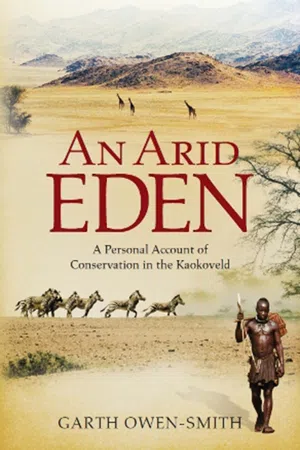
Two remarkable tales woven together - the story of the Kaokoveld, an arid eden in the remote north-west of Namibia, so nearly lost, but regained to become one of Africa's iconic wildlife tourism destinations, and also the story of a young man's search for an African way to do conservation in Africa. Garth Owen-Smith first visited the Kaokoveld in 1967. It was a life-changing experience. His unconventional ideas challenged both the conservation establishment and the former South African regime. Despite this, community-based conservation was pioneered in the Kaokoveld and today Namibia is a world leader in this field. But the early years - when the foundation for this ground-breaking approach to conservation was laid - are largely forgotten and untold. An Arid Eden: A Personal Account of Conservation in the Kaokoveld brings those years alive through the eyes of Owen-Smith, spanning four-and-a-half decades of extraordinary dedication, passion and achievement. The author and his partner Dr Margaret Jacobsohn have won some of the world's most prestigious conservation awards for their work in Namibia, which has always challenged convential wisdom. The NGO they founded continues to break conservation, agricultural and rural development paradigms.
Information
Print ISBN
9781868423637
Chapter One
Basalt Mountains
In north-west Namibia there is a region of red basalt ranges. It is a landscape of rock: sheer cliff faces, endless scree slopes and stone-choked valleys. Westward, towards the cold Atlantic coast, the mountains flatten out and are separated by broad gravel plains, littered with the debris of ancient lava flows.
It is a place where rain seldom falls, and in most years the earth’s hard surface lies barren and exposed to the baking sun and searing desert winds. The region is stark and hostile, but in the early morning and late afternoon light, when the basalt rocks turn to the colour of rust, and the distant mountains to soft shades of purple and blue, it can also be breathtakingly beautiful.
In spite of its aridity the basalt region supports a remarkable variety of hardy, drought-resistant plants. The stony pediments and less precipitous slopes are dotted with swollen-stemmed succulents, stunted trees and dwarf shrubs that in lean years wither to desiccated tufts of brittle, apparently lifeless twigs. Many of the species here are endemic, occurring only in the deserts of Namibia and south-western Angola. Amongst them is one of the world’s botanical wonders: Welwitschia mirabilis, a prehistoric cone-bearing plant consisting of just two giant, tentacle-like leaves growing from a gnarled and contorted woody stump.
Eastward, where the rainfall is slightly higher, the basalt ranges rise to over 1 500 metres above sea level. Here mopane bushes dominate the valleys, growing taller along the banks of rocky channels that drain the hill slopes. Although they flow only after heavy storms, these watercourses converge into dry riverbeds that traverse the gravel plains, creating arteries of life-supporting vegetation deep into the Namib desert. In a few places where the underground water-table is close to the surface there are also groves of graceful euclea trees and leathery-leafed salvadora bushes that provide shady refuges from the tropical sun.
When heavy rain does fall, the basalt region undergoes a dramatic transformation. From the shallow soil between the stones long-dormant seeds of annual grasses and forbs germinate and within weeks paint the valleys emerald green, in striking contrast to the red-brown scree on the hill slopes. The brief availability of moisture in the soil also enables the woody plants to produce new leaves and blossom. And with this abundance of fresh growth, insect populations explode, rodents and seed-eating birds multiply exponentially, and all the desert animals grow fat on the bounty of a benevolent season.
But the feast soon ends. Within months the green carpet of grass is bleached to pale yellow by the sun and dehydrating winds that in winter sweep down from the interior plateau. As the land dries out once more the ephemeral plants and insects die, but not before producing countless seeds and eggs to ensure that new generations of each species will appear when thunderstorms once more roll across the desert.
In spite of the very arid climate the basalt ranges are well endowed with small springs that provide drinking water for a remarkable array of large mammals. And because the volcanic soils are exceptionally fertile the grass that grows in the good seasons is cured into standing hay, thus retaining its nutrient value in subsequent years when little or no effective rain falls. This carry-over of high-quality grazing is crucial to Hartmann’s mountain zebra, the only exclusive grazer permanently inhabiting the region, and together with its ability to migrate large distances and climb the steepest slopes, enables it to survive the frequent droughts.
Like zebra, gemsbok and springbok also congregate in large numbers to feed on the green grass that grows wherever heavy showers have occurred. However, when it dries out both species can switch to browsing the leaves of the desert shrubs, which combined with their low drinking requirements allows them to penetrate deeper and remain longer in the true Namib, one of the driest habitats on earth.
Because they are exclusively browsers, kudu and giraffe prefer the more wooded areas further inland, but after good rains in the pre-Namib – the belt of plains and rocky ranges along the edge of the desert – kudu move westwards to exploit the flush of new growth there. Giraffe also follow the larger watercourses that traverse the basalt region far into the desert, and small groups may be seen striding sedately across the virtually barren gravel plains between them.
The herbivores that occur here in turn support a full spectrum of large predators, with prides of lions hunting the hills and riverbeds, cheetah coursing their prey on the gravel flats and leopard stalking the rocky gullies and more rugged mountain slopes. Packs of spotted hyena clean up behind the big cats, but also run down their own prey when the opportunity arises, while jackals are ubiquitous. Man has long been a predator here too – in the past as a hunter-gatherer killing game for animal protein and fat, but in more recent times with a commercial incentive as well.
Most remarkably, elephants also inhabit the basalt ranges, finding sufficient sustenance in the bark and leaves of the sparse desert trees and shrubs to maintain themselves. On their wanderings in search of food and water the pachyderms have worn a network of paths through the region, some of which go over the highest mountain passes. During the cool dry season a few herds also move down the larger riverbeds deep into the desert, quenching their thirst at remote springs whose whereabouts has been passed down through the generations.
In the 1960s the north-west contained Namibia’s biggest population of black rhino, but in little more than a decade the sky-rocketing black market price for their horns brought the species to the brink of extinction here and throughout most of Africa.
* * *
My story will start here, in the heart of the basalt ranges, one afternoon in March 1983. It was a dry year and although the wet season was nearing its end only a few light showers had so far fallen. Earlier in the day some promising cumulus clouds made a foray over the mountains, but they were soon driven back by a stiff breeze from the west and were now lying low on the eastern horizon. Before the wind picked up the day had been very hot: over 40 degrees in the shade and much higher in the sun. At such times life seemed suspended. Nothing moved and the only sound was the faint ringing in one’s ears.
By four o’clock the west wind that routed the clouds had tempered the quivering midday heat, and as the air cooled the stony desert came back to life. Along the watercourses tree leaves fluttered and the occasional call of a bird punctuated the silence. On an open hillside a small group of springbok that had been resting in the sun stood up, stretched and started walking to where they knew the sparse grazing was better.
As the springbok fanned out and moved slowly down the slope they passed close to a black rhino cow quietly feeding on the long rubbery stems of a euphorbia bush. Standing by her side was a three-month-old calf – a small, hornless replica of its ponderous, prehistoric-looking mother. Hearing the faint shuffle of the springbok hooves on the hard ground, the cow swung round to face them, her large round ears unerringly picking up the direction of every dislodged pebble. A few of the nearer springbok skittered nervously away, well aware that black rhino have a low tolerance for anything coming too close to them. When the springbok moved on the cow stared belligerently after them for some time before turning back to chew on the succulent euphorbia stems. As she ate the calf lay down on the ground next to her and went to sleep.
On a ridge overlooking the valley two men squatted on the ground, talking low-voiced to one another. For most of the day they had been following the tracks of the cow and calf – no easy task over the rocky terrain. Now for the first time they could see them. Before going any closer, however, they carefully discussed the situation. The wind was in their favour, but although rhino have very poor eyesight their hearing is exceptionally acute. Carefully they made their way down the slope, getting to within 50 metres before one of them raised the .303 rifle he was carrying, aimed just behind her shoulder and squeezed the trigger.
Shocked by the impact of the bullet the cow squealed in fear and rage, spraying crimson foam over the euphorbia’s branches and onto the stony ground. Now terrified by the smell of her own blood she charged across the rocks into another euphorbia, and with a mighty swing of her massive head demolished half of it before lurching on, seeking something else on which to vent her fury. But the bullet had shredded a lung and punctured her heart, and with the blood pressure to her brain dropping she staggered on for only a few more steps before collapsing. Woken by the cow’s squeals and headlong flight, the calf had scrambled to its feet and run after her, stopping next to her lifeless body and looking around in bewilderment for the source of the danger.
Once they were certain that the cow was dead the two men walked towards her. When they were about 30 metres away the calf could make out their strange upright shapes, and instinctively knowing that they were dangerous it charged at them. In a reflex action one of the men picked up a stone and threw it at their diminutive attacker, hitting the calf on the nose and stopping it in its tracks. A second stone struck it on the shoulder. Although its instinct was to stay with its mother, confused by her not moving and overcome by fear the calf ran away.
‘Why did you not shoot it?’ the unarmed man asked.
‘It was better not to risk the sound of another shot. The people from nature conservation sometimes come into this area now. We also don’t have bullets to waste on a rhino that has no horns to sell. Let the hyenas kill it.’
The two men went quickly to work, propping the cow’s head up on a stone and hacking her horns off with a machete. They took nothing else, but before leaving they cut branches from nearby bushes and covered the carcass. When they were satisfied that it would not easily be seen, even from the air, they picked up the horns and left.
The men had reason to be very pleased with their day’s work. This was not the first rhino they had killed, and for reasons they did not understand or care about, the man they sold the horns to would take as many as they could supply. For something so useless he also paid them well enough – R200 for an average-sized pair and R300 if they were very large. It was more than a month’s wages if you worked for the government, and a labourer would have to work even longer to earn that much on one of the white farms. If you did not talk too much about what you were doing in the bush, hunting rhino was a good way of getting money to buy cattle to replace the ones that died in the drought, buy school uniforms for your children or clothes for your wife.
While the men hurried back to their camp the rhino calf wandered aimlessly across the rocky landscape. Nearby a jackal yapped and then howled mournfully. In the distance another answered. By now the sun was hovering low over the horizon, and as its last rays lit up the mountain slopes they turned the basalt rocks to the colour of blood.
Chapter Two
Dust and Stones
Although March is one of the hottest months in Damaraland the nights are usually quite cool, and in the early hours of the morning I found a blanket insufficient and crawled into my sleeping bag. Now warm, but not exactly comfortable on the rocky ground, I lay on my back looking up at the brilliant display of pre-dawn stars and contemplated the day ahead.
It would probably not be very different to yesterday, or the day before – or many others my companion, Karl-Peter Erb, and I had spent recently. We had come here to carry out anti-poaching patrols on the farms purchased by the South African government in the 1960s to create a homeland for the Damara people. It was basalt country. Horizon-to-horizon rocks. Loose, treacherous, ankle-twisting rocks that made sure we walked with our eyes glued to the ground and paid little attention to the stark desert scenery around us. Regular foot-patrols here meant that you wore out a pair of veldskoen in less than six months.
Peter and I worked for the Namibia Wildlife Trust (NWT), a non-governmental organisation set up in 1982 to help the nature conservation authorities bring poaching in the country’s north-west under control. Previously this rugged mountainous region was known as the Kaokoveld, and was part of the largest conservation area in the world: Game Reserve No 2, proclaimed in 1907 by the German colonial government. But on the recommendation of the Odendaal Commission it was de-proclaimed in 1970, and together with over 200 previously white-owned farms had been divided into Kaokoland and Damaraland, tribal ‘homelands’ where the Damara and Herero-speaking residents could ‘exercise their right of self-determination’.
Prior to its de-proclamation the region had been inhabited by large populations of elephant and black rhino, as well as an exceptional variety of other big game animals, but little of this magnificent national heritage still survived. Elephant now numbered just a few hundred, while all other species had been decimated by the dual effects of illegal hunting and a devastating drought that ended the year before. Our greatest concern was for the black rhino. From the information we had so far gathered it was clear that the basalt ranges of western Damaraland contained the last viable population in Namibia, outside of the Etosha National Park – and that their numbers could be as low as 40! It did not require a crystal ball to see that time was running out for them, and for most of the Kaokoveld’s other wildlife.
Between the government and the NWT we were only able to put a total of eight men into the field, with just three four-wheel-drive vehicles, to cover an area of over 20 000 km2 in which rhino were still known to occur. And as most of the region had no roads, if we hoped to have any impact on the situation, getting out on foot was the only way. But just reaching the place to start a patrol could mean a hard day’s driving – sometimes two – from our respective bases at Khorixas and Wêreldsend.
Although the commercial trade in ivory and rhino horn was being controlled by outsiders, we suspected that most of the poaching was now being done by the local people – men who were skilled in bush craft and knew the country we patrolled much better than we did. Moreover, after a hunting excursion they could return to their villages, and become just another one of the friendly cattle herders we regularly passed on the side of the road. Both literally and figuratively, it was not a level playing field.
Nevertheless, we had achieved some success. While doing an aerial game survey Slang Viljoen, an elephant researcher, and Colin Britz, a field officer with a diamond mining company carrying out exploration in the area, had seen a number of elephant and rhino carcasses on the eastern edge of the basalts. They reported them to the Senior Nature Conservator, Chris Eyre, who followed up on the ground. After a long investigation, Chris had finally arrested six Herero men who were now awaiting trial. A few months before, Chris had also been able to convict a local resident for being in possession of six elephant tusks.
The previous October, Peter Erb and I had come across the carcass of a two-year-old rhino calf in the basalt ranges, about 30 km from our base camp. A male lion had been feeding on it and there was plenty of hyena spoor around, but I was sure that it was too big to have been killed by either the lion or hyenas – unless it had already been injured. Suspecting that it might have been wounded by poachers, we had thoroughly searched the surrounding area, and about two weeks later Peter had found the fairly fresh remains of an adult rhino cow near a small spring about 10 km away. The skull was missing and the carcass covered with brushwood. A blood trail was still visible leading to the place it had been shot, where we picked up two used cartridges. But that was all the evidence we had, and the case was abandoned. Over the following months Peter and I found four more rhino carcasses in the area, all of which had been poached, and another two that might have been.
To give us a better chance of catching the poachers I had worked out a patrolling system whereby we left our base camp late in the afternoon, reaching the area we planned to cover after dark. At first light the next morning we would walk in a wide circle looking for the tracks of humans or donkeys, returning about midday to where we had left our vehicle. After having something to eat and a rest, we would then drive to the next foot patrol starting point – again arriving after sunset. We concentrated on the basalt ranges because they still had the greatest number of rhino, and we knew that poachers were now operating there.
This was our third night out from our base at Wêreldsend, and from my bed on the rocky ground I noted that Venus, the bush alarm clock, was now well above the horizon and the sky in the east was gradually getting lighter. Nearby a chorus of jackals shattered the silence. It was time to get up.
Crouching next to the remains of our previous night’s fire I scratched among the embers until I found a few that were still glowing. After placing a handful of dry twigs on them I went for a pee and then washed my face in a nearby spring. When I returned, grey smoke was billowing from the twigs, and with a gentle blow they burst into flame. A few larger pieces of wood brought the fire to a bright blaze. After balancing our bent and blackened kettle over it, I found a suitable rock to sit on and waited for the water to boil. A few minutes later Peter, who had been sleeping nearby, joined me. When we had made ourselves a cup of tea he asked which way I planned to patrol. North-west, I replied, onto Palm, one of the farms that had been purchased by the government to create Damaraland.
‘That’s pretty rough country,’ Peter said softly, perhaps thinking about all the more pleasant places he could be at that moment. I knew he was not complaining, just mentally preparing himself for another hard day’s walking. He was, after all, only 21, and this was his first job after leaving school and a failed year at a university in South Africa. The NWT paid him the princely sum of R250 a month, and since starting work a little over a year before, he had spent much of his time doing foot patrols.
I didn’t blame him for being less than enthusiastic about another day of scrambling over Damaraland’s basalt rocks. There was very little to inspire one. Whole days had gone by without us seeing a single live animal, although carcasses were common enough. In fact, the basalt ranges were littered with the bleached bones of game that had died in the drought or been poached – in most cases it was now impossible to tell which.
By the time we had drunk a second cup of tea, rolled up our sleeping bags and started walking, all but the brightest stars had faded, and the still unseen sun painted delicate highlights onto a band of fluffy clouds along the eastern horizon. The morning air was crisp but I knew that in a few hours the temperature would be heading towards 40 degrees in the shade, and where we were planning to patrol there would not be many shady places.
By nine o’ clock we had covered about six kilometres. The sun was now well up and drops of perspiration were already starting to trickle down the sides of our faces. So far the largest animal we had seen was a hare that had dashed out from under a bush a couple of metre...
Table of contents
- Title page
- Epigraph
- Dedication
- Map of the Kaokoveld in the 1960s
- Preface
- Abbreviations and Acronyms
- 1. Basalt Mountains
- 2. Dust and Stones
- 3. An Arid Eden
- 4. The White Man’s Game
- 5. Working for BAD
- 6. The Clash of Cultures
- 7. A Wild Life
- 8. A New Decade
- 9. The Kaokoveld Controversy
- 10. Looking for Answers
- 11. A Stitch in Time
- 12. When it is Late Afternoon
- 13. A Rhodesian Ranch
- 14. Zimbabwe Rising
- 15. South-west of South West
- 16. Etosha: The Burning Question
- 17. The End of the World
- 18. ‘Desert elephants’
- 19. Rhinos on the Brink
- 20. Involving the Local People
- 21. Conservation and Politics
- 22. A Degraded Ecosystem
- 23. The Purros Project and More Poaching
- 24. Independence
- 25. Communal Conservancies
- 26. Looking Back and Forward
- Bibliography
- Pictures
- Copyright
Trusted by 375,005 students
Access to over 1.5 million titles for a fair monthly price.
Study more efficiently using our study tools.