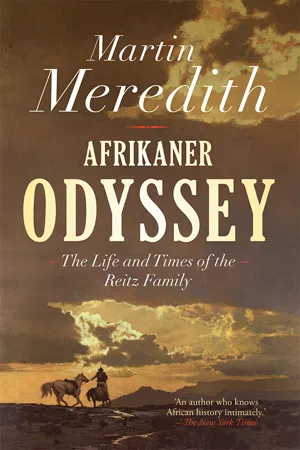
The odyssey of the Reitz family passes like a thread through the tapestry of South African history in the nineteenth and early twentieth centuries. Originally Dutch-Afrikaner gentry from the Cape, the family moved to the frontier settlement of Bloemfontein and played a key role in the building of the Orange Free State. At the heart of this tale is the extraordinary career of Deneys Reitz, whose account of his adventures in the field during the Anglo-Boer War (1899-1902), published as Commando, became a classic of irregular warfare. Martin Meredith interweaves Reitz's experiences, taken from his unpublished notebooks, with the wider story of Britain's brutal suppression of Boer resistance. Concise and readable, and featuring rare photographs from the family archives, Afrikaner Odyssey is a wide-ranging portrait of a distinguished Afrikaner family whose presence is still marked on the South African landscape.
- 215 pages
- English
- ePUB (mobile friendly)
- Available on iOS & Android
eBook - ePub
About this book
Information
chapter 1
/
The Fountain of Flowers
Long before the discovery of diamonds and gold on the highveld of southern Africa, the village of Bloemfontein, where Deneys Reitz was born, had achieved unusual distinction. It was founded in 1846 by a British army officer, Captain Henry Warden, who had been sent by the British authorities in Cape Town with orders to cross the Orange River, marking the northern frontier of the Cape Colony, and to establish a military outpost in the turbulent region beyond, then known as Transoranje. British officials were worried that intractable disputes over land and stock theft between emigrant trekboers from the Cape Colony who had settled in Transoranje and an assortment of rival African chiefdoms – Tswana, Sotho, Griqua and Khoikhoi – would increase the likelihood of clashes and instability in the northern interior. Warden’s mission, with the support of a small detachment of Cape Mounted Rifles, was to try to maintain peace.
The site that Warden chose for his garrison lay in a small valley surrounded by hills that dominated the vast plains between the Riet and Modder rivers. A small stream and a perennial spring there provided a reliable source of water. An emigrant trekboer, Johan Nicolaas Brits, and his family, had settled in the valley in the 1820s, living in a small mud house with a front garden of flowers and an orchard watered from a furrow between the spring and the stream. Wild clover growing around the spring led Brits to name his farm Bloem Fontein – ‘Fountain of Flowers’.
Warden paid Brits the sum of 500 rijksdaalders (£37.10s.0d) for his farm and set his detachment of riflemen the task of building a ‘Residency’ – a simple house of sun-dried bricks – and a stockade and stables. Within a few weeks, Bloem Fontein had grown into a small military settlement, 150 kilometres north of the Cape Colony border.
When Warden’s efforts to resolve land disputes made little headway, a new British governor, Sir Harry Smith, fresh from military victories in India, adopted a far more aggressive approach. In February 1848, without any consultation, he proclaimed British sovereignty over the entire region between the Orange and Vaal rivers, an area that included not only scattered Boer emigrant groups but land belonging to Tswana, Sotho and Griqua chiefdoms.
Smith’s arbitrary decree provoked opposition from several Boer factions. In July, an emigrant leader, Andries Pretorius, led a trekboer commando from northern districts and turfed Warden out of Bloem Fontein and back into the Cape. Relishing the opportunity for a fight, Smith retaliated with a force of British troops and Griqua auxiliaries, defeating Pretorius in a short, sharp battle at Boomplaats in Griqua territory and forcing him to retreat across the Vaal River into the Transvaal region.
Smith duly named his new territory the ‘Orange River Sovereignty’, declaring Bloem Fontein as its capital. An English visitor in 1848 described it as ‘a small village consisting of some half-dozen houses and some huts, prettily situated on the banks of a stream’. Warden was reinstated as Resident; a new fort was built on the slope of a kopje close to his residence and named Queen’s Fort, after Queen Victoria; and a surveyor was commissioned to draw up a plan for the development of the village, opting for long, straight streets running parallel to the stream, Bloem Spruit, as it was called. In November 1848, Warden sold a number of plots – ‘water erven’ – in Bloem Fontein, raising funds for the construction of a thatched hall on St George’s Street, which was used for school lessons, church services, public events and meetings of the legislative assembly of the Orange River Sovereignty.
From the outset, Bloemfontein acquired a distinctly English character. Most of its inhabitants were English-speakers. The territory’s first newspaper, The Friend of the Sovereignty and Bloemfontein Gazette, was published weekly with articles in Dutch and English but favoured the English cause. It was the only official bulletin for government proclamations.
The British government, however, soon became alarmed at the cost and difficulties of trying to maintain order in the highveld region. An influx of English settlers and land speculators after the proclamation intensified conflicts over land ownership. Warden made a bad situation worse by drawing up a demarcation line that deprived the Basotho leader, Moshoeshoe, of large chunks of fertile territory along the Caledon River valley and precipitated a series of clashes. The Boer leader, Andries Pretorius, threatened to side with Moshoeshoe against the Sovereignty unless Britain recognised the independence of the Boers north of the Vaal River. Elsewhere in southern Africa, British forces were engaged in a costly military campaign against Xhosa clans to the east.
Rather than plunge further into the quagmire, the British government decided to retreat. In January 1852, two British officials met Pretorius at Sand River and negotiated an agreement granting independence to ‘the Emigrant Farmers’ in territory north of the Vaal River – the Transvaal, or the Zuid-Afrikaansche Republiek, as it was later called.
But in the Orange River Sovereignty, the prospect of Britain’s withdrawal aroused considerable dismay and opposition, from trekboers as well as English residents. Protest meetings were held in Bloemfontein and other villages. British officials were consequently obliged to shun loyalist groups and negotiate with burgher representatives willing to shoulder the burden of government.
At a meeting in the government ‘school room’ in St George’s Street on 23 February 1854, a British commissioner, Sir George Clerk, signed a convention agreeing to transfer power to a republican committee. On 11 March, troops from the Cape Mounted Rifles rode out of the village, leaving behind four obsolete cannons in Queen’s Fort. As the London Times observed cynically, other bequests to the new Boer republic included ‘tables, chairs, desks, shelves, inkstands, green baize, safes … freely sacrificed in the cause of peace’.
As capital of the new Vrijstaat (Free State), Bloemfontein possessed few accoutrements. It was in reality no more than a rural dorp, a collection of some 60 houses, a few stores and church halls, dispersed among orchards, willow trees, dry-stone walls and rough wagon tracks. After the departure of British troops and officials, the white population dwindled to about 400.
The surrounding grass plains abounded with a vast array of wildlife, which often ventured into the village. A German store owner, Gustav Fichardt, recalled that shortly after his arrival in 1853, while he was standing on the stoep in conversation with his brother, a herd of wildebeest stampeded past them. The local postmaster was instructed to dispatch mail to the Cape Colony village of Colesberg no later than 4 pm to reduce the risk of lion attack. The highveld climate was generally benign; there were long, uninterrupted days of sunshine and dry air. But summer brought heat and storms; in winter there were many days of frost and bitter cold; and drought and locust plagues were common hazards.
The Vrijstaat itself possessed a new national flag of white and orange, but few resources. Its white population amounted to only about 15 000 scattered across a territory of 130 000 square kilometres; many were illiterate. The number of blacks was estimated to be about 50 000, mostly Tswana, Sotho, Griqua and Khoikhoi. The republic’s main product was wool for export. Supplies of building materials, furniture, household articles and clothing all had to be transported to Bloemfontein by ox-wagon across rough roads from Port Elizabeth, on the coast at Algoa Bay, a journey of 650 kilometres that took up to two months. The first plank floor installed in a private house in Bloemfontein came from the timbers of a ship that had foundered at Port Elizabeth.
Despite its inauspicious beginnings, the new republic rapidly took shape. Within two months of its independence, a council of elected members approved a constitution widely regarded as providing the country with a firm foundation. The constitution accepted as citizens all whites with six months’ residence. The legislature was a unicameral Volksraad whose members were elected by white males over the age of 18 – provided they had registered for military service. Executive power was placed in the hands of a president, directly elected for a period of five years, and an executive council composed of officials and Volksraad nominees. In local districts, the chief sources of authority were landdrosts (magistrates) appointed by the government and locally elected field-cornets and field commandants. The constitution also contained elements of a bill of rights, with provisions guaranteeing equality before the law, personal freedom and freedom of the press. Although Dutch was chosen as the official language of the Volksraad, English remained in common use in town and business life.
Disputes over land ownership, however, still festered. When the British departed, they had still not established a clear boundary with Moshoeshoe’s Sotho kingdom in the Caledon Valley. The republic’s first president, Josias Hoffman, made efforts to come to terms with Moshoeshoe, arranging a meeting with him. Without consulting the Volksraad, Hoffman presented Moshoeshoe with a cask of ceremonial gunpowder as a gesture of good faith. When Volksraad members belatedly heard of the gift, they accused Hoffman of supplying ammunition to the enemy and hounded him out of office.
The white quest for land was relentless. Aiming to gain a white monopoly of land ownership, white farmers took over Griqua lands around Philippolis and Rolong lands around Thaba ’Nchu. The border area with Moshoeshoe’s Sotho lands was soon engulfed in raid and counter-raid. In 1858, open warfare broke out. Boer commandos invaded from the north and the south, capturing cattle and ravaging villages and church mission stations. But as they advanced on Moshoeshoe’s mountain fortress at Thaba Bosiu, they met the full force of his army and retreated in disarray.
In 1865, war broke out again. This time, the Boer assault on Sotho villages and crops was so ruthless that several Sotho chiefs agreed to treaties that stripped them of nearly all their arable land. Boer commandos failed to capture Thaba Bosiu but, facing disaster, Moshoeshoe appealed to the British authorities for protection, imploring that his people might be considered ‘fleas in the Queen’s blanket’. In 1868, the British government decided to intervene, annexing Moshoeshoe’s kingdom as a separate British colony called Basutoland (modern Lesotho). Without consulting the Sotho, British and Boer officials proceeded to establish a boundary line that gave the Orange Free State all land north of the Caledon River and a large area in the triangle between the lower Caledon River and its junction with the Orange River. Basutoland consisted mainly of mountains, with only a narrow strip of arable land on the southern side of the Caledon River.
Despite the land gains it had made, the Orange Free State was left in dire straits. The financial burden of the Basuto wars was crippling. A paper currency issued by the government, commonly known as ‘bluebacks’, lost much of its nominal value. Twelve years after its founding, the Bloemfontein journal De Tijd remarked in 1866: ‘Simple people find themselves in a vast land, surrounded in all quarters by enemies, without judges, without soldiers, without money, divided through ignorance and derided by a Colony adjacent to it [the Cape].’
The Cape Colony itself was in a precarious state, afflicted in the 1860s by drought, locusts, a slump in wine exports, a fall in the price of wool and a banking crisis. Railway-building ground to a halt 110 kilometres outside Cape Town owing to lack of money.
Then, in 1869, prospectors made several valuable finds of alluvial diamonds on the banks of the Vaal River at Pniel, a German mission station that lay 150 kilometres west of Bloemfontein and 150 kilometres north of the Orange River border. A 130-kilometre stretch of the Vaal River was soon crowded with hundreds of prospectors, diggers and speculators wandering from claim to claim, establishing brief settlements – Delport’s Hope, Cawood’s Hope, Last Hope, Forlorn Hope, Fools Rush, Poorman’s Kopje.
The area had long been considered a part of Free State territory. Boer farmers in the neighbourhood had routinely registered their property titles with Free State authorities. To ensure effective control, President Johannes Brand decided in 1870 to appoint a landdrost at Pniel, with administrative powers over all Free State territory lying to the south of the Vaal River. The task was given to Oloff Truter, a Free State official with experience of the goldfields of Australia and California and a former policeman adept at handling ‘the rougher elements of the community’. A school, a courthouse and a prison were built at Pniel. The Free State Volksraad passed legislation regulating diggers’ activities, requiring them to pay ‘licence money’ to the authorities.
A few months...
Table of contents
- Contents
- List of Maps
- Author’s Note
- Prologue
- Chapter 1 - The Fountain of Flowers
- Chapter 2 - Family Fortunes
- Chapter 3 - Pretoria
- Chapter 4 - A Golden Fate
- Chapter 5 - A Model Republic
- Chapter 6 - Raiders
- Chapter 7 - The Shadow of War
- Chapter 8 - Tipping the Black Spot
- Chapter 9 - The Siege Strategy
- Chapter 10 - Spioenkop
- Chapter 11 - The Fall of Bloemfontein
- Chapter 12 - The Fall of Pretoria
- Chapter 13 - Scorched Earth
- Chapter 14 - Spitskop
- Chapter 15 - Raiding the Cape
- Chapter 16 - The Bitter End
- Chapter 17 - Madagascar
- Chapter 18 - Broedertwis
- Epilogue
- Select Bibliography
- About the book
- About the author
Trusted by 375,005 students
Access to over 1.5 million titles for a fair monthly price.
Study more efficiently using our study tools.
Frequently asked questions
Yes, you can cancel anytime from the Subscription tab in your account settings on the Perlego website. Your subscription will stay active until the end of your current billing period. Learn how to cancel your subscription
No, books cannot be downloaded as external files, such as PDFs, for use outside of Perlego. However, you can download books within the Perlego app for offline reading on mobile or tablet. Learn how to download books offline
We are an online textbook subscription service, where you can get access to an entire online library for less than the price of a single book per month. With over 1.5 million books across 990+ topics, we’ve got you covered! Learn about our mission
Look out for the read-aloud symbol on your next book to see if you can listen to it. The read-aloud tool reads text aloud for you, highlighting the text as it is being read. You can pause it, speed it up and slow it down. Learn more about Read Aloud
Yes! You can use the Perlego app on both iOS and Android devices to read anytime, anywhere — even offline. Perfect for commutes or when you’re on the go.
Please note we cannot support devices running on iOS 13 and Android 7 or earlier. Learn more about using the app
Please note we cannot support devices running on iOS 13 and Android 7 or earlier. Learn more about using the app
Yes, you can access Afrikaner Odyssey by Martin Meredith in PDF and/or ePUB format, as well as other popular books in History & African History. We have over 1.5 million books available in our catalogue for you to explore.