- 280 pages
- English
- ePUB (mobile friendly)
- Available on iOS & Android
eBook - ePub
About this book
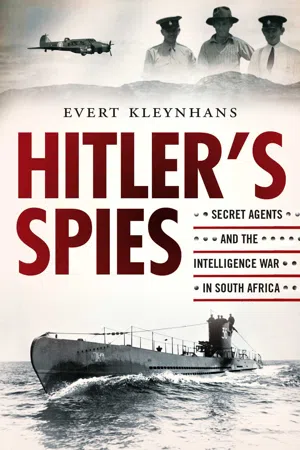
The story of the intelligence war in South Africa during the Second World War is one of suspense, drama and dogged persistence. In 1939, when the Union of South Africa entered the war on Britain's side, the German government secretly reached out to the political opposition, and to the leadership of the anti-war movement, the Ossewabrandwag.
The Nazis' aim was to spread sedition in South Africa and to undermine the Allied war effort. The critical strategic importance of the sea route round the Cape of Good Hope meant that the Germans were also after naval intelligence. Soon U-boat packs were sent to operate in South African waters, to deadly effect.
With the help of the Ossewabrandwag, a network of German spies was established to gather important political and military intelligence and relay it back to the Reich. Agents would use a variety of channels to send coded messages to Axis diplomats in neighbouring Mozambique. Meanwhile, police detectives and MI5 agents hunted in vain for illegal wireless transmitters.
Hitler's Spies presents an unrivalled account of the German intelligence networks that operated in wartime South Africa. It also details the hunt in post-war Europe for witnesses to help the government bring charges of high treason against key Ossewabrandwag members.
Information
Topic
HistoireSubtopic
Biographies militairesPostscript
Seventy years on, with the benefit of hindsight, we can draw a number of interesting conclusions about the intelligence war fought in South Africa during the Second World War. But there are a number of questions to be answered. One of the most important is: did the intelligence war have a broader impact on the war?
While German U-boats had some successes, operations in South African waters did not achieve sufficient sinkings to justify such far-flung operations indefinitely. Moreover, naval intelligence collected in South Africa during the war had no benefit for Axis naval operations in the Southern Ocean. Such information was completely out of date by the time it reached Berlin. The fact that German agents in the Union were not permitted to communicate directly with U-boats operating off the South African coast only added to the problem.
Furthermore, the political and military intelligence collected and transmitted from the Union by German agents throughout the war proved to be largely irrelevant. While it may be argued that political intelligence held some propaganda value for the Ossewabrandwag, in the grander scheme of things military intelligence emanating from the Union had no effect on the overall Axis war effort.
Therefore, the German intelligence networks operating in South Africa – including those run by Hans Rooseboom and Lothar Sittig, along with Hans van Rensburg and the inner circle of Ossewabrandwag – had no real strategic impact on the eventual outcome of the Second World War. Some might label these an amateurish undertaking, although I would maintain that the determined efforts to establish wartime contact between Germany and the Ossewabrandwag deserve recognition. The establishment of two-way communication between the Felix organisation and Berlin in 1943 is commendable given the distances involved and the technical know-how and equipment required.
Another question worth asking is: had the case of high treason against Van Rensburg gone to court, would it have succeeded?
The National Party victory in the 1948 general election counted in Van Rensburg’s favour. Although Malan and his cabinet debated the Barrett Report for some time, the episode has mostly disappeared from the South African collective memory. Ultimately, Van Rensburg seems to have emerged victorious, despite overwhelming evidence that he had committed high treason during the war.
In the event that Van Rensburg would have been prosecuted on charges of high treason, he might well have received a life sentence rather than the death penalty – as was the case with Robey Leibbrandt. He would in all likelihood also have received clemency from the Malan government, after serving a few mandatory years behind bars. In that event, he would have been elevated to the level of a national hero among the Afrikaners – thereby ensuring his upward political mobility in post-war, nationalist South Africa.
Whether or not there was a determined effort to sanitise the South African collective memory remains open for debate. All indications ...
Table of contents
- 00
- 01
- 02
- 03
- 04
- 05
- 06
- 07
- 08
- 09
- 10
- 11
- 12
- 13
- 14
- 15
- 16
- 17
Trusted by 375,005 students
Access to over 1.5 million titles for a fair monthly price.
Study more efficiently using our study tools.
Frequently asked questions
Yes, you can cancel anytime from the Subscription tab in your account settings on the Perlego website. Your subscription will stay active until the end of your current billing period. Learn how to cancel your subscription
No, books cannot be downloaded as external files, such as PDFs, for use outside of Perlego. However, you can download books within the Perlego app for offline reading on mobile or tablet. Learn how to download books offline
Perlego offers two plans: Essential and Complete
- Essential is ideal for learners and professionals who enjoy exploring a wide range of subjects. Access the Essential Library with 800,000+ trusted titles and best-sellers across business, personal growth, and the humanities. Includes unlimited reading time and Standard Read Aloud voice.
- Complete: Perfect for advanced learners and researchers needing full, unrestricted access. Unlock 1.5M+ books across hundreds of subjects, including academic and specialized titles. The Complete Plan also includes advanced features like Premium Read Aloud and Research Assistant.
We are an online textbook subscription service, where you can get access to an entire online library for less than the price of a single book per month. With over 1.5 million books across 990+ topics, we’ve got you covered! Learn about our mission
Look out for the read-aloud symbol on your next book to see if you can listen to it. The read-aloud tool reads text aloud for you, highlighting the text as it is being read. You can pause it, speed it up and slow it down. Learn more about Read Aloud
Yes! You can use the Perlego app on both iOS and Android devices to read anytime, anywhere — even offline. Perfect for commutes or when you’re on the go.
Please note we cannot support devices running on iOS 13 and Android 7 or earlier. Learn more about using the app
Please note we cannot support devices running on iOS 13 and Android 7 or earlier. Learn more about using the app
Yes, you can access Hitler's Spies by Evert Kleynhans in PDF and/or ePUB format, as well as other popular books in Histoire & Biographies militaires. We have over 1.5 million books available in our catalogue for you to explore.