- 312 pages
- English
- ePUB (mobile friendly)
- Available on iOS & Android
eBook - ePub
About this book
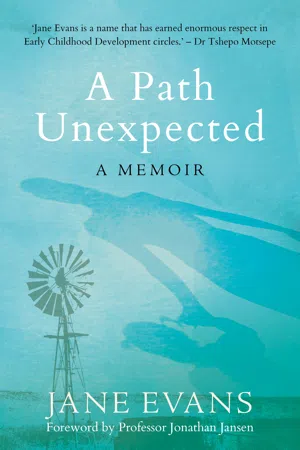
'Jane Evans is a name that has earned enormous respect in Early Childhood Development circles. The fact that ECD is an essential pillar in our country's programme of educational reform owes much to Jane and other activists of the time – many of whom are mentioned in her book. While this is a personal memoir it is also an important record of ECD in South Africa.' – Dr Tshepo Motsepe
Jane Evans begins her memoir with her career as a journalist in the big city, then tells of her moving to the small town of Viljoenskroon in the northern Free State with her husband, Anthony Evans, a well-known and respected businessman and farmer. It is here, in the heart of South Africa's maize lands during the height of apartheid, that Jane is moved to create the non-profit organisation Ntataise, marking the start of her activism for early childhood development (ECD) and advocacy for training women in rural communities to become ECD teachers.
Eloquently written and told with great sensitivity and humility, this is a memoir about love, loss, finding purpose, and how one woman's unexpected path led to family-like bonds in the unlikeliest of places – and about a dream so profound that it would influence generations of young learners and the women who teach them.
Information
A PATH UNEXPECTED
JANE EVANS
Jonathan Ball Publishers
Johannesburg · Cape Town · London
To Anthony
CONTENTS
Dedication
Foreword
Motto
Prologue
1 The farm
2 The town
3 Sausages and butter: Preserving tradition
4 The great divide
5 The pondok
6 The stad
7 The toilet-lid covers
8 16 June
9 The nursery school
10 Rebecca
11 Milk and oranges
12 Josephine
13 The washing of hands
14 The pothole
15 Sickness
16 Bonny
17 A modest proposal
18 Ntataise
19 Papadi
20 Suspicion
21 New wings
22 Too many questions
23 Unexpected progress
24 The do-gooder
25 Sowing the seeds
26 A warning
27 Drumbeats
28 Far and away
29 Patience
30 The ambassador
31 Woman of the Year
32 Flying the coop
33 Letsitele
34 Sharp sharp
35 The shoplifter
36 Election day
37 Letting go
38 Scientifically proven
39 Toy trolleys
40 Maria and Ishmael
41 New York
42 An empty space
43 A new millennium
44 Selena Moloke
45 The Queen Mother
46 Positive
47 The vigil
48 Toyi-toyi
49 Tomorrow
Epilogue
Addendum
Acknowledgements
About the book
Imprint page
FOREWORD
How to give outside of a pandemic
I FIRST MET JANE Evans one dark night on a Free State farm. It was my first job after returning from studies in the United States, one that entailed giving what the USAID-funded firm called ‘technical assistance’ to non-governmental organisations providing education to black South Africans. Nelson Mandela had been released from prison but the first democratic elections still lay ahead. Things were tense in the country and Viljoenskroon, in the northern Orange Free State, was precisely the kind of place in which an armed right-wing group called the Afrikaner Weerstandsbeweging would patrol the town against black locals and the coming ‘terrorist takeover’ about which these men had been brainwashed.
So, to be honest, on the drive from Johannesburg to the Evans farm I was a little on edge. A black man staying overnight on a white family farm in a rural province known for its racial backwardness was not exactly something to look forward to. The doors of the main house on Huntersvlei Farm swung open and there were Jane and Anthony Evans. That was the other shock. I had thought of these rural farms as being owned by heavy-duty Afrikaner men, the ones who offloaded in central South Africa while the rest of the Voortrekkers pushed on northwards towards Pretoria. I certainly did not expect a Rhodes Fellow with a degree from Oxford and a journalist who once did the women’s pages for an English newspaper in Johannesburg to be comfortably ensconced in a small town named for an Afrikaner farmer called Viljoen with a horse named Crown (the ‘kroon’ part of the town’s name).
Little did I know that Jane and Anthony were to become close friends over the next few decades and that we would work together closely in bringing education to young children and training to women who would become leaders in early childhood development in the province and throughout South Africa. Among them would be remarkable black women – at one moment the wives of farm labourers and the next travelling overseas to present their development work at international conferences. That, in sum, is everything you need to know about Jane Evans and the incredible work of transformation that she has accomplished in South African education. This is a book that tells Jane’s powerful story in the form of a moving and transforming memoir that at various moments had me in tears and at the end inspired me with renewed hope for our country.
This memoir is, however, different from the many others for which I have written forewords. To begin with, the writing is beautiful, even exquisite, drawing one into the story because of how it is told. No doubt Jane’s skills as a writer explain the quality of the story, but it is also because of her sincerity as a person. She does not flinch from telling her story in the context of Old World patriarchy and the chauvinism of influential men as she encounters them in the course of her life. Nor does she hold back from throwing light on the ordinary racism of the rural hinterlands as it impacts the black South Africans who work with the Evans family on their Huntersvlei Farm.
She writes about racism and sexism with the kind of the restraint but also self-awareness that makes the telling so much more powerful than that which comes with the rage and indignation of ordinary writing. I would not judge those who write about hurt and humiliation with the pen of rage but often that kind of writing stirs common passions at the expense of deeper insights into the invisible infrastructures of oppression that sustain the status quo.
Jane’s story is therefore not the usual memoir variety of ‘then-this-happened-then-that-happened’, but an eye-opening account of living and learning in the changing contexts of South Africa before and since the end of apartheid. A simple visit to grieve a passing soul in the township of Rammulotsi, where the black residents of Viljoenskroon live, is described so vividly as to reveal the contrast between privilege and poverty without the need to preach about the blight of inequality.
Which brings us to the central question in Jane’s compelling story: How do you give in ordinary times? The COVID-19 pandemic is extraordinary, the first of its scale in a century. At the time of writing more than 46 million people had been infected with the novel coronavirus and more than 1 million had died. Faced with this existential threat to communities and whole countries, South Africa’s rich have given spectacular amounts of money to the Solidarity Fund and countless development agencies.
What Jane’s memoir reveals is how to give in ordinary times; here, in the Evanses’ contribution to education and development in South Africa, I find five useful lessons. First, give where you are. They give on the farm to those who labour and manage in their sphere of influence. So often audiences ask me, ‘What can we do to help in education?’ Simple: give where you stand, where you work and where you live.
Second, give for the long term. The Evanses’ model of giving is to invest in the education of the youngest children knowing full well that, if the foundations are laid for further learning, then the chances of academic success over time are much more likely.
Third, give to build communities. What Jane and Anthony did was to locate early childhood development centres within communities so that everybody gains and develops in the process – the children, the trainers, the parents, the caregivers and those who supply food and equipment.
Fourth, give through involvement. The Evanses could have done what so many other wealthy people do: drop off resources at the point of need and hope for the best. Jane throws herself into the work of early childhood education. She lives and learns with her colleagues. Her contribution, more than financial resources, is herself.
Fifth, give to replace yourself. This is a crucial insight from Jane’s contribution to the people on and around the farm. She consciously trains young black women for leadership at the level of governance, management and administration of the project. When Jane stepped back after many years, I know it was difficult for her given her emotional investment. But I also know it was inevitable, for this approach to development is who Jane is as a development activist – somebody who develops others in order to hand over to others.
You will not find a moralising tone in this exceptional memoir. Jane writes about her life with humility and gratitude. In the process, she tells of her place in a broken country and her mission, with Anthony, to rebuild South Africa following the devastation of apartheid.
I cannot recommend this hopeful book more highly in these uncertain and anxious times because, as Jane reveals, we have been here before.
Jonathan D Jansen
Stellenbosch University
May 2020
My dear young people: I see the light in your eyes, the energy of your bodies and the hope that is in your spirit. I know that it is you, not I, who will make the future. It is you, not I, who will fix our wrongs and carry forward all that is right with the world.
– Nelson Mandela
PROLOGUE
IT STARTED SLOWLY. A tremble, almost imperceptible at first. Then the earth began to shiver, as if shrugging off a burden that lay hidden deep within. And then came the shaking. I reached out my arms to steady myself, and watched, transfixed, as the tall glasses of Coke and Fanta, condensation running down their sides, rattled and slid to the edge of the tray on the table in front of us. I stood up. I wanted to run outside. Someone pulled me back into my soft leather chair.
‘Jesus, sweet Jesus!’ a woman cried out, as she put her hands together in prayer. We were sitting in the home of Rebecca Sothoane, in the township of Rammulotsi in the Free State. She had died at the age of 73, and I had come to pay my respects to her family. Gold-coloured curtains, with delicate white netting behind them, were pulled to the side of each window. The television held pride of place in the centre of the room. And now, with the rumbling, the jittering, the clinking of crockery all around us, it felt as if the walls themselves were going to come tumbling down and destroy all of that in an instant. But just as quickly as it had started, the shaking stopped. The sudden silence was broken by Rebecca’s daughter, Josefina, who smiled shakily at me and said, ‘It’s my mother. She’s come to say she’s so pleased you’re here.’
In ...
Table of contents
- 9781776191192
Trusted by 375,005 students
Access to over 1.5 million titles for a fair monthly price.
Study more efficiently using our study tools.
Frequently asked questions
Yes, you can cancel anytime from the Subscription tab in your account settings on the Perlego website. Your subscription will stay active until the end of your current billing period. Learn how to cancel your subscription
No, books cannot be downloaded as external files, such as PDFs, for use outside of Perlego. However, you can download books within the Perlego app for offline reading on mobile or tablet. Learn how to download books offline
Perlego offers two plans: Essential and Complete
- Essential is ideal for learners and professionals who enjoy exploring a wide range of subjects. Access the Essential Library with 800,000+ trusted titles and best-sellers across business, personal growth, and the humanities. Includes unlimited reading time and Standard Read Aloud voice.
- Complete: Perfect for advanced learners and researchers needing full, unrestricted access. Unlock 1.5M+ books across hundreds of subjects, including academic and specialized titles. The Complete Plan also includes advanced features like Premium Read Aloud and Research Assistant.
We are an online textbook subscription service, where you can get access to an entire online library for less than the price of a single book per month. With over 1.5 million books across 990+ topics, we’ve got you covered! Learn about our mission
Look out for the read-aloud symbol on your next book to see if you can listen to it. The read-aloud tool reads text aloud for you, highlighting the text as it is being read. You can pause it, speed it up and slow it down. Learn more about Read Aloud
Yes! You can use the Perlego app on both iOS and Android devices to read anytime, anywhere — even offline. Perfect for commutes or when you’re on the go.
Please note we cannot support devices running on iOS 13 and Android 7 or earlier. Learn more about using the app
Please note we cannot support devices running on iOS 13 and Android 7 or earlier. Learn more about using the app
Yes, you can access A Path Unexpected by Jane Evans in PDF and/or ePUB format, as well as other popular books in Social Sciences & Social Science Biographies. We have over 1.5 million books available in our catalogue for you to explore.