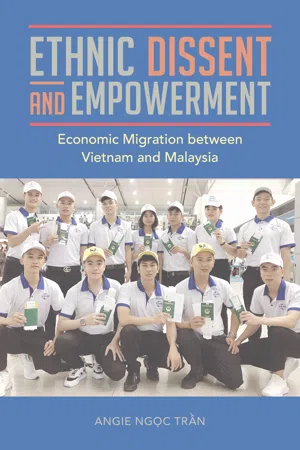
A rare study of labor migration in the Global South, Ethnic Dissent and Empowerment answers essential questions about why nations export and import migrant workers and how the workers protect themselves not only within the system, but by circumventing it altogether.
eBook - ePub
Ethnic Dissent and Empowerment
Economic Migration between Vietnam and Malaysia
- English
- ePUB (mobile friendly)
- Available on iOS & Android
eBook - ePub
About this book
Vietnam annually sends a half million laborers to work at low-skill jobs abroad. Angie Ng?c Tr?n concentrates on ethnicity, class, and gender to examine how migrant workers belonging to the Kinh, Hoa, Hrê, Khmer, and Chãm ethnic groups challenge a transnational process that coerces and exploits them. Focusing on migrant laborers working in Malaysia, Tr?n looks at how they carve out a third space that allows them a socially accepted means of resistance to survive and even thrive at times. She also shows how the Vietnamese state uses Malaysia as a place to send poor workers, especially from ethnic minorities; how it manipulates its rural poor into accepting work in Malaysia; and the ways in which both countries benefit from the arrangement.
Trusted by 375,005 students
Access to over 1.5 million titles for a fair monthly price.
Study more efficiently using our study tools.
Information
Publisher
University of Illinois PressYear
2022Print ISBN
9780252085277
9780252043369
eBook ISBN
9780252052248
1 Historical, Economic, Cultural, Religious Practices of the Five Ethnic Groups
A socialist cosmopolitan from Nam Định in Vietnam who migrated to the Czech Republic stays there with her extended family after the fall of the Soviet Bloc in 1989 to supply simple women’s clothes, assembled in Vietnam, to working-class customers in these formerly communist markets. A young Chăm Muslim seamstress in An Giang designs and employs her siblings to assemble traditional Muslim garments to be sold in modern-day Malaysia with the help of her aunt who lives there. Born far apart (Nam Định is in the north of Vietnam and An Giang is in the south), these two entrepreneurs’ paths demonstrate the effect of history and different migration patterns on their lives, yet they share a spirit of dynamism and creativity and a reliance on family networks that transcend national borders. A Khmer hamlet deputy chief in An Giang provides insights on the significant role of the wats (Khmer Buddhist temples) in preserving their language and culture and criticizes the indebtedness and landlessness problems related to the labor export policy affecting his villagers. A Hrê village leader in a mountainous district in Quảng Ngãi province (central of Vietnam) reminds Kinh officials of the traditional spirit of mutual aid among the Hrê migrants who left their villages to work in another country for the first time, hoping to fulfill the dreams promised by the labor export policy. Both indigenous leaders in provinces a thousand kilometers apart advocate for their respective villagers who participated in the labor export program in Malaysia and returned to Vietnam with debts they acquired in the process.
This chapter explains the historical and cultural contexts of and differences between the ethnic groups under consideration. I examine how different levels of access to economic resources—land, finance, and education—have placed each of the five ethnic groups on different levels of the ethnic hierarchies (table 2). At the same time, I examine some century-old cultural practices—national and transnational networks, language, and religion—that nearly reverse the rankings, empowering the Chăm and the Khmer. In the conclusion, drawing from the ethnic hierarchies, I signal factors that ground their strategies for survival and that even allow them to thrive in the labor brokerage state (LBS) system. These insights enable cross-group comparisons in subsequent chapters.
Kinh and Hoa Migrants in the Socialist and Market Eras
The history of mobility of socialist Kinh migrants parallels that of the non-Kinh migrants in Malaysia who received support not only from their extended family networks but also from the transnational communities in which they lived and worked. During the Cold War in the 1950s, the newly established Democratic Republic of Vietnam, north of the seventeenth parallel, had already become an LBS.1 The first waves of Vietnamese migration in the 1950s and 1960s were based on the spirit of international socialist brotherhood to support Vietnam’s anti-colonial French (in the 1950s) and anti-US imperialism (1960–75) wars.2 The governments of the Soviet Union, East Germany, and other Eastern European countries invited Vietnamese students, workers, and cadres to their countries for further academic and vocational training as well as party training at Communist Party schools and through apprenticeships. To pay debts to these socialist allies and to alleviate problems of unemployment and poverty in Vietnam, the Vietnamese government exported labor to Eastern Europe.3
After winning the US-Vietnam war in 1975, Vietnam was reunified into one country, the Socialist Republic of Vietnam, but it faced almost twenty years of a US trade embargo (1975–94). External pressures such as the crisis with China and the Chinese attack on Vietnam in 1979 also pushed Vietnam closer to the Soviet Bloc, culminating in Vietnam becoming a full member of the Council for Mutual Economic Assistance in 1978.4 Internally, Vietnam faced budget difficulties, reduced aid, and increased pressure to pay wartime and nation-building debts to the Soviet Bloc. So, between the 1980s and the end of the Cold War in 1989, the Vietnamese socialist state became a socialist labor broker, signing and implementing many bilateral labor agreements with the USSR, East Germany, Czechoslovakia, Poland, Bulgaria, and other countries to send them a combined total of about three hundred thousand low-skilled Kinh guest workers. As Vietnam opened its economy to the market system and eased price controls, Vietnamese seized the opportunity to mobilize capital (money) and goods to sell abroad and to bring back foreign goods to consume in Vietnam. Under this socialist labor export policy, these early socialist guest workers established a global diaspora to welcome and support subsequent waves of migrants, mostly from north of the seventeenth parallel.
After the fall of the Berlin Wall in 1989 and the disintegration of the Eastern Bloc in 1991, all the bilateral agreements became void. Many socialist migrants, who were still working under these contracts, had to make difficult decisions: either to return to Vietnam as required by the host countries or to stay and establish underground markets to sell Vietnamese products, forms of third spaces discussed in chapters 5 and 6.
The policies of the Cold War socialist LBS foreshadowed twenty-first century capitalist LBS practices in Vietnam and Malaysia embedded in the global system, when the Vietnamese state began sending migrants of different ethnic groups to work in Malaysia (chapter 2). The main difference, however, is that the contemporary guest workers include Kinh migrants from throughout Vietnam and a small number of the ethnic Hoa (the ethnic Chinese in Vietnam) and other ethnic minorities.5
Cultural Resources
In most studies about Vietnam, the Kinh are usually grouped together with the Hoa, who are highly assimilated with the majority Kinh. Over one thousand years of Chinese imperial and colonial rule left indelible economic, social, cultural, and religious influences in Vietnam that have persisted into the modern day. Mahayana Buddhism entered Vietnam by Silk Road traders and missionaries through southern China and the coast, and Chinese administrators and settlers brought Confucian philosophy, ideas, technologies, and words to Vietnam. Three basic Confucian ideas that spread to Vietnam and that continue to influence modern-day Vietnam are subjects’ loyalty to the king, sons’ piety toward their fathers, and wives’ submission and fidelity to their husbands and sons.6
The Vietnamese resisted sporadically during this thousand-year rule, beginning with the short-lived but famous Trưng Sisters uprising for independence between 39 and 43 CE. Within the context of Chinese colonial rule, the Vietnamese sense of national cultural identity is manifested in veneration of national mothers and fathers. Scholars have studied the pairing of mythic mothers with mythic fathers. Their specific interest is the development of Mother Goddess Liễu Hạnh’s cult (revered by spirit mediums) and the association it has come to have with the cult of Trần Hưng Đạo, the hero who defeated the invading Mongol and Chinese armies in the thirteenth century and who is revered as a Father of the Nation.
The Kinh-Hoa majority also have advantages over the ethnic minorities because of their access to social capital such as family networks and their use of Vietnamese, the official language of Vietnam, which enables them to acquire the skills and knowledge needed to make a living.7 A nationwide quantitative study on sources of inequality between the majority and the ethnic minorities shows the powerful role of language (Vietnamese) in privileging the Kinh majority and indicates that the removal of this language barrier could substantially reduce inequality between the Kinh majority and the other ethnic groups, especially in terms of access to education.8 Many Hoa also benefit from being able to speak the language of most employers in Malaysia: Chinese. A qualitative study undertaken by Thulstrup shows stark differences between the Kinh majority and the Co ethnic minority in terms of language, culture, and family relations. Thulstrup shows that the Kinh, through their social networks, have greater mobility and more connections in lowland areas where larger markets and wood-processing industries are located. The strength of Kinh social networks explains how they were able to invest early on in acacia (keo tree) plantations, which gave them access to the best land for establishing cash-crop production and inadvertently forced the Co ethnic minority in that area to clear areas further away from the commune, including in areas of protected forest.9
Economic Resources
The Hoa and the Kinh have greater access to key economic-based factors (such as land, finance, education, and health care) compared to the other three ethnic groups studied in this book. While the Hoa account for less than 1 percent of the population (over nine hundred thousand people), they command financial power and are the wealthiest minority.10 Chinese companies invest in what is known as the “greater China zone,” which includes Hong Kong, Taiwan, mainland China, and Southeast Asian countries, and to protect these investments, they rely on their ethnic connections—via social, cultural, language, and personal ties—and networks that they have established through globalization.11 Overall, the Hoa have better access to financing, surpassing the four other ethnic groups, including the majority Kinh.
The Kinh and the Hoa have a higher standard of living than the other ethnic groups in Vietnam. This standard is also reflected in higher school enrollment rates and greater access to health services.12 Major factors that account for the divergence include greater landownership, better access to credit, control of the means of production (such as farm tools or machinery), know-how, and education (which is mostly conducted in Vietnamese).
Even when access to credit is assumed to be the same among poor Kinh and the Hrê, the Khmer, and the Chăm Muslims, the outcomes still benefit the majority Kinh more than the others. An empirical study on the socioeconomic impact of rural credit in northern Vietnam shows that while Hoa and poor Kinh use credit to increase their income, members of the other three ethnic groups use it to create jobs, enhance nutrition, and secure access to medical services. This differential impact requires an understanding of preexisting unequal socioeconomic conditions beyond access to financial credit. The Kinh-Hoa are substantially richer than the other three ethnic groups in terms of monthly income per household, so they can afford to invest in making more money, whereas the other groups need to spend on survival essentials, such as jobs, food, and medical services.13
The issues of land distribution and acquisition are complicated, and landlessness is a problem that affects not only the poor ethnic minorities but also the poor Kinh majority. Nguyễn, McGrath, and White found that inequality in land distribution tends to be higher in delta regions such as the Red River Delta and the Mekong Delta (an area of abundant land). For instance, landlessness in the Mekong Delta is the result of a cycle of chronic poverty: peasants mortgage their land in response to ill health, business failure, an increase in the cost of agricultural inputs, or a decrease in output prices for cash crops.14 All of these factors, along with participation in the labor export program, can give rise to indebtedness, which compels poor peasants to sell their land. However, indebtedness affects poor ethnic minorities more than the Kinh majority. The majority of poor people in the Mekong Delta are landless; most are Khmer. Around 4 million people (out of the delta’s population of 18 million) are classified as poor. Out of these poor peasants, 2 million are landless and around 1 million are Khmer (which is half of the total Khmer population).
Kerkvliet’s study shows that since the early 1970s, the large influx of mostly Kinh migrants from the lowlands to the central highlands, often with state encouragement and assistance, has negatively affected communal land use of many ethnic minority highlanders. The increasing densities of the Kinh’s population in the area resulted in the decline of shifting cultivation, a practice integral to the minor...
Table of contents
- Cover
- Half Title
- Title Page
- Copyright Page
- Dedication
- Table of Contents
- List of Illustrations
- Acknowledgments
- Abbreviations
- Introduction
- 1. Historical, Economic, Cultural, Religious Practices of the Five Ethnic Groups
- 2. The Transnational Labor Brokerage System and Its Infrastructure
- 3. The Labor Recruitment Process and Indebtedness
- 4. Precarity and Coping Mechanisms
- 5. Physical Third Space Empowerment
- 6. Metaphorical Third Space Empowerment
- 7. Aspirations after Malaysia
- Appendix 1. Descriptions of the Samples
- Appendix 2. Land Issues Faced by the Five Ethnic Groups in This Study
- Appendix 3. Chronology of the Transnational Labor Brokerage State System, 1950s–2020
- Appendix 4. Legal Documentation of Labor Export Policies
- Notes
- Bibliography
- Index
Frequently asked questions
Yes, you can cancel anytime from the Subscription tab in your account settings on the Perlego website. Your subscription will stay active until the end of your current billing period. Learn how to cancel your subscription
No, books cannot be downloaded as external files, such as PDFs, for use outside of Perlego. However, you can download books within the Perlego app for offline reading on mobile or tablet. Learn how to download books offline
Perlego offers two plans: Essential and Complete
- Essential is ideal for learners and professionals who enjoy exploring a wide range of subjects. Access the Essential Library with 800,000+ trusted titles and best-sellers across business, personal growth, and the humanities. Includes unlimited reading time and Standard Read Aloud voice.
- Complete: Perfect for advanced learners and researchers needing full, unrestricted access. Unlock 1.5M+ books across hundreds of subjects, including academic and specialized titles. The Complete Plan also includes advanced features like Premium Read Aloud and Research Assistant.
We are an online textbook subscription service, where you can get access to an entire online library for less than the price of a single book per month. With over 1.5 million books across 990+ topics, we’ve got you covered! Learn about our mission
Look out for the read-aloud symbol on your next book to see if you can listen to it. The read-aloud tool reads text aloud for you, highlighting the text as it is being read. You can pause it, speed it up and slow it down. Learn more about Read Aloud
Yes! You can use the Perlego app on both iOS and Android devices to read anytime, anywhere — even offline. Perfect for commutes or when you’re on the go.
Please note we cannot support devices running on iOS 13 and Android 7 or earlier. Learn more about using the app
Please note we cannot support devices running on iOS 13 and Android 7 or earlier. Learn more about using the app
Yes, you can access Ethnic Dissent and Empowerment by Angie Ngoc Tran in PDF and/or ePUB format, as well as other popular books in Social Sciences & Asian History. We have over 1.5 million books available in our catalogue for you to explore.