- 300 pages
- English
- ePUB (mobile friendly)
- Available on iOS & Android
eBook - ePub
About this book
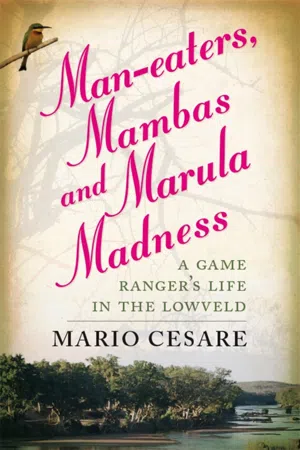
What started as a vision for the Olifants River Game Reserve [in South Africa] has become the story of a game ranger's life. With a naturalist's eye for detail as well as the bigger picture of managing a fragile ecosystem through years of drought and plenty, Mario Cesare brings a storyteller's delight - and a dash of Italian passion - to sharing his world. Life-and-death encounters with lion, elephant and buffalo are balanced by rescues and interventions as these giants of the lowveld suffer the effects of human interference in their ecosystem. There are problems with poachers and with rapacious neighbours; then the delights of success - and in the case of the elephant population, the conundrums of too much success. Mario Cesare's career has taken him from Timbavati and Mala Mala to Olifants River and beyond - and he delights in sharing his good fortune. His latest task: to develop and nurture the Olifants River Game Reserve as the fences of the Greater Kruger National Park area fall, undoing generations of damage. Man-eaters, Mambas and Marula Madness: A Game Rangers Life in the Lowveld provides a wealth of lessons on conservation as well as stories of life in the bush as it is enjoyed only by those fortunate enough to live on a 'Big Five' reserve.
Information
Management of Game Populations
A Never-ending Story
We know that ecology is not an exact science and that no game reserve encompasses a complete, self-regulating ecosystem. Depending on what the objectives and vision of a reserve are, policies may be determined which will necessitate some degree of intervention by the hand of man. This means implementation of agreed policies through active management from time to time. This is usually justifiable in situations where growing game populations begin to adversely affect their own habitat in a confined area, and where we then make use of all the scientific information available to balance things a little.
Prior to the removal of fences, some serious management decisions had to be made each year on Olifants. This process mainly dealt with game removals in the form of live capture and translocation. Up to 50 buffalo, 60 zebra and as many as four rhino were being captured and sold in severe winters. This may sound like a lot of animals, but if we take the buffalo population as an example, study of the actual results indicates a conservative rather than radical approach. When I arrived in 1993, the buffalo population stood at 65 and at the time of our inclusion as full members of APNR twelve years later, the number was nearly 300. In this twelve-year period, we had captured and sold more than 150 buffalo, with predation, natural deaths, hunting and train deaths accounting for quite a few more. Despite all manner of intervention by man, the population grew by nearly 15 per cent per annum. However, the same cannot be said of wildebeest numbers.
Prior to the removal of the internal fences in Balule, the wildebeest population in the Olifants west region stood at nearly 800. Today, as I write, that number is down to fewer than 200. Fence removals, which allowed predators into an area that they formerly found difficult to access, combined with a bad management decision to capture and remove 85 wildebeest, pushed the wildebeest population off the knife edge and into a spiral of decline.
Giraffe have been removed in the past, albeit in relatively low numbers, but I have never been an advocate for the removal of browsers from our reserve, particularly giraffe.
Our stipulation with regard to removals from Olifants was always that the animals captured represented as closely as possible a natural breeding group. As a result, we would often risk lower financial return rather than place any stress on the existing population structure. We have always adopted a conservative approach. For example, when taking off buffalo, buyers only wanted breeding heifers and trophy quality bulls. In the case of rhino, only cows and adult bulls were wanted. However, we insisted on only removing a rational mix in order to prevent structural imbalances in the herds. It may have cost us money, but the result of our fastidious selection policy over the years meant that when we approached the APNR for membership, we did so with a healthy representation of the larger species of herbivores. We were proud of it and others envied it.
Since the removal of the Klaserie fence and the adoption of the APNR management plan, this intensive hands-on manipulation is no longer necessary. Population control of large mammals such as elephant, if implemented, would be a collective management decision made at APNR level. A small percentage of certain big game is taken off in the form of commercial hunting and trophy hunting. This provides income for the running of certain APNR reserves that are unable to generate the necessary funds from levies alone.
It is important to understand and accept that we’re not an isolated farm, game farm or reserve. Olifants River Game Reserve is now an integral part of the Balule Nature Reserve, which is a member of the larger APNR, which in turn is open to the Kruger National Park and Transfrontier Park. It’s all quite a mouthful, I know, but in order to appreciate how we fit into the bigger picture – more importantly, the extent to which we actively manage the reserve in relation to this affiliation – the following background lays the foundations. As a reserve integral to and integrated with the Greater Kruger Park, we no longer decide unilaterally how many of this or how many of...
Table of contents
- Description
- Title page
- Map
- Dedication
- Map: Olifants Game Reserve
- Foreword
- Introduction
- From the ‘Magdalena Method’ to the Alliance with Olifants North
- The Klaserie Fence is History!
- Nothing Achieved … I’m Happy to Report
- Real Big Game Country
- To Cull or not to Cull, That is the Question
- Reflections on Youth and Nature Conservation
- Elephants … Their Future and Our Future
- Gerrit Scheepers
- There’s No Substitute for Enthusiasm
- How ‘Tau Kopje’ Got its Name
- ‘The Gentlemen’s Club’ … A Lesson in Loyalty
- Waterholes and Fire … a Practical Perspective
- Observations During Drought
- Global Warming and Rainfall Patterns
- Riding the Crest?
- ’Til Death Us Do Part …
- Shilo
- With a Little Human Help, ‘Hang-lip’ Gets a New Lease on Life
- Elephants Don’t Like Joggers
- White Lions
- Some More on Lions, and a Word or Two on Trophy Hunting
- Mamba … a True Sssssssssstory
- A Close Call at Hide Dam
- In the Marula’s Shade
- Management of Game Populations
- Back to My Roots … Turning 50!
- Fence Gone … Game Gone?
- Tree Huggers … We Have Them, Too!
- The Dynamism of Lions on Olifants
- Kudu and Bushpig Country
- A Stressful Time of Year
- Lion Update
- Vendetta …
- Jogging in the Bush
- Something of Value
- Bring ’em Back Alive …
- Poachers Caught …
- The 2000 Floods … 46 Years Early!
- Today’s Special … Free Leopards!
- Snare Removed from Elephant … Poachers Removed from Circulation
- Compassion … A Game Ranger’s Virtue?
- Rangers and Rifles
- Jest Jurgen … and There’s More!
- Tracking – Science or Mysterious Art?
- Not Just Another Buffalo Story
- The Olifants Annual Game Census … Is it Necessary?
- Easter is the Best Time
- Orphaned Rhino
- Black Rhino
- Leaving a Bloodline – Legacy or Liability?
- Elephant Field Tests a Tyre
- Olifants Rangers Versus Poachers Disunited
- Lost in the Bush …
- Tannin: The Tree-saving Kudu-killer?
- Witchdoctors!
- Signs of Elephant Running out of Space?
- Pigeons and Prisoners
- My Way with Leopards
- Man-eaters
- Man-eaters Can Swim, Too
- Marula Madness
- Photographs
- Bibliography and references
- Acknowledgements
- Copyright
Trusted by 375,005 students
Access to over 1.5 million titles for a fair monthly price.
Study more efficiently using our study tools.
Frequently asked questions
Yes, you can cancel anytime from the Subscription tab in your account settings on the Perlego website. Your subscription will stay active until the end of your current billing period. Learn how to cancel your subscription
No, books cannot be downloaded as external files, such as PDFs, for use outside of Perlego. However, you can download books within the Perlego app for offline reading on mobile or tablet. Learn how to download books offline
Perlego offers two plans: Essential and Complete
- Essential is ideal for learners and professionals who enjoy exploring a wide range of subjects. Access the Essential Library with 800,000+ trusted titles and best-sellers across business, personal growth, and the humanities. Includes unlimited reading time and Standard Read Aloud voice.
- Complete: Perfect for advanced learners and researchers needing full, unrestricted access. Unlock 1.5M+ books across hundreds of subjects, including academic and specialized titles. The Complete Plan also includes advanced features like Premium Read Aloud and Research Assistant.
We are an online textbook subscription service, where you can get access to an entire online library for less than the price of a single book per month. With over 1.5 million books across 990+ topics, we’ve got you covered! Learn about our mission
Look out for the read-aloud symbol on your next book to see if you can listen to it. The read-aloud tool reads text aloud for you, highlighting the text as it is being read. You can pause it, speed it up and slow it down. Learn more about Read Aloud
Yes! You can use the Perlego app on both iOS and Android devices to read anytime, anywhere — even offline. Perfect for commutes or when you’re on the go.
Please note we cannot support devices running on iOS 13 and Android 7 or earlier. Learn more about using the app
Please note we cannot support devices running on iOS 13 and Android 7 or earlier. Learn more about using the app
Yes, you can access Mhudi by Sol T Plaatje in PDF and/or ePUB format, as well as other popular books in Biological Sciences & Social Science Biographies. We have over 1.5 million books available in our catalogue for you to explore.