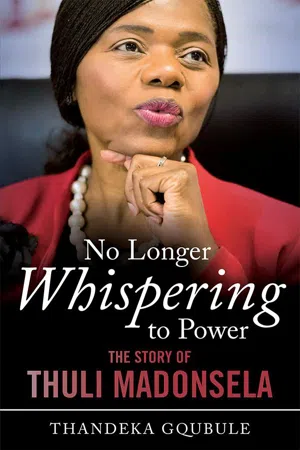
Thuli Madonsela achieved in seven years as Public Protector what few accomplish in a lifetime; her legacy and contribution cannot be overstated. In her final days in office she compiled the explosive State of Capture report and, two years before that, Secure in Comfort, the report on President Jacob Zuma's Nkandla residence. Praised and vilified in equal measure, Madonsela frequently found herself on centre stage in the increasingly fractious South African political scene. Yet, despite the intense media scrutiny, Madonsela remains something of an enigma. Who is this soft-spoken woman who stood up to state corruption? Where did she develop her views and resolve? In No Longer Whispering to Power Thandeka Gqubule, journalist and one of the 'SABC 8' fired and rehired by the broadcaster, attempts to answer these questions, and others, by exploring aspects of Madonsela's life: her childhood years and family, her involvement in student politics, her time in prison, her contribution to the Constitution, and her life in law.
- 268 pages
- English
- ePUB (mobile friendly)
- Available on iOS & Android
eBook - ePub
About this book
Information
PART I
THE MAKING OF
THULI MADONSELA
PROLOGUE
CROSSING THE MARA RIVER
I have walked that long road to freedom. I have tried not to falter; I have made missteps along the way. But I have discovered the secret that after climbing a great hill, one only finds that there are many more hills to climb. I have taken a moment here to rest, to steal a view of the glorious vista that surrounds me, to look back on the distance I have come. But I can only rest for a moment, for with freedom come responsibilities, and I dare not linger, for my long walk is not ended.
South Africa’s people have been on a protracted journey. It has, indeed, been a long walk to freedom; like Mandela, we have made missteps along the way. The story of Thuli Madonsela is the story of how we came to lose our way on the quest for a just society – and how we tried to find our way back onto the path of progress.
Initially, an air of foreboding suggested a need to move in a different direction – mere stirrings. Sporadic political violence followed – and, then, an avalanche of discontent.
By the end of Thuli Madonsela’s tenure, tens of thousands of reports had been concluded. But, two loomed larger than all others – Secure in Comfort (the Nkandla report) and State of Capture. These two reports played a cataclysmic role in enabling the country’s constitutional democracy to evolve.
During the Mbeki and Zuma administrations, it became clear that, whereas world-class jurisprudence, constitutional engineering and rugged inherited institutions were powerful, they were no match for a determined clique making a concerted attempt to take the resources of the state by storm. The Nkandla report, Secure in Comfort, was a foretaste of what was to come in the State of Capture report. The scale and depth of venality, and the extent to which it had become entrenched in society, was stupendous.
This was rendered more excruciatingly painful by the centuries of deprivation, especially of the African population, that had preceded it. The inequities that the reports exposed brought to mind the statements of Chris Hani, former Umkhonto we Sizwe (MK) commander in chief and South Africa’s own Che Guevara. As Hani told Beeld newspaper in 1992, ‘What I fear is that the liberators emerge as elitists […] who drive around in Mercedes Benzes and use the resources of this country […] to live in palaces and to gather riches.’
South Africa had been trying, for some time, to negotiate two tricky transitions simultaneously – the transition required to solve society’s structural economic problems, and a difficult political transition, dogged by the perennial South African race problem. It was unclear whether the newly liberated elite had the stomach, skill, or sense of opportunity to make and execute difficult political and macroeconomic changes concurrently.
Predictably, development performance plunged, along with economic growth. Hunger and anger rose; the ruling elite’s credibility eroded. The project to create a corrupt patrimonial and autocratic state ran into strong headwinds: a surge of political energy emerged, pushing South Africa to the brink.
This energy came from the belly of the social justice movement that had seen many different seasons of battle across the ages. ‘I think we are on the brink of something, and we are at a point where many things have not gone according to the SA constitutional dream […] A lot of things have gone well, but we are at a place where I would say we are in some respects like the children of Israel, lost in the desert. I honestly feel there is a sense of loss,’ Madonsela said in a Financial Mail interview a few days before leaving office.
In a late 2016 SABC television interview, Dirk Kotzé, political science professor at the University of South Africa, said that South Africa was poised on the brink of a transition. ‘The post-Zuma era has begun,’ he said. ‘This is heralded by the state capture report that Thuli Madonsela issued.’ On Twitter, one user called the report ‘Thuli’s final gift to South Africa’; another quoted Shakespeare’s Macbeth: ‘What need we fear who knows it, when none can call our power to account?’
For days after the State of Capture report, statements boldly asserting impunity came from sources close to the president. In response, discontent grew, until the nation seethed with rage.
Clearly, there were many rivers to cross.
The imagery of journeys abounds in Madonsela’s story. On her last day in office as Public Protector, her deputy, Kevin Malunga, said, ‘It has been an epic journey.’ Madonsela evoked the imagery of the children of Israel who forded the River Jordan to cross into the Promised Land. In the Bible’s book of Hebrews, it is clear that the Jordan is a timeless metaphor for crossing from death to renewal in eternity.
The idiom ‘crossing the Rubicon’ means reaching a point of no return. Arguably, Mandela helped the country to cross the river that brought it, miraculously and peacefully, through the transition to universal suffrage. We derive the expression from Julius Caesar’s audacious crossing of the Rubicon River, in northern Italy, in 49 bc. This crossing was considered an act of treason.
Historians tell us that, as Caesar crossed, he declared in Latin ‘alea iacta est’: the die is cast. In Madonsela’s final act in office, she cast the die. On the day of the report’s release, insurrection was in the air. The agony of many years’ want spilled onto the streets of Pretoria.
In his book Thabo Mbeki and the battle for the soul of the ANC, journalist William Gumede writes that ‘the sudden radicalisation of South Africa’s civil society after years of quiescence is largely due to growing impatience among the poor and the needy for official attention, empathy and delivery of jobs, services and welfare’.1 He goes on to describe how ‘[f]or millions of black South Africans, the only difference between their miserable lives under apartheid and their miserable lives under the democracy they fought so long and hard to attain, is that they have the right to vote. Many of the new social movements had sprung up in the restless period immediately before the 2000 local elections’.2
Thousands filled the streets of the capital and tried to storm the Presidency’s grand premises, the Union Buildings. Prof. Tinyiko Maluleke, a Pretoria academic, writes that ‘South Africa’s underclass, growing as it does, in a context of gross inequality, is certainly becoming a huge mass of the most wretched of the earth’3 – like the millions of animals on the Serengeti. ‘For a while’, Maluleke continues, ‘they may be appeased with song, poetry, meagre remittances and political rhetoric. But they will not be calm for long. The triggers for each uprising vary but there is a discernable cyclical rhythm, a clear pattern in the forms of mayhem deployed and the disruptive if also irreverent messages performed.’
The old social justice movement that filled the ranks of the United Democratic Front (UDF) to make the country ungovernable in the stormy 1980s was back on the streets. Banners were thrust into the sky: Save South Africa! Zuma must go! Defend our vote! Away with looting! A people’s assembly was called in Pretoria. Johnny Clegg sang one of his famous songs, the one so beloved of the female detainees at Diepkloof Prison: ‘Asimbonang’ uMandela thina,’ the ageing freedom crooner belted out, just as he had in the 1980s.
At a mass meeting at Wits, Thuli Madonsela turned around and said, to me and other ageing former student activists, ‘Where are the exiles? It is all of us from the 1980s, here. It feels like old times again!’
Can the people of South Africa negotiate yet another perilous transition? After all, rivers are metaphysically associated with transcendence. In Greek mythology, the god Charon escorts the souls of the deceased across the rivers between the worlds of the living and the dead. In the mythology of ancient Egypt, Kush and the lands around the Nile River, the dead were taken across the Nile to the City of the Dead.
In African mythology – Nguni mythology, in particular – the ancestors inhabit the blessed land beyond the reeds and the waters. The lessons of rivers are profound: the river is at once the metaphor for death and for deliverance. ‘I really believe in metaphysics: that when we join our thoughts, whether to wish evil or to do good, the universe – in my sense it’s God ...
Table of contents
- FOREWORD Nomawabo Msizi
- PART I THE MAKING OF THULI MADONSELA
- PART II THE PUBLIC PROTECTOR YEARS
- ABOUT THE BOOK
- ABOUT THE AUTHOR
Trusted by 375,005 students
Access to over 1.5 million titles for a fair monthly price.
Study more efficiently using our study tools.
Frequently asked questions
Yes, you can cancel anytime from the Subscription tab in your account settings on the Perlego website. Your subscription will stay active until the end of your current billing period. Learn how to cancel your subscription
No, books cannot be downloaded as external files, such as PDFs, for use outside of Perlego. However, you can download books within the Perlego app for offline reading on mobile or tablet. Learn how to download books offline
Perlego offers two plans: Essential and Complete
- Essential is ideal for learners and professionals who enjoy exploring a wide range of subjects. Access the Essential Library with 800,000+ trusted titles and best-sellers across business, personal growth, and the humanities. Includes unlimited reading time and Standard Read Aloud voice.
- Complete: Perfect for advanced learners and researchers needing full, unrestricted access. Unlock 1.5M+ books across hundreds of subjects, including academic and specialized titles. The Complete Plan also includes advanced features like Premium Read Aloud and Research Assistant.
We are an online textbook subscription service, where you can get access to an entire online library for less than the price of a single book per month. With over 1.5 million books across 990+ topics, we’ve got you covered! Learn about our mission
Look out for the read-aloud symbol on your next book to see if you can listen to it. The read-aloud tool reads text aloud for you, highlighting the text as it is being read. You can pause it, speed it up and slow it down. Learn more about Read Aloud
Yes! You can use the Perlego app on both iOS and Android devices to read anytime, anywhere — even offline. Perfect for commutes or when you’re on the go.
Please note we cannot support devices running on iOS 13 and Android 7 or earlier. Learn more about using the app
Please note we cannot support devices running on iOS 13 and Android 7 or earlier. Learn more about using the app
Yes, you can access No Longer Whispering to Power by Thandeka Gqubule in PDF and/or ePUB format, as well as other popular books in Política y relaciones internacionales & Biografías políticas. We have over 1.5 million books available in our catalogue for you to explore.