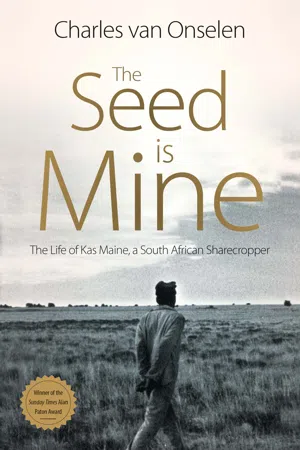
A bold and innovative social history, The Seed Is Mine concerns the disenfranchised blacks who did so much to shape the destiny of South Africa. After years of interviews with Kas Maine and his neighbors, employers, friends, and family – a rare triumph of collaborative courage and dedication – Charles van Onselen has recreated the entire life of a man who struggled to maintain his family in a world dedicated to enriching whites and impoverishing blacks, while South Africa was tearing them apart.
eBook - ePub
The Seed is Mine
The life of Kas Maine, a South African sharecropper 1894–1985
- 664 pages
- English
- ePUB (mobile friendly)
- Available on iOS & Android
eBook - ePub
About this book
Information
PART ONE
CHILDHOOD
*
‘The South African history which is really significant is that which tells us about the every day life of the people, how they lived, what they thought, and what they worked at, when they did think and work, what they produced and what and where they marketed, and the whole of their social organisation. Such a history of South Africa remains to be written.’
W. H. MACMILLAN,
The South African Problem and its Historical Development, 1919
CHAPTER ONE
Origins
c. 1780–1902
Lethebe Maine, so it was said, was the oldest of the ancestors. It was he who at some point during the eighteenth century established the family at Sekameng, on the eastern extremity of the highveld, where only the distant foothills of the Maluti Mountains suggested the great southern African escarpment beyond. There, on the open plains that rose gently from the upper reaches of the Caledon River, much game was still to be had. Indeed, Makaoteng, the name of the area in which Chief Theko of the BaSotho granted Lethebe a place of refuge, meant ‘the place of the people who live by hunting.’ Lethebe was a skilled hunter and a man known for his ability to prepare the leather hides that shielded his family from the unforgiving wintry blasts of the snow-clad Malutis.1
Sekameng, which lies in the Mafeteng district of modern-day Lesotho, had other claims to fame. As a ‘place of ilmenite,’ it was popular for its deposits of shiny black crystalline sekama, a mineral that was crushed into powder and mixed with fat for cosmetic purposes. Makaoteng itself was even more famous for the sandstone mountain named Kolo that peered down over the village. There, under the shadow of the mountain, at a time when there was still sufficient game to feed a growing family, Lethebe fathered a son, Seonya.2
Young Seonya walked in the footsteps of his MoSotho father, but by the time he came to take a wife, the economy of the open plains (Mabalane, as the BaSotho called it) had already changed. It seems likely that when he married the Maines were already firmly wedded to the soil, because his son was named Hwai—‘one who cultivates much and well.’ But the boy was born in troubled times, and it was difficult to translate the promise of his name into practice. By the 1820s, disturbances that emanated from deep within the troubled Nguni-speaking kingdoms, which lay beyond the escarpment and nearer the coast, were starting to decant bands of marauding refugees into the region of the Caledon River headwaters. The plains farther south where BaSotho groupings were settled were particularly vulnerable, and the resulting armed incursions by Zulu-speakers gave rise to what became known widely as The Scattering, or difaqane.3
Whether because of the difaqane or because of a famine that it helped to bring down on the people of the plains is unclear, but at some point before 1825, Seonya and his family abandoned Sekameng and made their way to the distant safety of kinsmen who lived on the northwestern perimeter of the highveld. Seonya led his family north for almost three hundred miles, along the cultural trails left by his forebears, across the Vaal River and then west toward Molote, near the present-day town of Rustenburg. There, Chief Mathope of the BaKubung—an offshoot of the culturally diverse Hoja grouping that clustered towards the Tswana end of the great Sotho-Tswana continuum spanning southern Africa—took in the Maines.4
The family’s new-found security was soon threatened by ominous political rumblings. When Chief Mathope died the Maines sided with his pregnant wife, Madubane, endorsing the claim that any male child of hers would have on the throne. But when the claim of the child, Lesele, was effectively denied by the late chief’s brothers, she and a group of her supporters abandoned the BaKubung for her ancestral home amongst yet other Tswana-speakers, the BaHurutshe. This exodus left the late Chief Mathope’s remaining clients, including the Maines, without any obvious source of political patronage or protection.5
The sense of unease that this squabble engendered in the family gave way to outright terror when the outer waves of the difaqane threatened BaKubung society as a whole. With the family now vulnerable from both within and without, Seonya decided to uncouple what remaining links they had to his hosts and to return to the Malutis, where the greatest Sotho-speaking chief of all, Moshweshwe, was drawing together the strands of the emerging BaSotho nation. For the newly ascendant faction of the BaKubung, however, Seonya’s decision to leave amounted only to treachery compounded; it took a hundred and twenty years for them to forgive the Maines.
With the outlines of what were eventually to become the Boer Republics just beginning to emerge, the Maines went back across a thinly populated central highveld that seemed to belong to all who were willing to consider southern Africa their home, crossed the Caledon River, and reestablished themselves at Sekameng. The worst of the violence unleashed by the difaqane had abated, and, under the umbrella of political protection afforded them by Moshweshwe’s astute diplomacy, the plains once again seemed to offer opportunities to settled agriculturalists. This time the young Hwai could live up to his name.
Scurrying around the hem of Kola’s skirts, Hwai acquired the basic knowledge that rural society demanded of a boy working with his father’s livestock and plough. The great sandstone mountain that loomed above the village and its even more impressive kinsmen—the mighty Malutis that rose to meet the sky in the east—had many skills to bestow on favoured children. Shepherding, the command and love of mountain ponies, and an enviable ability to dress stone and build with it all fell to any young man willing to learn. Grafted on to this was undoubtedly the greatest gift of all—the knowledge of herbal medicine that made Hwai a traditional doctor, a ngaka. By the time his father died Hwai was a fully fledged adult, a MoSotho, and the Maines’ earlier experience amongst the far-off BaKubung was no more than a distant memory.6
Hwai’s talents blossomed at a propitious moment. As early as 1863 the Lesotho lowlands were described in official documents as constituting ‘the granary of the Free State and parts of the Cape Colony.’ The prosperity of the plains was further enhanced when, four years later, diamonds were discovered at Kimberley and yet more new markets opened to the grain farmers of the interior. By 1873 the BaSotho were considered to be a ‘thriving and well-ordered people’; that year they exported 100,000 bags of grain—maize, sorghum and wheat—as well as 2,000 bags of wool to adjacent territories which were themselves starting to attract a growing number of commercial farmers of European descent. The highveld proper, which had seemed so open to all in the immediate wake of the difaqane, was becoming a patchwork quilt of white-owned farms where boundary pegs divided off the promise of the earth as a whole into that legal thing referred to as ‘property.’7
The Maines shared in much of the early BaSotho prosperity. In the two decades 1850–1870, Hwai contracted four marriages which between them yielded at least a dozen children. The first of these, to Modiehi, was an especially felicitous union from which issued three sons, Tshilo, Mpoko and Sekwala. Like their father and grandfather before them, each of the boys acquired the traditional craft skills of a MoSotho male. Perhaps at least as importantly, they were all socialised in an era when the power of an expanding market was opening unprecedented horizons for southern Africa’s black peasants.8
But in an economic cycle, as in life, the apex of a trajectory is by definition also the start of a downturn. In the mid-l860s the BaSotho became embroiled in a long and debilitating war with the burghers of the neighbouring Orange Free State, and shortly after it ended, the founder of the nation, Moshweshwe, died. By 1875, 15,000 of the younger men in a population of 130,000 had been drawn into the cash nexus of migrant labour on the highveld, and by 1884 the number was said to have doubled. Peasant societies that bleed manpower haemorrhage away their life blood; just as Hwai and his family had profited from the upturn in the market, so they were now called upon to share in the decline of the plains economy.9
In the late 1880s Kolo, who had for so long looked down benignly on the Maines, seemed to lose her smile. Whether it was the death of Modiehi, the strain of feeding a growing family or simply the capriciousness of a climate that produced one of its periodic famines is unknown but, at some point after 1889, Hwai, too, decided to abandon Makaoteng. Unlike his father before him, however, Hwai did not want to risk severing all links with Sekameng and therefore sought out a location that would ensure the family continued access to the cultural headwaters of Sotho society. Making his way up the valley of the Caledon River and then beyond it into the broken country that shied away from the Malutis, he eventually found a place on a farm at Mequatling, in the eastern Orange Free State. The choice of Mequatling, meaning ‘I am at home in the hills,’ proved to be a wise one.
Formerly an out-station of the Paris Evangelical Mission Society, a French Protestant grouping that had been active in Basutoland since the 1830s, and proclaimed as a farm only in 1874, Mequatling occupied a spectacular setting in the hills not far from the village named Clocolan. Here Hwai negotiated favourable terms as a tenant with a young white man named Max Woldmann, then in his late twenties. Woldmann, who had made a fortune during the previous three years by buying horses cheaply in the Free State and then selling them at a profit on the newly opened Witwatersrand goldfields, had acquired the property in March 1889. Having secured the farm of his choice, Woldmann required the services of several BaSotho men who had a knowledge of horses in order to allow him to undertake a journey home, where he hoped to re-establish contact with his family in Germany.10
Hwai and his sons seemed like especially attractive labour tenants, and their stay at Mequatling was most profitable. Family tradition has it that the Maines arrived at the farm with only a few pack-oxen but left with a large number of horses. Hwai certainly garnered sufficient resources during their stay for him to send at least one of his unmarried sons, Sekwala, back to Sekameng to secure a bride of the family’s choice. Unfortunately this young woman died during childbirth soon after her arrival at the farm; almost immediately thereafter, Hwai decided to cut short the family’s stay at Mequatling. This time he moved them about fifty miles northwest, onto a grain farm owned by a certain Dolf Brits in the district of Winburg.11
But in the early 1890s the commercial farmers around Winburg were riding the crest of a wave, and white landlords pressed hard on their black tenants. The Maines spent even less time on Brits’s f...
Table of contents
- Title Page
- Table of Contents
- Dedication
- Motto
- List of maps
- Preface and Acknowledgments
- Introduction
- PART I CHILDHOOD
- PART II YOUTH
- PART III MANHOOD
- PART IV MATURITY
- PART V SENIORITY
- Epilogue
- A Guide to Pronunciation
- Two Genealogical Tables
- A Chronology of the Farms where Kas Maine Worked, and Their Landlords
- Bibliography
- Notes
- Photo Section
- Also by Charles van Onselen
- Praise for the book
- About the Book
- Imprint page
Trusted by 375,005 students
Access to over 1.5 million titles for a fair monthly price.
Study more efficiently using our study tools.
Frequently asked questions
Yes, you can cancel anytime from the Subscription tab in your account settings on the Perlego website. Your subscription will stay active until the end of your current billing period. Learn how to cancel your subscription
No, books cannot be downloaded as external files, such as PDFs, for use outside of Perlego. However, you can download books within the Perlego app for offline reading on mobile or tablet. Learn how to download books offline
Perlego offers two plans: Essential and Complete
- Essential is ideal for learners and professionals who enjoy exploring a wide range of subjects. Access the Essential Library with 800,000+ trusted titles and best-sellers across business, personal growth, and the humanities. Includes unlimited reading time and Standard Read Aloud voice.
- Complete: Perfect for advanced learners and researchers needing full, unrestricted access. Unlock 1.5M+ books across hundreds of subjects, including academic and specialized titles. The Complete Plan also includes advanced features like Premium Read Aloud and Research Assistant.
We are an online textbook subscription service, where you can get access to an entire online library for less than the price of a single book per month. With over 1.5 million books across 990+ topics, we’ve got you covered! Learn about our mission
Look out for the read-aloud symbol on your next book to see if you can listen to it. The read-aloud tool reads text aloud for you, highlighting the text as it is being read. You can pause it, speed it up and slow it down. Learn more about Read Aloud
Yes! You can use the Perlego app on both iOS and Android devices to read anytime, anywhere — even offline. Perfect for commutes or when you’re on the go.
Please note we cannot support devices running on iOS 13 and Android 7 or earlier. Learn more about using the app
Please note we cannot support devices running on iOS 13 and Android 7 or earlier. Learn more about using the app
Yes, you can access The Seed is Mine by Charles van Onselen in PDF and/or ePUB format, as well as other popular books in History & Historical Biographies. We have over 1.5 million books available in our catalogue for you to explore.