- 356 pages
- English
- ePUB (mobile friendly)
- Available on iOS & Android
eBook - ePub
About this book
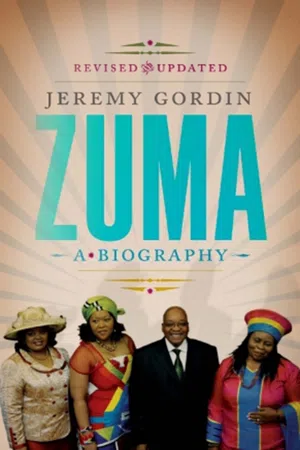
The first edition of Zuma, published in late 2008, concluded with Jacob Zuma's future balancing on a knife's edge. National elections loomed, but so did corruption charges and endless court battles. Since then Zuma's star has spectacularly risen - the corruption charges were dropped, he led the ANC to election victory and duly became President of South Africa, and his new cabinet and government appointments were generally well received. But he has also recently suffered a huge blow with revelations of another love-child, this time with the daughter of soccer supremo Irvine Khoza. Many of his supporters have distanced themselves from him, and Zuma is looking isolated. Pundits are once again wondering how long he'll survive as President. In this revised and updated edition, Jeremy Gordin takes the reader right up to present. He covers in detail the highs and lows of Zuma's past 18 months, including the final salvoes of his legal battles, as well as his first year as President. New material in this edition also includes the 'Pedro' document (a document Zuma wrote in 1986), and accurate information on his wives and children.
Information
CHAPTER 1
1942–1959
Zulu boy
Kusempondozankomo:
THE MOMENT JUST BEFORE DAWN, WHEN THE HORNS OF THE CATTLE BECOME VISIBLE
On 12 April 1942 Jacob Gedleyihlekisa Zuma was born into the Zuma clan at Nkandla, the first son of Gcinamazwi Zuma and Nokubhekisisa. ‘Gedleyihlekisa’ is a shortened version of an isiZulu phrase his father constructed – ‘Ngeke ngithule umuntu engigedla engihlekisa’ – which translated means ‘I can’t keep quiet when someone pretends to love me with a deceitful smile.’
With its deep gorges and steep ridges, the rainy Nkandla forest has always been a place of mystery, legend and final refuge.[1] King Cetshwayo, defeated by Zibhebhu, spent his last days there; in Nkandla the people once successfully defended themselves against King Shaka; more recently the rebels of Bhambatha had taken refuge in its depths.
These days the forest is badly denuded. The area around it, and the people who live in it, are deeply impoverished, and were even more so when Zuma was born. For some, there is electricity and water, and there are roads too, though many of them are still not tarred and, if you travel there during the rainy season, it is wise to do so in a four-wheel-drive vehicle. The poverty in those days, however, was also a poverty of spirit – of a once wealthy and powerful kingdom brought to its knees.
Zuma is a Zulu, a member of a tribe – or, more precisely, a federation of clans – which a bare 190 years ago, under Shaka kaSenzangakhona, became what has been called ‘Africa’s Sparta’. As the historian Leonard Thompson put it:
[The Zulu kingdom under Shaka] was a militarized state, made and maintained by a conscript army of about 40 000 warriors. Instead of the initiation system, which had integrated young men into the discipline of their particular chiefdoms, men were removed from civil society at about the age of puberty and assigned to age regiments, living in barracks scattered throughout the country. During their period of service they were denied contact with women and subjected to intense discipline.
… To foster loyalty to the state, Shaka and his councillors drew on the customary Nguni festivals. They assembled the entire army at the royal barracks for the annual first-fruits ceremony and before and after major military expeditions, when they used spectacular displays and magical devices to instil a corporate morale. The traditions of the Zulu royal lineage became the traditions of the kingdom; the Zulu dialect became the language of the kingdom; and every inhabitant, whatever his origin, became a Zulu, owing allegiance to Shaka.[2]
But to talk about an African Sparta is to have a skewed picture of the Zulu kingdom. This is because it emphasises what Dan Wylie has called the ‘stereotypical imagery of massed warriors – extravagant feathers waving, short stabbing-spears rusted with blood – pouring down grassy hillsides … a specifically Zulu cult and culture of romanticised yet rigorous brutality’ at the expense of all the other aspects of Zulu society, as it developed from roughly the 1820s until – under King Cetshwayo – it was destroyed in the 1880s.[3] For destroyed it was. Thompson summed it up succinctly:
The Zulu had been subjected in four stages. First, the kingdom was conquered and its army was broken up. Secondly, the country was split into thirteen separate units. Thirdly, white magistrates supplanted the chiefs as the most powerful men in their districts. And fourthly, the land was partitioned, leaving only about a third of the former kingdom in Zulu hands. Before the war, Theophilus Shepstone had expressed the hope that Cetshwayo’s warriors would be ‘changed to labourers working for wages’. That process had begun by the end of the nineteenth century.[4]
In 1906, the colonial authorities put down with a great loss of life and cruelty an uprising known as the Bhambatha (or Maphumulo) Rebellion, a popular revolt against the payment of poll tax. One of the major incidents of carnage during the rebellion took place in the Mome Gorge below the Nkandla forest. It was here, on 10 June 1906, that 1 000 men were trapped in the gorge and ripped apart by artillery trained on them from the surrounding high ground. ‘The injured and those who had found a cave or crevice in which to hide, had been finished off by the colonial militia and the African levies that had moved in with small arms, bayonets and assegais.’[5]
This happened 36 years before Zuma was born and it is not melodramatic, I believe, to say that the Zulu people remember with powerful feelings demeaning events such as these as well as their former glories.
‘When I was a young boy, there were two very old people in the village,’ said Zuma. ‘One came from the Ndlovu clan, another from the Bhengu, and they had been in their teens when the Bhambatha Rebellion ended. They used to tell of their experiences. And that, more than anything else, is what made me appreciate the sufferings of Africans. It was then, for the first time, when I was little, that I came to understand and to be angry about colonial oppression.’
Zuma makes no claim to gentle birth – he was an impoverished son of the soil, from a family of peasants. Blade Nzimande, the General Secretary of the South African Communist Party, loves to start his speeches at Zuma rallies by singing the Communist Party song that goes: ‘My mother was a kitchen girl,/ My father was a garden boy,/ That’s why I am a comm-u-nist …’ There’s a good reason for Nzimande’s choice. Zuma’s mother was a domestic worker. He remembers nothing of his policeman father, who died when he was about four.
His mother had three sons with his father – Jacob is the eldest – and the ‘big mother’, his father’s first wife, had four daughters and three sons, so there were plenty of siblings about. But, soon after her husband’s death, Zuma’s mother returned with her children to her parents’ home at KwaMaphumulo.
‘I was supposed to start school there, I was about seven or eight years old, but my grandfather, whose herdboy had gone off somewhere, asked that I take care of his cattle. He was supposed to find another herdboy, but he never did. So, although I was supposed to go to school, I couldn’t. That was it,’ said Zuma.
‘Later, my mother came to take me back to Nkandla – the family asked us to return – but there was no school at Nkandla. I was told to tend to the cattle and goats. And my mother went off to work as a domestic servant in the Durban area.’
Zuma liked the life.
‘Oh yes, besides tending the cattle, we did many things. Nkandla looked much the same then as it does now, though there were more ploughed fields then. We used to hunt birds in the surrounding area and in the forest with a rudimentary catapult. We also used to hunt animals with small knobkerries. We used to kill snakes. Actually, I was terrified of snakes – and I remember being told that the best way to deal with the fear was to kill even more of them. But, well …’
The herdboys would also dig holes so as to get into the ground hives of bees and steal their honey. They were trained in stick fighting, at which Zuma excelled. ‘He was a hero among his stick-fighting peers because he used to beat the hell out of them. He had good tactics. Everybody among his peers respected him for that,’ said Mncikiselwa Shozi, who knew Zuma as a boy.[6] But he wanted to learn things – he really missed school.
‘The media always report that I learned to read and write on Robben Island. Maybe they think it’s romantic. And of course my literacy was improved there and, yes, Ibie Ebrahim who was in my cell used to lend me books, and Judson Kuzwayo, who was arrested with me, also used to assist. But in fact I taught myself as a boy in Nkandla and later in the Cato Manor area of Durban where my mother was working.’
Zuma said that he used to harass the other children who were attending school in the area and would come home at night or at weekends.
‘I used to ask if I could look at their books and their slates. I really wanted to know what it was all about. Then I organised a kind of a night school. There was a woman in Nkandla, her name was Maria, and she had done standard four but was staying at home and not doing much of anything. I asked my uncles whether I could go to her for help after I had put the cattle back in the kraal in the evenings.
‘I remember the answer still – it came from either my mother or one of my uncles: “If the cattle are at home and well, then, yes, do that.” Other boys joined me, even ones who had been to school, and she took us through the work. I arranged it all – we paid her two shillings and sixpence a month, I remember.’
In 1990, Zuma said in an interview with the Helen Suzman Foundation:
Part of the reason I talk about my self-education more these days, is that I am trying to encourage those whose circumstances also did not allow them to go to school. If you are determined to educate yourself, it is possible – I’ve done it. People without formal education are looked down upon and often feel shy. But I am one of the few exceptions. I have done everything the educated have done. Education is education, whether it is formal or not. I want to use my example as an inspiration to those who did not have the opportunity to go to school. Without education one is like a warrior without weapons. You can’t fight the battle to survive in life. You can’t defeat things. You get defeated all the time. Once you have an education you remove those obstacles.[7]
As Zuma moved into his teens, he would visit his mother more often. He wasn’t allowed to go to the home where she worked in Cato Manor, but he had a cousin living in the Greyville area and he would walk around the city and take whatever odd jobs came his way.
Those days – the early 1950s – were a time when apartheid was gathering momentum, probably not a good time, if there ever was one, to be a black person. Does he feel bitter about whites? Does he, in truth, dislike them?
‘I once went into a café in Umgeni Road. I used to wander around in those days in my bare feet. There was a particular sweet that I liked. And it was there on the counter so I picked it up. But the owner thought I was taking it away from the white boy who was in front of me – or maybe he thought I was stealing it, I don’t know. He gave me such a klap that I was reeling. I was so angry that I cried and cried. And I thought: “One day I’ll fix him.” But, you know, I came to understand that this attitude was not part of the general oppression. It was just one man’s stupidity.
‘And so, no, I am not bitter or biased. That stuff is just too petty for words. It’s just not my way.’
But what made him – a rural Zulu boy with precious little education, brought up in the patriarchal traditions of the Zulu – turn to the African National Congress? Why give his life to the ANC, which it has turned out that he has? Why go to jail for a decade if he could have gone on with his life, got a job, and, if he wanted to be involved in politics, joined the resurgent Zulu nationalist movement that would become the Inkatha Freedom Party?
Zuma says that the first big influence on his awareness was the stories he heard as a child about Bhambatha’s rebellion. But he was especially influenced by his ‘father’s first son’, Muthukabongwa Zuma.
‘He had fought in the Second World War and he was a member of the ANC and he was a trade unionist. He preached endlessly about colonial oppression and the working class, and had an enormous influence on me.
‘Thirdly, in the Cato Manor township, and in Greyville when I used to stay with my cousin, I used to see the ANC volunteers in their uniforms, and I used to go to ANC public meetings, and I listened and I learned.
‘I used to visit my mother in Durban a lot, especially in winter, when there wasn’t so much work in Nkandla. But in those days it was not so much apartheid per se that worked on my mind – it was the overall and unrelenting oppression that Africans had faced.’
This was a time of great challenges and opportunities for the ANC, which already had a long and proud history. Since 8 January 1912, when it was founded as the South African Native National Congress (SANNC), it had fought – patiently, moderately and modestly, in the words of its first Nobel Peace Prize winning leader[8] – for the rights of black South Africans.
From its inception the ANC (which is what the SANNC became in 1923) represented both traditional and modern elements, from tribal chiefs to church and community bodies and educated black professionals, though women were only admitted as affiliate members from 1931 and as full members in 1943. The conspicuous failure of its gentlemanly approach to win any concessions from the government prompted the formation in 1944 of the ANC Youth League, which expressed the desire of a new generation for non-violent mass action. In 1947, when Zuma was five, the ANC allied with the Natal Indian Congress and Transvaal Indian Congress, broadening the basis of its opposition to the government.
In 1948, when Zuma was six, the National Party won the whites-only election and DF Malan became prime minister. In 1949, the Prohibition of Mixed Marriages Act was passed and then, in 1950, a rash of apartheid legislation appeared on the body politic: the Group Areas Act (people were not allowed to live among people of a different colour), the Suppression of Communism Act (banning the SA Communist Party), the Population Registration Act (people had to be registered according to their colour), and the Immorality Act (people of different colours were forbidden to have sexual intercourse). Significantly, so-called coloureds who had the vote were removed from the electoral rolls.
In June 1952, the ANC joined with other anti...
Table of contents
- Dedication
- Title page
- Epigraph
- Preface to the Second Edition
- Preface and Acknowledgements
- 1. 1942–1959 Zulu boy
- 2. 1960–1963 Working-class warrior
- 3. 1963–1973 The Island
- 4. 1974–1990 Silence, exile and cunning
- 5. 1990–1994 The talking times
- 6. 1993–2003 The greasy levers of power
- 7. 1999–2004 Bring us our machine guns
- 8. 2003–2004 Hefer or: Hamlet without the prince
- 9. 2004–2005 Shaik goes down
- 10. 2005 Annus miserabilis
- 11. November 2005 Interlude in Zuma-land
- 12. 2006 Rape trial
- 13. 2006 Days of dirty laundry
- 14. 2006-2007 The Floating Opera
- 15. 2007 Siyaya Limpompo! (We are going to Limpopo!)
- 16. 2007–2008 The Zuma tsunami
- 17. 2008 ‘Let’s kill all the lawyers’
- 18. September 2008 Let’s fire Mbeki instead
- 19. November 2008 President-in-waiting
- 20. January-April 2009 Off the hook
- 21. April–December 2009 Siyanqoba! (We are victorius!)
- 22. January–March 2010 The honeymoon ends
- Pictures
- Appendix I The Pedro Document
- Appendix II The Jacob Zuma family
- Appendix III Operation Vula
- Copyright
Trusted by 375,005 students
Access to over 1.5 million titles for a fair monthly price.
Study more efficiently using our study tools.
Frequently asked questions
Yes, you can cancel anytime from the Subscription tab in your account settings on the Perlego website. Your subscription will stay active until the end of your current billing period. Learn how to cancel your subscription
No, books cannot be downloaded as external files, such as PDFs, for use outside of Perlego. However, you can download books within the Perlego app for offline reading on mobile or tablet. Learn how to download books offline
Perlego offers two plans: Essential and Complete
- Essential is ideal for learners and professionals who enjoy exploring a wide range of subjects. Access the Essential Library with 800,000+ trusted titles and best-sellers across business, personal growth, and the humanities. Includes unlimited reading time and Standard Read Aloud voice.
- Complete: Perfect for advanced learners and researchers needing full, unrestricted access. Unlock 1.5M+ books across hundreds of subjects, including academic and specialized titles. The Complete Plan also includes advanced features like Premium Read Aloud and Research Assistant.
We are an online textbook subscription service, where you can get access to an entire online library for less than the price of a single book per month. With over 1.5 million books across 990+ topics, we’ve got you covered! Learn about our mission
Look out for the read-aloud symbol on your next book to see if you can listen to it. The read-aloud tool reads text aloud for you, highlighting the text as it is being read. You can pause it, speed it up and slow it down. Learn more about Read Aloud
Yes! You can use the Perlego app on both iOS and Android devices to read anytime, anywhere — even offline. Perfect for commutes or when you’re on the go.
Please note we cannot support devices running on iOS 13 and Android 7 or earlier. Learn more about using the app
Please note we cannot support devices running on iOS 13 and Android 7 or earlier. Learn more about using the app
Yes, you can access Zuma by Jeremy Gordin in PDF and/or ePUB format, as well as other popular books in History & Historical Biographies. We have over 1.5 million books available in our catalogue for you to explore.