- 300 pages
- English
- ePUB (mobile friendly)
- Available on iOS & Android
eBook - ePub
About this book
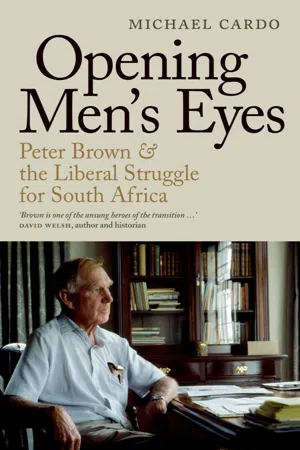
Peter Brown, leader of South Africa's Liberal Party until its demise in 1968, is one of the unsung heroes of South Africa's struggle against apartheid in pursuit of non-racial democracy. In Opening Men's Eyes, author Michael Cardo tells the story of how a privileged youngster growing up in the all-white world of racially conservative Natal settler society had the scales of racial prejudice removed from his eyes and how he set about opening the eyes of his compatriots. Cardo brings to life Brown's friendships across the colour bar with the likes of Archie Gumede, later one of the founders of the United Democratic Front, and his close relationship with the celebrated novelist Alan Paton, author of Cry, The Beloved Country. The book provides the first documented history of the Liberal Party, and shows how it was radicalised under Brown's leadership. Opening Men's Eyes offers a fascinating sidelight on South Africa's political and intellectual history.
Information
Topic
StoriaSubtopic
Biografie in ambito storicoPart One
PART
ONE
1. Origins and Childhood 1924-1938
1
ORIGINS AND CHILDHOOD
1924-1938
By the time Peter McKenzie Brown was born on 24 December 1924 at his parents’ Musgrave Road home, Monaltrie, high on the slopes of Durban’s tree-lined Berea, the Union of South Africa was a troublesome teen.
Fourteen and a half years earlier, on 31 May 1910, the Act of Union came into effect. It welded the two former British colonies, Natal and the Cape, and the two Boer Republics, Transvaal and the Orange Free State, into a single national polity. General Louis Botha, the man who fought heroically on the side of the Boers in the bitter South African War (1899-1902), was installed as Prime Minister with General Jan Smuts as his right-hand man.
Together, under the umbrella of the South African Party (SAP), they attempted to defuse old ethnic and linguistic rivalries by uniting Boer and Briton in a shared sense of nationhood. The fulcrum of their project was white supremacy: going into Union, all the provinces, with the exception of the Cape – where the nineteenth-century liberal tradition still prevailed – rejected black voting rights. With Botha and Smuts at the helm, a slew of segregationist legislation ensued. New laws imposed a job colour bar on the mines, restricted African land ownership to the ‘native reserves’ and controlled the influx of blacks to urban areas.
Botha and Smuts’s efforts to promote a shared national identity, based on Anglo-Afrikaner unity, were circumscribed by imperial notions of belonging. South Africa was still a British Dominion. The symbolic armour of Empire – ‘God Save the King’, the Union Jack and English itself – was brandished in public life in a way that rankled with those who had waged war against Britain. They had struggled for self-determination and resented this easy assumption of British superiority.
The adolescent nation was showing signs of fractiousness. Spurred on by their opposition to Union participation in the First World War, and galvanised by what they viewed as Botha’s heavy-handed subduing of the 1914 Boer Rebellion, those so aggrieved began to reassert themselves politically. Their message of cultural affirmation and national sovereignty was articulated not in the language of their forefathers, Dutch, but in the confident cadences of modern Afrikaans. They rejected British overlordship and wanted a more rigorous native policy to protect white interests.
In June 1924, the organisation that embodied their voice, the National Party, came to power by forming a coalition with the Labour Party. The Nationalist leader, General Barry Hertzog, was sworn in as Prime Minister. South Africa’s political trajectory was set to change decisively. Six months later, Peter Brown entered the world.
These, then, were the currents that were to determine the course of Brown’s public life and work: the fall of empire, the rise of Afrikaner nationalism, the legal codification of racial discrimination and their combined effect on black resistance to the Union’s racial politics.
* * *
59 Musgrave Road lies at the top of the Berea, the ridge which descends steeply into the Durban city centre below, and which, on a clear day, affords commanding views of Africa’s busiest port and out to the Indian Ocean beyond.
In the 1920s, as it is now, Musgrave Road was a prestigious address. Most of the gracious Victorian homes have given way to modern townhouse developments and apartment blocks, but the location still marks itself out as a place of privilege.
Framed by rows of palms and flamboyants, the Browns’ home, ‘Monaltrie’, was built in 1897 for the consul of Belgium and the Austro-Hungarian Empire, William Auerswald. Designed in the Queen Anne revivalist style, with red face-brick, white-painted balustrades, half-timbered gables, several verandas and an entrance portico, the two-storey villa was set on a large property that extended all the way up to Essenwood Road above. Today it is a national monument.
Brown’s father, Hugh, was a keen polo player, and he wanted space to stable his ponies. Many of Peter’s earliest memories were of time spent on the polo fields with his father and his two older siblings, Craig, born in 1917, and Elizabeth (known to the family as ‘Bet’), born in 1920.
Hugh Brown was born in 1886 to William George (‘WG’) Brown and his first wife, Dollie. WG Brown moved to South Africa from Scotland in the late 1870s and opened a trading store in a small settlement called Rietvlei, above the densely forested Karkloof Valley in the Natal Midlands. From there he settled in Pietermaritzburg, the capital of the Crown Colony of Natal, and became a minor importer and wholesaler. As his enterprise grew, he decided to relocate to the commercial hub of the colony, Durban, where he opened WG Brown & Co. The business supplied country stores with what was then called ‘Kaffir truck’ – goods such as blankets, copper wire, cheap cutlery and basic foodstuffs.
WG Brown was a tough Lowland Scot. (In later years, when Peter was asked whether he was conscious of his Scots descent, he replied: ‘Certainly, but more from my mother’s side than from his [WG Brown’s]. I think his was sort of Lowland, west coast of Scotland, whereas as they were true blue Highlanders.’).1
WG Brown was an astute businessman. His second wife, Elizabeth, a music teacher from Aberdeen whom he married in 1922, identified in him a ‘hard-headed Scottish capacity for driving good bargains’.2
He was as parsimonious as he was plucky, and he was unsentimental in his personal relationships – both with his son and his clients. But then relations between the traders of ‘Kaffir truck’ and their consumers were hardly based on charity and compassion.
For all that, Hugh, who took over the prospering family business and ran it until he died, became a businessman with a social conscience. Educated at Michaelhouse and Jesus College, Cambridge, he was a kind and temperate man who combined his business interests with active civic engagement and philanthropic pursuits. He was especially concerned with education and social welfare: he served on the Board of Governors of several Natal schools, and was a patron of St Martin’s Diocesan Home for Children in Durban.
Peter described his relationship with his father as ‘good’, and added, on reflection, that ‘it hadn’t reached the stage of any great intimacy’ by the time Hugh died on 21 August 1935.3
Hugh Brown died pursuing his passion: polo. He worked hard to establish polo as a sport in South Africa, as chairman of the South African Polo Association between 1930 and 1935. And he was a keen and able player (nicknamed ‘the Wizard’ for his control of the ball) and manager, having captained the South African team during a tour of Argentina in 1933.4
His death, in a semi-final at the South African Polo championships in Pietermaritzburg, was the result of an accident: he collided with two other players, was thrown off his pony and hit the back of his head on the ground. Hugh Brown was rushed unconscious to Grey’s Hospital, but it was too late to save him: his skull was badly fractured and he died of internal bleeding that night.
The Natal Witness ran a glowing tribute to Hugh Brown, noting that he had been the driving force behind polo in South Africa and ‘its most energetic proselytiser’.5
More than that, he was ‘one of those great and luminous souls … filled with a wide and abiding sympathy for the misfortunes of others’. His generosity was hidden behind a ‘modesty which was the outstanding trait of the man, a gentle unassuming manner which cloaked a character both rich and rare’. In his private life, he ‘was one to whom all in sorrow, need or happiness must gravitate, one who formed a centre wherever he was’. And, although he was a generous benefactor to good causes, the sum total of his benefactions would remain untold because ‘so many were unknown except to the recipient …’
Nearly seventy years later, when Peter Brown died, the Witness (as it had become) expressed similar sentiments about Brown junior. Peter inherited from his father a deep sense of civic duty. He also inherited a substantial amount of money. His father’s estate was valued at over £200 000, and part of it was used to set up a trust which, according to him, his mother ‘proceeded to administer very effectively’ with her brother-in-law, a Durban-based attorney named Jim Hathorn.6
Brown later reflected that he was financially independent, even during his mother’s lifetime, ‘as a result of that bequest’.
Brown’s mother, Helen Mary (aff...
Table of contents
- Cover
- Description
- Title Page
- Dedication
- Acknowledgements
- Prologue
- Part One
- Part Two
- Part Three
- Part Four
- Notes
- Photo Section
- Biography
- Copyright Page
Trusted by 375,005 students
Access to over 1.5 million titles for a fair monthly price.
Study more efficiently using our study tools.
Frequently asked questions
Yes, you can cancel anytime from the Subscription tab in your account settings on the Perlego website. Your subscription will stay active until the end of your current billing period. Learn how to cancel your subscription
No, books cannot be downloaded as external files, such as PDFs, for use outside of Perlego. However, you can download books within the Perlego app for offline reading on mobile or tablet. Learn how to download books offline
Perlego offers two plans: Essential and Complete
- Essential is ideal for learners and professionals who enjoy exploring a wide range of subjects. Access the Essential Library with 800,000+ trusted titles and best-sellers across business, personal growth, and the humanities. Includes unlimited reading time and Standard Read Aloud voice.
- Complete: Perfect for advanced learners and researchers needing full, unrestricted access. Unlock 1.5M+ books across hundreds of subjects, including academic and specialized titles. The Complete Plan also includes advanced features like Premium Read Aloud and Research Assistant.
We are an online textbook subscription service, where you can get access to an entire online library for less than the price of a single book per month. With over 1.5 million books across 990+ topics, we’ve got you covered! Learn about our mission
Look out for the read-aloud symbol on your next book to see if you can listen to it. The read-aloud tool reads text aloud for you, highlighting the text as it is being read. You can pause it, speed it up and slow it down. Learn more about Read Aloud
Yes! You can use the Perlego app on both iOS and Android devices to read anytime, anywhere — even offline. Perfect for commutes or when you’re on the go.
Please note we cannot support devices running on iOS 13 and Android 7 or earlier. Learn more about using the app
Please note we cannot support devices running on iOS 13 and Android 7 or earlier. Learn more about using the app
Yes, you can access Opening Men's Eyes by Michael Cardo in PDF and/or ePUB format, as well as other popular books in Storia & Biografie in ambito storico. We have over 1.5 million books available in our catalogue for you to explore.