- 300 pages
- English
- ePUB (mobile friendly)
- Available on iOS & Android
eBook - ePub
About this book
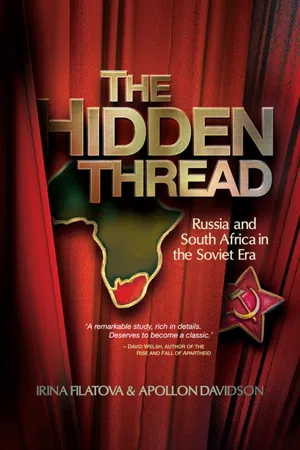
The Hidden Thread is a journey of revelation about the relationship between Soviet Russia and South Africa, hidden for most of its length. The story is told with insight and depth by Irina Filatova and Apollon Davidson, who have had a decades long association researching and writing on Russian and South African politics and history. This insightful work follows the often surprising twists and turns of the history of South Africa's relationship with Russia and its people which started in the eighteenth century and is still very much alive today. The story evolves from the Russian volunteers who fought alongside the Boers in the Anglo-Boer War to South Africans who participated in the Russian revolution and civil war; from the Russian Jewish immigration to South Africa to the close involvement of the South African communists in the Communist International; from the Soviet consulates in South Africa and the activities of South Africa's Friends of the Soviet Union Society during the Second World War to the vicissitudes of the Cold War and the 'hot' war in Angola; from the SACP and ANC's relations with the USSR to the volte-face of perestroika and South Africa's transition and to today's business, political, cultural and sometimes criminal connections between Russians and South Africans.
Information
CHAPTER 1
Three Centuries: Russia and South Africa Before the Soviet Era
The history of relations – or attempted relations – between South Africa and Russia began much earlier than one might think, with the establishment of the Cape Colony. There were unlikely connections, little-known plans and incredible voyages long before mutual visits between the two countries became commonplace.
From Jan van Riebeeck to Peter the Great
It was not really a surprise for us to discover how much the first Dutch administrators of the Cape Colony knew about Russia: seventeenth-century Holland had close trade and other relations with its neighbours. Muscovy was one of them.
Jan van Riebeeck, the founder and first commander of the European settlement at the Cape of Good Hope, mentions ‘Moscovy’ in his diary as early as September 1652, soon after his arrival at the Cape. Van Riebeeck thought of using seals’ fat for food, ‘considering how much train oil is annually extracted from seals in Moscovy’.1
Among the early Cape settlers there was at least one émigré from Moscow, Johannes Swellengrebel (Schwellengrebel), father of the first Cape Town-born governor of the Cape Colony, Hendrik Swellengrebel. Johannes was born in Moscow in 1671 and died in Cape Town in 1744. His father, Heinrich Schwellengrebel, was born into an Amsterdam worker’s family and in 1643 became a trader in Moscow, where he lived until his death in 1699. Johannes spent most of his life in Russia before becoming an official of the Dutch East India Company in the Cape. This ‘Russian from Moscow’, as the South African Dictionary of National Biography called him, could have told a lot about Russia – and not only to his son, the governor.2
There were, of course, no South Africans in Russia in those days. What little knowledge the Russians had about South Africa came from books – and this luxury was available only to the chosen few. Until the end of the seventeenth century only theological books were printed in Moscow. Secular books were written and copied by hand and were, of course, very expensive and rare. However, those who had access to them could find all sorts of interesting information about distant lands, some real, some invented. The best sources of such information were the so-called cosmographies, hand-written geographies of the time. The most famous surviving cosmography dates back to 1670. Based on the work of a Flemish author, Gerard Mercator (1512‒1594), the expanded Russian edition contained references to Africa and Madagascar.
South Africa was clearly depicted on maps brought to Russia from abroad. A Dutch mission presented Tsar Aleksei Mikhailovich (who ruled from 1645 to 1676) with a huge seven-foot copper globe made by pupils of the famous Dutch geographer and cartographer Willem Janszoon Blaeu. The globe still exists and is housed in a museum in Red Square at the very centre of Moscow. One can still discern the words Caput de Bonae Speranca at the southern tip of the African continent. It was, perhaps, this globe that struck the imagination of Aleksei Mikhailovich’s son, Peter the Great, arousing his passion for travel.
Peter was 25 when, in 1697, he spent more than four months in Holland as Peter Mikhailov, learning every possible naval skill from carpentry to mathematics and navigation. Every day he and his companions worked and dressed as common workers, sail makers, mast builders, or seamen. Peter’s dream was to build his own fleet and open the southern seas for Russia, which was not a naval power at that time.
Among Peter’s friends in Holland was Nicolaas Witsen, burgomaster of Amsterdam and one of the directors of the Dutch East India Company. It was he who gave Peter and his companions permission to work at the Company’s docks. Witsen accompanied Peter to his meetings with many important people, first of all with the Prince of Orange, William III, who simultaneously held the titles of Stadholder of Holland and King of England.3 The culmination of the friendship was the gift that Witsen gave Peter in the name of the citizens of Amsterdam when the Tsar’s visit was finally over. It was one of the ships that was built during Peter’s stay. One of Peter’s biographers wrote: ‘Peter was so delighted that he threw himself on Witsen’s neck. He accepted the present with gratitude and gave the vessel the name Amsterdam.’4
Witsen was a well-educated and well-travelled man who visited many European countries and studied astronomy, mathematics and classics at the University of Leiden.5 His interest in Peter – at that time an uncouth youth – was scholarly too. In 1664 he spent about a year in Russia and subsequently published three volumes of his impressions and notes about this trip. These volumes were thought sufficiently interesting to be published again three centuries later.6 During Peter’s stay in Amsterdam Witsen was working on another book which was to provide detailed descriptions of several countries and regions of the world, including Central Asia, Northern Persia, the Caucasus, the Crimea, China and Japan. Russia, with its eastern regions, was to occupy the central place in this publication. To have the Russian tsar as a consultant on his own country was a real stroke of luck for the author.
Two large volumes of this book were published in 1705. They were beautifully illustrated, supplied with maps and detailed descriptions of many Russian cities and towns, geographic features, traditions and habits. As a source for his information Witsen often gave ‘the Russian court’. This clearly meant Peter. Naturally, he dedicated his book ‘To Tsar and Great Prince Piotr Alekseevich’.7
This friendship is important for us here, as, without a doubt, Witsen was the person who got Peter interested in Southern Africa. Witsen had already been a director of the Dutch East India Company for four years by the time Peter appeared in Amsterdam, and the Cape Colony was constantly on his mind. His signature appears on many Company letters addressed to the governor of the Cape. Moreover, this governor, Simon van der Stel, was Witsen’s personal friend, who even named a mountain range in the Tulbagh area after him. Later this range, Witsenberg, gave Witsen’s name to one of South Africa’s famous wines.8
During Peter’s reign Russian knowledge of Africa accumulated exponentially. In 1713 the first map of Africa, based on a map by a famous Dutch cartographer, Frederick de Witt Senior (1616‒1689), was published in Moscow. In 1719 the first Russian book containing a detailed description of Africa was published. It was a translation of a book by the German geographer, Johann Hübner.9 Hübner's Geography was translated into all the major European languages and in Germany 36 editions of the book were published during the author’s lifetime and more later. Hübner called the southern part of the African continent ‘Cafferia’ and wrote that it was situated ‘on both sides of the Cape of Good Hope’. He also described the important Dutch fortress at the Cape as ‘the door to East India’. The book was translated and published on Peter’s order.
In 1723 Peter decided to send an expedition of two ships around the southern tip of Africa to Madagascar and, if and when this had been achieved, even further, to India. The details of the expedition were top secret. Few people, even among those involved, knew the whole plan. It was forbidden to discuss anything connected with it before the expedition started – and the more so after it failed. Some of these secrets, however, left traces in the archives. For this important mission Peter chose two frigates, the Amsterdam-Gallei and De Kroon de Liefde, bought in Holland. There were several Dutchmen among the officers, and Admiral JV Hooft, another Dutchman and the commanding ensign in Revel (now Tallinn, the capital of Estonia), oversaw the preparations.10
The ships left the port of Rogervick (close to Revel) on 21 December 1723, carrying Peter’s letter ‘To the Highly Revered King and Sovereign of the Glorious Island of Madagascar’.11 The king of Madagascar did not exist. The letter was in fact addressed to the leader of the pir...
Table of contents
- Description
- About the Authors
- Title
- Dedication
- Acknowledgements
- Abbreviations and Acronyms
- Introduction: Why South Africa – and Russia?
- Chapter 1: Three Centuries: Russia and South Africa Before the Soviet Era
- Chapter 2: Enter the Bolsheviks
- Chapter 3: New Politics and New Business Contacts
- Chapter 4: In the Communist International
- Chapter 5: Indoctrination or Scholarship? Teaching and Studying South Africa at the Communist University of Eastern Toilers
- Chapter 6: The ‘New Jerusalem’: The USSR’s Friends and Fellow Travellers
- Chapter 7: Together against Hitler
- Chapter 8: The Red Peril: the USSR in South Africa’s Cold War Ideology and Policy
- Chapter 9: Against Colonialism and Apartheid: South Africa in Soviet Theory and Policy in the Cold War Era
- Chapter 10: The Secret War
- Chapter 11: The Regular War
- Chapter 12: The ANC, the SACP and the USSR
- Chapter 13: Comrades in Arms: Soviet Military Aid to the ANC
- Chapter 14: ‘Moscow Gold’, Soviet Universities and Much Else
- Chapter 15: The Promised Land
- Chapter 16: Perestroika: Winds of Change in the North
- Chapter 17: Pretoriastroika: Winds of Change in the South
- Chapter 18: Volte Face: Establishing Diplomatic Relations
- Chapter 19: Just Another Country?
- Postscript: The USSR and the ‘South African Miracle’
- Picture Section
- Notes
- Bibliography
- Copyright
Trusted by 375,005 students
Access to over 1.5 million titles for a fair monthly price.
Study more efficiently using our study tools.
Frequently asked questions
Yes, you can cancel anytime from the Subscription tab in your account settings on the Perlego website. Your subscription will stay active until the end of your current billing period. Learn how to cancel your subscription
No, books cannot be downloaded as external files, such as PDFs, for use outside of Perlego. However, you can download books within the Perlego app for offline reading on mobile or tablet. Learn how to download books offline
Perlego offers two plans: Essential and Complete
- Essential is ideal for learners and professionals who enjoy exploring a wide range of subjects. Access the Essential Library with 800,000+ trusted titles and best-sellers across business, personal growth, and the humanities. Includes unlimited reading time and Standard Read Aloud voice.
- Complete: Perfect for advanced learners and researchers needing full, unrestricted access. Unlock 1.5M+ books across hundreds of subjects, including academic and specialized titles. The Complete Plan also includes advanced features like Premium Read Aloud and Research Assistant.
We are an online textbook subscription service, where you can get access to an entire online library for less than the price of a single book per month. With over 1.5 million books across 990+ topics, we’ve got you covered! Learn about our mission
Look out for the read-aloud symbol on your next book to see if you can listen to it. The read-aloud tool reads text aloud for you, highlighting the text as it is being read. You can pause it, speed it up and slow it down. Learn more about Read Aloud
Yes! You can use the Perlego app on both iOS and Android devices to read anytime, anywhere — even offline. Perfect for commutes or when you’re on the go.
Please note we cannot support devices running on iOS 13 and Android 7 or earlier. Learn more about using the app
Please note we cannot support devices running on iOS 13 and Android 7 or earlier. Learn more about using the app
Yes, you can access The Hidden Thread by Irina Filatova in PDF and/or ePUB format, as well as other popular books in History & Historical Biographies. We have over 1.5 million books available in our catalogue for you to explore.